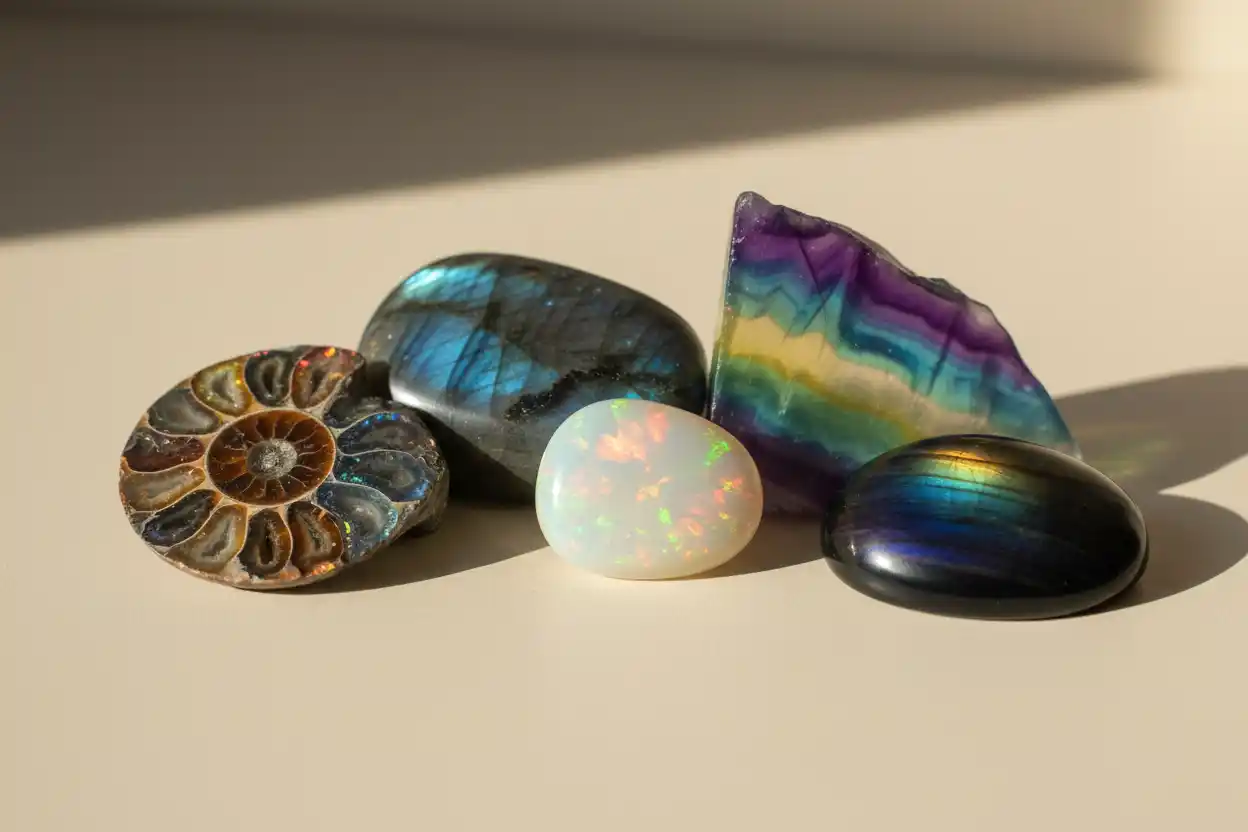
Rainbow Crystals: Meanings, Types and Spiritual Uses
Rainbow crystals may display shifting spectral colors, several fixed color zones or an artificial iridescent coating. These appearances can look similar in photographs, yet they arise through different structures and processes.
Precious opal diffracts light through organized silica spheres. Labradorite produces labradorescence through microscopic feldspar structures. Pearl and mother of pearl show orient through layered nacre. Rainbow fluorite and watermelon tourmaline display bands or zones of bodycolor rather than true iridescence. Aura quartz and mystic topaz receive their rainbow surfaces from manufactured coatings.
Modern crystal traditions connect rainbow colors with hope, inclusion, creativity, integration and accepting several parts of an experience at once. These are symbolic interpretations rather than scientifically proven healing effects.
This guide owns belief-based meanings, meditation and intentional use. The rainbow gemstones guide owns optical phenomena, treatment, durability and jewelry selection.
Rainbow Crystals at a Glance
| Rainbow crystal or material | Source of the color | Common symbolic theme | Important caution |
|---|---|---|---|
| Rainbow fluorite | Natural bands and zones of bodycolor | Mental flexibility and organization | Soft with perfect cleavage |
| Rainbow moonstone | Multicolor labradorescence in transparent labradorite | Intuition and emotional cycles | Feldspar cleavage |
| Labradorite | Labradorescence from internal feldspar structures | Boundaries and imagination | Protect from impacts |
| Spectrolite | Strong multicolor labradorescence in Finnish labradorite | Transformation and self-trust | Trade name should be used accurately |
| Precious opal | Diffraction-based play-of-color | Creativity and emotional expression | Soft, sometimes treatment-sensitive |
| Ammolite | Interference in fossilized ammonite shell layers | Change and ancestral time | Thin, fragile color layer |
| Rainbow obsidian | Iridescent layers within volcanic glass | Self-examination and recovery | Sharp edges and glass-like fracture |
| Iris agate | Diffraction through fine agate banding | Hidden potential and perspective | Effect requires correct orientation |
| Iris quartz | Natural near-surface or internal iridescent structures | Clarity and unexpected insight | Coated quartz may be substituted |
| Fire agate | Iridescent interference over limonite layers | Courage and grounded vitality | Cutting quality controls the effect |
| Mother of pearl | Interference and diffraction in nacre | Adaptability and emotional steadiness | Soft organic material |
| Pearl with orient | Layered nacre producing rainbow shimmer | Wisdom and maturity | Sensitive to chemicals and abrasion |
| Rainbow hematite | Natural nanoscale surface structures or coatings | Stability through change | Some market material is coated |
| Bornite or peacock ore | Oxidation-related surface film | Renewal and changing perspective | Trade name may conceal treatment |
| Bismuth crystals | Oxide-film interference, commonly on laboratory-grown crystals | Structure and change | Usually manufactured crystal forms |
| Aura quartz | Artificial metallic coating | Celebration and personal expression | Coating can scratch or abrade |
| Mystic topaz | Artificial thin-film coating | Reinvention and visible confidence | Surface coating needs special care |
| Watermelon tourmaline | Natural pink, pale and green zoning | Emotional balance and boundaries | Not truly iridescent |
| Ametrine | Natural or treatment-related purple-yellow quartz zoning | Reflection balanced with action | Not an optical rainbow |
What Makes a Crystal Look Rainbow-Colored?
Several different visual mechanisms are grouped informally under the word rainbow.
Iridescence occurs when structures on or within a material interfere with light, causing colors to change with viewing angle.
Play-of-color is a specific form of iridescence most famously seen in precious opal. The flashes may move or change as the stone rotates.
Labradorescence is the colorful sheen found in labradorite and related feldspar material.
Orient describes the rainbow-like iridescence visible in fine nacreous pearls.
Color zoning means the crystal grew with sections of different bodycolor. Rainbow fluorite, ametrine and watermelon tourmaline are examples.
Coating places an artificial thin film over a gemstone or crystal. Aura quartz and mystic topaz belong in this category.
Understanding the mechanism does not prevent someone from enjoying the material spiritually. It simply keeps a natural optical effect, natural color zoning and human-applied coating from being described as the same thing.
Rainbow Fluorite
Rainbow fluorite commonly shows purple, green, blue, yellow and colorless bands.
The colors form as the chemistry and defects within the crystal change during growth. They usually remain fixed in place rather than flashing with movement.
Modern practitioners associate rainbow fluorite with organizing several ideas, changing perspective and moving between focused work and creative exploration.
Its physical delicacy matters. Fluorite has low hardness and perfect cleavage. Keep it away from pockets, water rituals, hard crystals and unstable shelf edges.
The where-to-buy-rainbow-fluorite guide owns authenticity, dyeing and seller checks.
Rainbow Moonstone
Rainbow moonstone is a commercial name for transparent to translucent labradorite that displays multicolor flashes.
Although the trade name contains moonstone, the material belongs to plagioclase feldspar rather than the potassium-rich feldspar intergrowth traditionally called moonstone.
Its shifting blue, green, yellow and orange flashes encourage symbolic associations with emotional cycles, intuition and recognizing that one situation can look different from another angle.
Feldspar cleavage makes the stone vulnerable to hard blows. Pendants and earrings are safer than exposed rings.
The where-to-buy-rainbow-moonstone guide owns imitation and assemblage concerns.
Labradorite and Spectrolite
Labradorite produces labradorescence through microscopic structures within the feldspar.
The effect may appear blue, green, gold, orange, violet or multicolored. A dark body often creates dramatic contrast.
Spectrolite is a trade name associated with high-quality Finnish labradorite showing strong spectral colors. It should not be applied automatically to every multicolor labradorite.
Contemporary symbolism connects both materials with imagination, personal boundaries and viewing transitions as sources of information rather than only disruption.
The dedicated labradorite healing-properties guide owns the complete belief-based workflow.
Precious Opal
Opal can display moving flashes of red, orange, yellow, green, blue and violet.
The play-of-color results from diffraction within organized internal structures. Common opal lacks this spectral display, so not every opal is a rainbow crystal.
Modern symbolism associates precious opal with creativity, emotional expression and allowing identity to remain complex.
Opal varies in stability, porosity and treatment. The types-of-opal guide owns body types and varieties, while the treated-opal guide covers dye, smoke treatment, impregnation and assembled stones.
The opal healing-properties guide retains detailed spiritual claims and their safety framing.
Ammolite
Ammolite is an iridescent organic gem obtained from fossilized ammonite shell material.
Its layered aragonite structure produces red, orange, yellow, green, blue and violet interference colors. Because the color-bearing layer is thin and fragile, Ammolite is frequently stabilized or assembled with protective backing and caps.
Its fossil origin encourages symbolism involving deep time, adaptation and recognizing that change can preserve as well as destroy.
The Ammolite buying guide owns assembled construction, grading and durability.
Rainbow Obsidian
Rainbow obsidian is volcanic glass that reveals colored bands when cut and oriented correctly.
The colors may include purple, green, gold, blue and pink against a dark body. Thin internal layers and aligned microscopic structures create the sheen.
Modern practices associate rainbow obsidian with examining difficult emotions gradually rather than forcing immediate disclosure.
It fractures like glass and may develop sharp edges. The where-to-buy-rainbow-obsidian guide owns orientation, imitations and seller checks.
Iris Agate and Iris Quartz
Iris agate displays spectral colors when very fine banding diffracts transmitted light.
The effect may remain hidden under ordinary reflected light and become visible only when the slice is thin enough and correctly illuminated.
Natural iris quartz can show iridescence associated with very fine structures near crystal surfaces or within fractures. It should not be confused automatically with coated aura quartz.
These materials symbolize overlooked qualities and the value of changing illumination before concluding that nothing is present.
Fire Agate
Fire agate contains thin layers associated with iron oxides that produce shifting red, orange, green, gold and violet colors.
A skilled cutter follows the contours of the color-bearing layers. Cutting too deeply can remove the fire, while leaving too much chalcedony can conceal it.
Its earthy body and moving color encourage symbolism involving grounded courage rather than impulsive risk.
The where-to-buy-fire-agate guide owns buying and imitation boundaries.
Pearl and Mother of Pearl
Pearl may display orient—a subtle rainbow shimmer visible on or just below the surface.
Mother of pearl is nacreous shell material rather than a whole pearl. Its layered structure also produces iridescence.
These materials are commonly associated with maturity, adaptation, patience and emotional steadiness.
They are soft and sensitive to cosmetics, acids and abrasion. The pearl cleaning guide and mother-of-pearl cleaning guide own their separate physical-care procedures.
Rainbow Hematite
Natural rainbow hematite can display purple, blue, green, yellow and orange iridescence.
Some examples develop their colors from nanoscale surface structures, while others in the market may be coated or chemically altered.
The symbolism often combines hematite’s grounding associations with the flexibility represented by changing colors.
The broader hematite meaning guide owns mineral identity and full spiritual use. Buyers should not assume that every brightly colored metallic stone is naturally iridescent hematite.
Bornite and Peacock Ore
Bornite develops colorful oxidation films naturally and is frequently called peacock ore.
Chalcopyrite may also be sold under the name, especially after chemical treatment intensifies its blue, purple and green tarnish.
Symbolically, the changing surface can represent adaptation and the difference between an object’s fresh interior and weathered exterior.
The trade name should never replace exact mineral identity. Artificially enhanced color is still visually attractive, but it should be represented honestly.
Bismuth Crystals
Bismuth can form geometric hopper crystals with blue, gold, green, pink and purple oxide colors.
Most large rainbow bismuth crystals sold in metaphysical shops are produced by melting and controlled cooling rather than mined in that form.
Their stepped geometry and changing colors encourage associations with orderly transformation and appreciating human-created materials without misrepresenting them as natural crystals.
Manufactured origin does not prevent personal symbolism. It does require accurate labeling.
Aura Quartz and Mystic Topaz
Aura quartz is natural or synthetic quartz coated with a thin metallic layer. The coating may create blue, gold, pink, purple or rainbow iridescence.
Mystic topaz is usually colorless topaz coated with a thin film that produces a multicolor surface. The mystic-topaz guide owns its manufacturing, care and symbolism.
These coatings are real physical modifications rather than naturally occurring quartz or topaz colors. Abrasives, polishing and rough wear can damage them.
The gemstone-treatments guide explains why coating should be disclosed prominently.
Watermelon Tourmaline
Watermelon tourmaline commonly shows a pink or red interior, pale intermediate zone and green outer section.
The colors are fixed growth zones rather than moving spectral flashes. A slice may resemble the cross-section of a watermelon.
Contemporary symbolism links it with emotional openness supported by boundaries. The pink center can represent feeling, while the green exterior represents growth and protection.
The watermelon-tourmaline buying guide owns zoning quality, treatments and authenticity.
Ametrine
Ametrine combines purple amethyst and yellow citrine zones within quartz.
It is not an iridescent gemstone, but its strong natural color division places it in many rainbow and multicolor collections.
Its symbolism frequently centers on balancing contemplation with action. Purple can represent evaluation, while yellow represents implementation.
Opalite and Manufactured Rainbow Glass
Opalite is commonly a manufactured glass with a blue-white body and warm orange glow against transmitted light.
It is not natural opal or moonstone. Other rainbow glasses may contain metallic films, internal foils or dichroic layers.
Manufactured materials can be attractive and meaningful when represented accurately. The laboratory-grown-versus-natural gemstones guide explains why manufactured glass, synthetic gemstones and treated natural stones are separate categories.
Rainbow Crystal Meaning
Rainbow crystals commonly symbolize integration, optimism, inclusion and the possibility that several truths or emotions can coexist.
The full spectrum may represent moving beyond all-or-nothing thinking. A person can be disappointed and still hopeful, cautious and still curious, or grieving while beginning a new stage.
This symbolism is most constructive when it supports emotional complexity rather than pressuring someone to remain cheerful.
Rainbow Crystals for Creativity
Moving and multicolor effects can encourage closer observation. An opal may reveal a new color after a slight rotation, while a labradorite cabochon can appear gray until the correct angle activates its flash.
A creativity practice can use that visual change as a reminder to alter the question, medium, scale or viewing position.
The crystal cannot supply artistic skill independently. It may, however, help mark a period reserved for experimentation.
Rainbow Crystals for Hope and Change
Rainbow symbolism often appears after storms in cultural storytelling, making it a natural image for recovery and renewed possibility.
A grounded practice should not treat hope as certainty that every outcome will be favorable. Hope can mean continuing one useful action while accepting uncertainty.
Ammolite, rainbow obsidian and labradorite suit change-related symbolism because their appearances depend on layers, orientation and transformation.
Meditation with Rainbow Crystals
Choose one crystal and move it slowly beneath a stable light. Notice which colors appear, disappear and return.
Use the changing view to consider whether a problem has been examined from only one angle.
Afterward, identify one action rather than treating every flash as a supernatural message. The crystals-for-meditation guide owns the broader practice.
Cleansing and Charging
Rainbow crystals cannot share one physical cleansing method because their materials vary widely.
Opal, fluorite, pearl, coated quartz, Ammolite and obsidian require different handling. Water, salt, sunlight and heat may damage one material even when another tolerates brief exposure.
The crystal-cleansing guide provides symbolic options. Sound, quiet reflection and placement on a clean dry cloth avoid many physical risks.
Frequently Asked Questions
1. What is a rainbow crystal?
It is an informal category for crystals or gem materials displaying several colors through iridescence, play-of-color, zoning, inclusions, tarnish or artificial coating.
2. Which rainbow crystal shows the strongest natural color change?
Precious opal, fine labradorite, spectrolite and Ammolite can display dramatic shifting spectral colors.
3. Is rainbow moonstone real moonstone?
It is generally transparent labradorite, a related feldspar accepted under the rainbow-moonstone trade name.
4. Is aura quartz natural?
The quartz base may be natural, but its metallic rainbow coating is manufactured and should be disclosed.
5. Is mystic topaz naturally rainbow-colored?
No. Its rainbow appearance comes from a thin artificial coating applied to topaz.
6. Is rainbow fluorite iridescent?
Usually not. Its rainbow appearance comes from natural bands and zones of fixed bodycolor.
7. What do rainbow crystals symbolize?
They commonly symbolize hope, inclusion, creativity, integration, changing perspective and emotional complexity.
8. Can rainbow crystals heal depression?
No crystal has been scientifically proven to treat depression. A crystal may accompany reflection but should not replace qualified care.
9. Can all rainbow crystals go in water?
No. Fluorite, opal, pearl, Ammolite, coated gems and unknown composites may be damaged or altered.
10. Do rainbow crystals fade in sunlight?
Some materials and coatings can fade or deteriorate. Treatment history and mineral identity must be checked individually.
11. Are rainbow bismuth crystals natural?
Bismuth is a natural element, but the large colorful hopper crystals commonly sold are usually manufactured by controlled cooling.
12. Which rainbow crystal is best for jewelry?
Sapphire, tourmaline and durable quartz-based materials generally tolerate wear better than fluorite, pearl, opal or Ammolite. The exact construction and treatment remain important.
Rainbow crystals are not one mineral family or one optical effect. Their colors may come from diffraction, interference, microscopic layering, growth zoning, oxidation or a deliberate coating. Learning which process created the appearance makes the collection more interesting rather than less meaningful. Symbolically, the shared lesson is that a complete view often appears only after the object—or the observer—changes position.
Rainbow materials can be browsed alphabetically through Crystals That Start With R and Gemstones That Start With R.
Rainbow crystal meanings, energy claims and chakra uses belong to cultural or contemporary spiritual practice. Crystals do not diagnose, prevent or cure medical or mental-health conditions. Natural, treated and manufactured rainbow materials should be identified and cared for according to their actual composition.