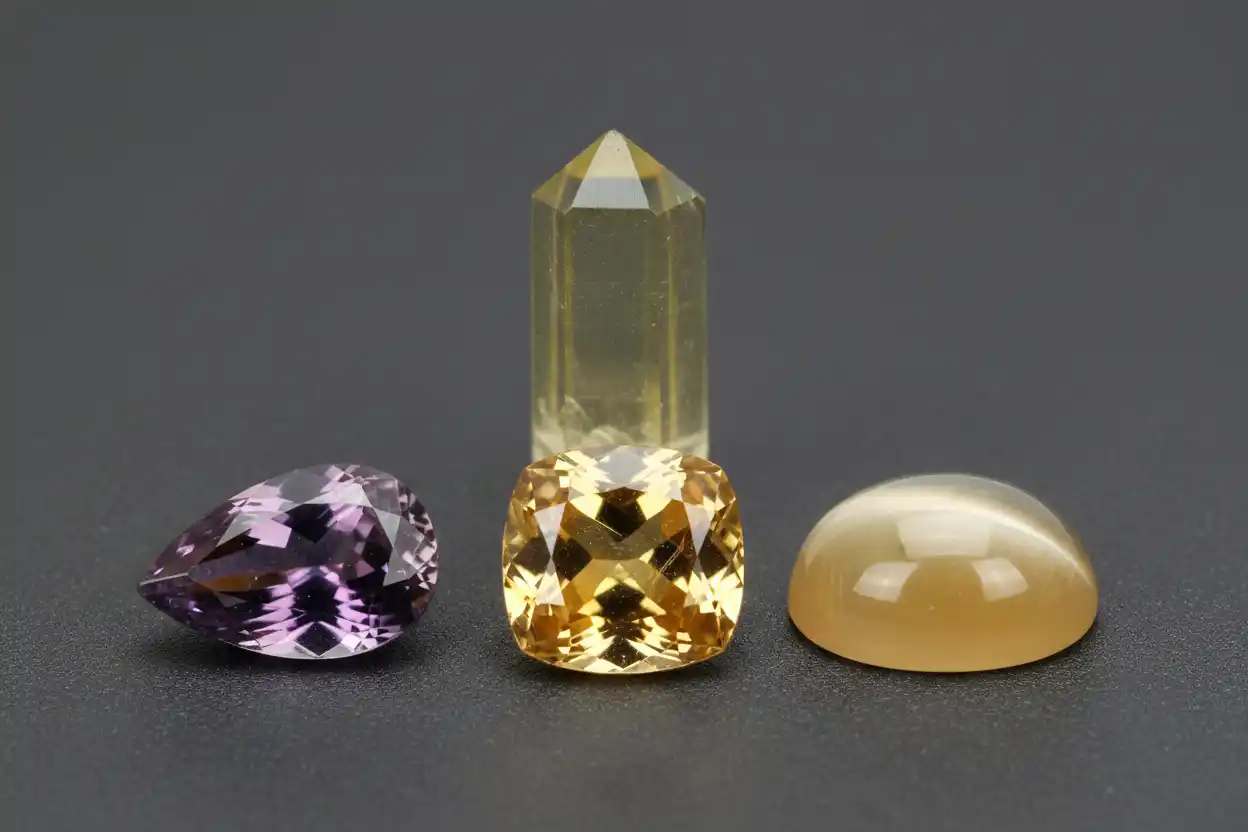
Scapolite: Meaning, Properties & Symbolism
Scapolite is a group of tetragonal framework silicate minerals that commonly forms long, shaft-like crystals in metamorphosed carbonate rocks. Gem-quality material is best known for transparent yellow, golden, pink, and violet stones, while fibrous inclusions can produce a sharply defined cat’s-eye effect.
Unlike gemstones with one fixed composition, scapolite forms a chemical series dominated by sodium-rich marialite and calcium-rich meionite. Its attractive colors and rarity appeal to collectors, but moderate hardness, brittleness, and distinct cleavage require thoughtful cutting and careful wear.
Scapolite at a Glance
| Property | Scapolite |
|---|---|
| Composition | Solid-solution series between marialite, Na₄Al₃Si₉O₂₄Cl, and meionite, Ca₄Al₆Si₆O₂₄CO₃, with related sulfate-bearing members |
| Group or type | Scapolite-group tectosilicate |
| Color | Colorless, white, grey, yellow, gold, orange, pink, violet, purple, blue, green, or brown |
| Crystal system or texture | Tetragonal |
| Habit | Long prismatic, columnar, massive, granular, or fibrous |
| Luster | Vitreous to pearly |
| Transparency | Transparent to opaque |
| Mohs hardness | Approximately 5–6 |
| Cleavage | Distinct to good in prismatic directions |
| Tenacity | Brittle |
| Common uses | Faceted collector gems, cat’s-eye cabochons, mineral specimens, occasional-wear jewelry |
| Primary care concern | Cleavage, low-to-moderate hardness, brittleness, heat, and ultrasonic vibration |
What Is Scapolite?
Scapolite is a mineral group rather than one chemically uniform species. Its members share a tetragonal framework but vary in sodium, calcium, aluminum, silicon, chlorine, carbonate, and sulfate content.
Marialite represents the sodium- and chlorine-rich end of the main series. Meionite represents the calcium- and carbonate-rich end, while intermediate compositions occur far more commonly than chemically pure endmembers.
Silvialite describes a sulfate-bearing scapolite-group member. Additional chemical substitutions produce a broad compositional range that reflects the fluids and rocks involved in formation.
The name comes from Greek words associated with a rod or shaft, referring to the mineral’s elongated prismatic crystals. This habit helps explain its placement among distinctive collector minerals as well as the wider types of gemstones.
Scapolite appears alphabetically in both crystals that start with S and gemstones that start with S.
Scapolite Composition
The marialite–meionite series changes through coupled substitutions. As calcium and aluminum increase, sodium and silicon generally decrease, while carbonate can replace chlorine within channels in the crystal framework.
This variable chemistry affects refractive index, density, fluorescence, color, and geological occurrence. A sodium-rich transparent stone may not produce the same gemological readings as a calcium-rich example.
Commercial sellers usually label faceted material simply as scapolite because determining an exact species requires chemical or spectroscopic analysis. A standard gemstone report may identify the group without assigning a precise endmember.
The composition also allows chlorine, carbonate, sulfate, sulfur species, and trace elements to enter different structural positions. Consequently, color mechanisms can vary between deposits and even between stones from one locality.
How Scapolite Forms
Scapolite commonly develops during regional or contact metamorphism of carbonate-rich rocks. Marbles, calc-silicate gneisses, granulites, amphibolites, and skarns provide favorable environments.
Fluids rich in chlorine, carbonate, sulfur, sodium, or calcium react with feldspar, carbonate minerals, and other silicates. These reactions can form scapolite as elongated crystals, replacement masses, granular aggregates, or part of a complex metamorphic assemblage.
In some rocks, scapolite replaces plagioclase feldspar during fluid-driven alteration. Geologists study that replacement because it records movement of saline fluids through the crust.
Pegmatites and hydrothermal environments produce scapolite less commonly. Crystals from these settings may occur with feldspar, quartz, calcite, mica, amphibole, pyroxene, garnet, or other calc-silicate minerals.
Gem-quality pockets require an unusual combination of open space, suitable chemistry, slow crystal growth, and limited fracturing. Most scapolite remains opaque, included, fractured, or unsuitable for faceting.
Scapolite Colors and Their Causes
Yellow and golden scapolite dominate the transparent gem market. Shades range from pale straw and lemon yellow to honey, amber, orange-yellow, and brownish gold.
Iron-related defects and sulfur-associated color centers can contribute to yellow coloration. However, scapolite chemistry varies enough that one simple cause cannot explain every yellow stone.
Pink, lavender, violet, and purple material commands collector interest. Color centers involving sulfur species, trace impurities, structural defects, or combinations of these factors have been proposed for different deposits.
Purple scapolite can resemble amethyst or iolite, while yellow examples may resemble citrine or heliodor. Gemological testing separates them more reliably than color alone.
Colorless, grey, white, pink, blue, green, and brown material also occurs. Transparent blue or strongly saturated violet examples are much less common than pale yellow stones.
Scapolite therefore appears in both yellow gemstones and purple gemstones, although color directories cannot communicate its full compositional range.
Scapolite Varieties and Phenomena
Transparent faceted scapolite forms the principal jewelry material. Yellow and golden stones are most readily available, followed by smaller quantities of pink or violet gems.
Cat’s-eye scapolite contains aligned needles, tubes, fibers, or elongated inclusions. When a cutter shapes the rough as a cabochon with the inclusion direction properly oriented, reflected light forms a narrow band across the dome.
Fine chatoyancy should appear sharp, continuous, and mobile. A broad or diffuse eye may result from poorly aligned inclusions, a low dome, uneven polishing, or disorganized internal structures.
Some scapolite displays strong fluorescence. Depending on composition and locality, ultraviolet light may produce yellow, orange, red, or other reactions. Fluorescence supports identification only when combined with additional tests because many unrelated gems can respond similarly.
Rare material may show unusual pleochroism or color-change behavior. Such claims require controlled observation under standardized light sources rather than edited marketplace photographs.
Inclusions in Scapolite
Liquid inclusions, crystalline inclusions, healed fractures, fingerprint-like veils, tubes, needles, and fibrous structures occur in natural scapolite. Their abundance partly explains why clean facetable rough remains uncommon.
Parallel inclusions create cat’s-eye material. Other internal features may scatter light, lower transparency, or produce a silky appearance.
Fractures can follow cleavage or cross the crystal irregularly. Some reach the surface and collect polishing residue, oil, dirt, or liquid.
Inclusions may support natural origin and occasionally help indicate locality, but they rarely prove either point on their own. Laboratory gemologists compare inclusion scenes with spectroscopy, chemistry, optical properties, and known reference samples.
Important Scapolite Localities
Myanmar’s Mogok region has produced yellow, pink, and violet scapolite, including transparent faceting material. Its varied marble and calc-silicate deposits also host ruby, spinel, phlogopite, and numerous collector minerals.
Madagascar supplies yellow, golden, violet, and cat’s-eye material. Individual deposits can differ in color, composition, inclusion pattern, and treatment response.
Tanzania and Kenya have yielded gem-quality scapolite from East African metamorphic terrains. Sri Lanka is particularly associated with faceted stones and cat’s-eye examples recovered from gem gravels.
Afghanistan and Pakistan produce crystals and cuttable rough from metamorphic and pegmatitic environments. Brazil has supplied golden stones, while Canada is known for large scapolite crystals and metamorphic occurrences.
Norway, Italy, Russia, Finland, Sweden, and other countries contain important mineralogical localities. Provenance can add collector value when a specimen comes with reliable documentation.
How to Identify Scapolite
Transparent scapolite commonly has a refractive index around the mid-1.50s, although composition creates meaningful variation. It is uniaxial and usually shows moderate birefringence.
Specific gravity generally falls around 2.5–2.8. Calcium-rich material tends to have higher refractive index and density than sodium-rich material.
A hardness near 5–6 means scapolite scratches more easily than quartz, beryl, corundum, or chrysoberyl. Distinct cleavage and brittle tenacity provide additional clues but make destructive testing inadvisable.
Pleochroism may appear in colored stones. Under magnification, a gemologist may also see characteristic tubes, veils, needles, crystals, or cleavage-related fractures.
The how to identify crystals guide explains the value of combining optical data, density, magnification, fluorescence, and spectroscopy. Scapolite should not be identified from color or one handheld observation alone.
Scapolite Lookalikes
Yellow scapolite can resemble citrine, yellow beryl, feldspar, topaz, chrysoberyl, sphene, or yellow sapphire. Its lower hardness and different refractive properties eliminate several of these possibilities.
Chrysoberyl is harder, tougher, denser, and usually has a higher refractive index. Cat’s-eye chrysoberyl also tends to command much higher prices than ordinary cat’s-eye scapolite.
Sphene has stronger dispersion, visible doubling, higher refractive index, and wedge-shaped crystal forms. Both gems can be brittle, but their optical appearances differ noticeably under magnification.
Purple scapolite may resemble amethyst or iolite. Amethyst has quartz properties, including hardness 7 and lower birefringence, while iolite is biaxial and often shows strong blue, grey, or yellow pleochroism.
In rough form, pale yellow scapolite may be confused with feldspar, calcite, apatite, quartz, or scheelite. Scheelite has much greater density and often shows strong fluorescence.
Treatments and Color Stability
Most transparent scapolite is marketed as untreated, but treatment remains possible. Buyers should request written disclosure rather than assuming every stone has natural color.
Heating can alter some violet or purple material toward yellow or lighter tones. The result depends on the original color center and the stone’s chemistry.
Experimental irradiation and color-center research have also shown that scapolite colors can change under energetic exposure. Such findings do not mean irradiated scapolite is common in ordinary jewelry, but laboratories may investigate unusual color when value justifies testing.
Surface coatings and dyes are uncommon for clean transparent faceted stones, although they can appear on low-value material or imitations. Oils or resins may enter surface-reaching fractures, whether intentionally or during routine handling.
The gemstone treatments explained guide covers the disclosure standard. For an expensive violet, pink, color-change, or phenomenal stone, an independent report can address identity and detectable treatment.
Synthetic Scapolite and Imitations
There is no important mainstream jewelry market for laboratory-grown scapolite. Producing it commercially would offer little advantage over using more established synthetic gems.
Glass, cubic zirconia, synthetic spinel, synthetic quartz, natural quartz, feldspar, and other yellow or violet stones can serve as substitutes. Cat’s-eye glass may imitate phenomenal scapolite through aligned fibers or manufactured structures.
A strong eye in an imitation can look unusually uniform from edge to edge. Bubbles, curved growth features, lower density, mold marks, or an incorrect refractive index may reveal glass.
A seller’s use of “created,” “simulated,” “lab,” or “scapolite color” requires careful reading. “Scapolite color” can describe appearance without claiming the material is scapolite.
Cutting Behavior
Scapolite challenges cutters because it combines cleavage, brittleness, moderate hardness, and frequent inclusions. Sawing or grinding across a stressed area can split rough unexpectedly.
Orientation affects color, pleochroism, inclusion visibility, yield, and durability. A cutter may sacrifice weight to place cleavage away from exposed facet junctions or to improve face-up saturation.
The mineral’s moderate refractive index requires suitable proportions. Overly shallow cutting often produces a transparent window through the center, while excessive depth can retain weight without improving appearance.
Facet edges may abrade or chip during polishing. Careful pressure, fresh laps, controlled heat, and accurate preforming reduce risk.
Cat’s-eye rough must be oriented so the inclusion direction lies perpendicular to the finished eye. An incorrect cut can produce a weak, off-center, or invisible band.
Durability and Jewelry Suitability
Scapolite has fair to poor durability for demanding jewelry. Its hardness of about 5–6 leaves it vulnerable to scratches from household dust, quartz grains, harder gemstones, and many common surfaces.
Distinct cleavage and brittle tenacity create a more serious concern. A blow can split the gem even when the surface shows little prior wear.
Pendants, earrings, brooches, collector pieces, and occasional-wear dress rings offer safer uses. Protective bezels, halos, low settings, and guarded sides reduce exposure.
Scapolite is usually a poor choice for an unprotected daily engagement ring. Buyers considering it among yellow engagement ring stones should weigh its unusual color against its maintenance demands.
Collectors who prioritize rarity may still accept that tradeoff. The setting, lifestyle, replacement expectations, and willingness to remove the ring during routine activities matter as much as appearance.
Scapolite Value and July 2026 Asking Prices
Scapolite price depends on color, saturation, clarity, cut, size, phenomenon, treatment status, origin documentation, and overall rarity. Yellow material has the broadest supply, while fine violet, pink, cat’s-eye, and unusual-color stones occupy narrower markets.
As of July 2026, commercial faceted yellow scapolite commonly carries asking prices around $15–$35 per carat. Cleaner stones with richer golden color, stronger cutting, or more attractive sizes often appear around $35–$100 per carat.
Fine violet or pink stones, sharp cat’s-eyes, precision-cut gems, unusually clean large examples, and documented stones from notable deposits may exceed $100 per carat. Exceptional collector pieces can move substantially higher, although the thin market makes direct comparisons difficult.
Large size does not guarantee value. A heavily windowed, pale, chipped, fractured, or poorly cut ten-carat stone may be less desirable than a smaller gem with balanced color and strong brilliance.
The dedicated scapolite price guide owns the detailed valuation intent, including price tiers and the effect of color, clarity, size, origin, phenomenon, and cutting.
Buying Scapolite
Confirm whether the seller offers a faceted transparent gem, a cat’s-eye cabochon, rough, or a mineral specimen. Price comparisons should remain within the same product type.
For a faceted stone, ask for carat weight, dimensions, color description, treatment disclosure, clarity, cut style, return policy, and neutral-light video. Measurements reveal whether the gem carries excessive hidden depth or has a shallow window.
Examine facet edges and the girdle for chips or abrasion. Surface-reaching cleavage and fractures should be disclosed because they affect both appearance and durability.
For a cat’s-eye, request video under one small moving light. A strong eye should travel smoothly across the dome rather than remain painted in one position.
Origin claims require documentation when they influence price. A statement such as “Mogok,” “Madagascar,” or “Sri Lanka” should not command a premium without reliable support.
The dedicated buy scapolite guide covers seller evaluation, product selection, reports, photographs, returns, and purchasing channels without expanding the present identification guide into a transactional page.
Cleaning and Storage
Clean scapolite by hand with lukewarm water, mild soap, and a soft brush. Use light pressure around facet junctions and surface-reaching fractures.
Rinse quickly and dry the gem with a lint-free cloth. Avoid prolonged soaking when the stone has fractures, filling, coating, glue, or an uncertain treatment history.
Do not use steam or ultrasonic cleaning. Heat, vibration, cleavage, and internal fractures create an unnecessary breakage risk. The gemstones in ultrasonic cleaners guide explains why apparent cleanliness does not guarantee structural safety.
Keep scapolite away from bleach, acids, aggressive dips, and sudden temperature changes. Strong prolonged light may also be unwise for unusually colored or treatment-uncertain material.
Store the gem separately in a padded compartment. Harder stones such as sapphire, spinel, topaz, quartz, and diamond can scratch it.
Scapolite Meaning and Symbolism
Scapolite does not have the same continuous historical symbolism as quartz, ruby, sapphire, or jade. Most modern interpretations developed through contemporary mineral collecting and crystal traditions.
Its shaft-like crystal form has encouraged associations with direction, purpose, structure, and personal alignment. Yellow scapolite is often linked symbolically with optimism, motivation, confidence, and practical decision-making.
Purple material may be associated with perspective, reflection, imagination, or spiritual inquiry. Cat’s-eye scapolite can serve as a symbol of alertness, observation, and maintaining focus through changing circumstances.
Modern practitioners also describe scapolite as representing independence, problem-solving, responsibility, and the willingness to change an unhelpful pattern. These ideas remain spiritual or personal beliefs rather than measured properties of the mineral.
No scientific evidence shows that scapolite treats disease, changes metabolism, or guarantees psychological outcomes. A specimen or jewel can still hold genuine personal meaning as a keepsake, design object, geological record, or reminder of an intention.
Frequently Asked Questions
1. Is scapolite one mineral or a mineral group?
It is a group containing chemically related tetragonal minerals, most commonly compositions between marialite and meionite.
2. What is the difference between marialite and meionite?
Marialite is sodium- and chlorine-rich, while meionite is calcium- and carbonate-rich. Natural scapolite commonly has an intermediate composition.
3. Which scapolite color is rarest?
Strong violet, pink, blue, unusual color-change material, and fine phenomenal stones are generally scarcer than ordinary pale yellow scapolite.
4. Does scapolite fluoresce?
Many specimens do, sometimes in yellow, orange, red, or related colors, but the response varies with composition and locality.
5. What produces a cat’s-eye in scapolite?
Parallel needles, tubes, fibers, or elongated inclusions reflect a narrow band of light from a properly oriented cabochon.
6. Can purple scapolite become yellow?
Heating can alter the color of some purple or violet material, although results depend on its chemistry and original color center.
7. How can scapolite be separated from quartz?
Scapolite is softer, has distinct cleavage, and usually shows different refractive, density, optical, and inclusion characteristics.
8. Is synthetic scapolite common?
No. Commercial laboratory-grown scapolite is not a significant jewelry product; glass and other yellow or violet gems are more common substitutes.
9. Is scapolite suitable for an engagement ring?
It is vulnerable to scratching, cleavage, and impact, so it suits protected occasional-wear rings better than unrestricted daily wear.
10. Can scapolite go in an ultrasonic cleaner?
No. Ultrasonic vibration can enlarge fractures or trigger cleavage-related damage.
11. Why do some faceted scapolites have a large window?
Shallow proportions, poor orientation, or weight-retaining cuts can allow light to pass through the center instead of returning to the viewer.
12. What should a laboratory report disclose for valuable scapolite?
It should confirm identity and list detectable treatment. Origin or color-cause opinions may require additional testing and may not always be possible.
Scapolite rewards buyers who value uncommon color and geological complexity, provided they evaluate cut, treatment, cleavage, and intended wear before allowing rarity alone to drive the purchase.