
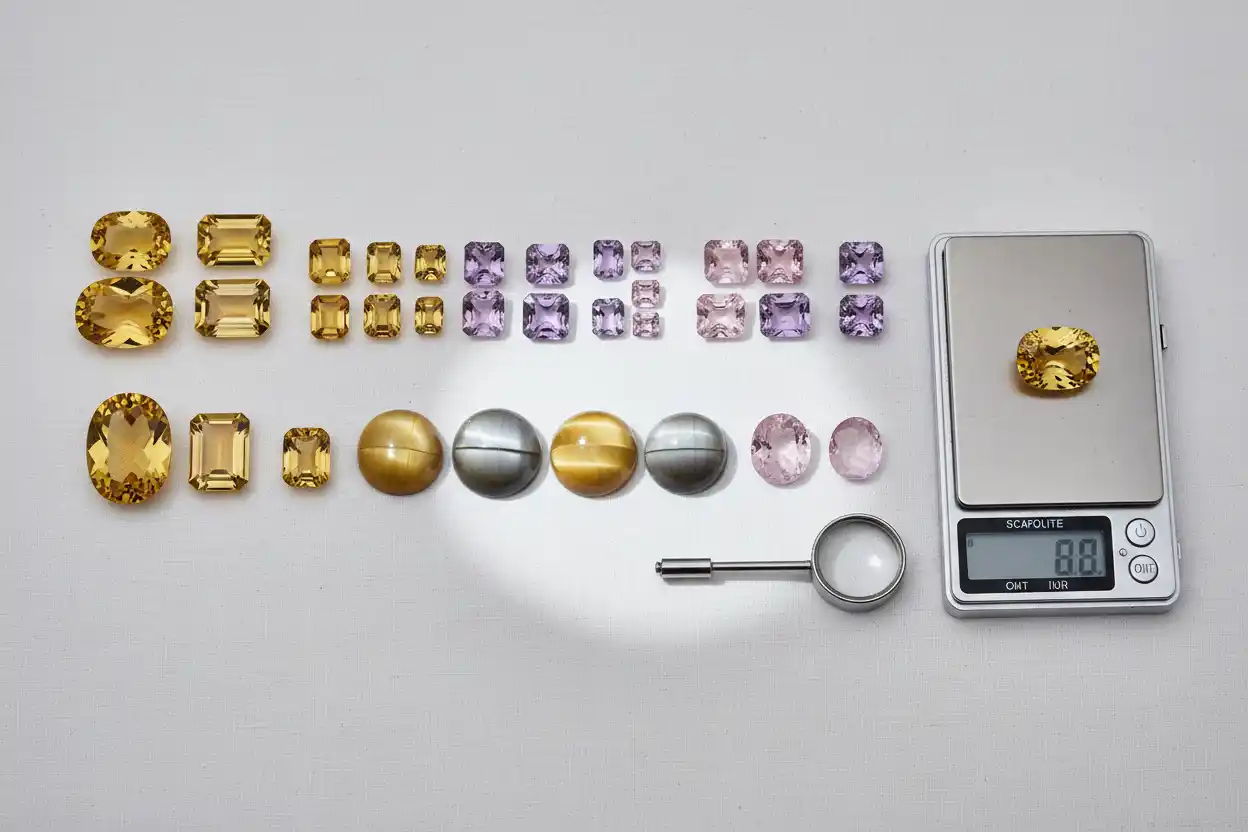

Scapolite prices in 2026 commonly range from approximately $15 to $225 per carat. Yellow commercial stones often sit below $100 per carat, while saturated violet, blue-violet, precision-cut and fine cat’s-eye material can reach $100 to $500 per carat.
Exceptional collector gems may cost more, but Scapolite has a small market. Its rarity as a faceted stone does not automatically create the high prices associated with Ruby, Sapphire or Alexandrite because general consumer demand remains limited.
Scapolite Price per Carat in 2026
The following ranges represent broad U.S. specialist-retail expectations for natural loose Scapolite.
| Scapolite quality | Typical characteristics | Approximate 2026 retail price |
|---|---|---|
| Entry commercial | Pale yellow, colorless, included, windowed or basic cutting | $15–$40 per carat |
| Good commercial | Attractive honey-yellow or light violet color and competent cutting | $40–$100 per carat |
| Fine | Saturated yellow, purple or violet, good transparency and balanced proportions | $80–$225 per carat |
| Premium | Rare blue-violet, rich purple, fine cat’s-eye effect or precision cutting | $200–$500 per carat |
| Exceptional collector stone | Rare color, unusual phenomenon, major size or documented provenance | $500–$1,000+ per carat |
Current specialist inventories place average Scapolite offers near the middle of this range, with ordinary dealer listings around $15 to $225 per carat. Individual purple, collector and phenomenal gems can sit higher.
The general relationship among rarity, appearance, craftsmanship and demand appears in How Gemstone Prices Are Determined.
What Is Scapolite?
Scapolite is a mineral series whose principal end members are sodium-rich marialite and calcium-rich meionite.
Most gem material falls between those end members rather than matching either pure composition. The exact chemistry influences refractive index, density, fluorescence and other gemological properties.
Scapolite can occur colorless, white, yellow, orange, pink, violet, purple, blue, gray, brown and reddish brown.
Transparent material is faceted, while fibrous or included rough may be cut into cabochons that display chatoyancy or asterism.
The completed Scapolite guide owns mineral composition, formation, localities and symbolic traditions. This page remains focused on price and value.
Why Scapolite Is a Collector Gem
Transparent Scapolite is much less familiar to jewelry buyers than Citrine, Amethyst, Topaz or Sapphire.
That limited recognition has two effects. Fine gems are genuinely uncommon, but prices remain moderate because consumer demand is relatively small.
Collectors value Scapolite for its unusual colors, fluorescence, mineral-group chemistry and phenomenal varieties.
Large transparent yellow stones are available, preventing size from creating an automatic premium. By contrast, saturated violet and certain cat’s-eye stones can be difficult to replace.
Precision cutting also matters because affordable rough allows skilled lapidaries to create distinctive designs without sacrificing extremely expensive material.
Yellow Scapolite Prices
Yellow is the most familiar faceted Scapolite color.
Commercial stones range from pale straw and lemon yellow to honey, golden yellow and yellow-orange. Most cost approximately $20 to $100 per carat.
Fine saturated golden material with excellent transparency and cutting can reach $100 to $225 per carat.
Brown and gray modifiers reduce value. Overly pale stones can resemble colorless quartz, while excessively dark stones may lose brightness.
Yellow Scapolite should remain lively rather than appearing smoky or muddy. Neutral-light video is especially helpful because warm photography can intensify an ordinary pale-yellow stone.
The broader market for similarly colored materials appears in Yellow Gemstones.
Purple and Violet Scapolite Prices
Purple and violet Scapolite generally command stronger prices than ordinary yellow material.
Good stones may cost approximately $75 to $225 per carat. Saturated blue-violet or reddish-purple gems with fine clarity can reach $200 to $500 per carat.
The color should remain visible in ordinary indoor light. Pale gray-violet material may lose its identity once set.
Strongly colored stones are often small or included, so a clean multi-carat gem can attract collector interest.
Purple Scapolite can resemble Amethyst because the two may have overlapping refractive indices and densities. Correct optical testing becomes important when the Scapolite name creates a premium.
The broader purple-gem market appears in Purple Gemstones, while quartz pricing remains separate in the Amethyst Price Guide.
Pink and Reddish Scapolite
Pink, salmon, reddish-brown and red-violet Scapolite occurs in transparent and chatoyant material.
Transparent pink stones may cost approximately $50 to $250 per carat, depending on saturation, clarity and rarity.
Fibrous pink or reddish Scapolite is often cut into cat’s-eye cabochons. Fine examples can display a bright moving line against a peach, mauve or reddish body.
The market occasionally mislabels pink cat’s-eye Scapolite as Pink Moonstone or red Moonstone. Such names are misleading because Moonstone is feldspar and shows a different optical phenomenon.
The family-level Moonstone market appears in the Moonstone Price Guide.
Blue Scapolite
Blue Scapolite is rare and has a specialized collector market.
The color may range from pale blue and gray-blue to blue-violet. Fine stones can cost several hundred dollars per carat when the color is clearly visible and the identity is documented.
A blue claim deserves caution because Scapolite is not commonly encountered in saturated blue faceted material.
The gem may be confused with Sapphire, Tanzanite, Iolite, Kyanite or treated quartz.
A laboratory report becomes more reasonable when a rare blue color materially increases the price.
Current family-level blue-corundum pricing appears in the Sapphire Price Guide, but Scapolite should remain in its own collector category.
Cat’s-Eye Scapolite Prices
Parallel fibers, tubes or needle-like inclusions can create chatoyancy when Scapolite is cut as a cabochon.
Commercial brown, gray and yellow cat’s-eye stones may cost approximately $5 to $50 per carat.
Fine pink, lavender, violet or golden cabochons with a sharp centered eye can reach $50 to $250 per carat.
Exceptional stones with strong transparency, a narrow moving line and attractive body color may rise beyond $250 per carat.
A broad diffuse band is less valuable than a sharp eye. The effect should move smoothly as the light source changes position.
The cabochon’s base should align with the internal fibers. Poor orientation creates a weak or off-center line even when the rough contains strong chatoyant potential.
Star Scapolite
Scapolite can occasionally display four- or six-rayed asterism.
Star material is rarer than ordinary cat’s-eye Scapolite and is primarily collected for the phenomenon rather than broad jewelry demand.
Fine examples require complete rays, good centering, attractive body color and enough translucency for the effect to remain visible.
Pricing is highly individual. Commercial stones may cost tens of dollars per carat, while an exceptional documented star can reach several hundred per carat.
Asterism must be separated from surface scratches, fiber-optic glass and other phenomenal imitations.
Fluorescent Scapolite
Some Scapolite fluoresces strongly under ultraviolet light in yellow, orange, pink or other responses.
Fluorescence can add collector interest, particularly in documented Canadian material and unusual crystal specimens.
However, ultraviolet reaction alone does not create a high gemstone price. The stone should also have attractive daylight color, crystal form or transparency.
A strongly fluorescent but opaque or damaged specimen may remain inexpensive.
Fluorescence should be treated as a supplemental collector feature rather than a substitute for ordinary visual quality.
Scapolite Prices by Size
Scapolite occurs in crystals large enough to produce substantial faceted stones.
| Scapolite weight | Commercial quality | Fine quality | Premium or specialty |
|---|---|---|---|
| Under 2 ct | $15–$75 per carat | $75–$175 per carat | $150–$350 per carat |
| 2–5 ct | $20–$90 per carat | $80–$200 per carat | $175–$400 per carat |
| 5–10 ct | $20–$100 per carat | $90–$225 per carat | $200–$500 per carat |
| 10–25 ct | $15–$90 per carat | $75–$200 per carat | $175–$450 per carat |
| Above 25 ct | Often priced individually | Depends on color and cutting | Collector evaluation required |
Price per carat may decline in large pale-yellow stones because size is available and jewelry demand becomes limited.
A large saturated violet or precision-cut stone follows a different pattern because attractive color and skilled cutting can remain scarce.
Dimensions should be compared with weight. Deep pavilions can add carats without creating proportionate face-up presence.
Clarity and Transparency
Faceted Scapolite is generally expected to appear transparent or lightly included.
Yellow material can be available in clean sizes, so heavy clouds and large fractures reduce value.
Purple and rare-color material may receive greater inclusion tolerance. Even then, the stone should transmit enough light to remain lively.
Surface-reaching fractures increase setting risk because Scapolite has cleavage and only moderate hardness.
For cat’s-eye material, inclusions are necessary to create the phenomenon. The buyer should distinguish useful oriented fibers from random cloudiness that weakens the effect.
A fine eye can justify reduced transparency when the line remains sharp and centered.
Cut Quality
Scapolite can produce bright faceted stones when proportions are carefully chosen.
Ovals, cushions, emerald cuts and pears are common. Large yellow rough is also used for fantasy and precision cuts.
A shallow pavilion creates windowing, while excessive depth hides weight and may darken purple material.
Because Scapolite rough is generally affordable, poor cutting should not receive the same tolerance granted to exceptionally rare Ruby or Paraíba Tourmaline rough.
Precision cutting can become the largest component of the finished price. A custom stone may cost $200 or more per carat even when ordinary commercial rough is inexpensive.
Detailed inspection belongs to the Scapolite Buying Guide.
Tanzania and East African Scapolite
Tanzania produces yellow, brown, reddish, violet and chatoyant Scapolite.
Pink-to-brown cat’s-eye material can contain oriented inclusions that create a moving line. Transparent yellow and violet stones also enter the collector market.
Kenya and Mozambique have produced additional Scapolite, including large transparent crystals and facetable yellow material.
East African origin does not automatically establish a premium. Color, phenomenon, transparency and cutting remain more important.
A fine Tanzanian purple stone may command strong collector pricing, while ordinary yellow rough from the same region remains affordable.
Myanmar Scapolite
Myanmar has produced white, pink, violet and fibrous Scapolite.
Pink and reddish cat’s-eye material is among the better-known phenomenal varieties. Fine stones can have an attractive mauve or salmon body with a distinct eye.
Myanmar origin may support collector interest, but documentation is uncommon for low-cost cabochons.
The gem can be confused with Feldspar or Moonstone in local and online markets. Independent identification becomes important when the seller uses a rare color or origin to justify a high price.
Madagascar, Pakistan and Other Sources
Madagascar produces yellow, pink and other Scapolite colors, including mineral specimens and facetable rough.
Pakistan has supplied attractive purple and blue-violet material that appears in specialist inventories.
Canada is known for fluorescent crystals and specimen material, while Brazil and Sri Lanka have also yielded gem Scapolite.
Origin normally matters less than visible quality. Nevertheless, a documented collector crystal from a specific deposit may command a provenance premium.
Irradiated and Heated Scapolite
Scapolite can receive treatment to change its color.
Irradiation may convert certain yellow stones to lavender or violet. Some irradiated colors may fade under heat or prolonged light.
Heating can alter violet Scapolite toward yellow in some material.
Treatment disclosure is therefore important for strongly colored lavender and violet stones. A seller should state what is known rather than describing every purple gem as naturally colored.
Untreated status may interest collectors, but it requires credible evidence. Ordinary appearance and a seller card are not enough to establish a natural-color premium.
The wider enhancement framework appears in Gemstone Treatments Explained.
Scapolite vs Amethyst
Purple Scapolite can resemble Amethyst closely.
The two may have similar refractive index and specific gravity ranges, but their optic characters and crystal structures differ.
Amethyst is quartz and is widely available. Ordinary purple Scapolite is rarer but has a smaller public market.
A stone should not receive a Scapolite premium without proper identification. Likewise, rarity does not guarantee that Scapolite will cost more than a fine precision-cut Amethyst.
Current Amethyst pricing belongs to the Amethyst Price Guide.
Scapolite vs Citrine and Golden Beryl
Yellow Scapolite can resemble Citrine, Heliodor, Topaz and Yellow Sapphire.
Citrine is quartz and usually costs less. Its current market appears in the Citrine Price Guide.
Heliodor is golden beryl and generally has greater hardness. Its market appears in the Heliodor Price Guide.
Scapolite’s lower hardness, collector status and possible fluorescence distinguish it commercially. However, color alone cannot confirm identity.
Scapolite vs Sphene and Serendibite
Sphene can show stronger dispersion, higher refractive character and vivid yellow-green color. Its separate market belongs to the planned Sphene Price Guide.
Serendibite is an exceptionally rare collector mineral that can occur in deep blue-green colors. Its planned market belongs to the Serendibite Price Guide.
Scapolite usually offers larger sizes and lower prices. Its appeal rests on unusual colors, chatoyancy, fluorescence and lapidary possibilities rather than extreme scarcity alone.
Scapolite Jewelry Prices in 2026
| Jewelry type | Broad U.S. retail range |
|---|---|
| Silver pendant with commercial yellow Scapolite | $75–$400 |
| Silver cat’s-eye ring | $100–$600 |
| Gold pendant or earrings | $400–$2,500 |
| Gold ring with a fine purple or yellow stone | $600–$3,500 |
| Precision-cut or collector Scapolite jewel | $1,500–$7,500+ |
The setting often contributes more value than the loose gem.
Scapolite is better suited to pendants and earrings than hard-wear rings because its moderate hardness and cleavage increase vulnerability.
A ring should use a protective bezel or low-profile setting, particularly for included or cat’s-eye material.
Durability and Care
Scapolite has a Mohs hardness around 5.5 to 6 and distinct cleavage.
It can scratch more easily than Quartz, Topaz, Sapphire and Diamond. Sharp impact may also cause chips or cleavage breaks.
Warm water, mild soap and a soft cloth provide the safest routine. Steam and ultrasonic cleaning should be avoided, particularly for included, treated or phenomenal stones.
Long exposure to strong sunlight or repair heat may affect certain irradiated colors.
Scapolite jewelry should be stored separately from harder gemstones and removed before household work, exercise or impact-prone activity.
Certification and Appraisal
Most ordinary yellow Scapolite does not justify an expensive laboratory report.
Testing becomes more useful when:
- A purple or blue stone carries a strong premium
- Natural color is claimed
- Cat’s-eye material may be Feldspar or another gem
- A major fluorescent specimen has an important locality label
- The stone may be Amethyst, Citrine or Golden Beryl
- A precision-cut collector gem requires insurance documentation
A report can establish Scapolite identity and disclose detectable treatment within the laboratory’s scope. It does not provide a universal color or phenomenon grade.
The Gemstone Certification Labs comparison explains report limitations.
Does Scapolite Hold Its Value?
Commercial Scapolite has limited resale liquidity.
The gem is not widely recognized, and many jewelers do not maintain an active secondhand market for it.
Fine purple stones, sharp cat’s-eyes, rare blue material, important fluorescent specimens and recognized precision cuts may attract collectors.
Even so, finding the right buyer can take time. A collector stone purchased at an aggressive retail markup may resell below its original price.
The broader framework appears in Do Gemstones Hold Their Value?.
Price Guide vs Buying Guide
This page owns Scapolite’s 2026 prices and value factors. The buying guide owns the detailed inspection of color, phenomenon, cut and seller disclosure.
The completed Gemstones That Start With S and Crystals That Start With S directories connect Scapolite with the site’s alphabetical structure.
Online buyers should request rotating video, dimensions, treatment information and a return period through How to Buy Gemstones Online Without Getting Scammed.
The Buying & Value hub connects Scapolite pricing with certification, treatment and resale guidance.
Frequently Asked Questions
1. How much is Scapolite worth per carat in 2026?
Most Scapolite costs approximately $15 to $225 per carat. Fine purple, blue-violet, precision-cut or phenomenal stones may reach $200 to $500 per carat or more.
2. What Scapolite color is most valuable?
Saturated violet, blue-violet and rare blue generally receive the strongest faceted-gem prices.
3. How much is yellow Scapolite worth?
Most yellow Scapolite costs approximately $20 to $100 per carat. Fine saturated or precision-cut stones can reach $100 to $225 per carat.
4. How much is purple Scapolite worth?
Good purple material commonly ranges from $75 to $225 per carat. Premium blue-violet stones may cost several hundred dollars per carat.
5. Is cat’s-eye Scapolite valuable?
Commercial stones can be inexpensive, while sharp pink, violet or golden cat’s-eyes may reach $50 to $250 per carat or more.
6. Does large Scapolite cost more per carat?
Not automatically. Large yellow stones are available, so color and cutting usually matter more than weight.
7. Is Scapolite normally treated?
Some purple or lavender colors may result from irradiation, while heating can alter certain violet material toward yellow.
8. Can Scapolite color fade?
Some irradiated colors may fade with prolonged light or heat exposure.
9. Is purple Scapolite the same as Amethyst?
No. Scapolite is a separate mineral series, while Amethyst is quartz. Professional testing may be necessary because their properties can overlap.
10. Is pink cat’s-eye Scapolite a type of Moonstone?
No. It is sometimes mislabeled as Pink Moonstone, but the materials and optical effects differ.
11. Does Scapolite need a laboratory report?
Commercial yellow stones usually do not. Testing is useful for rare colors, treatment claims and valuable phenomenal material.
12. Is Scapolite a good investment?
Its collector market is small and resale can be slow. Fine rare-color, phenomenal and precision-cut stones have better prospects than ordinary commercial material.
Scapolite’s Rarity Does Not Guarantee a High Price
Scapolite is uncommon enough to interest gem collectors, yet unfamiliar enough to remain affordable. Its best value lies in unusual violet color, sharp chatoyancy, fluorescence or precision cutting rather than size alone.
In 2026, most attractive faceted stones fall between $40 and $225 per carat. Higher prices should correspond to rare color, exceptional phenomenon, skilled lapidary work or documentation that clearly separates the gem from common quartz and feldspar lookalikes.