Yellow Gemstones for Engagement Rings: Best Stones Compared
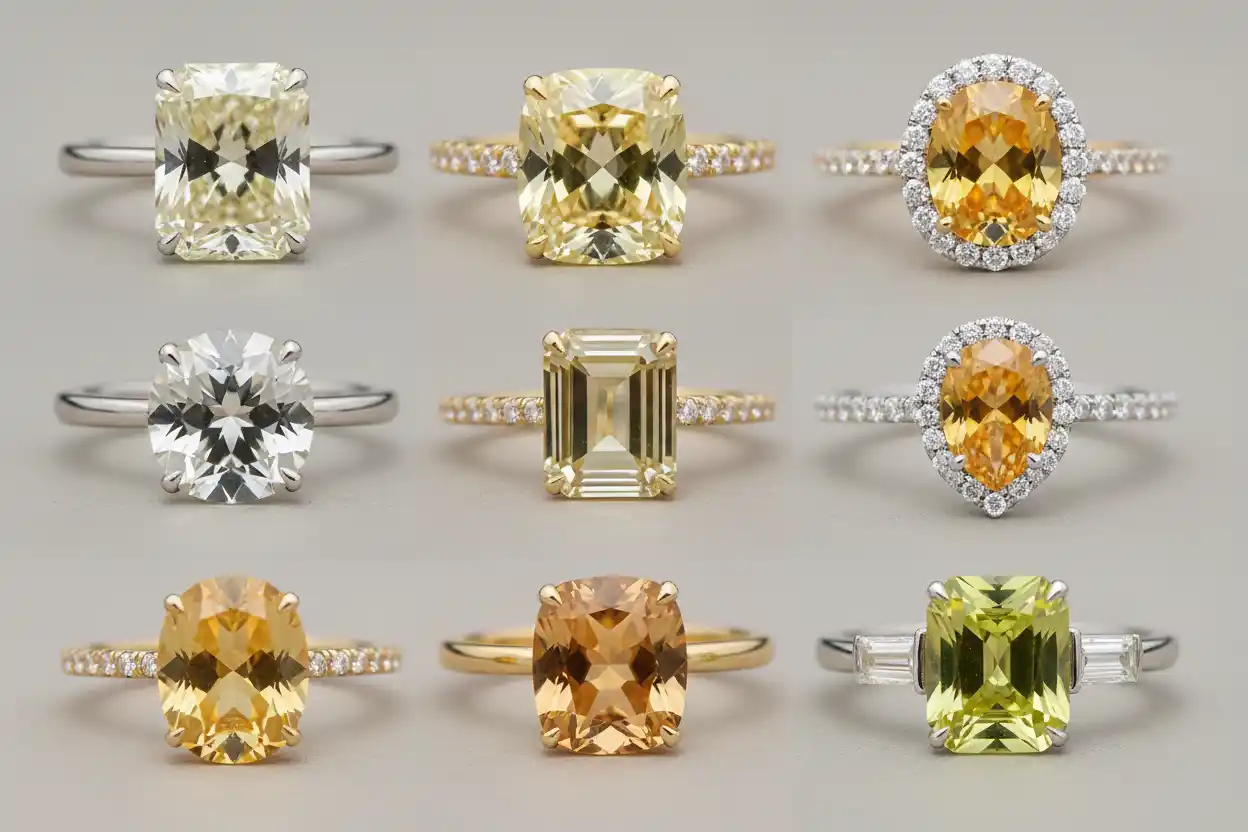
Yellow gemstones for engagement rings range from exceptionally durable Fancy yellow Diamonds and Yellow Sapphires to affordable Citrine, Heliodor, Topaz, Zircon and Sunstone. Their colors can appear lemon, canary, golden, honey, champagne, greenish yellow or orange-yellow.
The best choice depends on the wearer’s daily routine, desired sparkle, budget and tolerance for treatment or laboratory origin. A stone that performs well in earrings may be too brittle, cleavable or abrasion-prone for a ring worn every day.
Hardness is only one part of durability. Toughness, cleavage, internal fractures, treatment stability and setting design also determine whether a gemstone will survive years of normal wear.
The broader best gemstones for engagement rings guide compares durable stones across all colors. This page focuses on yellow center stones, while the yellow gemstones guide covers their wider names, meanings and jewelry uses.
Best Yellow Engagement-Ring Stones at a Glance
| Yellow gemstone | Mohs hardness | Daily-wear suitability | Optical character | Main buying concern |
|---|---|---|---|---|
| Natural Fancy yellow Diamond | 10 | Excellent | High brilliance, fire and scintillation | Natural color, grading and price |
| Laboratory-grown yellow Diamond | 10 | Excellent | Diamond brilliance and durability | Origin and color-treatment disclosure |
| Yellow Sapphire | 9 | Excellent | Bright, durable and usually calmer than Diamond | Heat, diffusion, synthetic origin and color stability |
| Yellow Chrysoberyl | 8.5 | Very good | Crisp brilliance with honey or yellow-green color | Identity and rarity of fine color |
| Yellow Spinel | 8 | Very good | Clean, lively and relatively understated | Natural color and synthetic Spinel |
| Yellow Topaz | 8 | Moderate | Clear, glassy and available in large sizes | Perfect cleavage |
| Heliodor | 7.5–8 | Good | Elegant pale-to-golden Beryl appearance | Windowing, fractures and treatment |
| Yellow Tourmaline | 7–7.5 | Good with protection | Strong pleochroism and varied yellow tones | Color stability, treatment and inclusions |
| Yellow Zircon | 6–7.5 | Moderate | High brilliance and strong fire | Brittleness, abrasion and heat treatment |
| Citrine | 7 | Moderate to good | Warm transparent color and accessible sizes | Heat treatment and surface wear |
| Yellow Garnet | 6.5–7.5 | Moderate to good | Bright color with varied fire | Exact species and inclusions |
| Yellow Sunstone | 6–6.5 | Limited to moderate | Warm glow or aventurescence | Cleavage and abrasion |
| Yellow Opal | About 5.5–6.5 | Limited | Honey body with possible play-of-color | Crazing, heat and impact |
The gemstone hardness chart explains scratch resistance. The toughness-versus-hardness guide explains resistance to breaking, while the gemstone cleavage guide covers structurally weak directions.
Natural Fancy Yellow Diamond
Yellow Diamond offers the strongest combination of scratch resistance, brilliance, market recognition and standardized grading.
Nitrogen-related defects absorb blue light and allow a yellow body color to dominate. Greater saturation can move a stone from faint or light yellow into Fancy, Fancy Intense, Fancy Vivid and other colored-Diamond categories.
The Diamond engagement-ring guide owns shapes, settings and conventional Diamond purchase decisions. The Diamond buying guide covers reports and quality factors more broadly.
For a yellow Diamond, color distribution and intensity often matter more than conventional colorlessness. Radiant, cushion and oval cuts are popular because their facet patterns can strengthen face-up color.
A yellow Diamond should have an independent colored-Diamond report confirming:
- Natural Diamond identity
- Natural or treated color origin
- Color grade
- Color distribution
- Clarity
- Measurements
- Carat weight
- Any inscription
Coatings, irradiation and high-pressure high-temperature treatment can alter Diamond color. A report is essential because visual appearance cannot establish natural origin.
Laboratory-Grown Yellow Diamond
Laboratory-grown yellow Diamond is produced through controlled growth rather than geological formation.
It has the same essential carbon composition and Diamond crystal structure as natural Diamond. Therefore, it provides Diamond hardness and broadly comparable optical behavior.
Yellow and orange colors can result from growth-related nitrogen or post-growth treatment, depending on the manufacturing process.
Laboratory-grown yellow Diamond can offer a larger or more saturated stone for the same initial budget. However, buyers should consider changing production costs and resale expectations.
The seller must state laboratory origin clearly. A grading report should identify the stone as laboratory-grown and describe detectable post-growth treatment.
Laboratory-grown Diamond is not a simulant, but it is not mined Diamond.
Yellow Sapphire
Yellow Sapphire is yellow Corundum and is one of the strongest natural alternatives to Diamond.
Its Mohs hardness 9 provides excellent scratch resistance, while sound stones generally tolerate frequent wear.
The Sapphire engagement-ring guide owns family-wide ring settings and purchase considerations.
Yellow Sapphire may appear:
- Pale straw
- Lemon yellow
- Canary yellow
- Golden yellow
- Greenish yellow
- Orange-yellow
- Brownish yellow
Color, clarity and cutting strongly affect value. A poorly cut stone may show a transparent window through the center, while an overly deep stone hides weight below the setting.
Natural, heat-treated, beryllium-diffused and synthetic Yellow Sapphire all occur. Some stones also display color instability that becomes apparent only through professional testing.
The treated-Sapphire guide explains heat, diffusion, filling and synthetic material.
For a significant purchase, obtain an independent colored-stone report addressing natural origin and detectable treatment.
Yellow Chrysoberyl
Chrysoberyl is a durable beryllium aluminum oxide mineral with Mohs hardness 8.5.
Transparent yellow and yellow-green Chrysoberyl can provide a crisp, lively engagement-ring stone with greater rarity than Citrine.
Colors include pale yellow, lemon, chartreuse, honey and brownish yellow.
Chrysoberyl has generally good toughness and no prominent easy cleavage comparable to Topaz. Rounded cuts and protected corners make it a practical daily option.
Cat’s-eye Chrysoberyl belongs to a different visual category and is usually cut as a cabochon.
Alexandrite is the color-change variety of Chrysoberyl and should not be represented as an ordinary yellow stone merely because it appears yellowish under one light.
A report is useful because Yellow Sapphire, Heliodor, Zircon and synthetic materials can resemble transparent yellow Chrysoberyl.
Yellow Spinel
Yellow Spinel offers Mohs hardness 8, good toughness and a lively but restrained brilliance.
Natural yellow Spinel is less familiar than red, pink or blue material and may appear yellow, yellow-orange, brownish yellow or greenish yellow.
Fine natural stones can be difficult to find in matched sizes, which makes custom sourcing more likely.
Synthetic Spinel is widely produced and may appear exceptionally clean and evenly colored.
A natural-origin premium requires laboratory confirmation.
Spinel works well in round, oval and cushion cuts. Sharp corners need normal protection, but the material is generally suitable for frequent wear.
Its lower market recognition can provide individuality, although resale demand may be narrower than for Diamond or Sapphire.
Yellow Topaz
Yellow Topaz offers attractive yellow, golden and sherry tones in sizes that would be expensive in Diamond or Sapphire.
Topaz reaches Mohs hardness 8, but perfect cleavage limits its suitability for unrestricted daily wear.
A sharp impact in the wrong direction can split the stone. Therefore, a low bezel or protective halo is preferable to a tall exposed setting.
The dedicated Citrine versus Yellow Topaz comparison explains why visual color is insufficient for identification.
Imperial Topaz can include yellow-orange, orange-pink and reddish tones, although trade definitions vary. The Imperial Topaz guide owns that narrower variety.
Yellow Topaz suits buyers who want:
- A large natural center stone
- Warm transparent color
- Moderate initial price
- Occasional or careful daily wear
- A protected setting
- Acceptance of cleavage-related risk
It should not be marketed under misleading names such as yellow Diamond Topaz.
Heliodor
Heliodor is yellow-to-greenish-yellow Beryl.
Its hardness of approximately 7.5 to 8 makes it reasonably resistant to scratching, although fractures and inclusions can reduce toughness.
The Heliodor buying guide covers color, cutting and reports.
Heliodor often has an elegant pale appearance rather than the intense saturation of Yellow Sapphire or Fancy Diamond.
Large transparent crystals allow substantial faceted stones. However, cutters may retain excessive depth, creating a small face-up outline or central window.
A well-cut oval, cushion or emerald cut can make an understated engagement ring.
Yellow Beryl should not be confused with Golden Beryl as though they were separate standardized species. Heliodor and Golden Beryl are overlapping trade descriptions within yellow Beryl.
Yellow Tourmaline
Yellow Tourmaline can belong to Elbaite, Dravite or another Tourmaline composition depending on chemistry.
Colors range from pale lemon and golden yellow to greenish yellow, brown-yellow and orange-yellow.
Tourmaline has Mohs hardness around 7 to 7.5 and no easy cleavage, but inclusions and elongated crystal structure can create fracture risks.
Strong pleochroism means the stone may show different colors from different directions. Correct orientation can improve face-up yellow or reduce unwanted brown and green tones.
The types of Tourmaline guide provides family-wide context.
Heat and irradiation can alter some Tourmaline colors. A report becomes useful for unusually vivid, expensive or origin-specific stones.
Protect elongated cuts and pointed corners with secure prongs.
Yellow Zircon
Zircon is a natural zirconium silicate and should not be confused with Cubic Zirconia.
Yellow Zircon can display strong brilliance and fire because of its high refractive index and dispersion.
Its double refraction may make rear facet edges appear doubled through the stone.
Zircon’s durability varies with its structural condition. Facet junctions can abrade, while brittle stones may chip during daily wear.
The Zircon buying guide covers heat treatment, metamict structure and quality factors.
A Yellow Zircon engagement ring needs:
- A low protective setting
- Rounded or protected corners
- Avoidance of heavy impact
- Gentle professional cleaning
- Periodic inspection
- Acceptance of possible repolishing
Cubic Zirconia should never be shortened to Zircon in a way that confuses the natural gem with the synthetic simulant.
Citrine
Citrine offers yellow-to-orange color, large clean stones and accessible pricing.
Its Mohs hardness 7 makes it suitable for careful daily wear, although it scratches more readily than Sapphire, Chrysoberyl or Diamond.
Most Citrine is heat-treated Amethyst. That treatment is accepted and generally stable, but it should be disclosed.
A strong engagement-ring Citrine should have:
- Even face-up color
- Limited brown or gray masking
- Good light return
- No large central window
- Protected corners
- Limited surface-reaching fractures
- Secure setting
- Realistic replacement value
The Citrine versus Yellow Sapphire guide compares their hardness, optics and pricing.
Citrine works well for buyers who prefer a substantial natural Quartz center without the cost of a highly saturated Sapphire or Diamond.
Yellow Garnet
Yellow Garnet can include varieties or mixtures within the Grossular, Andradite, Spessartine and related Garnet groups.
Colors may appear lemon, golden, honey, brownish yellow or yellow-orange.
Garnet generally has useful toughness and no easy cleavage, although hardness varies by species.
The types of Garnet guide explains why one Garnet label does not describe every yellow stone.
Mali Garnet can show yellow-green to golden colors and lively dispersion. Topazolite is a yellow-to-brown Andradite variety, while some Grossular appears pale yellow.
A report is useful when the seller charges for a rare Garnet variety or locality.
Rounded shapes and protective settings support frequent wear.
Yellow Sunstone
Sunstone can appear yellow, peach, orange, red or green and may show aventurescence.
The Sunstone buying guide covers Feldspar type, Oregon provenance and copper inclusions.
Sunstone’s hardness of approximately 6 to 6.5 and Feldspar cleavage make it less suitable for unrestricted daily wear.
Nevertheless, a transparent yellow Sunstone or warm aventurescent cabochon can create a distinctive occasional-wear engagement ring.
Choose a bezel or halo, avoid high settings and remove the ring before exercise or manual work.
Aventurescent glass and Goldstone can imitate sparkle, so material identity should be confirmed.
Yellow Opal
Yellow Opal provides a completely different visual effect from faceted brilliant stones.
The body may be lemon, cream, honey or golden, while precious material can display play-of-color.
Opal is more vulnerable to scratching, impact, dehydration and thermal shock than Diamond, Sapphire or Quartz.
A Yellow Opal engagement ring is most suitable when:
- The wearer accepts careful use
- The stone has a low protective bezel
- The ring is removed for washing and manual work
- Replacement is financially manageable
- The seller discloses solid, doublet or triplet construction
- The Opal type and stability are understood
The stone should be chosen for its individuality rather than as a Diamond substitute.
Natural and Laboratory-Grown Yellow Stones
Laboratory-grown Diamond, Sapphire and Spinel are widely available.
A laboratory-grown gemstone can have essentially the same chemical composition and crystal structure as its natural counterpart, but its origin must be disclosed.
Moissanite and Cubic Zirconia can also be produced in yellow colors. They are distinct manufactured gemstones rather than laboratory-grown Diamond.
Ask the seller to identify each stone as:
- Natural
- Laboratory-grown
- Treated natural
- Synthetic counterpart
- Imitation
- Composite
- Assembled stone
The gemstone certification guide explains what major laboratory reports can and cannot establish.
Yellow Treatments
Yellow color may result from natural trace elements, structural defects, heat, irradiation, diffusion or coating.
Common examples include:
- Heat-treated Citrine
- Heated Yellow Sapphire
- Beryllium-diffused Sapphire
- Irradiated or annealed Diamond
- Coated Diamond
- Heat-treated Zircon
- Irradiated Quartz
- Surface-coated Beryl or Topaz
- Dyed Opal or Quartz
- Resin-filled fractures
The gemstone treatments guide explains their durability and disclosure implications.
Treatment does not automatically make a stone unsuitable. The important issues are accurate description, stable performance and appropriate pricing.
Selecting the Cut
Radiant, cushion and oval cuts can strengthen yellow color and hide small amounts of zoning.
Emerald and Asscher cuts emphasize transparency and color evenness but reveal inclusions and windowing more easily.
Round brilliant cuts produce familiar sparkle but may show less face-up color than modified brilliant styles.
Pear and marquise shapes appear larger for their weight but need protection at the points.
Cabochons suit phenomenal Chrysoberyl, Sunstone and Opal.
The cutter should work with the gemstone’s optical behavior rather than forcing every material into a Diamond-style design.
Selecting the Setting
A bezel gives strong edge protection and suits Topaz, Zircon, Citrine, Sunstone and Opal.
A halo can increase apparent size while protecting the center from some side impacts.
V-shaped prongs shield pointed corners.
Low-profile baskets reduce snagging and leverage.
Yellow gold can intensify warmth and make modest saturation appear richer. White gold and platinum create contrast and may make greenish or brownish modifiers more visible.
Rose gold works well with orange-yellow, champagne and honey colors.
The setting should support the stone’s weaknesses rather than merely match its color.
Reports, Ethics and Price
Independent reports are most important for Fancy yellow Diamond, Yellow Sapphire, natural Spinel, rare Chrysoberyl and expensive treatment-sensitive stones.
The ethical gemstone sourcing guide provides questions about mining, labor, laboratory production and traceability.
Do not assume that every mined stone is harmful or every laboratory product has a minimal footprint. Ask for evidence from the specific supply chain.
The gemstone pricing guide explains how rarity, treatment, cutting, reports and retail markup affect cost.
Purchase an engagement ring primarily for wear and personal meaning rather than expecting guaranteed investment performance.
Frequently Asked Questions
1. What is the best yellow gemstone for an everyday engagement ring?
Fancy yellow Diamond, laboratory-grown yellow Diamond and Yellow Sapphire provide the strongest mainstream durability.
2. What is the best natural yellow Diamond alternative?
Yellow Sapphire and Chrysoberyl are among the most durable natural alternatives, while Heliodor offers a softer and more affordable appearance.
3. Is Yellow Sapphire durable enough for daily wear?
Yes. Corundum has Mohs hardness 9 and generally performs well in properly designed engagement rings.
4. Is Citrine suitable for an engagement ring?
Citrine can work for careful daily wear, but it scratches more readily than Sapphire or Diamond and benefits from a protective setting.
5. Is Yellow Topaz a good engagement-ring stone?
It can work for careful wear, but perfect cleavage creates a splitting risk after strong impact.
6. Is Yellow Zircon the same as Cubic Zirconia?
No. Zircon is a natural mineral, while Cubic Zirconia is a laboratory-created simulant.
7. What is the most affordable natural yellow center stone?
Citrine, Yellow Topaz and some Heliodor stones are among the most accessible transparent natural options.
8. Which yellow gemstone has the most fire?
Fancy yellow Diamond and yellow Zircon can show strong fire, while laboratory-created yellow Moissanite can display especially intense rainbow dispersion.
9. Are most Yellow Sapphires treated?
Heat treatment is common, while diffusion-treated and synthetic stones also occur. An independent report is important for major purchases.
10. Can yellow Diamonds be treated?
Yes. Irradiation, annealing, high-pressure high-temperature treatment and coating can create or alter yellow color.
11. Which setting best protects a softer yellow stone?
A low bezel or protective halo generally offers more edge protection than a tall exposed prong setting.
12. What should I ask before buying?
Ask for exact identity, natural or laboratory origin, color treatment, report, measurements, setting construction and return terms.
Choose Durability Before Chasing the Brightest Yellow
Yellow engagement-ring stones can deliver vivid color at almost any budget, but their long-term performance differs dramatically. Diamond and Sapphire tolerate demanding wear, while Citrine, Topaz, Zircon, Sunstone and Opal require increasingly deliberate protection.
The yellow crystals guide provides wider symbolic and collector context. Choose the stone whose color, origin, care and replacement expectations still feel comfortable after years of everyday wear.