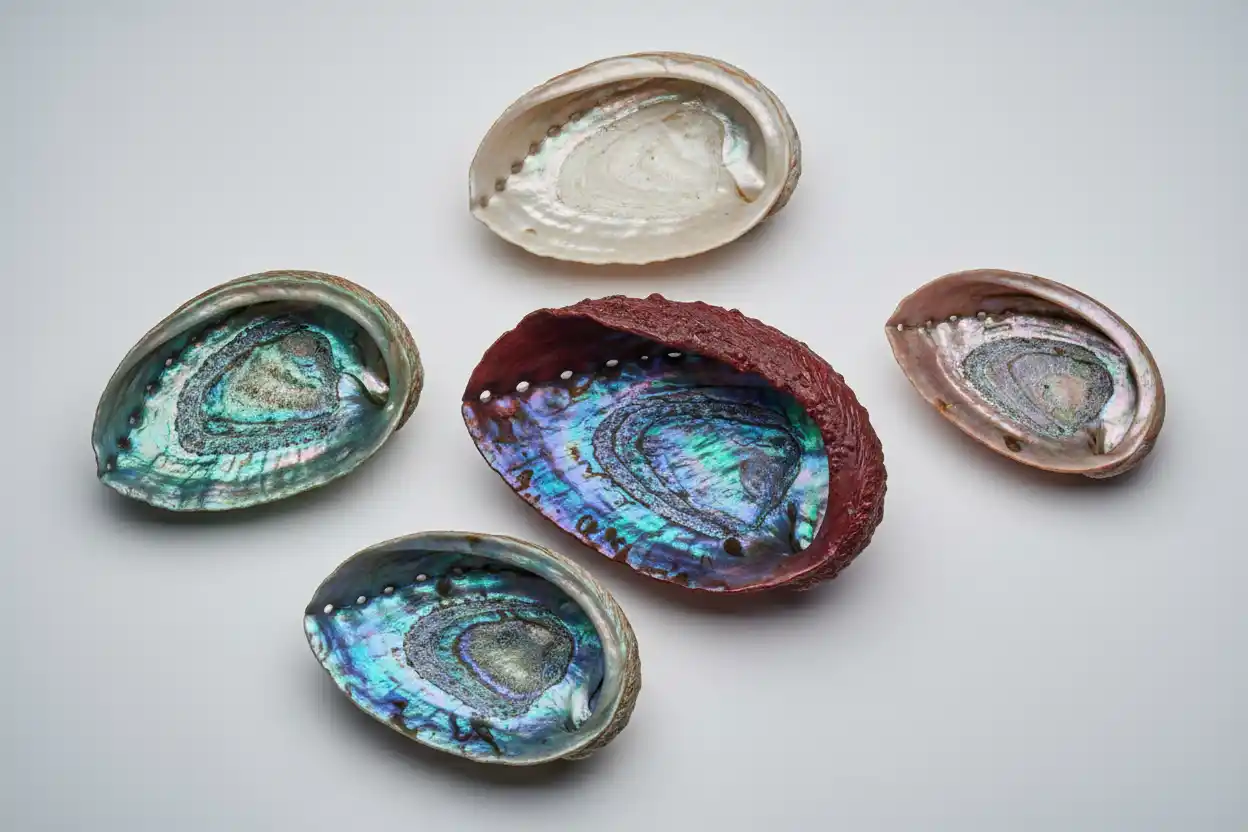
Types of Abalone Shell: Colors and Varieties Explained
Abalone Shell is the iridescent inner lining of marine gastropod shells from the genus Haliotis. Different abalone species can produce noticeably different combinations of blue, green, turquoise, violet, pink, silver, bronze, and red, although color also changes with shell thickness, cutting orientation, polish, light angle, and any backing or coating.
New Zealand pāua is the best-known jewelry material because of its intense blue-green and purple iridescence. However, red, green, pink, black, white, pinto, flat, and Australian abalone shells each have their own visual character and trade uses.
Abalone Shell at a Glance
| Property | Abalone Shell |
|---|---|
| Material type | Natural mollusk shell; organic gem material rather than a mineral species |
| Main composition | Layered aragonite nacre with an organic matrix; outer shell can also contain calcite-rich layers |
| Main colors | Blue, green, turquoise, violet, pink, silver, cream, bronze, red, black, and multicolor |
| Optical effect | Iridescence caused by interference within thin nacre layers |
| Transparency | Opaque, with limited translucency in very thin sections |
| Approximate hardness | Commonly around 3–4, varying with shell layer and construction |
| Structure | Layered and laminated |
| Tenacity | Tougher than pure aragonite because of its composite structure, but still brittle and prone to chipping or delamination |
| Common forms | Whole polished shells, cabochons, beads, inlay chips, veneer, laminates, doublets, and composites |
| Main care concern | Acids, abrasion, dry heat, soaking, ultrasonic vibration, thin edges, and separation from backing |
What Makes Abalone Shell Iridescent?
The iridescent inner surface of an abalone shell is nacre, also called mother of pearl. Nacre consists mainly of microscopic aragonite tablets arranged in stacked layers and connected by a thin organic matrix.
Light reflects from several layers at once. Some wavelengths reinforce one another while others cancel, producing shifting colors that change as the shell or viewer moves.
The resulting effect is structural color rather than a simple surface pigment. A green area may flash turquoise, gold, violet, or pink when viewed from a different angle.
Layer thickness, tablet orientation, natural growth structure, and polishing all influence the visible palette. Therefore, two pieces cut from the same shell can look surprisingly different.
The relationship between abalone nacre and other shell materials is explained in the broader Abalone Shell guide. For family-level comparison, Mother of Pearl includes nacre from several mollusk groups rather than abalone alone.
How Abalone Shell Types Are Classified
Abalone Shell can be divided in three useful ways:
- By biological species
- By dominant color and pattern
- By manufactured form, such as solid shell, veneer, laminate, or reconstructed sheet
Species-based names are the most precise when the shell’s origin is documented. However, commercial sellers often use broad color names without identifying the animal.
A “blue Abalone Shell” may be New Zealand pāua, green abalone, dyed shell, or a blue-dominant section cut from another species. Likewise, “pink abalone” can refer either to the species Haliotis corrugata or simply to shell with a pink flash.
The best listings provide both the biological or regional source and the product construction.
Main Abalone Shell Varieties
| Variety | Typical appearance | Main commercial use | Important distinction |
|---|---|---|---|
| New Zealand pāua | Strong blue, turquoise, green, violet, and gold | Fine inlay, veneer, cabochons, jewelry | Usually the most intensely blue-purple material |
| Red abalone | Green, blue, pink, red, and silver iridescence | Whole shells, inlay, carvings | Species name refers to the animal and outer shell, not a uniformly red interior |
| Green abalone | Blue-green, turquoise, green, silver | Cabochons, polished shells, inlay | Often strongly green or teal inside |
| Pink abalone | Pink, green, blue, cream, bronze | Whole shells, cabochons, décor | Pink can be a species name or color description |
| Black abalone | Green, pink, silver, dark bronze | Collector shells, inlay | Outer shell is dark; inner nacre remains iridescent |
| White abalone | Pale green, blue, silver, cream | Rare collector and historic shell | Protected status makes documented legal origin especially important |
| Pinto abalone | Green, blue, pink, silver, mottled | Regional crafts, polished shells | Northern Pacific species with variable iridescence |
| Flat abalone | Pale green, blue, silver, cream | Collector shells and regional material | Less common in mainstream jewelry |
| Australian greenlip | Green, blue, turquoise, silver | Inlay, aquaculture by-product shell | Large commercial Australian species |
| Australian blacklip | Dark green, blue, violet, bronze | Inlay, whole shells, jewelry | Dark shell exterior with richly colored nacre |
| Australian brownlip | Bronze, green, blue, cream | Whole shell and decorative use | Often marketed under regional rather than species-level names |
New Zealand Pāua Shell
New Zealand pāua, primarily Haliotis iris, is the most recognizable Abalone Shell in modern jewelry and inlay work.
Its nacre commonly displays saturated electric blue, turquoise, emerald green, violet, indigo, and occasional gold or magenta flashes. Dark natural lines can create strong contrast between adjacent color zones.
Pāua shell is frequently sliced into thin veneer for musical instruments, knife handles, boxes, furniture, fishing lures, jewelry, and decorative marquetry.
Because the shell is naturally curved, larger “sheets” are normally assembled from thin shell sections and bonded to a supporting layer. A veneer product should not be represented as one solid flat piece carved directly from a shell.
Some commercial sheets are coated with acrylic or resin to increase gloss, flexibility, and durability. Others use black backing to intensify blue and green colors.
Natural pāua can vary from dark peacock tones to lighter green and silver areas. An overly uniform electric-blue sheet may have been selectively assembled, dyed, coated, or heavily edited in photographs.
Red Abalone Shell
Red abalone, Haliotis rufescens, is the largest abalone species along the Pacific coast of North America.
The name comes largely from reddish coloration on the shell exterior and surrounding tissue. The polished nacre can display green, blue, pink, silver, bronze, red, and violet.
Larger shell size makes red abalone useful for whole-shell décor, broad inlay pieces, and larger cabochons. However, size does not guarantee uninterrupted color because worm damage, erosion, natural holes, and muscle attachment areas can reduce usable yield.
Red abalone shell was historically abundant in Californian commerce. Modern material should come from legal aquaculture, documented older stock, or another lawful source rather than unauthorized wild collection.
Warm pink and bronze flashes often distinguish red abalone from strongly blue New Zealand pāua, although overlap is substantial.
Green Abalone Shell
Green abalone, Haliotis fulgens, is especially known for blue-green and turquoise nacre.
The interior can show teal, emerald, blue, silver, violet, and pale gold. Some pieces have broad green areas with less purple than typical pāua.
The exterior is usually brownish and ridged, while the polished interior reveals much stronger color.
Green abalone is used for whole polished shells, cabochons, small carvings, beads, and inlay.
A seller may use “green abalone” merely as a color description. Species-level identification is stronger when accompanied by shell shape, origin, size, and supplier documentation.
Pink Abalone Shell
Pink abalone, Haliotis corrugata, can produce nacre with pink, green, blue, silver, cream, and bronze iridescence.
Its interior is not always predominantly pink. Some shells are greener or more silver, while others contain noticeable rosy and copper-colored zones.
The shell exterior commonly has corrugated or wavy ridges, which influenced the species name.
Pink abalone is used as a whole collector shell and as smaller cut components. Patterned areas near natural growth lines can create attractive mixed-color cabochons.
Listings should distinguish genuine pink abalone species from ordinary shell dyed pink or selected solely for a pink flash.
Black Abalone Shell
Black abalone, Haliotis cracherodii, has a dark exterior that may appear blue-black, green-black, or nearly black.
Its nacre remains pearly and iridescent, commonly showing pink, green, silver, and bronze.
The word black therefore describes the living animal and exterior shell more accurately than the polished interior.
Black abalone is a protected species in the United States. Shell offered under this name requires particularly credible legal provenance.
Old shell collections may contain genuine historic examples, but age alone does not establish legal acquisition or species identity.
For jewelry purposes, black-backed pāua veneer is sometimes called black abalone. That product construction is different from natural shell of the black abalone species.
White Abalone Shell
White abalone, Haliotis sorenseni, is a rare North American species whose nacre may display pale blue, green, silver, cream, and pink.
The name refers to aspects of the animal rather than a completely white shell interior.
Because the species is federally protected and has suffered severe population decline, buyers should not treat newly collected wild white abalone shell as an ordinary craft supply.
Historic museum specimens, scientifically managed material, and properly documented legal sources belong to a different category from unrestricted commercial shell.
Pale Abalone Shell sold as “white abalone” may instead be bleached shell, a pale section from another species, or ordinary white mother of pearl.
Pinto Abalone Shell
Pinto abalone, Haliotis kamtschatkana, occurs along the northeastern Pacific coast.
Its nacre can show green, blue, pink, silver, cream, and bronze, with considerable variation between individuals.
Pinto shells are usually smaller than the largest red abalone shells, limiting the size of uninterrupted inlay sections.
The material may appear in regional Indigenous art, collector shells, small cabochons, and coastal craft markets.
Collection rules vary by jurisdiction, so provenance should accompany claims of recently harvested wild shell.
Flat Abalone Shell
Flat abalone, Haliotis walallensis, is a less familiar northeastern Pacific species.
The interior commonly has pale green, blue, silver, and pink iridescence. Shell shape and respiratory-hole structure help biologists distinguish it from related species.
Flat abalone is uncommon in mainstream jewelry marketing. Pieces may instead be sold generically as Californian or Pacific abalone.
An unsupported flat-abalone claim adds little value unless the species and origin have been documented.
Australian Abalone Shell
Australia has several commercially important abalone species, especially greenlip, blacklip, and brownlip abalone.
Greenlip abalone commonly produces green, blue, turquoise, silver, and pale violet nacre. Its relatively large shell provides useful inlay and decorative material.
Blacklip abalone can display deep green, blue, violet, bronze, and silver against a dark exterior.
Brownlip abalone may show more bronze, cream, green, and subdued blue, although individual variation remains substantial.
Aquaculture and regulated fisheries can generate shells as by-products of the food trade. Documentation should identify whether the shell came from farming, licensed harvest, older stock, or another legal source.
Natural Color Categories
Abalone Shell color names often describe whichever hue dominates one cut area rather than a separate species.
Blue Abalone Shell
Blue-dominant shell usually contains turquoise, cobalt, or blue-violet flash. Pāua is the most famous source, but other species can produce blue sections.
Green Abalone Shell
Green-dominant shell ranges from pale seafoam to emerald and dark teal. Green abalone and Australian greenlip are common trade associations.
Purple Abalone Shell
Purple areas may appear violet, plum, magenta, or indigo. They are especially desirable when combined with blue and green.
Pink and Red Abalone Shell
Pink, copper, and red flashes often occur in red, pink, and black abalone nacre. Thin-shell interference and viewing angle can make a pink area shift toward green or bronze.
Silver and White Abalone Shell
Silver areas have weaker color contrast and may resemble conventional mother of pearl. They can still show soft rainbow movement beneath directional light.
Bronze and Gold Abalone Shell
Bronze, gold, and copper tones occur in several species and are often selected for warmer jewelry designs or wood inlay.
The wider visual relationship appears in Rainbow Gemstones, though abalone’s color mechanism is nacreous interference rather than the crystal phenomena seen in opal or labradorite.
Solid Shell, Veneer, and Composite Varieties
Abalone products should also be classified by construction.
Solid Shell Cabochons
A solid-shell cabochon is cut from a relatively thick natural section. It may still have a backing for reinforcement, but the visible layer is genuine shell.
Solid pieces are limited in thickness and size because abalone shells are curved and laminated.
Shell Veneer
Veneer consists of very thin pieces bonded to paper, fiberglass, resin, adhesive film, or another flexible support.
Veneer is suitable for inlay but should not be described as a thick solid gem slab.
Laminated Shell
Laminated material combines multiple shell pieces or layers to create a larger or stronger sheet.
Join lines may be visible under magnification or at the edge.
Shell Doublets and Triplets
A doublet may place Abalone Shell over a dark backing or beneath a clear protective cap.
Triplets can use shell between a backing and a transparent dome. These constructions can improve durability and color contrast.
The broader principles are explained in gemstone doublets and triplets.
Reconstructed Abalone
Reconstructed products use small shell fragments, powder, resin, and pigment to produce a uniform slab or cabochon.
They may contain genuine shell but are not one natural shell section.
Coated or Acrylic-Enhanced Shell
Acrylic coatings improve gloss, scratch resistance, and handling. They may also change color depth.
Treatment should be disclosed under the same transparency principles described in gemstone treatments explained.
Abalone Shell Versus Mother of Pearl
All Abalone Shell nacre is mother of pearl, but not all mother of pearl comes from abalone.
The types of Mother of Pearl guide includes white-lip, black-lip, gold-lip, freshwater, conch-related, and other shell materials.
Abalone generally shows stronger blue, green, purple, and irregular multicolor patterning. Pearl-oyster nacre often has a smoother white, silver, cream, gold, or dark grey appearance.
Abalone also has a characteristic row of respiratory holes in the whole shell, while bivalve shells have a different overall form.
The two materials have similar sensitivity to acids, abrasion, dry heat, and harsh cleaning.
Abalone Shell Versus Pearl
A pearl forms as a separate rounded or irregular object inside a mollusk, while Abalone Shell nacre forms as part of the shell lining.
Abalone can produce blister pearls and rare cultured products, but most abalone jewelry uses cut shell rather than free spherical pearls.
The types of Pearl guide separates freshwater, Akoya, Tahitian, South Sea, and other pearl categories.
Pearl authenticity tests should not be applied mechanically to flat Abalone Shell veneer. Their constructions and commercial forms differ.
Abalone Shell Versus Ammolite and Opal
Ammolite is iridescent fossil ammonite shell whose color arises from preserved aragonite layers. Its geological age, fossil origin, fracture pattern, and durability differ from modern abalone.
The types of Ammolite page owns Ammolite’s color grades, patterns, natural layers, doublets, and triplets.
Opal is hydrated amorphous silica. Precious opal’s play-of-color comes from ordered silica structures rather than nacre tablets.
The types of Opal guide separates precious, common, black, white, boulder, fire, crystal, and other opal categories.
All three materials can look rainbow-colored, but they require different identification, pricing, and care.
Abalone Shell and Coral
Both Abalone Shell and types of Coral are marine-derived organic gem materials.
Coral consists mainly of calcium carbonate skeleton produced by colonial animals, whereas abalone is a mollusk shell with layered nacre.
Coral is generally more uniform in color and does not show abalone’s strong nacreous interference.
Both markets require attention to species protection, legal harvest, international trade rules, and transparent sourcing.
Identifying Genuine Abalone Shell
Genuine shell commonly shows irregular flowing color, fine growth lines, layered edges, natural pits, and variations between adjacent sections.
Under magnification, the color should appear integrated with the layered shell rather than printed as a surface image.
Solid shell has a laminated cross-section. Thin flakes may reveal pale calcium-carbonate layers beneath a darker backing or coating.
Resin imitations may show bubbles, molded texture, repeated patterns, and uniform color depth.
Printed acrylic can reproduce a photographic abalone pattern. The pattern may repeat across several pieces or remain unnaturally sharp at one depth.
Reconstructed shell can contain genuine fragments surrounded by resin. Seams and angular chips may become visible from the back or edge.
The seller should state whether a product is solid shell, veneer, laminate, composite, coated shell, or imitation.
Durability and Jewelry Use
Abalone Shell is soft compared with Quartz, Topaz, Sapphire, and most faceted gemstones. The gemstone hardness chart provides useful scratch-resistance context.
Rings and bracelets expose the material to abrasion, impact, soap, sanitizer, and water. Protected earrings, pendants, brooches, and inlay usually last longer.
Thin shell can chip around drill holes. Laminated edges may also separate if they absorb water or encounter heat.
A clear cap or bezel can protect the surface, although trapped moisture and damaged adhesive remain possible.
Pearl, Coral, and shell care overlap. Detailed nacre-safe methods appear in how to clean Mother of Pearl jewelry and how to clean Pearl jewelry.
Cleaning Abalone Shell
Wipe Abalone Shell with a soft, slightly damp cloth. When needed, use a very small amount of mild soap and dry it promptly.
Avoid vinegar, lemon juice, acids, bleach, ammonia, alcohol, abrasive powder, toothpaste, and harsh jewelry dips.
Calcium carbonate reacts with acid, while the organic layers and adhesives may be damaged by heat or solvents.
Do not use steam or ultrasonic equipment. Vibration can promote delamination or separate the shell from a backing.
Prolonged soaking is unnecessary and may affect glue, resin, paper backing, or thin laminated sheets.
The care principles in how to clean Coral jewelry are also relevant to delicate marine-derived materials.
Abalone Shell Value and July 2026 Asking Prices
Abalone Shell is usually priced by piece, sheet, shell, or finished object rather than by carat.
As of July 2026, small loose cabochons and inlay pieces commonly carry asking prices around $2–$15 each. Larger or better-matched cabochons may range from $10–$40.
Common polished whole shells often appear around $5–$30, depending on species, size, condition, color, and whether the outer surface has been removed.
Natural or assembled veneer sheets commonly ask approximately $20–$40 for standard craft sizes. Acrylic-enhanced, colour-matched, premium pāua, and specialized luthier sheets may cost more.
Fine jewelry, complex marquetry, antique inlay, and designer work derive most of their value from craftsmanship, metal, age, provenance, and construction rather than the shell alone.
Protected or scientifically important species should never receive a casual price premium that encourages undocumented wild harvest.
Buying Abalone Shell Responsibly
Ask for the species or regional source, especially when the seller claims New Zealand pāua, Californian red abalone, black abalone, or white abalone.
Request disclosure of aquaculture, licensed fishery by-product, legal older stock, or another documented source.
The product description should explain whether the item is solid shell, assembled veneer, laminate, acrylic-coated sheet, doublet, triplet, or reconstructed composite.
Photographs should show the exact piece from several angles because iridescence and pattern vary substantially.
Avoid products marketed as newly harvested shell from protected populations without supporting permits or provenance.
General online transaction safeguards appear in how to buy gemstones online.
Frequently Asked Questions
1. What is the most colorful type of Abalone Shell?
New Zealand pāua is especially known for strong blue, turquoise, green, violet, and gold iridescence.
2. Is pāua the same as Abalone Shell?
Pāua is the Māori name for New Zealand abalone species, especially Haliotis iris, whose shell is one type of Abalone Shell.
3. Does red abalone have a red interior?
Not always. Its nacre can show green, blue, pink, silver, bronze, and red, while the species name also reflects the outer shell and animal.
4. What is the difference between Abalone Shell and Mother of Pearl?
Abalone nacre is a type of mother of pearl, but mother of pearl also comes from pearl oysters, freshwater mussels, and other mollusks.
5. Is blue Abalone Shell naturally blue?
Yes, natural nacre can show strong blue structural color, although dye, coatings, and dark backing can intensify it.
6. Are flat Abalone Shell sheets natural?
They usually contain genuine shell, but most large flat sheets are assembled from thin pieces and bonded to a supporting layer.
7. What is reconstructed Abalone Shell?
It is a composite made from small shell pieces or powder combined with resin or another binder.
8. Can Abalone Shell be dyed?
Yes. Shell can be dyed, coated, backed, or acrylic-enhanced, and those processes should be disclosed.
9. Is Abalone Shell suitable for an everyday ring?
It is better suited to protected occasional wear because the surface scratches and thin layers can chip or separate.
10. Can Abalone Shell go in an ultrasonic cleaner?
No. Vibration and cleaning solution can damage the layered shell or loosen its backing.
11. Why is species provenance important?
Some abalone populations are protected or tightly regulated, so documented legal and sustainable sourcing matters.
12. What determines Abalone Shell value?
Species or origin, color intensity, usable size, thickness, condition, natural pattern, construction, treatment, provenance, and workmanship determine value.
Abalone Shell types are best understood through both biology and construction. A naturally vivid pāua veneer, a legal red abalone whole shell, and a resin-bound shell composite may all contain nacre, yet their origin, durability, rarity, and value are fundamentally different.
Abalone collection and trade rules vary by species and jurisdiction, and some wild populations are protected. Buy shell with credible legal provenance. Cutting and grinding shell can produce fine calcium-carbonate and organic dust; use wet methods, effective local exhaust ventilation, sealed eye protection, suitable respiratory protection, and controlled cleanup.