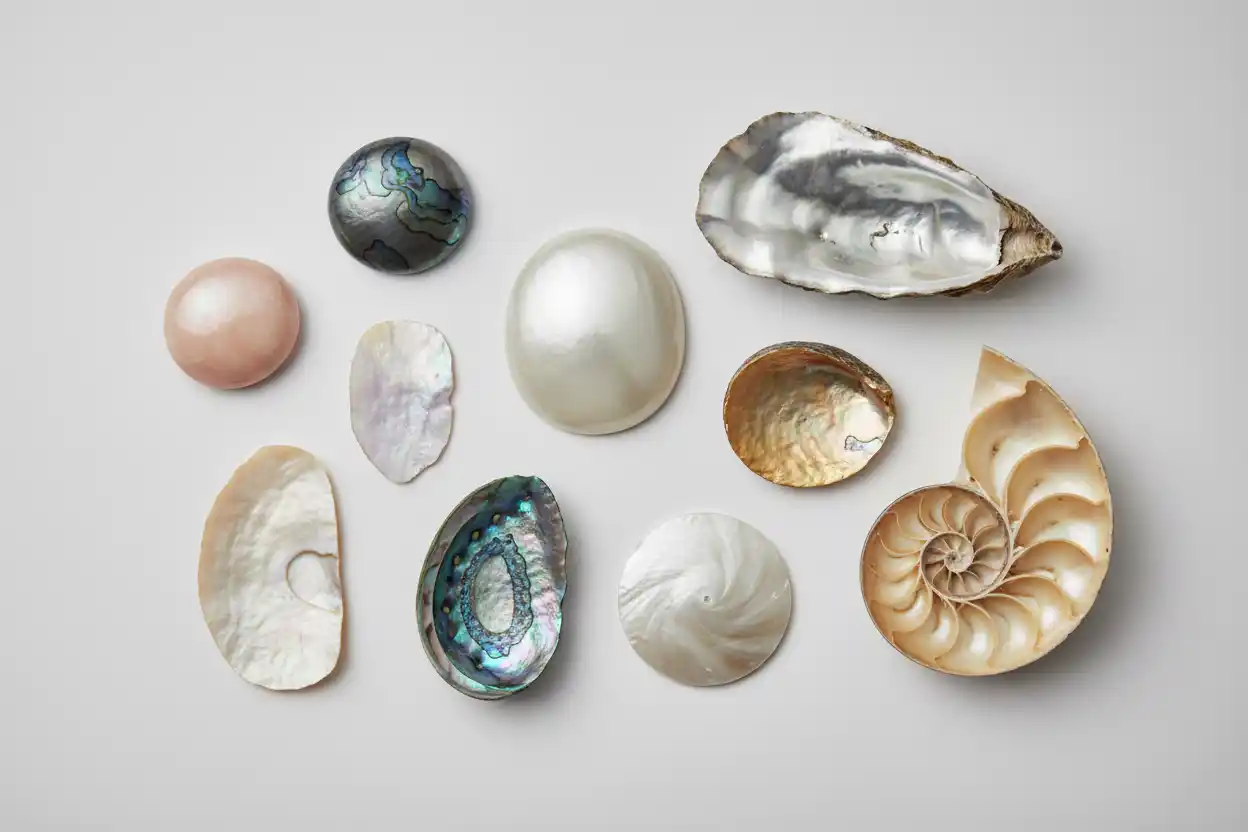
Types of Mother of Pearl: Colors and Varieties Explained
Mother of pearl is the iridescent inner shell layer produced by certain mollusks. Also called nacre, it consists mainly of microscopic calcium-carbonate tablets held together by a small proportion of organic material, creating a layered composite that reflects shifting white, silver, pink, gold, blue, green, and violet colors.
Different types of mother of pearl come from different mollusk species and shell regions. Their color, thickness, curvature, pattern, durability, and legal sourcing can vary considerably. The parent mother of pearl meaning and properties guide covers the material as a whole, while this guide separates the major shell sources and commercial varieties.
Mother of Pearl at a Glance
| Property | Mother of Pearl |
|---|---|
| Composition | Primarily aragonite calcium carbonate, CaCO₃, with conchiolin and other organic components; some shells also contain calcitic layers |
| Material group | Organic–inorganic biogenic gem material |
| Main colors | White, silver, cream, gold, yellow, pink, gray, black, brown, blue, green, violet, and multicolored iridescence |
| Crystal system or texture | Layered aggregate of microscopic aragonite tablets and organic matrix |
| Typical form | Curved shell lining cut into cabochons, beads, plaques, cameos, buttons, veneer, inlay, and carvings |
| Luster | Pearly to iridescent |
| Transparency | Opaque to translucent at thin edges |
| Mohs hardness | Commonly approximately 2.5–4.5, varying by shell structure |
| Cleavage | No conventional single-crystal cleavage; layered material can peel, chip, or delaminate |
| Tenacity | Brittle to moderately resilient in compact layers |
| Common uses | Earrings, pendants, beads, watch dials, buttons, inlay, cameos, furniture decoration, musical instruments, and carved ornaments |
| Main care concern | Scratching, acids, cosmetics, dehydration, heat, dye, resin, delamination, and wildlife-sourcing restrictions |
Mother of Pearl, Nacre, Shell, and Pearl
Mother of pearl and nacre are two names for the same iridescent shell material.
A pearl forms when a mollusk deposits nacre or another shell substance around an internal irritant, parasite, tissue implant, or cultured nucleus. Mother of pearl is cut directly from the shell lining.
Therefore, mother of pearl is not an unfinished pearl. It is the shell material from which many nacreous pearls derive their surface composition and color.
The broader pearl meaning and properties guide explains the gem produced inside the mollusk. The planned types of pearl guide retains the classification of Akoya, South Sea, Tahitian, freshwater, and other pearls.
How Nacre Produces Iridescence
Nacre consists of thin aragonite tablets stacked in layers and separated by organic material.
The tablets are comparable in scale to visible wavelengths of light. When light enters the layered structure, reflections from adjacent layers interfere with one another.
Certain wavelengths strengthen while others cancel. As the shell moves, the path of light changes, creating shifting colors.
Tablet thickness, orientation, layer continuity, curvature, pigments, and the underlying shell color all influence the visible effect. Consequently, two white shells can display very different pink, green, or blue overtones.
White-Lip Oyster Mother of Pearl
White-lip pearl oysters, especially Pinctada maxima, produce large shells with broad areas of white or silver-white nacre.
This material is associated with South Sea pearl-producing regions, including Australia, Indonesia, the Philippines, and nearby tropical waters.
The nacre may appear bright white, silver, cream, or white with pink, green, and blue overtones. Large shell size allows cutters to produce broad watch dials, plaques, knife scales, buttons, and inlay with fewer joins.
Fine white-lip material has strong iridescence, relatively even layers, good thickness, minimal worm damage, and few cracks.
White-lip shell is not identical to a white South Sea pearl. The shell provides nacreous material, while a pearl forms as a separate biological object.
Silver-Lip Mother of Pearl
Silver-lip mother of pearl comes from the silvery portion of large pearl-oyster shells, commonly associated with Pinctada maxima.
Its base appears cooler than cream or gold-lip material. Overtones may include blue, green, pale pink, and violet.
The term can describe a shell population, a geographic strain, or simply the silver-colored region of a shell. Sellers should therefore specify the actual source when known.
Fine silver-lip material is popular for watch faces and precision inlay because its cool neutral ground complements white metals and dark backgrounds.
Gold-Lip Mother of Pearl
Gold-lip mother of pearl comes from shells with cream, yellow, champagne, or golden nacre, particularly portions of Pinctada maxima.
Color ranges from pale ivory and warm cream to stronger yellow-gold along the shell edge. Natural zoning may create a transition from white center to gold margin.
Cutters often preserve the strongest golden area for pendants, carved flowers, cameos, and decorative inlay.
Bleaching can reduce natural warmth, while dye can intensify pale material. Treatment should be disclosed when the color or finish has been modified.
Black-Lip Oyster Mother of Pearl
Black-lip pearl oysters, Pinctada margaritifera, produce dark shell nacre associated with Tahitian and other dark cultured pearls.
The body may appear silver-gray, charcoal, blackish, green, bronze, brown, or purple. Iridescent overtones can include peacock green, blue, rose, violet, and gold.
Not every part of the shell is uniformly dark. Pale central areas, dark outer margins, growth bands, and color zoning are natural.
Fine black-lip material has strong orient, good surface continuity, and enough thickness for cutting. It is used for cabochons, pendants, beads, buttons, dials, and inlay.
Tahitian-Style Mother of Pearl
“Tahitian mother of pearl” usually refers to black-lip oyster shell associated with French Polynesia and the wider Pinctada margaritifera pearl industry.
The name should describe genuine regional or species provenance rather than any dyed gray shell.
Natural material can show green, blue, violet, bronze, silver, and peacock effects. These colors echo the nacre of Tahitian cultured pearls, although an individual shell section and finished pearl may not match exactly.
Documentation matters when origin adds a price premium.
Freshwater Mussel Mother of Pearl
Freshwater mother of pearl comes from nacreous mussels rather than marine pearl oysters.
Shells may appear white, cream, silver, pale pink, lavender, yellowish, or gray. Iridescence is often softer and more uniform than the intense color fields found in abalone.
Freshwater shell is widely used for buttons, beads, cabochons, carved components, nucleus material, and inlay.
China has become a major source through its freshwater pearl and shell-processing industries. Historic production also occurred in Japan, Europe, and North America.
Species, aquaculture practices, shell thickness, and processing quality influence appearance. “Freshwater mother of pearl” should not be confused with a freshwater cultured pearl.
Pink and Lavender Freshwater Mother of Pearl
Certain freshwater shells show naturally pale pink, rose, peach, or lavender nacre.
The color may be subtle and uneven, particularly near shell edges or growth areas. Strong uniform purple or hot pink frequently indicates dye.
Natural pastel material is valued for beads and inlay because it provides color without a painted surface.
Sellers should state whether pink or lavender color is natural, bleached, dyed, irradiated, or coated.
Abalone Mother of Pearl
Abalone shell produces some of the most vivid mother of pearl.
Abalone belongs to the genus Haliotis and forms one-piece ear-shaped shells. Its nacre commonly shows intense green, blue, turquoise, violet, silver, pink, and bronze bands.
The pattern can be wavy, mottled, striped, cloud-like, or topographic. Mineral layers, pigments, growth structure, and shell curvature create the distinctive appearance.
Abalone shell is thinner and more curved than many pearl-oyster shells. Cutters often laminate it to a backing for stability.
The dedicated types of abalone shell guide owns the species-level and regional classification.
Pāua Mother of Pearl
Pāua is the Māori name associated particularly with New Zealand abalone species, including Haliotis iris.
Its mother of pearl is known for saturated blue, green, turquoise, purple, and pink iridescence. Dark boundaries and curved growth lines can create dramatic patterns.
Pāua has cultural, geographic, ecological, and legal significance. The name should not be applied generically to every blue-green abalone shell.
Authentic New Zealand sourcing, harvest regulation, and cultural context distinguish pāua from unrelated dyed shell.
Thin sections are often stabilized or backed for jewelry and inlay. That construction should be disclosed when it affects durability.
Red, Green, and Pink Abalone Shell
Different Haliotis species produce characteristic but overlapping color ranges.
Red abalone shell can show deep green, blue, red, pink, bronze, and silver. Green abalone may display turquoise, green, blue, and gold.
Pink abalone commonly has softer silver, green, pink, and blue tones. However, shell color varies within species and according to age, habitat, diet, and growth.
A visual pattern alone rarely proves species. Reliable harvest or supplier documentation offers stronger evidence.
Trochus Mother of Pearl
Trochus or topshell mother of pearl commonly comes from large Indo-Pacific marine gastropods such as Tectus niloticus.
The shell provides bright white to silver nacre with subtle green, pink, or blue orient. Its relatively thick walls and compact structure have made it important for buttons, carvings, beads, and inlay.
Trochus shell lacks the intense multicolor pattern of abalone, but its clean white appearance suits precision work.
International trade and fisheries management may apply because several large marine shell resources have experienced heavy harvesting.
Turbo and Green Snail Shell
Turbo shells and related marine gastropods can provide white, silver, cream, or green-tinted mother of pearl.
The nacre often shows curved bands that follow the spiral shell. Some material displays strong green, blue, and pink iridescence.
Commercial names such as green snail, green turbo, or cat’s-eye shell can be inconsistent. Not every spiral shell product has the same species or nacre structure.
Cutters commonly use the curved shell for beads, domed cabochons, buttons, and mosaics.
Pen Shell Mother of Pearl
Pen shells from genera such as Pinna and Atrina can produce bronze, brown, black, gold, or silver shell material.
Some parts of the shell are fibrous, thin, or less strongly nacreous than pearl-oyster shell. Consequently, durability and polish vary by section.
Dark pen-shell material may be used for inlay and ornamental panels. However, the name should not be confused with black-lip oyster mother of pearl.
Nautilus Mother of Pearl
Nautilus shells have a pearly inner layer with white, cream, silver, and subtle rainbow iridescence.
Sections can reveal the shell’s spiral chamber structure, making them popular in decorative objects and inlay.
Modern nautilus trade can be subject to wildlife regulations. A seller should provide lawful provenance rather than relying on the shell’s availability in souvenir markets.
Intact shells and sliced sections carry different ethical and legal considerations from by-product shell sourced through food or pearl production.
White Mother of Pearl
White mother of pearl is a color category that can come from marine pearl oysters, freshwater mussels, trochus shells, and other mollusks.
It may show silver, pink, green, blue, or gold overtones. A pure neutral white appearance can result from naturally pale nacre, bleaching, or selective cutting.
The shell source matters because thickness, curvature, layer structure, and color stability differ.
“White mother of pearl” is therefore less precise than a description such as natural white-lip oyster shell, bleached freshwater shell, or white trochus nacre.
Black and Gray Mother of Pearl
Black and gray mother of pearl commonly comes from black-lip oyster, pen shell, dark abalone, or dyed pale shell.
Natural material often shows uneven green, silver, bronze, violet, and blue overtones. Perfectly uniform jet-black color can indicate dye or coating.
Edges and drill holes may reveal a paler underlying layer. However, some naturally dark shells also contain strong internal zoning.
Black mother of pearl is used in cufflinks, watch dials, guitar inlay, earrings, and contemporary geometric jewelry.
Blue and Green Mother of Pearl
Blue-green mother of pearl is most strongly associated with abalone and pāua, although black-lip and other shells can show similar overtones.
Natural abalone color usually forms irregular bands and waves. Uniform cobalt blue or emerald green may indicate dye.
The dedicated abalone article should own the full identification of blue-green shell. Within this page, the important boundary is that “blue mother of pearl” describes appearance rather than one species.
Golden and Brown Mother of Pearl
Golden material may come from gold-lip pearl oyster, pen shell, trochus margins, or treated shell.
Natural gold generally varies from cream to yellow and bronze rather than appearing as a uniform metallic coating.
Brown mother of pearl can show bronze, copper, gray, green, and violet overtones. Dark organic layers may contribute to the base tone.
Applied metallic paint and foil-backed composites can imitate the effect, especially in costume jewelry and decorative tiles.
Blister Mother of Pearl and Mabe Components
A blister forms when a pearl-like nacreous growth remains attached to the shell.
After cutting, the nacreous dome can be filled and backed to create a mabe cultured pearl or blister-pearl component.
The finished object is not simply a flat piece of mother of pearl, although shell material may form its surface or backing.
The distinction should remain with pearl terminology. The pearl buying guide covers pearl forms and quality without duplicating them here.
Natural, Bleached, and Dyed Mother of Pearl
Bleaching lightens stains, yellow areas, organic color, and unevenness. It can create a cleaner white base for buttons and inlay.
Dye produces vivid pink, red, blue, green, purple, black, and orange. The color may enter porous areas, cracks, drill holes, and organic layers.
Natural color usually varies with growth structure. Dyed material may look unusually even or reveal concentrated color at damaged edges.
Treatment does not make the material unusable, but it should be disclosed. The general gemstone treatments guide explains why accurate naming matters more than whether every treatment is undesirable.
Stabilized and Backed Mother of Pearl
Thin or fragile shell may be impregnated with resin or bonded to a backing.
Backings can include shell, resin, glass, stone, metal, composite board, or another support. They make delicate abalone and thin veneers easier to set.
A backed cabochon should not be represented as one solid thick piece of natural shell. The construction affects repair, care, and value.
Clear coatings may improve surface gloss and protect color, but scratches can expose the underlying nacre.
Reconstructed Mother of Pearl
Shell fragments, chips, or powder can be mixed with resin, pressed, dyed, and cut into uniform shapes.
Reconstructed material may have repeated patterns, molded edges, polymer-rich surfaces, or a more uniform appearance than natural shell.
It can be suitable for affordable beads, buttons, and decorative components when described accurately.
Terms such as shell pearl, simulated mother of pearl, composite shell, and reconstructed shell should not be used interchangeably without explanation.
Mother of Pearl Imitations
Plastic, acrylic, resin, laminated film, coated glass, ceramic, and pearlescent paint can imitate mother of pearl.
Plastic may feel lighter and warmer, show mold seams, or repeat the same pattern across several pieces. Glass tends to be heavier and may contain bubbles.
Artificial pearlescent film can create strong uniform rainbow color but lacks the natural layered growth structure visible under magnification.
The real versus fake pearl guide focuses on pearls rather than flat shell, but many principles involving coatings, composites, and imitation materials also apply.
Formation and Biological Context
Mollusks secrete shell material through mantle tissue.
Nacre forms when mantle cells deposit aragonite tablets and organic matrix in repeated layers along the inner shell surface. The structure protects the animal and strengthens the shell.
Species, water chemistry, temperature, food, disease, age, pollution, and growth rate influence the final nacre.
Marine pearl oysters, freshwater mussels, abalones, gastropods, and nautiluses live in different habitats. Their shell structures and colors therefore reflect distinct biological adaptations rather than one universal mother-of-pearl process.
Harvesting and Production Context
Mother of pearl can come from pearl farming, food fisheries, shell-button production, aquaculture, regulated wild harvest, or historic stock.
Shell recovered as a by-product of pearl or food production can provide additional economic value. Nevertheless, by-product status does not automatically prove sustainable or legal sourcing.
Abalone, trochus, nautilus, freshwater mussels, and other species may face local harvest limits, trade controls, protected-area rules, or population pressures.
A responsible seller should identify the shell type and source when possible. Generic statements such as ethically sourced shell are less useful than specific traceability.
Inclusions, Blemishes, and Natural Structure
Mother of pearl may contain growth lines, worm holes, pits, chalky layers, color boundaries, organic staining, cracks, and thin non-nacreous sections.
These features can demonstrate natural origin but also affect durability and polish.
Fine material has continuous nacre, strong orient, enough thickness for cutting, and few structural weaknesses. However, dramatic abalone patterns often include natural dark lines and irregular layers.
A polished surface should be examined under side lighting to reveal scratches, resin, filled pits, and delamination.
How Mother of Pearl Is Identified
Mother of pearl has a layered structure, pearly luster, low hardness, and characteristic iridescence.
Under magnification, natural shell may show growth lines, fine tablet structure, organic boundaries, pores, and species-related texture.
Raman spectroscopy, infrared spectroscopy, microscopy, X-radiography, and chemical analysis can separate shell from plastic, resin, glass, and reconstructed composites.
A hot needle, acid, scraping, and destructive solvent tests can damage valuable shell and should not be attempted.
Significant antique, wildlife-regulated, or high-value material may justify specialist examination. The general scope of laboratory documentation appears in gemstone certification.
Cutting and Manufacturing
Shell is sawn into blanks, flattened or backed, shaped, ground, engraved, drilled, and polished.
Large pearl-oyster shells yield broad flat pieces for dials and inlay. Abalone requires careful orientation so its strongest color bands appear on the finished face.
Thin layers can chip during drilling. Excessive heat may burn organic components, discolor the surface, soften resin, or cause delamination.
Inlay artists cut many small pieces and fit them into wood, metal, lacquer, stone, or composite channels. Precision and pattern matching often contribute more value than the shell blank itself.
Durability and Jewelry Suitability
Mother of pearl is soft compared with most gemstones. The gemstone hardness chart places it below quartz, feldspar, topaz, sapphire, moissanite, and diamond.
Its layered structure provides some resilience, yet thin pieces can chip, peel, or delaminate. The distinction between hardness and toughness appears in gemstone toughness versus hardness.
Earrings, pendants, brooches, cufflinks, and protected inlay suit the material. Exposed rings and bracelets receive more scratches and chemical contact.
A backing can improve durability, but adhesive and composite construction add their own care limitations.
Mother of Pearl Prices in 2026
Ordinary mother-of-pearl components remain affordable.
Small buttons, beads, charms, and commercial cabochons commonly cost approximately $1–$10 per piece. Larger natural white or freshwater cabochons often range from $5–$25.
Abalone, black-lip, gold-lip, pāua, and precision-cut components commonly fall near $10–$75, depending on size, color, thickness, backing, and pattern.
Large matched panels, watch dials, carved cameos, artist-cut inlay sets, and documented rare shell can cost $75–$500 or more.
Antique furniture, musical-instrument inlay, branded watches, historic buttons, and fine jewelry may be worth thousands, but most of that value comes from workmanship, age, design, metal, maker, and provenance rather than shell weight.
Mother of pearl is normally sold by piece, strand, panel, or finished object rather than by carat.
Buying Guidance
Ask what mollusk produced the material.
A precise description such as natural white-lip oyster shell, black-lip shell, freshwater mussel nacre, or backed pāua is more informative than generic rainbow mother of pearl.
Request disclosure of bleaching, dye, coating, resin, backing, lamination, and reconstructed content.
Inspect both sides and all edges. Natural shell should not display identical color patterns across many pieces unless they were cut from neighboring sections.
For antique or protected species material, request provenance and legal documentation appropriate to the transaction.
General online-buying safeguards appear in how to buy gemstones online.
Mother of Pearl and Pearl Jewelry
Mother of pearl commonly appears in earrings, pendants, rings, cufflinks, watches, beads, and carved plaques.
Its care overlaps with pearl jewelry because both contain soft, acid-sensitive nacre. The dedicated guide to pearl earrings covers ear-jewelry construction, while pearl necklaces addresses strands and pendants.
However, flat shell inlay and a spherical pearl are valued through different criteria. Pearl shape, nacre thickness, surface, and matching belong to the dedicated pearl price guide, not this mother-of-pearl types page.
Cleaning and Storage
Wipe mother of pearl with a soft, slightly damp cloth after wear.
When necessary, use lukewarm water and a small amount of mild soap. Avoid soaking, and dry the piece immediately.
Acids, vinegar, lemon juice, perfume, hairspray, alcohol, bleach, ammonia, silver dip, abrasive powder, and toothpaste can etch or dull the nacre.
Ultrasonic and steam cleaning are unsuitable because vibration and heat can damage layered shell, backing, dye, resin, and adhesive. Broader equipment guidance appears in gemstones in ultrasonic cleaners.
The complete material-specific method belongs in how to clean mother of pearl jewelry.
Store shell separately in a padded box away from harder gemstones and dry heat. Apply perfume, lotion, and cosmetics before putting the jewelry on.
Meaning and Symbolism
Mother of pearl has been used in personal ornaments, religious art, furniture, instruments, buttons, mosaics, and ceremonial objects across many cultures.
Modern symbolism often connects it with calm, protection, family, creativity, adaptability, and the reflective qualities of the sea.
White material may be associated with simplicity, black-lip with depth, gold-lip with warmth, and abalone with change or visual diversity.
Its relationship with pearls also connects it indirectly with the June birthstone guide.
These meanings reflect cultural history, artistic use, color symbolism, and personal belief. They are not scientifically demonstrated effects of aragonite tablets or shell species.
Frequently Asked Questions
1. What are the main types of mother of pearl?
Major types include white-lip, silver-lip, gold-lip, black-lip, freshwater mussel, abalone, pāua, trochus, turbo, pen-shell, and nautilus mother of pearl.
2. Is mother of pearl the same as nacre?
Yes. Nacre is the scientific and gemological term for the layered iridescent shell material commonly called mother of pearl.
3. Is mother of pearl the same as pearl?
No. Mother of pearl is cut from the inner shell. A pearl is a separate growth formed within the mollusk.
4. Which type has the strongest rainbow colors?
Abalone, especially New Zealand pāua, commonly produces the most saturated blue, green, purple, pink, and turquoise iridescence.
5. What is black-lip mother of pearl?
It is dark nacre from black-lip pearl oysters, commonly showing gray, green, blue, violet, bronze, and peacock overtones.
6. Is white mother of pearl always natural white?
No. It can be naturally pale, selectively cut, bleached, coated, or reconstructed. Treatment should be disclosed.
7. Can mother of pearl be dyed?
Yes. Shell is frequently dyed pink, red, blue, green, purple, orange, or black, with color often concentrating in pores and cracks.
8. Is backed abalone still real mother of pearl?
The visible shell layer can be natural mother of pearl, but the finished component is a composite and should be described as backed or laminated.
9. How can plastic imitation be recognized?
Plastic may show mold seams, repeated patterns, low weight, uniform color, or a surface effect that lacks natural depth. Laboratory testing provides stronger confirmation.
10. Is mother of pearl suitable for rings?
It can be used in protected inlay or occasional-wear rings, but softness, acids, cosmetics, impact, and water exposure make earrings and pendants safer.
11. Does mother of pearl require wildlife documentation?
Requirements depend on the mollusk species, harvest location, age, and destination country. Abalone, nautilus, trochus, and other shells may face specific controls.
12. Which mother-of-pearl type is most valuable?
Fine pāua, black-lip, gold-lip, large white-lip panels, rare documented shell, and expertly carved or inlaid material can command the highest prices, although workmanship often matters more than the raw shell.
Mother of pearl is not one uniform white shell. A silver-white Pinctada maxima panel, golden shell edge, peacock black-lip cabochon, pastel freshwater bead, and saturated pāua inlay each reflects a different mollusk, habitat, shell structure, and craft tradition. Related M entries are organized in the crystals that start with M directory and the gemstones that start with M guide.
Safety disclaimer: Cutting, grinding, drilling, or sanding shell can release fine calcium-carbonate and organic dust. Use wet-working methods, effective local extraction, eye protection, and correctly rated respiratory protection; do not dry-grind shell in an enclosed or unventilated workspace.