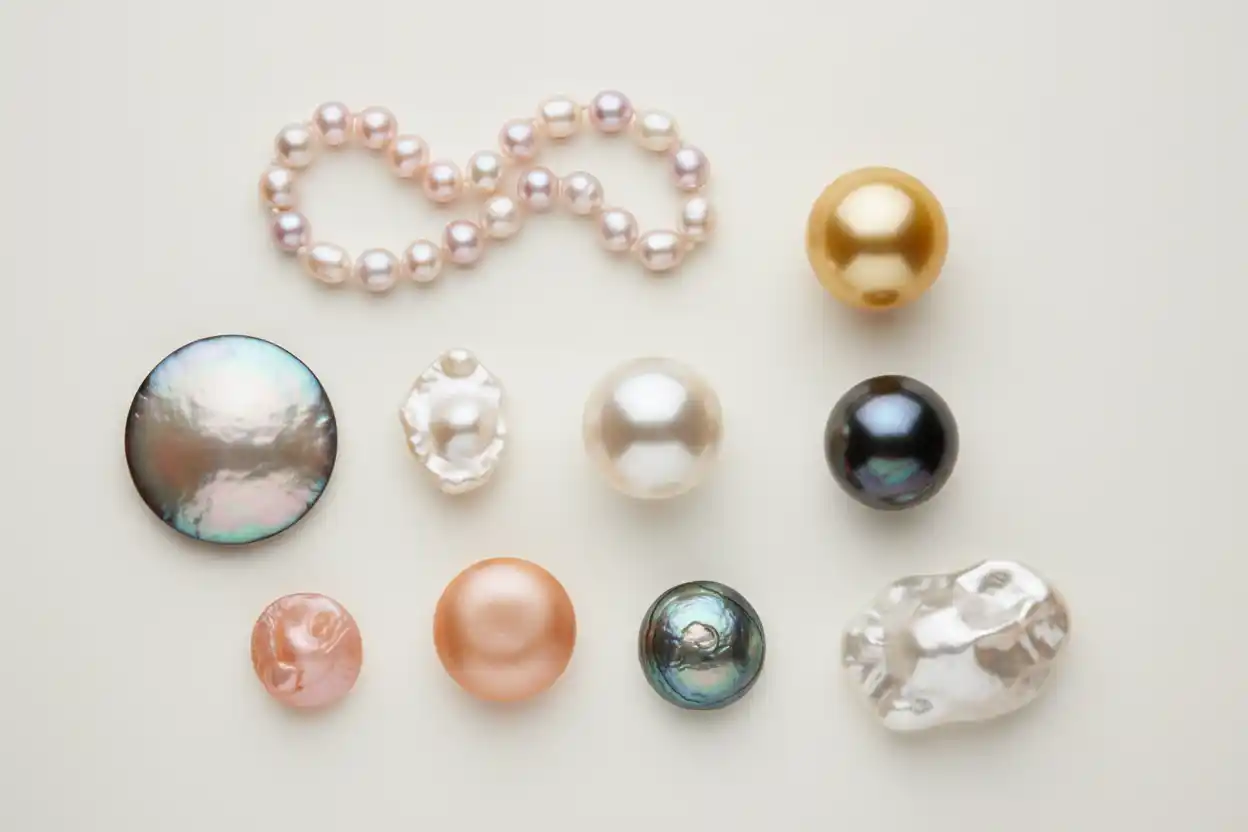
Types of Pearl: Colors and Varieties Explained
Pearls are organic gems produced inside mollusks, but the word covers materials with very different origins, structures, colors, sizes, cultivation methods, and market values. A small white Akoya cultured pearl, a large golden South Sea pearl, a flame-patterned conch pearl, and an irregular freshwater keshi may all be genuine pearls without belonging to the same biological or commercial category.
The most useful pearl classification begins with whether the pearl formed naturally or through human-assisted cultivation. From there, gemologists consider the mollusk species, saltwater or freshwater environment, bead or tissue nucleation, nacreous or non-nacreous structure, body color, overtone, shape, and treatment history. The main pearl meaning and properties guide covers the gem as a whole, while this article separates its principal types.
Pearl at a Glance
| Property | Pearl |
|---|---|
| Composition | Mainly calcium carbonate, commonly aragonite or calcite, combined with organic material |
| Material group | Organic–inorganic biogenic gem material |
| Main colors | White, cream, silver, yellow, gold, peach, pink, lavender, gray, green, blue, brown, black, orange, and purple |
| Structure | Concentric nacre or non-nacreous calcium-carbonate growth deposited by a mollusk |
| Typical forms | Round, near-round, button, oval, drop, pear, circled, semi-baroque, baroque, blister, and irregular |
| Luster | Pearly, orient-rich, porcelain-like, or flame-patterned depending on type |
| Transparency | Opaque to translucent at thin edges |
| Mohs hardness | Usually about 2.5–4.5 |
| Cleavage | None in the conventional single-crystal sense |
| Tenacity | Generally good when fresh, but surfaces scratch and older or overprocessed pearls may become fragile |
| Common uses | Necklaces, earrings, pendants, rings, brooches, bracelets, buttons, carvings, and collector specimens |
| Main care concern | Scratching, cosmetics, acids, dehydration, excessive bleaching, dye, heat, ultrasonic vibration, and worn drill holes |
Pearl Versus Mother of Pearl
Pearl and mother of pearl contain related shell materials but form in different places.
Mother of pearl is the iridescent lining of a mollusk shell. A pearl forms within the mollusk’s soft tissue or pearl sac as calcium-carbonate layers accumulate around a nucleus or biological disturbance.
Consequently, mother of pearl is not an unfinished pearl, nor is every pearl simply a rounded section of shell. The two materials may share nacre, yet their growth geometry differs.
The wider shell sources and nacre colors appear in types of mother of pearl.
Natural Pearls
Natural pearls form without deliberate human intervention.
A natural pearl begins when mantle tissue or another biological process creates a pearl sac within the mollusk. The animal deposits calcium carbonate and organic material inside that sac over time.
Natural pearls can be nacreous or non-nacreous, saltwater or freshwater, and round or highly irregular. Because their formation is accidental, only a small proportion of wild mollusks produce pearls, and an even smaller proportion yield attractive gem-quality examples.
Historically, pearl divers searched entire oyster beds to recover a limited number of valuable pearls. Cultured-pearl farming replaced much of that destructive and unpredictable supply.
Natural origin cannot be confirmed reliably from surface appearance. X-radiography and computed tomography reveal internal growth structures that help distinguish natural pearls from bead-cultured and non-bead-cultured products.
Large, well-formed natural pearls with important provenance occupy a specialist auction market rather than the ordinary jewelry trade.
Cultured Pearls
Cultured pearls form after deliberate human intervention creates the conditions for a pearl sac.
A technician may insert a round shell bead together with donor mantle tissue, implant mantle tissue without a bead, or attach a shaped nucleus to the shell for blister cultivation.
The mollusk performs the biological work of depositing nacre or other shell material. Therefore, cultured pearls are genuine pearls rather than artificial imitations.
Cultured origin does not determine quality by itself. Fine cultured pearls can have excellent luster, thick nacre, clean surfaces, attractive colors, and carefully matched strands.
The distinction between biological cultivation and laboratory manufacture is clarified in lab-grown versus natural gemstones, although pearls require their own cultivation terminology.
Saltwater Pearls
Saltwater cultured pearls grow in marine oysters, primarily species within the Pteriidae family.
The three dominant saltwater categories are Akoya, South Sea, and Tahitian cultured pearls. They are usually bead cultured, meaning a round shell nucleus and donor mantle tissue are inserted into the oyster.
Saltwater oysters typically produce fewer pearls per cultivation cycle than freshwater mussels. That limitation, combined with longer growth periods and mortality risk, contributes to higher prices.
Freshwater Pearls
Freshwater cultured pearls grow primarily in mussels inhabiting lakes, ponds, and rivers.
Traditional tissue-nucleated freshwater culture can produce several pearls within one mussel. Because no round bead occupies the center, much of the finished pearl consists of nacre.
Modern bead-nucleated freshwater production can create larger and rounder pearls that resemble Akoya or South Sea products. Visual appearance alone may not reveal the environment or cultivation method.
China dominates current freshwater production, although Japan and the United States have important historical and specialist freshwater pearl traditions.
Akoya Cultured Pearls
Akoya pearls are the classic white saltwater cultured pearls used in traditional graduated and uniform necklaces.
They are produced mainly by Pinctada fucata and related small pearl oysters. Japan remains the best-known source, while China and Vietnam also produce Akoya pearls.
Typical sizes range from approximately 2 to 10 millimeters, with 6–8 millimeters especially familiar in necklaces. Larger round Akoya pearls become progressively more difficult to produce.
Body colors include white, cream, silver, pale yellow, and occasionally blue-gray. Rose, silver, cream, and green overtones can appear above the body color.
Fine Akoya pearls are valued for sharp, mirror-like luster, round shape, clean surfaces, adequate nacre, and close matching. Thin nacre can reveal the bead nucleus or create a chalky, worn surface over time.
Hanadama Akoya Pearls
Hanadama is a quality-related trade and laboratory designation associated with high-grade Japanese Akoya pearls.
It is not a separate mollusk species. Moreover, grading standards and report issuers can differ, so the term should be supported by a recognized report rather than used as unverified advertising.
A Hanadama designation does not remove the need to inspect size, color, luster, surface, nacre, and strand matching.
Blue Akoya Pearls
Natural-color blue Akoya pearls may show silver-blue, gray-blue, aqua, green, or violet overtones.
Their color can be associated with organic material, nacre structure, or an imperfect relationship between the bead and pearl sac. Some were historically rejected as lower grade, yet distinctive natural blue material now has a collector and designer market.
Blue Akoya should be distinguished from dyed blue cultured pearls.
South Sea Cultured Pearls
South Sea cultured pearls grow primarily in the large silver-lip and gold-lip pearl oyster, Pinctada maxima.
Australia, Indonesia, and the Philippines are leading producers. Other cultivation occurs in parts of Southeast Asia and the Pacific.
South Sea pearls are generally the largest mainstream cultured pearls. Common sizes range from approximately 8 to 18 millimeters, while exceptional pearls can exceed that range.
Their nacre often creates a softer, satin-like luster rather than the sharp mirror reflection associated with the finest Akoya pearls. Large size, thick nacre, long cultivation, and limited suitable environments contribute to their value.
White and Silver South Sea Pearls
White South Sea pearls come primarily from silver-lip oysters.
Body colors range from bright white and silver to cream. Overtones may include rose, blue, green, or cool silver.
Australian pearls are strongly associated with clean white-to-silver colors, although origin cannot be established from color alone.
Fine specimens combine strong luster, substantial nacre, attractive shape, clean surface, and even color. Perfectly round large pearls are rare, while drops and baroque shapes can offer distinctive character at lower prices.
Golden South Sea Pearls
Golden South Sea pearls come mainly from gold-lip Pinctada maxima oysters.
Colors range from pale champagne and yellow to deep saturated gold. Green, bronze, and rose overtones may modify the body.
Natural deep gold commands a premium when color remains even and luster is strong. However, dye and color treatment can imitate or intensify golden appearance.
The shell’s lip color influences the potential pearl color, but farming conditions, donor tissue, genetics, and cultivation management also play roles.
Tahitian Cultured Pearls
Tahitian cultured pearls grow primarily in the black-lip oyster, Pinctada margaritifera.
French Polynesia is their defining production region, although the species occurs across a broader Indo-Pacific area.
They are frequently called black pearls, yet most are not truly black. Common body colors include gray, charcoal, silver, green, brown, blue, and aubergine.
Overtones may create peacock green, violet, rose, blue, bronze, or gold effects. Peacock-colored pearls commonly combine a green body with rose or violet overtone.
Typical sizes range from approximately 8 to 14 millimeters. Larger round examples with fine luster and clean surfaces become significantly rarer.
A dark dyed freshwater pearl should not be sold as Tahitian. Mollusk identity and cultivation environment matter as much as appearance.
Freshwater Tissue-Nucleated Pearls
Traditional Chinese freshwater pearls form after small pieces of mantle tissue are inserted into a mussel without a round bead.
The resulting pearls can be nearly all nacre. Shapes include round, near-round, button, oval, drop, potato, rice, stick, coin, and baroque.
Natural colors include white, cream, peach, pink, lavender, and mixed pastel shades. Dye can create black, blue, green, red, and stronger fashion colors.
Modern production has dramatically improved roundness, luster, and size. Fine freshwater pearls can resemble Akoya pearls closely enough that laboratory imaging may be needed for reliable classification.
Bead-Nucleated Freshwater Pearls
Bead-nucleated freshwater pearls contain an inserted nucleus, commonly accompanied by mantle tissue.
They can reach larger sizes and more consistent roundness than many tissue-only products. Some display metallic luster and strong natural pink, peach, lavender, or white colors.
Commercial labels such as Edison, Ming, ripple, or fireball may describe particular production lines, shapes, surfaces, or colors. These terms are not universally standardized biological classifications.
A seller should state freshwater cultured origin rather than using a fashionable trade name as the complete identity.
Japanese Freshwater Pearls
Japan has produced distinctive freshwater pearls from Lake Biwa and Lake Kasumigaura.
Biwa pearls became known for elongated, baroque, and textured shapes. However, the name Biwa is often misused for any stick-shaped freshwater pearl regardless of origin.
Kasumiga pearls may be bead nucleated and can display rose, purple, gold, bronze, green, and multicolored surfaces.
Authentic lake origin adds specialist interest, but it requires documentation.
Keshi Cultured Pearls
Keshi pearls are non-bead-cultured pearls that form as a by-product or consequence of pearl cultivation.
In a bead-cultured oyster, the implanted bead may be rejected while the transplanted mantle tissue continues forming a pearl sac. Alternatively, displaced tissue cells can create an additional nacreous pearl.
Because they lack a round bead nucleus, keshi pearls are commonly irregular, freeform, or baroque and consist largely of nacre.
Keshi can occur in Akoya, Tahitian, South Sea, and freshwater cultivation. Their colors reflect the host mollusk.
Despite occasional marketing claims, cultured keshi should not be described as natural pearls when human intervention initiated the pearl-forming process.
Mabe and Cultured Blister Pearls
A cultured blister pearl grows attached to the inner shell.
A technician places a shaped nucleus against the shell, and the mollusk covers it with nacre. After harvest, the blister is cut from the shell.
A mabe product is commonly assembled by removing the original nucleus, filling the hollow nacre dome, and attaching a mother-of-pearl backing.
Mabe pearls are therefore assembled cultured blister products rather than whole free pearls. They are commonly hemispherical and used in earrings, rings, brooches, and pendants.
Their larger face-up size can provide a dramatic appearance at a lower cost than an equally broad whole pearl.
Baroque Pearls
Baroque describes irregular asymmetrical shape rather than one biological pearl type.
Akoya, freshwater, South Sea, Tahitian, keshi, natural, and non-nacreous pearls can all be baroque.
Shapes may resemble teardrops, flames, wings, crosses, leaves, clouds, or abstract sculptures. Rings, ridges, tails, and flattened areas create individuality.
Fine baroque pearls are valued for luster, appealing form, color, and suitability for design. Irregularity alone does not mean low quality.
Circled Pearls
Circled pearls have one or more grooves or rings running around their circumference.
They are particularly common among Tahitian and South Sea cultured pearls. Growth conditions and movement within the pearl sac contribute to the pattern.
Strong luster and attractive color can make circled pearls desirable even though they are not round. Their rings also create visual texture that hides minor surface blemishes.
Button, Drop, Oval, and Round Pearls
Shape classification applies across pearl types.
Round pearls are the most symmetrical and usually command the highest premium when other factors are equal. Near-round pearls show minor deviation from a sphere.
Button pearls are flattened on one side and suit earrings and rings. Drops are elongated with one narrower end, while pear shapes have a more defined tapered form.
Oval pearls are symmetrically elongated. Semi-baroque and baroque categories cover progressively greater irregularity.
A matched pair of clean drops may be more valuable than two unrelated round pearls because matching shape, color, luster, and size is difficult.
Nacreous Pearls
Nacreous pearls contain the layered aragonite-and-organic structure associated with pearl oysters, freshwater mussels, and some other mollusks.
They display pearly luster and orient created by light interacting with thin nacre layers.
Akoya, South Sea, Tahitian, and most freshwater cultured pearls belong to this category. Many natural oyster and mussel pearls are also nacreous.
Nacre quality influences both beauty and durability. Thin, chalky, cracked, or poorly adherent nacre reduces value.
Non-Nacreous Pearls
Non-nacreous pearls lack the familiar stacked nacre structure.
They can display porcelain-like surfaces, flame patterns, cellular structures, silky sheen, or granular textures. Conch, melo, scallop, quahog, clam, and several gastropod pearls fall within this broad group.
These pearls are usually natural because routine commercial cultivation remains limited or experimental for many producing mollusks.
The word non-nacreous does not mean fake or inferior. Some are among the rarest and most valuable pearls.
Conch Pearls
Conch pearls form primarily in the queen conch, Aliger gigas.
They are non-nacreous and commonly appear white, cream, yellow, peach, orange, pink, or red-pink. Fine examples display a visible flame-like surface pattern.
Pink color, distinct flame structure, attractive shape, and larger size contribute to value. Perfect rounds are exceptionally rare.
Queen conch fisheries and trade are regulated. Provenance and lawful sourcing are therefore important alongside gem quality.
Shell, ceramic, glass, and resin can imitate conch pearls.
Melo Pearls
Melo pearls form in large Melo sea snails from Southeast Asian waters.
Their colors include cream, yellow, orange, brown-orange, and intense golden orange. Fine examples display flame-like structures beneath a porcelain-like surface.
Strong orange color can fade under prolonged sunlight, so conservative display and storage are advisable.
Melo pearls are generally natural and extremely rare. Dyed shell, coated shell spheres, and resin products may imitate them.
Quahog Pearls
Quahog pearls form in the northern quahog clam, Mercenaria mercenaria.
Colors include white, cream, lavender, purple, violet, brown, and mixed shades. Some display visible flame or cellular patterns.
Purple quahog pearls attract particular collector interest, especially when color is saturated and the surface remains smooth.
They are rare by-products of clam fisheries rather than a mainstream cultured product.
Scallop Pearls
Scallop pearls are non-nacreous pearls formed by scallop species.
They commonly contain calcite and may display a cellular, patchwork, or mosaic-like surface structure. Colors include white, cream, pink, orange, purple, brown, and gray.
Attractive symmetry and strong pattern increase value. Because they remain unfamiliar to many consumers, a laboratory report can be especially useful.
Abalone Pearls
Abalone pearls form in Haliotis mollusks.
They may show green, blue, turquoise, violet, pink, silver, and bronze colors similar to abalone shell. Natural whole abalone pearls are exceptionally rare because the mollusk’s anatomy makes free round growth difficult.
Horn-shaped, tooth-shaped, baroque, and blister forms are more typical. Cultured abalone blister pearls are also produced.
The shell species and regional variations are covered in types of abalone shell.
Pearl Color Types
Pearl color includes body color, overtone, and orient.
Body color is the dominant underlying color. Overtone is a translucent surface tint such as rose, green, or blue. Orient is the shifting rainbow effect produced by thin nacre layers.
White pearls may show rose, cream, or silver overtones. Golden pearls range from champagne to deep gold. Tahitian pearls may display green, peacock, aubergine, blue, gray, or bronze.
Freshwater pearls supply natural peach, pink, lavender, and white. Non-nacreous pearls expand the range into flame-patterned pink, orange, purple, and brown.
Color should be examined under neutral illumination because colored backgrounds and warm lighting can alter perception.
Pearl Treatments
Pearls may be bleached to reduce stains or even body color. Maeshori and related processing can improve luster through cleaning and controlled treatment.
Dye creates black, gray, blue, pink, green, purple, gold, and other colors. Irradiation can darken some pearls or nuclei.
Coatings may improve gloss or create metallic and iridescent effects. Filling, impregnation, peeling, polishing, and surface working can modify damaged pearls.
The dedicated treated pearl guide retains detailed identification and disclosure boundaries.
Routine processing does not automatically make a pearl undesirable. However, strong color and rarity claims must account for treatment.
Imitation Pearls
Imitation pearls may be glass, shell, plastic, ceramic, composite material, or coated beads.
A pearlescent coating produces the visible surface, while the bead beneath provides shape and weight. Some high-quality glass imitations can feel substantial and appear convincing.
The tooth test is unreliable and can scratch both genuine and imitation surfaces. Magnification, surface structure, drill holes, weight, X-radiography, and spectroscopy provide better evidence.
The dedicated real versus fake pearl guide owns the consumer identification intent.
Pearl Value Factors
Seven factors dominate pearl assessment: size, shape, color, luster, surface quality, nacre quality, and matching.
Luster is often the most immediately visible feature. Fine pearls show sharp, bright reflections and a sense of depth.
Surface quality considers pits, bumps, scratches, wrinkles, spots, and cracks. Completely flawless pearls are rare, so placement and severity matter.
Nacre quality affects appearance and durability. Matching becomes crucial in pairs, strands, and graduated layouts.
Origin and cultivation type shape the available size and color range, but a poorly lustrous South Sea pearl is not automatically more beautiful than a fine freshwater pearl.
Pearl Prices in 2026
Pearls are normally priced per piece, pair, or strand rather than per carat.
Commercial freshwater strands may cost approximately $20–$300. Better round, metallic-luster, large, or carefully matched freshwater strands commonly range from $300 to $2,000, with exceptional products moving higher.
Akoya strands commonly begin around $300–$500 for smaller commercial sizes. Fine 7–8 millimeter Japanese strands may range from approximately $800 to $3,000, while large premium matched strands can exceed $10,000.
Tahitian strands commonly range from approximately $500 to $10,000 or more. Large round pearls, strong natural peacock color, fine luster, and close matching raise prices rapidly.
White and golden South Sea strands often begin around $1,000–$3,000 and can reach $10,000–$50,000 or more for large, clean, deeply colored, well-matched pearls.
Keshi and baroque pearls vary widely because shape, luster, size, and rarity differ. A distinctive designer keshi piece may cost more than a conventional lower-grade round strand.
Natural nacreous pearls, conch, melo, quahog, scallop, and important historic pearls occupy specialist markets. Fine individual examples may cost thousands or tens of thousands of dollars, while exceptional documented pearls can sell for far more.
The dedicated pearl price guide should retain detailed future market tables.
Buying Guidance
Begin by asking whether the pearl is natural or cultured, saltwater or freshwater, nacreous or non-nacreous, bead cultured or non-bead cultured, and treated or untreated.
Evaluate luster before focusing on size. A smaller pearl with crisp reflections often looks finer than a larger chalky example.
Check surfaces under diffused light and inspect drill holes for peeling nacre, dye concentration, cracks, or coating wear.
For strands, compare matching, length, clasp quality, knotting, and thread condition. Each pearl should be knotted individually in a valuable necklace to reduce rubbing and loss.
The complete purchase process belongs in the pearl buying guide. General online safeguards appear in how to buy gemstones online.
Important natural-pearl, conch, melo, and high-value cultured-pearl claims may justify an independent report. The scope of such documents appears in gemstone certification.
Pearl Jewelry
Pearl earrings may use matched studs, drops, hoops, clusters, or baroque designs. Matching two pearls can add significant value.
A pearl necklace may be uniform, graduated, multicolored, station-set, pendant-based, or composed of mixed pearl types.
Pearls also appear in rings, bracelets, brooches, and hair ornaments, although exposed designs collect more scratches and cosmetic residue.
Metal components should not rub continuously against pearl surfaces. Smooth cups, secure posts, and correctly fitted drill holes reduce wear.
Durability and Care
Pearls are much softer than most mineral gemstones. The gemstone hardness chart places them below quartz, feldspar, sapphire, and diamond.
Their layered composite structure gives reasonable toughness, but the surface scratches easily. The difference between hardness and breakage resistance appears in gemstone toughness versus hardness.
Apply perfume, hairspray, lotion, and cosmetics before putting pearls on. After wear, wipe them gently with a soft damp cloth.
When deeper cleaning is necessary, use lukewarm water and a very small amount of mild soap. Do not soak strands because water can weaken silk and enter drill holes.
Avoid steam, ultrasonic cleaners, acids, bleach, ammonia, alcohol, abrasive cloths, and jewelry dips. The full process belongs in how to clean pearl jewelry.
Store pearls separately in a soft breathable pouch rather than an airtight hot container. Periodic wear can be compatible with stable humidity, but direct contact with perspiration and cosmetics still requires wiping.
Meaning and Symbolism
Pearls have represented status, purity, wisdom, tears, prosperity, marriage, protection, and transformation in different cultures and historical periods.
White pearls are often associated with simplicity or new beginnings, golden pearls with abundance, pink pearls with affection, and dark Tahitian colors with independence or mystery.
Pearl is one of the traditional gems in the June birthstone guide.
The dedicated pearl healing properties guide owns the broader spiritual-practice intent.
These meanings reflect cultural history, personal belief, and color symbolism. They are not scientifically demonstrated effects of nacre, calcium carbonate, or mollusk species.
Frequently Asked Questions
1. What are the four main cultured pearl types?
The four major commercial groups are Akoya, South Sea, Tahitian, and freshwater cultured pearls.
2. Are cultured pearls real pearls?
Yes. A mollusk produces their shell material biologically after human-assisted nucleation or tissue implantation.
3. What is the difference between natural and cultured pearls?
Natural pearls form without deliberate human intervention. Cultured pearls form after people initiate pearl-sac development through bead, tissue, or blister cultivation.
4. Which pearl type is usually largest?
South Sea cultured pearls are generally the largest mainstream cultured pearls, commonly ranging from about 8 to 18 millimeters.
5. Which pearl has the sharpest luster?
Fine Akoya pearls are especially known for bright, mirror-like reflections, although exceptional luster can occur in other pearl types.
6. Are Tahitian pearls naturally black?
They are naturally dark, but most are gray, green, silver, brown, blue, or peacock rather than pure black.
7. What is a keshi pearl?
A keshi is a non-bead-cultured pearl formed within a cultivated mollusk, often after a bead is rejected or transplanted tissue creates an additional pearl sac.
8. What is a mabe pearl?
A mabe is an assembled cultured blister-pearl product made from a nacre dome that is filled and backed after removal from the shell.
9. Are conch and melo pearls nacreous?
No. They are non-nacreous pearls with porcelain-like surfaces and characteristic flame structures.
10. Can freshwater pearls look like Akoya pearls?
Yes. Modern round bead-nucleated or high-quality tissue-nucleated freshwater pearls can resemble Akoya closely, sometimes requiring X-ray analysis for classification.
11. Are colored pearls always dyed?
No. White, cream, gold, pink, peach, lavender, gray, green, blue, and dark colors can occur naturally. Strong or unusual color should still be checked for treatment.
12. Which pearl type is most valuable?
Exceptional documented natural pearls occupy the highest market. Among mainstream cultured products, large fine South Sea and Tahitian pearls commonly command the strongest prices.
Pearl types are defined by biology and cultivation rather than color alone. A round Japanese Akoya, golden Pinctada maxima pearl, dark Tahitian pearl, all-nacre freshwater baroque, cultured keshi, and natural conch pearl each records a different mollusk and growth process. Related entries appear in the crystals that start with P directory and the gemstones that start with P guide.