Types of Kyanite: Colors and Varieties Explained
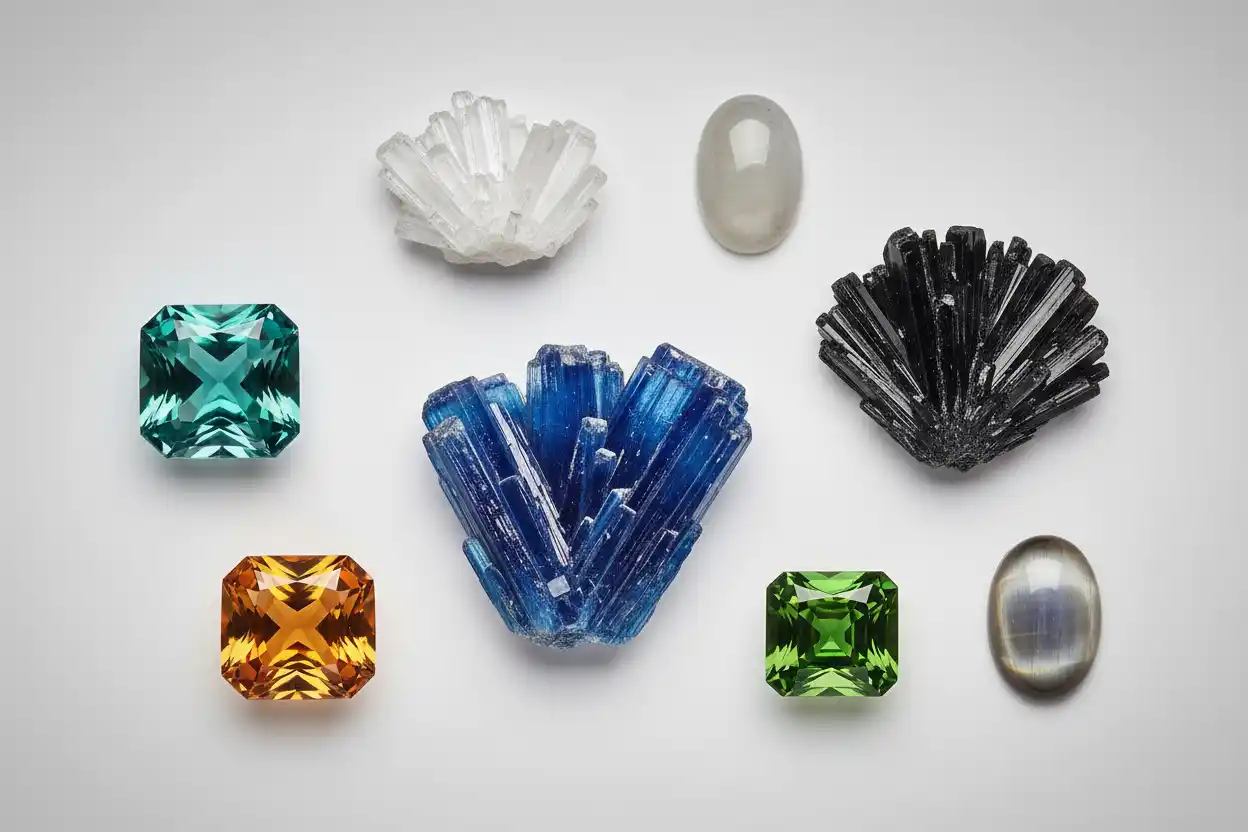
Kyanite is an aluminum silicate best known for long blue blades and an unusual hardness that changes according to direction. Although blue remains its dominant gem color, the mineral also occurs in black, green, teal, orange, white, gray, yellowish, pinkish, and rarely color-changing or chatoyant material.
Most types of kyanite are not separate mineral species. Instead, they are distinguished by color-producing trace elements, inclusions, crystal habit, transparency, locality, or optical effect. The main kyanite meaning and properties guide covers the mineral as a whole, while this article separates its principal colors and practical market varieties.
Kyanite at a Glance
| Property | Kyanite |
|---|---|
| Composition | Aluminum silicate, Al₂SiO₅ |
| Mineral group | Aluminosilicate polymorph group |
| Main colors | Blue, indigo, teal, green, black, white, gray, colorless, yellow, orange, pink, and violet-blue |
| Crystal system | Triclinic |
| Typical habit | Elongated blades, flattened prisms, columnar crystals, radiating fans, fibrous aggregates, and massive material |
| Luster | Vitreous on crystal faces; pearly on cleavage surfaces |
| Transparency | Transparent to opaque |
| Mohs hardness | Approximately 4.5–5 parallel to the crystal length and 6.5–7 across it |
| Cleavage | Perfect in one direction and good in another |
| Tenacity | Brittle |
| Common uses | Faceted collector gems, cabochons, beads, carvings, mineral specimens, ceramics, refractory products, and kiln furniture |
| Main care concern | Directional softness, cleavage, edge chipping, setting pressure, and sudden temperature changes |
What Makes Kyanite Unusual?
Kyanite belongs to a group of three minerals with the formula Al₂SiO₅. Its polymorphs andalusite and sillimanite have the same chemical composition but different crystal structures.
Each polymorph forms under a different pressure-and-temperature range. Kyanite typically indicates relatively high-pressure metamorphism, whereas andalusite generally reflects lower-pressure conditions. Sillimanite forms at higher temperatures.
Geologists use these minerals to reconstruct the metamorphic history of mountain belts. A kyanite-bearing schist can therefore reveal that its host rock once existed much deeper in Earth’s crust than its present exposure suggests.
Kyanite’s second defining characteristic is its directional hardness. Scratching parallel to the long crystal axis may give a hardness near 4.5–5, while testing across the blade may produce a value near 6.5–7. The gemstone hardness chart cannot express that unusual anisotropy with one simple number.
Blue Kyanite
Blue is the most familiar and commercially important kyanite color. It ranges from pale gray-blue and denim to vivid cornflower, royal blue, sapphire blue, and deep indigo.
Iron-related absorption generally produces the blue color, although the exact oxidation state, concentration, and crystal-growth environment affect tone and zoning. Many crystals show a darker blue strip through the center with paler edges.
Fine faceting material should combine strong blue color, transparency, manageable cleavage, and enough thickness for a pavilion. That combination is uncommon because kyanite commonly forms as thin blades with fractures or cloudy zones.
Nepal became particularly associated with transparent sapphire-like blue material. Brazil, Kenya, Tanzania, India, Zimbabwe, Switzerland, Russia, and the United States also produce blue crystals of varying quality.
The dedicated blue kyanite guide owns its detailed symbolism and use, while the blue kyanite buying guide covers seller checks and quality evaluation.
Indigo and Violet-Blue Kyanite
Some blue kyanite contains a strong violet, ink-blue, or indigo component. The appearance can change as the stone turns because kyanite is pleochroic.
A faceted gem may look pale blue along one direction, stronger blue along another, and nearly colorless or gray from a third angle. Cutters must therefore orient the rough for the most attractive face-up combination rather than maximum weight alone.
Excessively dark indigo stones can lose brilliance in ordinary indoor lighting. Conversely, a moderate violet-blue tone may give the gem more individuality than standard medium blue.
Blue and violet-blue kyanite can resemble sapphire, iolite, tanzanite, spinel, or blue glass. The dedicated kyanite versus sapphire guide retains that direct identification comparison.
Teal and Blue-Green Kyanite
Teal kyanite combines blue and green in tones ranging from pale aqua to deep petrol blue.
Some deposits produce distinct greenish zones within otherwise blue crystals. Chromium can contribute to turquoise-blue or greenish coloration in certain chrome-bearing examples, while iron-related mechanisms dominate many ordinary blue-green stones.
Teal material may show stronger directional color than conventional blue kyanite. A stone can appear green from one viewing angle but distinctly blue when rotated.
Clear, richly colored teal gems are uncommon and may command a premium. However, “teal kyanite” remains a visual description rather than a formally defined mineral variety.
Green Kyanite
Green kyanite ranges from pale mint and yellow-green to forest, olive, and bluish green.
Color causes vary. Chromium can create vivid green or turquoise-green material, while iron-related absorption and mixed trace chemistry may produce muted olive tones.
Transparent green kyanite is considerably less common in jewelry than blue material. Many green crystals remain specimen-grade because they are thin, fractured, or included.
Attractive green crystals are often kept intact when their natural form is more valuable than the small gem that cutting would yield. The broader green gemstones guide places green kyanite among stones with similar appearance but different durability.
Chrome Kyanite
Chrome kyanite contains measurable chromium substituting for aluminum in the crystal structure.
It may show turquoise-blue, teal, blue-green, or saturated green coloration. Some documented material contains unusually high chromium concentrations, making it chemically and mineralogically distinctive.
Not every green kyanite qualifies as chrome kyanite. A seller should not apply the name based on color alone because iron-bearing material can create similar shades.
Spectroscopy or chemical analysis provides the strongest confirmation. Consequently, an expensive chrome claim should come with meaningful analytical or locality documentation.
Orange Kyanite
Orange kyanite is one of the mineral’s most unusual gem colors.
Fine material from Tanzania may range from pale peach and apricot to pumpkin orange and reddish orange. Manganese in the trivalent state is associated with its color.
Many orange crystals are thin and strongly included, so clean faceted stones remain uncommon. An attractive specimen may also contain contrasting green, blue, or colorless zones.
Orange kyanite can resemble hessonite garnet, spessartine, orange sapphire, fire opal, or glass. Its optical properties, directional hardness, cleavage, and pleochroism separate it from those materials.
The orange gemstones guide provides broader color comparisons without treating orange kyanite as an ordinary mass-market stone.
Black Kyanite
Black kyanite commonly forms flattened, radiating, fan-shaped, or bladed aggregates rather than transparent faceting crystals.
Graphite and other dark inclusions can produce gray-black to nearly black color. The traditional name rhätizite or rhaeticite has been used for dark graphite-bearing kyanite, especially material associated with alpine localities.
Many black kyanite fans show silvery, gray, or bronze reflections across their blade surfaces. Broken edges may reveal lighter gray internal material.
Black specimens are popular in crystal collections, but their thin blades chip readily. The dedicated black kyanite guide owns its symbolism and specimen care, while where to buy black kyanite covers authenticity and repair checks.
Black kyanite also appears beside other dark materials in the black gemstones guide.
White and Colorless Kyanite
White kyanite may be chalky, pearly, translucent, or intergrown with quartz and mica. Transparent colorless crystals are much rarer.
Colorless faceting material can show strong brilliance, but inclusions, cleavage, and thin crystal shape limit availability. It may resemble quartz, topaz, danburite, or synthetic colorless stones.
White kyanite often forms in metamorphic rocks containing quartz, mica, garnet, or staurolite. Its blade shape and directional hardness help distinguish it from visually similar minerals.
Gray and Silver Kyanite
Gray kyanite ranges from pale silver to charcoal and blue-gray.
Fine graphite, mineral inclusions, structural defects, and weak blue color can all contribute to the appearance. Gray material may show pearly cleavage surfaces or a metallic-looking sheen without actually possessing metallic luster.
Some gray blades are polished into cabochons or pendants, although most remain specimen material. Attractive fans with intact terminations have greater value than broken pieces of comparable weight.
Yellow Kyanite
Yellow kyanite occurs in pale straw, cream-yellow, golden, and brownish yellow shades.
It is considerably less common than blue and may overlap visually with iron-stained white material. Therefore, a seller should distinguish internal natural coloration from a superficial coating of iron oxides.
Transparent yellow gems are rare. Strong zoning, cleavage fractures, and thin rough usually restrict finished sizes.
Pink and Reddish Kyanite
Pink kyanite is rare and may appear pale rose, mauve, lilac-pink, or reddish violet.
Manganese, chromium, or mixed trace-element effects may contribute depending on the locality. Some reported pink material is closer to purple or red-brown when viewed under neutral light.
Because pink kyanite is uncommon, identity and treatment claims deserve laboratory confirmation. Pale sapphire, spinel, tourmaline, glass, and synthetic materials can produce a similar appearance.
Zoned and Multicolored Kyanite
Kyanite frequently displays uneven color.
A crystal may have a dark blue central strip, colorless outer zones, green edges, or alternating blue and teal regions. Other examples combine white, gray, orange, and blue within one blade.
Zoning records changing trace-element availability and growth conditions. It can reduce the value of a conventional faceted stone when the color looks patchy, yet the same feature may enhance a natural crystal specimen.
Cutters sometimes place the strongest blue zone beneath the table. However, that strategy may create a dark stripe or leave pale areas near the girdle if the rough is not oriented carefully.
Cat’s-Eye Kyanite
Rare kyanite contains aligned fibrous or needle-like inclusions that create chatoyancy.
When correctly oriented and cut as a cabochon, the inclusions reflect a narrow band of light. The strongest examples show a sharp centered eye that moves across the dome.
Most chatoyant kyanite appears blue, gray, greenish, or blackish. The eye may be broad or diffuse because inclusions and cleavage interrupt the reflection.
Cat’s-eye material is usually more valuable than an ordinary opaque cabochon when the effect is strong, centered, and supported by a pleasing body color.
Kyanite Crystal Habits
Kyanite’s name comes from the Greek word associated with blue, but its blade-like form can be more diagnostic than color.
Individual crystals are often elongated and flattened. Parallel intergrowths create thick blades, while radiating groups form fans or sprays.
Twinning is common. Some crystals display repeated lamellae or overlapping blades that complicate cutting.
Massive kyanite occurs in quartzite, schist, gneiss, and other metamorphic rocks. Blue blades within white quartz or pale matrix can produce attractive decorative material, although such rock should not be valued like transparent faceting rough.
Ruby-in-Kyanite and Mixed Metamorphic Material
Commercial pieces sometimes combine blue kyanite, red corundum or ruby, mica, quartz, and other metamorphic minerals.
“Ruby in kyanite” generally describes a multi-mineral rock rather than a single variety of pure kyanite. Red areas should not automatically be assumed to be gem ruby without testing because garnet, iron oxide, or other minerals can look similar.
These materials are commonly carved or polished into cabochons, spheres, and decorative objects. Their value depends on pattern, mineral identification, stability, and workmanship rather than transparent gem quality.
Formation and Geological Context
Kyanite develops mainly during regional metamorphism of aluminum-rich rocks.
Shale and mudstone can become schist or gneiss as pressure and temperature increase during mountain building. Under sufficiently high pressure, aluminum and silica reorganize into kyanite.
The mineral also appears in quartz veins, metamorphosed pegmatites, eclogitic rocks, and deposits affected by high-pressure fluids. Associated minerals may include quartz, mica, garnet, staurolite, corundum, rutile, graphite, and feldspar.
Because kyanite indicates a particular metamorphic pressure range, geologists treat it as an index mineral. Its presence helps map metamorphic zones and reconstruct buried crustal conditions.
Major Localities and Mining Context
Nepal is well known for transparent blue gem material. Tanzania supplies rare orange kyanite, while Kenya and parts of East Africa produce blue, green, and mixed-color crystals.
Brazil and India supply specimen blades, black fans, quartz-rich decorative material, and some faceting rough. Switzerland, Austria, Italy, France, and Russia produce important alpine and metamorphic specimens.
The United States has substantial industrial kyanite resources, particularly in Virginia and parts of the Appalachian region. Industrial mining targets bulk aluminosilicate material for refractory and ceramic manufacture rather than transparent gemstones.
When heated to high temperatures, kyanite converts partly into mullite and silica while expanding. That behavior makes it valuable in heat-resistant ceramics, kiln furniture, foundry products, electrical porcelain, and other refractory applications.
Inclusions and Internal Features
Kyanite may contain graphite, rutile, mica, quartz, iron oxides, fluid inclusions, healed fractures, growth tubes, and other mineral crystals.
Parallel tubes or needles can create chatoyancy. Graphite contributes to black and dark gray material, while iron-rich zones influence blue and brown tones.
Cleavage feathers require particular attention. A bright internal line may look like a harmless inclusion in a photograph but connect with the surface and create a serious setting risk.
Eye-clean faceted kyanite is uncommon in larger sizes. Minor inclusions may therefore be acceptable when color, brilliance, and structural condition remain strong.
How Kyanite Is Identified
Directional hardness is one of kyanite’s classic properties, although scratch testing should not be performed on finished jewelry or valuable crystals.
Its refractive indices, birefringence, biaxial optical character, specific gravity around 3.5–3.7, pleochroism, and cleavage provide a reliable gemological identification.
Blue sapphire is harder, denser, and usually shows different refractive behavior. Tanzanite has one prominent cleavage direction and a different optical range. Iolite commonly shows stronger blue-to-colorless pleochroism but lower refractive indices.
The general crystal identification guide explains why several independent observations are safer than one destructive test.
Treatments, Synthetics, and Imitations
Most kyanite is sold without routine treatment.
Oil or resin may enter surface-reaching fractures, while wax or clear coatings can improve the appearance of rough specimens and carvings. Dye may alter pale or porous mixed rock, although transparent faceted kyanite is not commonly dyed.
Heating is not a routine commercial enhancement because color and structural response are unpredictable and cleavage increases risk.
Synthetic kyanite has been produced for research and ceramic applications, but laboratory-grown gem kyanite is not a normal jewelry product.
Imitations include glass, synthetic spinel, synthetic sapphire, quartz, dyed rock, and assembled material. Enhancement terminology is covered in the gemstone treatments guide.
Cutting Behavior
Kyanite is difficult to facet because hardness changes with direction.
One facet may polish normally while an adjacent facet abrades or develops ripples. Perfect cleavage can open during sawing, preforming, polishing, transfer, or setting.
Rough is commonly shallow and blade-shaped, so ovals, cushions, pears, marquises, rectangles, and freeforms preserve more weight than deep rounds.
Cutters must balance color orientation, pleochroism, cleavage, face-up dimensions, and yield. A deep pavilion can make blue material look too dark, while a shallow cut can create a transparent window through the center.
Cat’s-eye rough requires a cabochon aligned with the inclusions. Black fans and well-formed blades usually retain more value as specimens than as cutting rough.
Durability and Jewelry Suitability
Kyanite’s directional hardness makes durability difficult to summarize.
Certain surfaces may resist scratching nearly as well as quartz, while others abrade much more easily. Perfect cleavage and brittle tenacity create a greater concern than moderate surface wear.
The gemstone cleavage guide explains why a sharp blow or tight prong can split a stone even when no scratch appears. The broader distinction is covered in gemstone toughness versus hardness.
Earrings, pendants, brooches, and occasional-wear rings are the safest jewelry formats. Rings should use protective settings, rounded shapes, and no prong directly over a fracture.
Kyanite is not a practical choice for an unrestricted everyday engagement ring, particularly when the stone has thin corners or visible cleavage feathers.
Kyanite Prices in 2026
Kyanite prices depend on transparency, color, zoning, cleavage condition, size, cut, optical effect, locality, and specimen quality.
Commercial included blue faceted stones commonly retail around $15–$60 per carat. Better transparent medium-to-vivid blue material often falls near $60–$175 per carat.
Fine clean Nepalese blue stones, saturated teal or chrome-bearing material, attractive orange gems, and strong cat’s-eye examples may reach approximately $175–$400-plus per carat. Exceptional stones can exceed these ranges when size and clarity are unusual.
Black fans and ordinary blue blades may cost $5–$40. Aesthetic crystal groups, sharp alpine specimens, rare-color crystals, or important locality pieces commonly range from $50 to several hundred dollars, with museum-level examples priced higher.
Kyanite does not have a highly standardized global price structure. Therefore, individual quality and seller expertise create substantial variation.
Buying Guidance
First decide whether you want a transparent faceted gem, a cat’s-eye cabochon, a black fan, or a natural crystal specimen.
For faceted stones, request exact dimensions, weight, videos in neutral lighting, clarity details, treatment disclosure, and views of the girdle. A deep stone may carry weight without appearing correspondingly large.
Inspect color distribution. Strong central zoning can create a dark stripe, while pale edges may reduce the visual impact of an otherwise vivid blue stone.
For specimens, examine every blade and termination. Repairs, glue, reconstructed matrix, polished tips, or stabilized fractures should be disclosed.
The complete transaction checklist belongs in where to buy real kyanite. General protections for remote purchases appear in how to buy gemstones online.
Cleaning and Storage
Clean kyanite briefly with lukewarm water, mild soap, and a very soft brush.
Support the jewelry over a padded surface because an accidental drop can follow a cleavage plane. Rinse it gently and dry it with a lint-free cloth.
Avoid steam, abrupt temperature changes, abrasive cleaners, acids, and ultrasonic machines. Vibration may enlarge an existing cleavage fracture or loosen the setting.
Store kyanite separately from quartz, topaz, sapphire, and diamond. Black fans and blade specimens need padded boxes that prevent pressure on thin edges.
Meaning and Symbolism
Modern spiritual traditions often associate kyanite with communication, self-reflection, thoughtful decision-making, and the ability to consider different perspectives.
Blue kyanite is commonly linked with calm expression, black with steadiness or boundaries, green with renewal, and orange with creativity or motivation. The dedicated kyanite color meaning guide retains the detailed symbolic comparison.
These associations arise from color symbolism, modern crystal practice, and personal interpretation. They are not scientifically demonstrated effects of aluminum silicate, trace elements, or crystal direction.
Frequently Asked Questions
1. How many types of kyanite are there?
There is no fixed number. Kyanite is classified by color, trace chemistry, inclusions, crystal habit, transparency, locality, and optical phenomena such as chatoyancy.
2. What is the most common kyanite color?
Blue is the most familiar and commercially important color, ranging from pale gray-blue to deep indigo.
3. What is the rarest type of kyanite?
Transparent orange, pink, vivid chrome-rich green, and strong cat’s-eye kyanite are among the least common gem varieties.
4. What causes orange kyanite?
Manganese in the trivalent state is associated with the orange coloration found in notable Tanzanian material.
5. Is black kyanite a genuine form of kyanite?
Yes. Black and gray-black kyanite commonly contains graphite or other dark inclusions and often forms radiating fans or blades.
6. Is chrome kyanite always green?
No. Chromium-bearing kyanite may appear turquoise-blue, teal, blue-green, or green. Chemical testing is needed to confirm chromium content.
7. Why does kyanite have two hardness values?
Its atomic bonding differs according to crystallographic direction, so the mineral scratches more easily parallel to its long axis than across it.
8. Is ruby-in-kyanite one mineral?
No. It is generally a multi-mineral metamorphic rock containing kyanite with corundum or ruby and may also include quartz, mica, or other minerals.
9. Can kyanite show a cat’s-eye effect?
Yes. Rare material with aligned inclusions can display chatoyancy when correctly oriented and cut as a cabochon.
10. Is kyanite routinely heat-treated?
No. Most material is sold without routine color enhancement, and heating creates substantial structural risk.
11. Can kyanite be worn in a ring?
It can be worn in a protected occasional-wear ring, but cleavage, directional softness, and brittle edges make earrings and pendants safer.
12. Why is fine faceted kyanite uncommon?
Most crystals are thin, zoned, fractured, included, or affected by cleavage. Cutting also requires difficult orientation because hardness and color vary with direction.
Kyanite’s types are best understood as different outcomes of metamorphic pressure, trace chemistry, inclusions, crystal growth, and cutting orientation. A Nepalese blue gem, Tanzanian orange blade, graphite-dark fan, chrome-rich teal crystal, and chatoyant cabochon all preserve the mineral’s unusual directional character. K-group entries can be compared through the crystals that start with K directory and the gemstones that start with K guide.