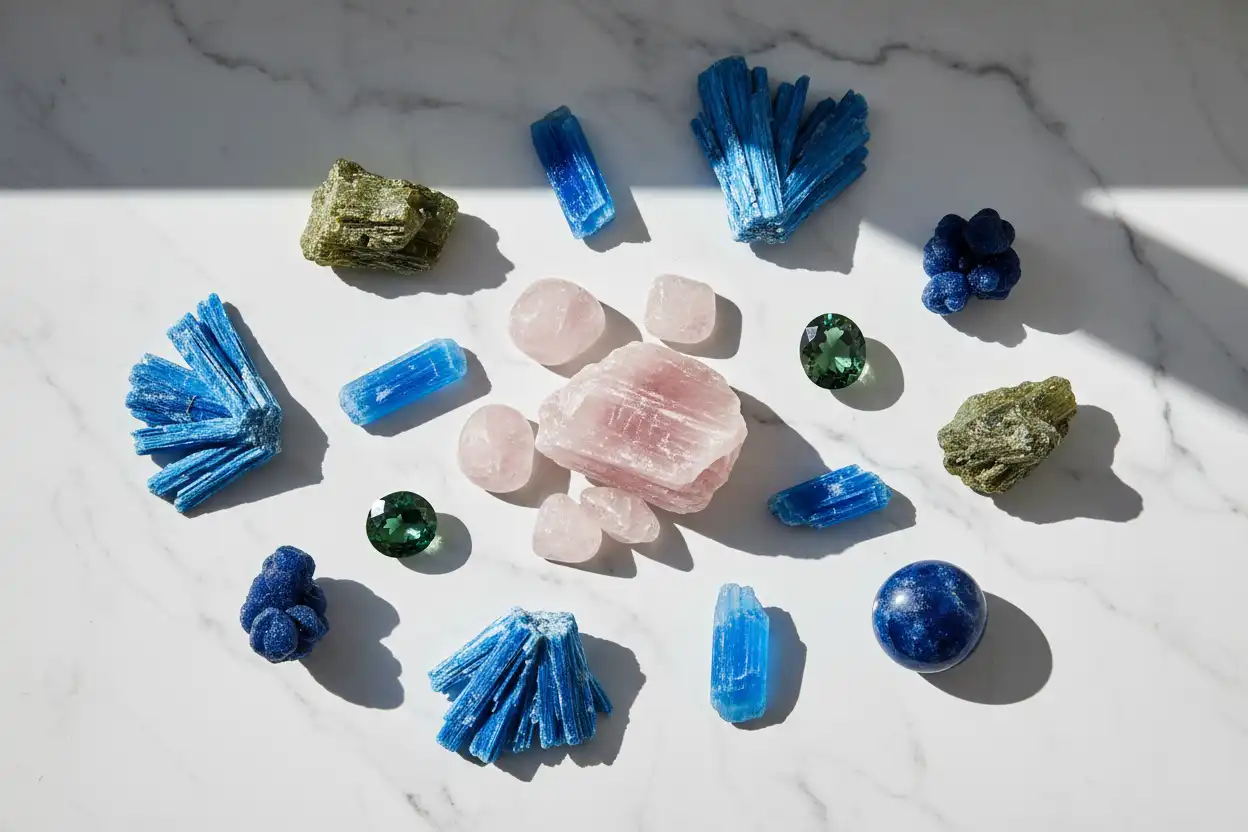
Crystals That Start With K: Names and Meanings
Crystals that start with K include K2 stone, Kambaba jasper, kammererite, kimberlite, kinoite, kornerupine, kunzite and kyanite.
The K list contains patterned rocks, rare collector minerals, valuable gemstones and materials with unusual physical properties.
The meanings below come from crystal traditions and personal symbolism rather than medical science.
Continue from the previous directory with Crystals That Start With J.
K Crystals at a Glance
| Crystal or material | Typical appearance | Common symbolic meaning |
|---|---|---|
| K2 Stone | Pale granite with vivid blue spots | Perspective and resilience |
| Kambaba Jasper | Dark green stone with black circular patterns | Calm and connection with nature |
| Kammererite | Pink, violet or purple flaky crystals | Self-acceptance and transformation |
| Kimberlite | Dark igneous rock that may carry diamond | Potential and perseverance |
| Kinoite | Bright blue copper-bearing crystals | Communication and insight |
| Kornerupine | Green, brown, yellow or blue-green crystals | Individuality and clear direction |
| Kunzite | Pale pink to violet spodumene | Affection and emotional openness |
| Kyanite | Blue, black, green or orange bladed crystals | Communication and alignment |
K2 Stone
K2 stone is a commercial name for a pale granitic rock marked by vivid blue spots or patches, usually associated with azurite.
It is also sold as:
- K2 granite.
- K2 jasper.
- Raindrop azurite.
- Azurite in granite.
Despite the word “jasper,” K2 stone is not a traditional jasper. Genuine material is known for blue azurite occurring in a pale, visibly granular rock matrix.
Its traditional meanings include:
- Perspective.
- Resilience.
- Clear communication.
- Balancing practical and creative thinking.
- Remaining composed during challenges.
K2 stone can contain several minerals with different hardness levels. Avoid strong impacts, acids and aggressive cleaning.
Very uniform blue circles or surface-only coloring may deserve closer inspection, especially when provenance is unclear.
Kambaba Jasper
Kambaba jasper is a dark green decorative stone with black or deep green circular patterns.
It is sometimes marketed as:
- Crocodile jasper.
- Green stromatolite jasper.
- Nebula-like jasper.
Its traditional symbolism includes:
- Calm.
- Patience.
- Emotional stability.
- Connection with nature.
- Accepting gradual development.
Kambaba jasper is generally sold as polished stones, beads, carvings and cabochons.
Because the commercial name can be applied inconsistently, examine the pattern, origin and seller description. The guide to buying real Kambaba jasper explains what to check before purchasing.
Explore other patterned materials in the broader jasper guide.
Kammererite
Kammererite is the traditional name for chromium-bearing clinochlore.
It commonly appears:
- Pink.
- Lavender.
- Violet.
- Reddish purple.
- As flaky or plate-like crystals.
Modern mineral references classify it as a chromium-bearing variety of clinochlore rather than a separate mineral species.
Kammererite is traditionally associated with:
- Self-acceptance.
- Emotional balance.
- Transformation.
- Releasing harsh self-judgment.
- Recognizing personal strengths.
It is soft and may flake or split along its layered structure. Keep specimens away from water soaking, abrasion and harder stones.
Its relationship with clinochlore explains its layered formation and delicate texture.
Kimberlite
Kimberlite is an igneous rock formed from magma that rose rapidly from deep within Earth.
It is famous because some kimberlite bodies contain diamonds. However, most kimberlite does not contain gem-quality diamond.
Kimberlite may appear:
- Dark gray.
- Greenish gray.
- Brown.
- Blue-gray when weathered.
- Coarse or brecciated.
Its symbolic associations include:
- Hidden potential.
- Perseverance.
- Transformation under pressure.
- Recognizing value beneath an ordinary surface.
- Long-term development.
Kimberlite is a rock composed of several minerals rather than one crystal. Individual specimens may contain olivine, mica, pyroxene and altered minerals.
Learn about the best-known gem associated with this rock in the diamond meaning guide.
Kinoite
Kinoite is a hydrous copper-calcium silicate mineral known for vivid blue crystals and coatings.
It may occur as:
- Small prismatic crystals.
- Bright blue crusts.
- Veins.
- Compact masses.
- Crystals on copper-rich matrix.
Kinoite was approved as a mineral species in the late 1960s and first formally described in 1970.
Its traditional meanings include:
- Communication.
- Insight.
- Emotional honesty.
- Expressing difficult ideas calmly.
- Recognizing connections between thoughts.
Kinoite is mainly collected as a mineral specimen. Because it contains copper and may occur with other copper minerals, it should not be placed in drinking water.
Keep crystal surfaces dry and avoid abrasive brushes.
Kornerupine
Kornerupine is an uncommon borosilicate mineral that may appear:
- Green.
- Yellow-green.
- Brown.
- Blue-green.
- Nearly colorless.
Some gem-quality kornerupine is strongly pleochroic, showing different colors when viewed from different directions.
Its traditional symbolism includes:
- Individuality.
- Clear direction.
- Adaptability.
- Independent judgment.
- Recognizing personal priorities.
Transparent material may be faceted, while opaque or included specimens are generally kept by collectors.
Fine kornerupine can resemble tourmaline, peridot or other green gemstones. Professional testing may be appropriate when rarity or value affects a purchase.
Kunzite
Kunzite is the pink to violetish-purple variety of spodumene.
Its color may range from:
- Nearly colorless pink.
- Pale lilac.
- Lavender.
- Violet-pink.
- Strong pink-purple.
Kunzite is pleochroic and has two directions of perfect cleavage, both of which influence how cutters orient and protect the stone.
Its traditional meanings include:
- Affection.
- Emotional openness.
- Compassion.
- Gentle communication.
- Releasing emotional tension.
Kunzite may fade after prolonged exposure to strong light, which is why it has sometimes been called an evening or “midnight” stone.
Its appearance can overlap with morganite and other pale pink gems. Compare their color, hardness and crystal structure in Kunzite vs. Morganite.
Color, clarity, size and treatment affect cost, as explained in the kunzite price guide.
Kyanite
Kyanite is an aluminum silicate mineral commonly found as elongated or bladed crystals.
Its colors include:
- Blue.
- Black.
- Green.
- Orange.
- Gray.
- White.
Kyanite has an unusual difference in hardness depending on the direction in which it is tested. It is also strongly cleavable, making thin blades vulnerable to splitting.
Its traditional meanings include:
- Communication.
- Alignment.
- Self-expression.
- Connecting values with actions.
- Resolving internal contradictions.
Different kyanite colors have their own symbolic associations, covered in the kyanite color meaning guide.
Blue kyanite may resemble sapphire in photographs, but the two differ greatly in hardness, durability and structure. Review Kyanite vs. Sapphire for the key distinctions.
K Crystals by Color
Blue K Crystals
Blue examples include:
- K2 stone.
- Kinoite.
- Blue kyanite.
- Blue-green kornerupine.
Green K Crystals
Notable green examples include:
- Kambaba jasper.
- Green kornerupine.
- Green kyanite.
- Some kimberlite.
Pink and Purple K Crystals
Examples include:
- Kunzite.
- Kammererite.
- Violet kyanite.
Black and Dark K Crystals
Examples include:
- Black kyanite.
- Kimberlite.
- Dark Kambaba jasper patterns.
Which K Crystals Are Suitable for Jewelry?
Common jewelry materials include:
- K2 stone.
- Kambaba jasper.
- Kornerupine.
- Kunzite.
- Kyanite.
Kambaba jasper and polished K2 stone are frequently used in cabochons, pendants and beads.
Kunzite and kornerupine may be faceted, but their cleavage and internal features require careful setting.
Kyanite is better suited to earrings, pendants and protected designs than rings exposed to frequent impact.
Compare their durability, rarity and jewelry use in Gemstones That Start With K.
Care Notes for K Crystals
K materials require several different precautions:
- Keep K2 stone away from acids that could affect copper-bearing blue areas.
- Store Kambaba jasper separately if it contains fractures or softer matrix.
- Protect kammererite from abrasion because its flaky crystals are delicate.
- Treat kimberlite as a multi-mineral rock rather than assuming uniform hardness.
- Keep kinoite dry and away from consumable liquids.
- Protect kornerupine and kunzite from hard impacts.
- Store kunzite away from prolonged strong sunlight.
- Support kyanite blades so they cannot bend, split or strike harder stones.
For a wider list of light-sensitive materials, consult Crystals That Fade in Sunlight.
Frequently Asked Questions
What is the most popular crystal that starts with K?
Kyanite and kunzite are among the best-known. K2 stone and Kambaba jasper are also popular in polished crystal collections.
Which blue crystals start with K?
K2 stone, kinoite and blue kyanite are the most notable examples.
Which purple crystals start with K?
Kunzite, kammererite and some kyanite specimens may appear purple or violet.
Is K2 stone a jasper?
No. K2 stone is a commercial name for a pale granitic rock with blue azurite.
Is kammererite a separate mineral?
It is now generally classified as chromium-bearing clinochlore rather than a separate mineral species.
Does all kimberlite contain diamonds?
No. Only a small proportion of kimberlite bodies contain diamonds, and fewer contain economically valuable gem material.
Is kunzite suitable for everyday rings?
Kunzite can be worn in rings, but its cleavage and light sensitivity make protected settings and careful wear advisable.
Why does kyanite have different hardness readings?
Its crystal structure produces different scratch resistance along different crystallographic directions.
Continue Exploring Crystals
Continue alphabetically with Crystals That Start With L, or browse foundational crystal guides in the Crystals 101 collection.