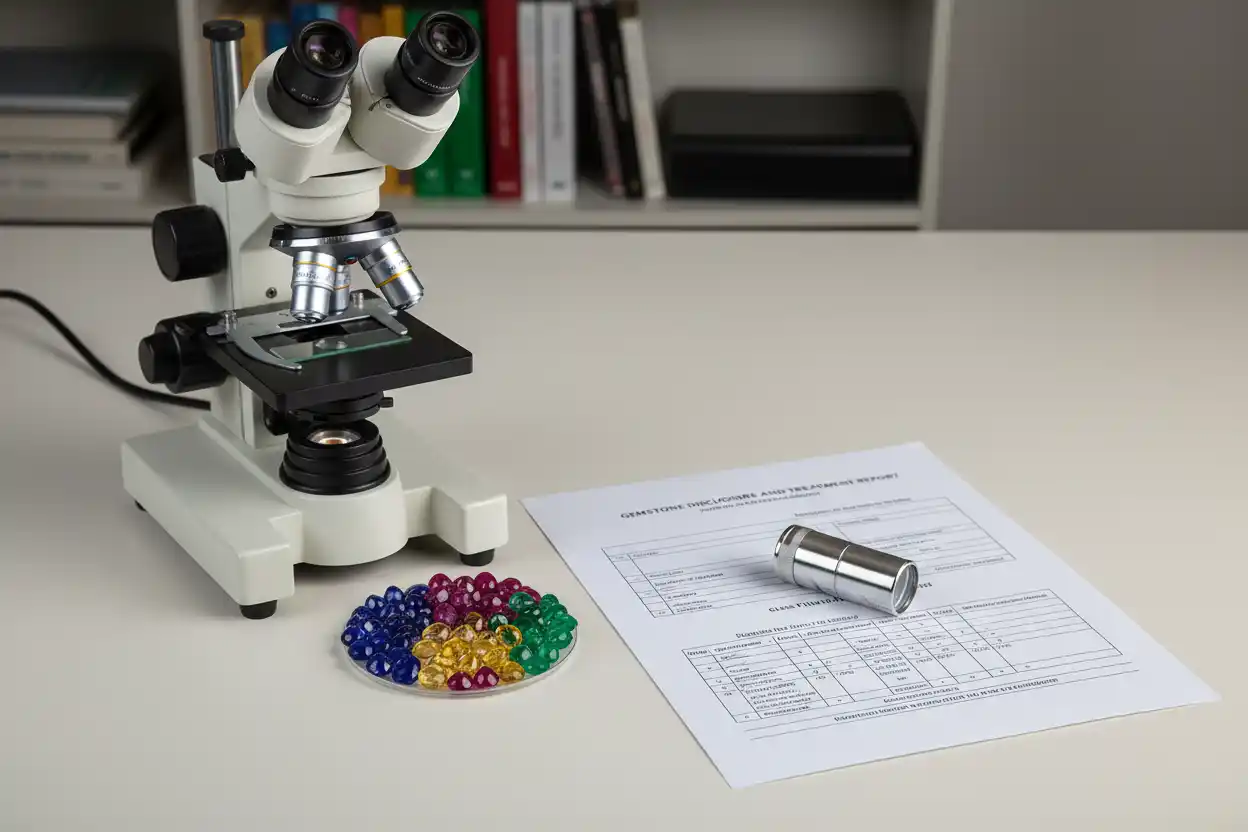
Gemstone Treatments Explained: Heat, Diffusion, Oil and Filling
Gemstone treatment is not automatically a sign that a stone is fake. Many natural gems are heated, filled, oiled, irradiated, dyed or otherwise enhanced after mining, but the type and extent of treatment can materially change the stone’s durability, care requirements and market value.
The central issue is disclosure. A buyer should know what the stone is, what was done to it, whether that enhancement is stable and how the treatment influenced the price.
What Is a Gemstone Treatment?
A gemstone treatment is a human-controlled process used to alter the appearance, durability or marketability of gem material. Treatments may improve color, reduce the visibility of inclusions, strengthen porous material or make low-grade rough attractive enough for jewelry.
Treatment is different from laboratory growth. A treated ruby may have formed naturally and later been heated, whereas a laboratory-grown ruby crystallized in a controlled manufacturing environment. The broader differences are covered in Lab-Grown vs Natural Gemstones.
Treatments are also different from imitations. Cubic zirconia sold as a diamond substitute is not a treated diamond; it is a separate material. Similarly, a glass-filled ruby still contains natural corundum, while a red glass imitation contains no natural ruby at all.
Because those distinctions are difficult to establish from appearance alone, valuable stones often justify independent analysis. The Gemstone Certification Labs comparison explains what major laboratories can report and what a laboratory document does not guarantee.
The Main Treatment Categories
| Treatment | What it changes | Commonly associated gems | Stability and care | Typical influence on value |
|---|---|---|---|---|
| Heat | Color, clarity or both | Ruby, sapphire, tanzanite, aquamarine, zircon | Often stable, but results vary by material | Frequently accepted; untreated fine stones may command premiums |
| Diffusion | Color near the surface or deeper within the stone | Sapphire and some ruby | Depends on the diffusion process and depth | Usually worth less than comparable untreated or conventionally heated material |
| Oiling or resin filling | Visibility of surface-reaching fissures | Emerald, demantoid and other fractured gems | Filler can dry, leak, discolor or be damaged | Depends heavily on the amount and type of filler |
| Glass filling | Transparency and apparent clarity | Low-grade ruby and some diamonds | Can be vulnerable to heat, chemicals and repair procedures | Usually causes a substantial discount |
| Impregnation or stabilization | Durability and color uniformity | Turquoise, jade and porous ornamental gems | Varies with the substance used | Accepted in some markets but must be disclosed |
| Dyeing or coating | Surface or body color | Agate, quartz, pearls, jade, topaz and others | May scratch, fade or react to chemicals | Usually lowers value compared with naturally colored material |
| Irradiation | Color through induced color centers | Topaz, diamond, quartz and some beryl | Often stable, although certain colors can fade | Market acceptance depends on material, stability and disclosure |
This page owns the general treatment framework. Material-specific evidence, identifying characteristics and buying risks belong to dedicated guides such as treated ruby, treated sapphire and treated emerald.
Heat Treatment
Heat treatment exposes gem material to controlled temperatures, sometimes in a carefully managed atmosphere. Depending on the mineral and process, heating may improve color, remove an unwanted secondary hue, dissolve microscopic inclusions or heal certain fractures.
Ruby and sapphire have been heated for centuries. Conventional heat can intensify or lighten color, improve transparency and alter internal silk. In high-value corundum, the distinction between no indications of heating and evidence of heating can have a major effect on price.
However, “heated” does not describe every possible corundum enhancement. A traditionally heated sapphire is commercially and gemologically different from a diffusion-treated sapphire or a glass-filled ruby. Buyers should therefore request the complete enhancement description rather than accepting a vague statement such as “enhanced.”
Tanzanite is another familiar example. Much of the material entering the jewelry market has been heated to reduce brownish or greenish components and produce the blue-to-violet appearance buyers expect. The treatment is normally stable under ordinary wear, although the stone itself remains vulnerable to sharp impact and sudden temperature changes. The dedicated Tanzanite guide covers the material’s identity and durability without replacing treatment disclosure.
Aquamarine is commonly heated to reduce green components and create a purer blue. This practice is widely accepted, and color quality usually matters more to price than an “unheated” label. Buyers who need aquamarine-specific detection and disclosure guidance should use the treated Aquamarine guide.
Topaz may also undergo heat, irradiation or coating, depending on the color being produced. Those processes should not be grouped together because they create different identification and care concerns. The treated Topaz guide addresses those material-specific distinctions.
Is Heat Treatment Permanent?
Many conventional heat treatments are considered stable during ordinary jewelry use. The treatment does not normally reverse simply because the stone is worn in sunlight or cleaned in mild soapy water.
Nevertheless, the gem may remain sensitive to a jeweler’s torch, abrupt heating or aggressive repair procedures. Filled fractures can also be altered during heat treatment, and a stone may contain more than one enhancement. A jeweler should receive the treatment information before resizing, retipping or resetting the piece.
Diffusion Treatment
Diffusion treatment uses heat to introduce coloring elements into a gemstone or move existing components within its crystal structure. The resulting color may be concentrated near the surface or extend farther into the stone, depending on the element, temperature, time and process.
Early surface-diffused sapphires often developed a shallow blue layer. Recutting, repolishing or deep scratching could remove part of that layer and reveal lighter material beneath it. Consequently, these stones were valued substantially below comparable natural-color or conventionally heated sapphires.
Later methods, including beryllium diffusion, can produce color that penetrates much more deeply. This makes the treatment harder to recognize through simple visual inspection and means that the old assumption that all diffusion is merely surface-deep is unreliable.
Diffusion is not the same as ordinary heating. Both may involve high temperatures, yet diffusion deliberately alters color through the movement or addition of chemical components. A seller who describes a diffusion-treated sapphire only as “heated” has not provided a sufficiently specific disclosure.
Laboratory analysis may be necessary, particularly when significant money is involved. A buyer comparing sapphire varieties should also review Types of Sapphire rather than assuming that every unusual color represents an untreated natural variety.
Oiling and Clarity Enhancement
Oiling reduces the visibility of surface-reaching fissures by introducing a substance with optical properties closer to those of the gemstone than air. Once the fissure contains oil instead of air, light reflects less strongly from the crack, making the stone appear cleaner and more transparent.
Emerald is the material most closely associated with oiling. Natural emeralds frequently contain fissures, and colorless oil has long been used to improve their appearance. Some stones receive traditional oils, while others contain artificial resins or polymers that may be more durable or more difficult to remove.
The amount of filler matters. An emerald with insignificant or minor clarity enhancement is not commercially equivalent to one with extensive filling. Major laboratories may describe the degree of clarity modification using terms such as insignificant, minor, moderate or significant, although wording and reporting policies differ.
Filler type matters as well. Oils may dry out or migrate over time, while resins can discolor, react to heat or complicate future cleaning. A gemstone may also be re-oiled after a laboratory report was issued, so the condition of an older report should be compared with the stone as it exists today.
Does Oiling Make an Emerald Fake?
No. An oiled natural emerald remains a natural emerald, provided that the underlying material is natural beryl colored as emerald. However, the treatment must be disclosed because it affects appearance, care and value.
The enhancement does not turn poor natural material into the equivalent of a naturally transparent, minimally enhanced emerald. Price comparisons should therefore account for color, clarity, filler type, degree of enhancement and laboratory findings.
The dedicated Emerald buying guide should own emerald selection criteria, while the treated Emerald guide owns material-specific identification and enhancement evidence.
Fracture Filling and Glass Filling
Fracture filling introduces glass, polymer, resin or another material into cracks and cavities. Like oiling, it reduces the optical contrast between the host gem and the fracture. Some filling methods produce a modest clarity improvement, while others transform heavily fractured material into a transparent-looking commercial product.
Lead-glass-filled ruby is one of the most important examples. Low-grade corundum with extensive fractures can be heated with lead-rich glass, which fills the openings and dramatically improves apparent transparency. The resulting product may contain a substantial volume of glass relative to usable ruby.
Such material can look impressive in photographs, yet it should not be priced as a conventionally heated ruby. It may be damaged by a jeweler’s torch, acids, pickling solutions, ultrasonic cleaning or other repair processes that an untreated ruby could tolerate.
Fracture-filled diamonds present a separate issue. Filling can make feathers and fractures less visible, but the filler may show a flash effect under magnification and can be harmed during high-temperature jewelry repair. The diamond itself remains diamond, although its enhanced clarity is not equivalent to a naturally clearer stone.
Before purchasing any filled stone, ask whether the disclosure names the host material and the filling substance. Phrases such as “clarity enhanced” can conceal a wide range of processes unless the seller explains them.
Treatment, Composite and Synthetic Material Are Different
A treatment changes an existing gem. A composite combines two or more components, while a synthetic reproduces a natural gem material through laboratory growth.
An opal doublet, for example, may place a thin slice of natural opal on a dark backing. A triplet can add a transparent protective cap. These constructions are covered separately in Gemstone Doublets and Triplets.
Laboratory-grown corundum, emerald or diamond is not merely “treated natural” material. It has a laboratory origin that should be clearly disclosed. Conversely, a natural gemstone can be both laboratory identified and treated after mining.
Treatments That Need Special Care
Not all treatments create the same maintenance risk. Conventional heat in aquamarine or tanzanite is generally stable, whereas oil, resin, glass and surface coatings may require much more caution.
Ultrasonic and steam cleaning can worsen fractures, remove filler or damage treated material. Solvents may affect oil, dye, resin or polymer. High temperatures used during jewelry repairs can alter fillings or reveal previously concealed cracks.
For that reason, a jeweler should know about the treatment before beginning repair work. General ultrasonic suitability is covered in Which Gemstones Can Go in an Ultrasonic Cleaner?, while individual stones may require stricter care.
Examples that deserve dedicated guidance include treated Jade, treated Opal, treated Pearl and treated Turquoise.
How Treatments Affect Gemstone Value
A treatment does not create one universal discount. Market impact depends on the gemstone, the process, treatment stability, rarity of untreated material and how strongly buyers value natural condition.
Conventional heating is accepted for many commercial sapphires, rubies, tanzanites and aquamarines. Even so, a fine ruby or sapphire with an independent no-heat determination can command a substantial premium over a visually comparable heated stone.
Diffusion, extensive resin filling and lead-glass filling usually cause larger discounts because these processes can have a stronger influence on appearance or durability. Oiling in emerald is common, but the price still changes with the degree and type of filler.
Treatment also interacts with every other value factor. Color, transparency, cutting, carat weight, provenance and demand still matter. The full valuation framework is explained in How Gemstone Prices Are Determined.
What Treatment Disclosure Should Include
A useful disclosure should answer four questions:
- What is the gemstone material?
- Is it natural, laboratory-grown, composite or an imitation?
- What treatment or treatments were detected or declared?
- Does the treatment affect durability, cleaning, stability or value?
A seller should not rely on euphemisms such as “improved,” “processed” or “enhanced for beauty” when the actual process is known. The description should be specific enough for a buyer to understand the commercial consequences.
Disclosure should also appear before purchase, not only on an invoice delivered afterward. Online shoppers should save the listing, return policy and treatment statement. The broader seller-verification process appears in How to Buy Gemstones Online Without Getting Scammed.
Can You Identify Treatment at Home?
Some treatments leave visible clues under a loupe or microscope. Surface diffusion may concentrate color along facet junctions, lead-glass-filled ruby can show gas bubbles and colored flashes, and fracture-filled diamonds may display a flash effect.
However, those clues are not universal. Modern treatments can be subtle, and natural inclusions sometimes resemble treatment features. A home inspection can reveal reasons for caution, but it cannot reliably prove that every treatment is absent.
High-value purchases should therefore rely on a respected laboratory rather than a seller’s handheld tester. A lab report can identify the gem and disclose treatments within the laboratory’s testing scope, but it does not set the retail price or guarantee future resale value.
Questions to Ask Before Buying a Treated Gemstone
Ask the seller for the exact treatment rather than a yes-or-no answer to “Is it enhanced?” Request any laboratory report before the return period expires, and check that its measurements, weight and photograph match the stone.
You should also ask whether the treatment is stable, whether it creates special cleaning restrictions and whether the jeweler can safely repair the setting. Finally, compare the asking price with stones carrying the same treatment status—not with untreated examples selected to make the offer appear unusually cheap.
The Buying & Value hub brings these commercial questions together without replacing stone-specific buying and identification pages.
Frequently Asked Questions
1. Is a heat-treated gemstone still real?
Yes. A naturally formed gemstone remains natural after heat treatment, although the treatment must be disclosed when it affects value, care or purchasing decisions.
2. Does heat treatment always lower a gemstone’s value?
Not always to the same degree. Heating is accepted for many commercial gems, but fine untreated ruby and sapphire can command substantial premiums over comparable heated stones.
3. What is the difference between heat treatment and diffusion?
Conventional heat alters a stone through temperature and atmosphere. Diffusion uses heat to move or introduce coloring components, creating color that may be shallow or deeper within the gem.
4. Is diffusion treatment permanent?
The induced color may be stable, but shallow surface diffusion can be affected by recutting or deep repolishing. Modern diffusion processes can penetrate more deeply, so laboratory testing is important.
5. Why are emeralds treated with oil?
Oil enters surface-reaching fissures and reduces their visibility. This can improve apparent clarity without changing the underlying natural identity of the emerald.
6. Is resin filling the same as traditional oiling?
No. Both reduce fissure visibility, but resins and polymers can have different stability, removal and discoloration characteristics from traditional oils.
7. Is a glass-filled ruby a real ruby?
It contains natural corundum, but glass may form a significant part of the finished product. It should be clearly sold as glass-filled or composite-treated ruby and priced accordingly.
8. Can a fracture-filled diamond be worn every day?
It can be worn, but the filler may be vulnerable to heat and certain repair procedures. The jeweler should be informed before cleaning, resizing or retipping the setting.
9. Must gemstone treatments be disclosed?
Treatments should be disclosed when they are not permanent, require special care or significantly affect value. Accurate disclosure is also essential to avoid misleading buyers.
10. Can a loupe reveal every gemstone treatment?
No. A loupe may show clues, but many treatments require advanced microscopy, spectroscopy or chemical analysis.
11. Will a gem laboratory identify the treatment?
A respected laboratory can test for many major treatments and state its findings within the scope of the report. No report should be interpreted as a financial appraisal.
12. How should treated gemstones be cleaned?
Use the least aggressive safe method: lukewarm water, mild soap and a soft brush unless material-specific advice says otherwise. Avoid steam, ultrasonic cleaning, solvents and repair heat when filler or coating may be present.
Treatment Is a Disclosure Issue, Not a Simple Quality Label
A treatment can be stable, traditional and commercially accepted, or it can radically change a gemstone’s appearance and durability. Therefore, “treated” by itself does not tell a buyer enough.
The safest purchase is one where the material, treatment, stability, care restrictions and price basis are all stated clearly. Once those facts are available, a treated gemstone can be evaluated on its actual merits rather than being dismissed as fake or mistaken for a rarer untreated stone.