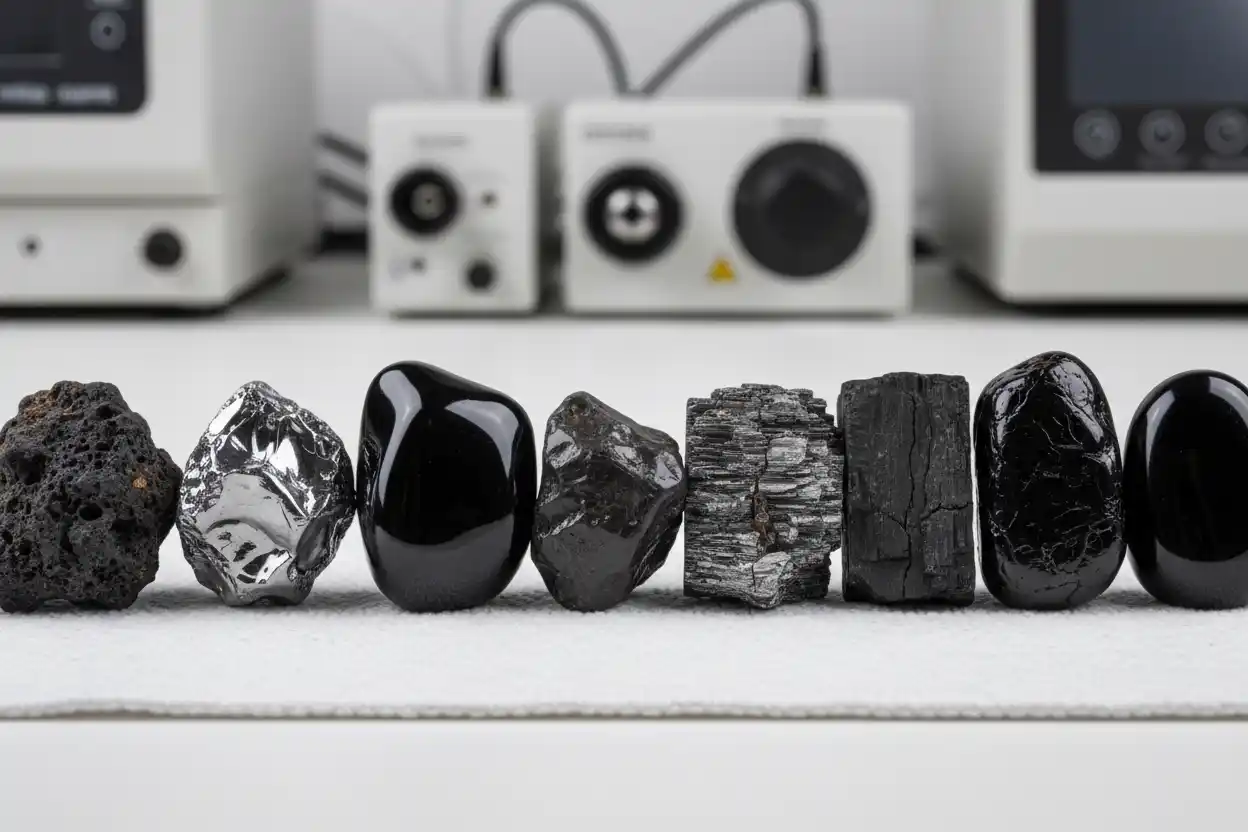
How to Spot Treated or Synthetic Shungite
Shungite is a carbon-rich geological material associated most famously with Paleoproterozoic rocks in Karelia, northwestern Russia. The term is used both for carbonaceous matter and for rocks containing varying proportions of that carbon, quartz, silicates, sulfides, carbonates, and other minerals.
That variability makes Shungite different from a single mineral such as Quartz, Sapphire, or Pyrite. It does not have one fixed chemical formula, one universal carbon percentage, one diagnostic hardness, or one standardized appearance.
A polished Shungite bead may be natural rock that was merely shaped. Another object may have been oiled, waxed, lacquered, impregnated with resin, repaired, or manufactured from Shungite powder and polymer. These products should not share the same untreated label.
The phrase synthetic Shungite is usually misleading. Carbon black, graphite powder, activated carbon, resin composites, ceramic, glass, and engineered carbon materials may resemble one aspect of Shungite, but they do not reproduce its complete natural rock assemblage and geological history.
Shungite alteration and product categories at a glance
| Product category | What it is | Common evidence | Correct description |
|---|---|---|---|
| Natural rough Shungite | Naturally formed carbon-rich rock or carbonaceous material | Irregular mineral texture, carbon-rich matrix, associated quartz or sulfides | Natural Shungite |
| Polished Shungite | Natural material shaped and polished | Cut surfaces, rounded edges, retained internal rock texture | Polished natural Shungite |
| Oiled or waxed Shungite | Surface treated to deepen black color or increase luster | Greasy shine, residue in pits, uneven fading after cleaning | Surface-treated Shungite |
| Lacquered or coated Shungite | Clear or black film applied to the exterior | Peeling, scratches, bubbles, surface-only gloss or color | Coated Shungite |
| Resin-stabilized Shungite | Fragile or fractured material impregnated with polymer | Resin in pores or cracks, bubbles, fluorescence, FTIR absorption | Stabilized natural Shungite |
| Fracture-filled Shungite | Individual cracks or cavities filled with resin or adhesive | Smooth filler, bubbles, different luster | Filled Shungite |
| Repaired Shungite | Broken sections rejoined with glue | Join line, interrupted texture, adhesive fluorescence | Repaired natural material |
| Reconstructed Shungite | Powder or fragments bonded with resin, cement, or glass | Binder between particles, molded body, repeated texture | Composite containing Shungite |
| Heat-treated Shungite rock | Material heated for industrial or experimental purposes | Changed carbon structure, conductivity, porosity, or mineral phases | Heat-modified Shungite material |
| “Synthetic Shungite” | Carbon black, graphite, resin, ceramic, glass, or engineered carbon sold under Shungite terminology | Uniform manufactured structure and no natural rock assemblage | Shungite imitation or carbon composite |
What Shungite is
Shungite is commonly associated with ancient metamorphosed carbon-rich rocks of the Lake Onega region in Karelia.
The carbonaceous component is structurally disordered rather than equivalent to one large, well-crystallized graphite crystal. Depending on the specimen, the surrounding rock may contain substantial quartz, mica, chlorite, carbonates, sulfides, and other mineral phases.
The broader geology and conventional material profile appear in Shungite: Meaning, Properties & Symbolism.
The carbon content and luster vary widely. Some material appears matte, gray-black, earthy, and rock-like. Higher-carbon vein or migrated material may be brighter, more lustrous, brittle, and irregularly fractured.
The tracker’s Types of Shungite page owns the differences among high-carbon, ordinary black, gray, lustrous, vein, rock-bearing, and commercial trade categories.
This article remains focused on what may happen to the material after mining.
“Elite” or “noble” is not a treatment term
Retailers frequently use elite, noble, silver, or high-carbon Shungite for lustrous material.
These are trade descriptions rather than universally standardized laboratory grades. A highly reflective piece may be naturally carbon rich, polished, coated, or some combination of those conditions.
The label does not prove a specific carbon percentage, mine, geological form, fullerene concentration, or untreated status.
A seller should provide actual analytical data when a precise carbon-content claim materially affects price.
Carbon percentage does not answer every question
Two specimens with similar carbon content may differ in mineral matrix, porosity, texture, conductivity, mechanical strength, trace elements, and geological occurrence.
Conversely, one object can contain genuine Shungite powder at a high proportion while still being a manufactured resin composite.
Bulk carbon analysis therefore helps characterize material but does not automatically prove that an item is one intact natural rock.
Raman spectroscopy, X-ray diffraction, microscopy, elemental analysis, and examination of binders provide a fuller conclusion.
Polishing
Polishing removes the natural outer surface and creates a smoother reflective face.
A matte black rock may become noticeably darker after polishing because the smooth surface scatters less light. This visual change does not require dye.
Polished natural Shungite can be made into beads, pendants, spheres, pyramids, tiles, cabochons, and decorative forms.
The sides of a drilled bead or existing chip should reveal rock texture that remains consistent with the polished face. Natural variation may include lighter mineral grains, small metallic sulfides, gray patches, or irregular carbon-rich bands.
Polishing is a physical modification rather than a synthetic origin or color treatment.
Tumbling
Tumbling rounds corners and repeatedly abrades the exterior.
The process can make mixed rock appear more uniform because sharp mineral boundaries and weathered surfaces are removed. A final polishing compound may produce additional gloss.
Tumbled Shungite remains natural material when the starting rock was genuine and no binder was added.
However, tumbling makes visual source identification more difficult by removing the natural fracture surface and geological context.
Oiling
Oil can deepen black color, increase apparent luster, conceal dry patches, and make a lower-carbon surface look richer in photographs.
Residue may collect around drill holes, carving recesses, pits, cracks, and unpolished edges.
The effect can fade as the oil migrates, evaporates, or is removed during cleaning. Dust may adhere to treated areas.
A polished Shungite surface can look naturally lustrous, so shine alone does not prove oil. FTIR offers stronger evidence for organic material.
Waxing
Wax can fill shallow surface pores, reduce chalkiness, and create a more even polish.
Heat may soften it, while solvents or abrasion can remove it. White or cloudy wax residue can collect in recesses as the treatment ages.
A light finishing wax may be applied to decorative objects without changing the underlying rock identity. Heavy wax used to conceal fractures or weak material should receive clearer disclosure.
Lacquer and clear coatings
Acrylic, lacquer, polyurethane, silicone, or another clear film may be used to create gloss, reduce black dust, seal porous material, and protect skin or clothing from rubbing against the surface.
Possible clues include peeling, bubbles, scratches through the film, pooling in pits, and a plastic-like shine.
The coating may fluoresce differently from the carbonaceous rock under ultraviolet light, although not every polymer reacts strongly.
A coating can hide surface dusting without making the underlying object one solid natural piece. Microscopy and FTIR help identify the film.
Black coatings
A black paint, resin, graphite-rich layer, or pigment can be applied to pale rock, ceramic, glass, resin, or a lower-carbon Shungite product.
An existing chip may expose gray, white, brown, or transparent material beneath the black surface. Color can also wear from sharp edges while remaining in recesses.
Graphite-containing paint may make an imitation electrically conductive, reducing the usefulness of a simple multimeter test.
Raman analysis of the coating and the underlying body can reveal whether both are consistent with natural Shungite rock.
Resin stabilization
Shungite-bearing rock can contain fractures, weak layers, mineral boundaries, pores, and friable carbon-rich areas.
Polymer impregnation may strengthen a carving, improve polish, reduce crumbling, and hold mixed mineral grains together.
Under magnification, possible evidence includes transparent filler across pores, bubbles, polymer bridging grains, and a different luster where resin reaches the surface.
Ultraviolet light can reveal some resins. FTIR provides stronger evidence by detecting organic absorption absent from the untreated rock matrix.
A stabilized object may contain genuine natural Shungite but depend structurally on polymer.
Fracture filling
A specific crack or cavity may be filled without impregnating the whole object.
Clear or black resin can reduce the visibility of the fracture and keep a bead, tile, pyramid, or pendant from separating.
Possible clues include a smooth substance across an irregular break, round bubbles, shrinkage gaps, and a seam that polishes differently from the surrounding rock.
The original fracture remains present. Filling does not restore natural geological continuity.
Repairs
A broken Shungite object may be rejoined with adhesive.
Repairs are especially relevant to brittle high-carbon pieces, carved forms, pyramids, plates, and pendants drilled near an edge.
Inspect whether mineral grains, veins, and fracture surfaces align naturally across the suspected join. Glue may appear as a shiny line, fluoresce under ultraviolet light, or contain bubbles.
A repaired piece can still consist entirely of genuine Shungite fragments. It should nevertheless be described as repaired rather than intact.
Reconstructed Shungite
Shungite chips, powder, carbon black, graphite, quartz, cement, resin, and pigment can be combined into molded objects.
The finished product may contain genuine Shungite but did not exist as one natural rock.
Under magnification, particles may sit within a transparent or opaque binder. Repeated grain size, mold seams, bubbles, a smooth polymer skin, and uniformly dispersed glittering particles support manufactured construction.
A correct description should state reconstructed, bonded, composite, or Shungite-containing material.
The general construction framework appears in Gemstone Doublets and Triplets, even when the composite uses mixed particles rather than flat layers.
Powder-filled resin
Some pendants, beads, phone plates, coasters, and decorative products use Shungite powder in epoxy or another polymer.
The material can be lightweight, easily molded, and consistent in appearance. Its conductivity depends on the amount, type, and connection of carbon particles.
Such an object is not one natural Shungite stone. It is a composite whose properties may differ substantially from the source powder.
The percentage and particle source should be documented rather than implied by the object’s black color.
Heat-treated Shungite
Heating Shungite can change its carbon structure, porosity, mineral phases, electrical behavior, and mechanical properties.
Industrial and scientific processes have heated Shungite-bearing rock to create fillers, sorbents, conductive materials, and other engineered products.
This is different from routine gemstone heat treatment. Jewelers do not generally heat ordinary Shungite to produce a more valuable natural-looking black color.
A heat-modified industrial product should be described by its actual composition and manufacturing purpose rather than marketed as rare elite Shungite.
Heat as a home test
Flame and hot-needle tests are inappropriate.
Heat can burn resin, soften wax, damage lacquer, oxidize sulfides, crack mixed minerals, and release fumes or dust. A synthetic polymer and a natural carbon-rich rock can both respond unpredictably.
The result would not establish Karelian origin, carbon percentage, geological structure, or treatment history.
Is synthetic Shungite scientifically possible?
Researchers can manufacture amorphous carbon, reduced graphene oxide, carbon black, graphite-like materials, carbon composites, and mineral-carbon mixtures.
Those products may reproduce selected structural or electrical features of Shungite carbon.
However, Shungite as traded is a naturally formed carbonaceous material or carbon-bearing rock whose identity includes geological age, metamorphic history, mineral assemblage, texture, and locality.
A piece of engineered amorphous carbon is therefore not automatically synthetic Shungite in the same way that laboratory-grown corundum is synthetic Sapphire.
The more accurate terms are carbon black, graphite composite, reduced-graphene-oxide material, carbon-resin composite, or Shungite imitation—depending on what the product actually contains.
The origin terminology appears in Lab-Grown vs Natural Gemstones.
Fullerenes are not a practical authenticity test
Shungite is often marketed through claims about fullerenes.
Scientific discussion of fullerene-like structures and trace fullerene occurrence has been complex, and findings vary by sample and analytical approach.
Even where a carbon nanostructure is detected, that result does not prove that a finished bead is untreated, from a specific mine, or one intact natural rock.
Synthetic carbon materials can also contain fullerenes or fullerene-like structures.
A certificate advertising fullerene energy without identifying analytical method, concentration, sample preparation, and testing laboratory provides little authentication value.
Conductivity tests
Carbon-rich Shungite can conduct electricity, but conductivity varies with carbon content, mineral matrix, porosity, moisture, surface polish, electrode spacing, pressure, and measurement method.
Lower-carbon rock may give a weak or inconsistent reading. A resin composite can remain insulating unless enough connected carbon particles are present.
Conversely, graphite, conductive paint, carbon black, metal-filled resin, and other imitations can pass a basic conductivity test.
A multimeter reading is therefore a screening observation rather than proof of Shungite identity or locality.
Black residue
Some Shungite leaves gray or black residue on fingers, cloth, or water, particularly when rough, dusty, freshly ground, or high in friable carbon.
Polished and coated pieces may leave little residue. Graphite, coal, carbon black, pigment, and resin composites can also mark surfaces.
The presence or absence of black dust cannot establish authenticity.
Loose dust should be removed gently rather than inhaled or deliberately produced through scratching.
Associated minerals
Shungite-bearing rock may contain quartz, silicates, carbonates, and sulfides such as Pyrite.
The profiles of Quartz: Types, Properties & Meaning, Calcite: Meaning, Properties & Symbolism, and Pyrite: Meaning, Healing Properties & Uses explain those common mineral categories.
Light grains, metallic specks, veins, or mixed texture do not automatically indicate filler. They can belong to the natural rock.
However, an imitation may deliberately add quartz chips, glitter, or metallic pigment. Raman or XRD mapping can determine whether those components have a credible geological relationship.
Shungite versus glass, Obsidian, graphite, and coal
Black glass and Obsidian can imitate polished Shungite through color and luster. Their amorphous silica-rich structure differs from carbon-rich Shungite rock.
The general glass distinction appears in Glass vs. Crystal.
Graphite can be conductive, black, soft, and marking. Coal and anthracite can also resemble matte or lustrous Shungite.
These materials are not false when sold under their own names. The broad substitution workflow belongs to Real vs Fake Shungite, while this page remains focused on treatment and manufactured construction.
Hardness and breakage
Shungite does not have one universal Mohs hardness because the marketed material can include different proportions of carbonaceous matter, quartz, silicates, sulfides, carbonates, and binder.
A softer carbon-rich surface may scratch or mark easily, while quartz-rich rock can contain harder grains. High-carbon lustrous material can also be brittle despite its compact appearance.
The Gemstone Hardness Chart explains why a mixed rock cannot always be represented by one neat number.
The difference between scratching and structural failure appears in Gemstone Toughness vs Hardness.
A scratch test damages polished objects and cannot establish treatment or source.
Professional testing
Raman spectroscopy examines the disordered carbon bands and identifies graphite-like carbon, quartz, Calcite, Pyrite, glass, pigments, and several fillers.
X-ray diffraction identifies crystalline mineral phases within the rock. The carbon component may produce broad features rather than the sharp pattern of highly crystalline graphite.
Microscopy reveals natural grain relationships, coatings, resin, repairs, bubbles, and reconstructed particles.
FTIR identifies wax, oil, resin, lacquer, and adhesive. Thermogravimetric analysis can estimate carbon, mineral, moisture, and organic-binder behavior.
Elemental and ash analysis measure carbon and mineral composition. Electron microscopy can examine the carbon texture at much smaller scales.
No single test automatically proves a seller’s elite, noble, fullerene-rich, or specific-mine claim.
Reports and provenance
A laboratory report is rarely economical for an ordinary inexpensive bead. Testing becomes more useful for high-priced high-carbon specimens, large sculptures, claimed collector-grade vein material, synthetic claims, and suspected resin composites.
The completed Gemstone Certification Labs Compared explains report scope. Use How to Read a Gem Lab Report to determine whether the laboratory tested the whole object, a powder sample, one surface, or only carbon content.
The seller-focused workflow appears in Where to Buy Real Shungite. Request source information, treatment disclosure, close photographs of chips and drill holes, and a precise explanation of any carbon-percentage claim.
Before ordering through an unfamiliar marketplace, follow How to Buy Gemstones Online Without Getting Scammed.
Care
Shungite objects vary enough that one aggressive cleaning method is unsuitable.
Use a soft dry cloth for routine dusting. A sound untreated polished piece can be wiped briefly with a slightly damp cloth and dried promptly.
Avoid prolonged soaking, steam, ultrasonic cleaning, household solvents, bleach, acids, abrasives, and high heat. Those methods can damage coatings, resin, glue, sulfides, carbonate grains, and weak rock boundaries.
Traditional non-damaging handling appears in How to Cleanse and Charge Shungite.
Shungite and drinking water
A decorative or jewelry-grade Shungite object should not automatically be treated as a certified drinking-water filter.
Peer-reviewed testing has found that commercial Shungite samples can release nickel, lead, cadmium, chromium, arsenic, and other metals into water, even while showing adsorption behavior for some contaminants.
Coatings, resin, polish, glue, metal findings, unknown mine waste, and treatment residues create additional variables.
Use water-treatment materials only when they have been independently tested and certified for that exact purpose.
Frequently Asked Questions
1. Is Shungite commonly treated?
There is no large standardized gemstone-treatment market, but polishing, oil, wax, lacquer, resin stabilization, filling, repair, and reconstruction can occur.
2. Does polishing make Shungite fake?
No. Genuine natural rock can be cut, tumbled, drilled, and polished.
3. Can Shungite be oiled or waxed?
Yes. Oil or wax can deepen black color, increase gloss, and conceal dry or porous areas temporarily.
4. Can Shungite be resin stabilized?
Yes. Polymer may strengthen fractured rock, improve polish, and hold weak mineral grains together.
5. What is reconstructed Shungite?
It is a manufactured composite made from Shungite fragments or powder combined with resin, cement, glass, carbon black, or another binder.
6. Is synthetic Shungite widely available?
No standardized laboratory-grown counterpart is established in the ordinary gem market. Most synthetic listings describe carbon composites or imitations.
7. Is carbon black synthetic Shungite?
No. Carbon black is an engineered carbon material and lacks Shungite’s natural geological rock assemblage and formation history.
8. Does electrical conductivity prove authenticity?
No. Conductivity varies among genuine specimens, while graphite, conductive paint, carbon black, and metal-filled composites can also conduct electricity.
9. Does black residue prove a stone is Shungite?
No. Genuine Shungite may mark surfaces, but graphite, coal, pigments, and carbon composites can do the same.
10. Do fullerenes prove a piece is genuine?
No. Fullerene-related claims are not a practical consumer authentication method and do not prove treatment status, locality, or solid natural construction.
11. Can Raman spectroscopy identify Shungite?
Raman spectroscopy can characterize disordered carbon and associated minerals, but provenance and treatment may require XRD, FTIR, microscopy, and elemental analysis as well.
12. Should Shungite jewelry be used to make drinking water?
No. Decorative material should not be used as a drinking-water filter unless the exact product has been independently tested and certified for that purpose.
Conclusion
Shungite treatment is primarily physical and structural rather than a standardized color-enhancement industry.
Polishing can deepen natural black appearance, while oil, wax, lacquer, and clear coatings can alter luster. Resin may stabilize weak rock or fill fractures, and powder or fragments can be manufactured into reconstructed composites.
The phrase synthetic Shungite usually conceals a different material category. Carbon black, graphite, activated carbon, resin, ceramic, and engineered carbon products may copy selected properties without reproducing a natural Karelian carbon-rich rock.
A dependable conclusion combines geological texture with Raman spectroscopy, X-ray diffraction, FTIR, microscopy, and carbon or elemental analysis. Conductivity, black residue, luster, or a fullerene marketing claim cannot establish authenticity and treatment by themselves.
Safety note: Do not grind, burn, acid-test, inhale dust from, or use unidentified Shungite products to prepare drinking water. Mixed Shungite rock can contain sulfides and trace metals, while coatings, resin, glue, and polishing residues introduce additional unknowns.