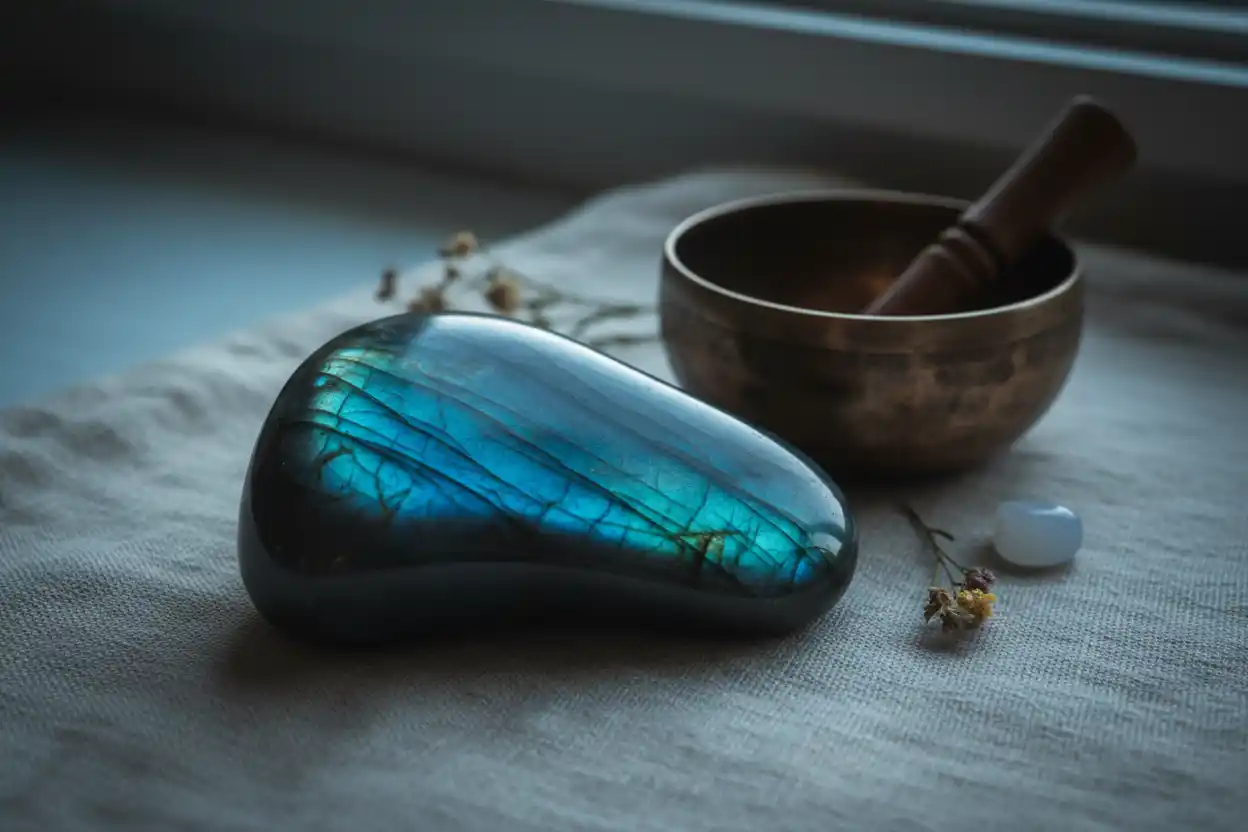
How to Cleanse and Charge Labradorite
The safest ways to cleanse and charge Labradorite are sound, intention, visualization, gentle breath, indirect indoor moonlight, and a written dedication. A brief damp wipe or lukewarm rinse may be suitable for a sound polished piece, but prolonged soaking, salt burial, steam, ultrasonic vibration, and rough contact should be avoided.
Labradorite is a brittle plagioclase feldspar with strong cleavage. Its blue, green, gold, orange, or multicolored labradorescence comes from internal structure rather than a surface coating, so aggressive polishing cannot strengthen the flash and may instead damage the stone.
What Cleansing and Charging Mean
Cleansing is a personal or spiritual ritual used to mark a new beginning, release earlier associations, or prepare an object for intentional use.
Charging generally means dedicating the stone to a purpose, routine, memory, or personal value.
Neither practice is required to preserve Labradorite. No established scientific evidence shows that cleansing alters its chemistry, labradorescence, health effects, or measurable physical energy.
The gemstone’s geology, optical effect, localities, and traditional symbolism belong to the broader Labradorite guide.
Belief-based wellness claims belong separately to Labradorite Healing Properties.
Why Labradorite Requires Feldspar-Safe Rituals
Labradorite belongs to the plagioclase series within the feldspar group.
Its material-family context appears in the Feldspar guide.
Labradorite normally ranks approximately 6 to 6.5 on the Mohs scale. It is brittle and has perfect cleavage in one direction, less-perfect cleavage in another, and an additional distinct cleavage direction.
| Property | Ritual implication |
|---|---|
| Mineral group | Feldspar |
| Series | Plagioclase |
| Mohs hardness | Approximately 6 to 6.5 |
| Tenacity | Brittle |
| Cleavage | Perfect, less perfect, and distinct in different directions |
| Optical effect | Labradorescence |
| Safest ritual methods | Sound, intention, visualization, breath, and indoor moonlight |
| Water exposure | Brief contact only for sound material |
| Main risks | Cleavage, chips, scratches, fractures, glue, coatings, matrix, and settings |
The gemstone hardness chart explains why Quartz, Topaz, Sapphire, and many other stones can scratch Labradorite.
The gem’s brittleness and cleavage create additional risks beyond surface wear. Those distinctions appear in Gemstone Toughness vs Hardness and Gemstone Cleavage Explained.
Labradorescence Is Internal
Labradorescence is an iridescent optical effect produced by light interacting with fine internal structures within the feldspar.
The flash may appear blue, green, gold, orange, red, purple, or multicolored depending on orientation and internal layering.
It can disappear when the stone is turned away from the correct viewing angle.
This change does not mean the Labradorite has lost energy or needs stronger cleansing.
Cleaning may remove surface oil that obscures the polish, but it cannot reposition internal structures, enlarge a color patch, or create a flash where cutting orientation is poor.
The full range of appearances belongs to Types of Labradorite.
Inspect the Labradorite First
Examine the stone beneath bright, indirect light.
Look for open fractures, chipped edges, cleavage-related lines, worn polish, damaged drill holes, loose settings, cloudy glue, lifting backing, or color transfer.
Natural internal lamellae, inclusions, and dark lines are not necessarily damage.
However, a line that catches on a cloth, widens during handling, or reaches a freshly chipped edge may indicate a fracture.
Thin slabs, carved points, broad cabochons, and beads with large drill holes require careful support.
When the stone is loose or visibly fractured, use a non-contact ritual.
Physical Cleaning Is Separate
A symbolic ritual does not remove dust, cosmetics, skin oil, or residue.
The full physical-care method belongs to How to Clean Labradorite Jewelry Safely.
A stable polished stone can be cleaned briefly with lukewarm water, mild soap, and a soft cloth or brush.
Ultrasonic and steam equipment should be avoided because vibration, heat, and pressure can stress cleavage, fractures, settings, and glue.
The machine-specific comparison belongs to Which Gemstones Can Go in an Ultrasonic Cleaner?.
Dry the stone completely before beginning a spiritual ritual.
Method 1: Cleanse Labradorite with Sound
Place the Labradorite on a folded cloth or padded tray.
Ring a bell, chime, tuning fork, or singing bowl nearby. You may also hum, chant, clap gently, or play calm music.
Do not place it inside a metal bowl or allow it to vibrate against ceramic, glass, or another stone.
Several gentle tones are sufficient.
Sound is especially suitable for fractured cabochons, glued pendants, elastic bracelets, matrix specimens, and stones whose construction is uncertain.
Method 2: Use Intention
Leave the Labradorite supported on a soft surface or hold it loosely above a cloth.
Choose one practical purpose. It might remind you to protect focused work time, prepare carefully for change, review a decision from several perspectives, or maintain a boundary during a demanding period.
State the intention silently or aloud.
The changing flash can serve as a personal metaphor for perspective without implying that labradorescence creates measurable energetic effects.
Return the stone to a protected storage area after the ritual.
Method 3: Use Visualization
Place Labradorite where it cannot roll or fall.
Imagine previous associations fading while its internal flash becomes linked with the chosen purpose.
Some practitioners visualize blue, green, gold, white, or neutral light. Others follow the natural color movement as they tilt the stone slightly.
The image is symbolic rather than a physical alteration of the feldspar.
Avoid repeatedly turning a thin or fractured stone in the hands. Visualization works equally well while the object remains still.
Method 4: Use Gentle Breath
Keep the Labradorite on a padded cloth.
Take several slow breaths and exhale gently toward it once or twice.
Avoid creating visible condensation around fractures, drill holes, glue seams, elastic, or metal settings.
Do not hold a large slab by one edge.
State the intention after the brief breath ritual.
Method 5: Use Indirect Moonlight Indoors
Place Labradorite indoors near a window on a padded tray or inside an open lined jewelry box.
An hour, an evening, or overnight indoor placement may be used.
Outdoor placement introduces dew, rain, grit, animals, temperature changes, and accidental impact.
The moon phase affects personal symbolism rather than the gemstone’s physical properties.
The wider light-exposure framework belongs to Which Crystals Can and Can’t Go in the Sun.
Method 6: Use a Written Dedication
Write one concise statement and place it beside the Labradorite.
A practical statement might focus on adapting to a new role, noticing information before reacting, protecting creative time, or approaching uncertainty methodically.
Keep clips, staples, pens, and metal objects away from the polished surface.
Leave the arrangement for several minutes or an evening.
A written method keeps the stone dry and limits unnecessary handling.
Method 7: Use a Brief Water Ritual
A sound polished Labradorite can receive a brief lukewarm rinse.
Hold it over a padded bowl rather than a hard sink. Dry it immediately and allow moisture around settings or drill holes to evaporate.
Do not soak it for hours or overnight.
Avoid water for open fractures, glued cabochons, matrix specimens, elastic strands, coated material, antique settings, or stones combined with water-sensitive components.
The wider water-safety comparison belongs to Which Crystals Can and Can’t Go in Water.
Method 8: Use a Companion Object with a Barrier
Some practitioners place Labradorite near Moonstone, Sunstone, Clear Quartz, Selenite, a photograph, or a written intention.
Use separate padded supports.
Quartz is harder and can scratch Labradorite. Another feldspar may also chip it when hard grit becomes trapped between the stones.
Direct contact is unnecessary for the symbolic arrangement.
The general method comparison belongs to How to Cleanse Crystals.
Labradorite, Moonstone, and Rainbow Moonstone
Labradorite and Moonstone both belong to the feldspar group, but their optical effects and typical compositions differ.
The full distinction belongs to Labradorite vs Moonstone.
Traditional Moonstone displays adularescence, while Labradorite displays labradorescence.
“Rainbow Moonstone” is commonly a trade name for white labradorite that shows blue or multicolored flashes. Its material profile belongs to the Rainbow Moonstone guide.
The Moonstone ritual page is How to Cleanse and Charge Moonstone.
All these feldspars require protection from cleavage-related impact and rough handling.
Labradorite and Sunstone
Sunstone is another feldspar material, but it typically displays aventurescence or reflective inclusions rather than classic labradorescence.
Its material profile belongs to the Sunstone guide, while its ritual care appears in How to Cleanse and Charge Sunstone.
Some Oregon Sunstone is itself copper-bearing labradorite.
Shared feldspar chemistry does not make every specimen identical. Inclusion type, cleavage, fractures, setting, and treatment still matter.
Avoid Direct Salt Burial
Salt grains can scratch Labradorite and become trapped inside fractures, drill holes, setting openings, and rough surfaces.
Saltwater adds prolonged moisture and may damage glue, elastic, metal, coatings, and companion stones.
Do not press a broad cabochon or slab into coarse salt.
When salt has symbolic importance, keep it in a separate bowl while the Labradorite remains on a lined dish nearby.
Avoid Soil Burial
Soil contains Quartz grains, mineral debris, moisture, fertilizers, microorganisms, and organic acids.
These materials can scratch polished feldspar, lodge inside fractures, or weaken stringing.
Outdoor burial also creates pressure and loss risks.
A nature-based alternative places Labradorite near a plant while keeping it dry and separated from soil.
Avoid Steam, Ultrasound, and Thermal Shock
Steam combines heat, pressure, and rapid temperature change.
Ultrasonic equipment applies vibration that can stress cleavage and fractures.
Neither method is necessary for symbolic cleansing.
Keep Labradorite away from boiling water, radiators, heated bowls, saunas, open flame, and abrupt temperature changes.
A short dry ritual provides the intended symbolism without exposing the feldspar to machinery.
Use Smoke Conservatively
A brief cool-smoke ritual may be used cautiously in traditions that include it.
Keep the stone away from flames, hot ash, incense coals, and heated containers.
Smoke can leave oily residue that dulls the polish and temporarily reduces the visible flash.
Sound, intention, and visualization provide cleaner alternatives.
Jewelry-Specific Ritual Care
A Labradorite ring should remain on a padded tray because rings often have exposed cabochons and worn bezels.
Labradorite earrings should be separated so their posts cannot scratch the opposite stone.
A Labradorite necklace should be laid flat so its chain cannot rub across the polish.
Likewise, a Labradorite bracelet should not be soaked when it contains elastic, knots, multiple drill holes, or glued caps.
Buying and Value Context
The Labradorite buying guide covers flash color, coverage, viewing angle, body color, cracks, polish, cutting orientation, treatment, and construction.
Market factors belong to the Labradorite price guide.
A cleansing ritual cannot improve weak labradorescence, reposition the flash, or restore a deeply scratched surface.
Those issues depend on cutting orientation and physical condition rather than symbolic preparation.
Frequently Asked Questions
1. What is the safest way to cleanse Labradorite?
Sound, intention, visualization, gentle breath, a written dedication, and indirect indoor moonlight are the safest methods.
2. Can Labradorite be cleansed in water?
A sound polished stone may receive a brief lukewarm rinse. Avoid soaking fractured, glued, coated, strung, or matrix-supported pieces.
3. Can Labradorite be left in moonlight overnight?
Yes, when kept indoors on a padded surface.
4. Can Labradorite be charged in sunlight?
Brief indirect light is generally less concerning than impact or heat, but prolonged outdoor exposure is unnecessary.
5. Can Labradorite be cleansed with salt?
Direct salt contact is best avoided because grains can scratch feldspar and enter fractures or settings.
6. Can Labradorite be cleansed with smoke?
A brief cool-smoke ritual is possible, but residue can dull the polish and obscure the flash.
7. Can Clear Quartz charge Labradorite?
Some practitioners use it symbolically. Keep the stones separated because Quartz is harder and can scratch Labradorite.
8. Does cleansing strengthen labradorescence?
No. The optical flash depends on internal structure, cutting orientation, lighting, and surface polish.
9. Is Rainbow Moonstone a type of Labradorite?
The trade name commonly refers to white labradorite displaying blue or multicolored labradorescence.
10. How long should Labradorite charge?
A few minutes or an evening is sufficient. There is no scientifically required duration.
11. How often should Labradorite be cleansed?
Use a schedule that fits your practice while minimizing soaking, impact, and unnecessary handling.
12. Does cleansing change Labradorite scientifically?
No established evidence shows that cleansing alters its chemistry, labradorescence, health effects, or measurable physical energy.
Conclusion
Labradorite’s changing flash comes from internal feldspar structure rather than a surface layer that needs forceful renewal. Sound, intention, visualization, and protected moonlight preserve its polish and cleavage-sensitive body while allowing the ritual to remain personal. When the flash seems weak, change the lighting angle before changing the cleansing method.
Crystal cleansing and charging are spiritual or personal practices, not scientifically established methods for changing health, energy, or the physical properties of Labradorite.