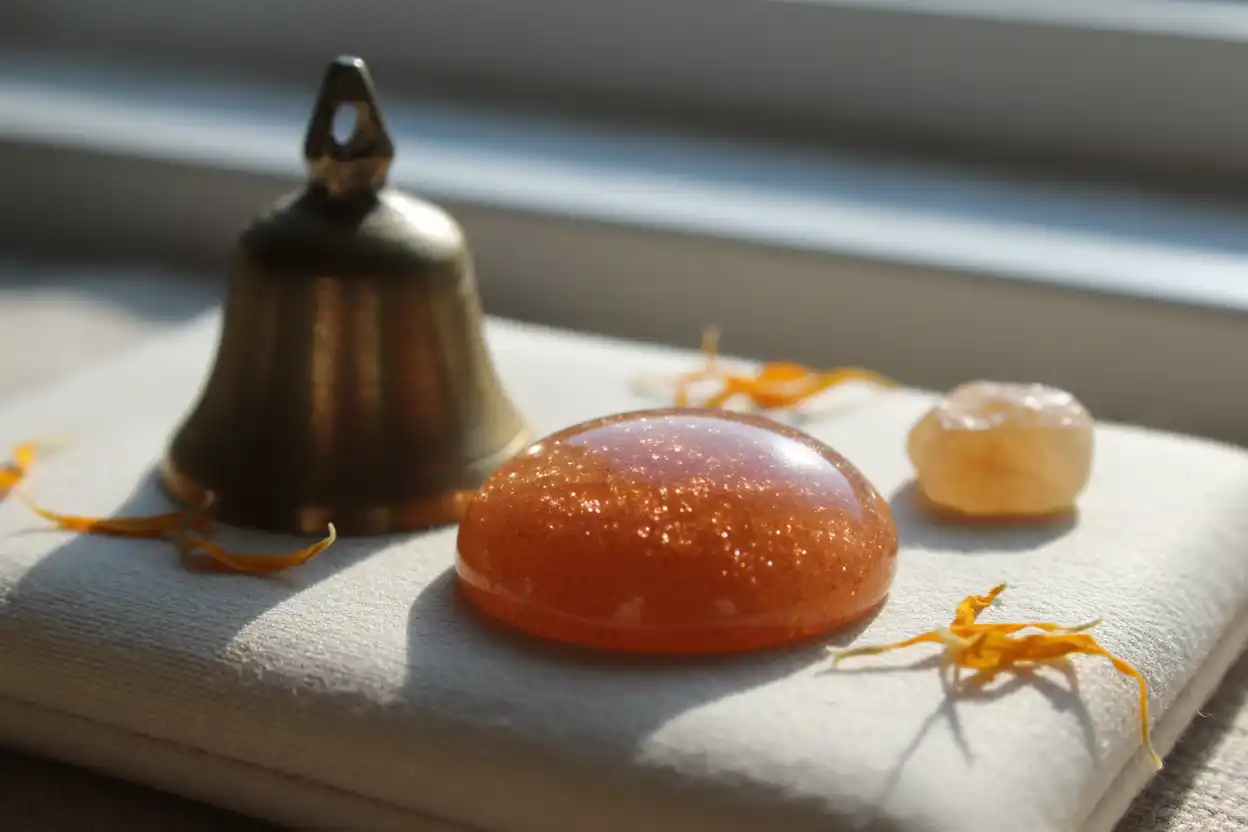
How to Cleanse and Charge Sunstone
The safest ways to cleanse and charge Sunstone are sound, intention, visualization, gentle breath, indirect indoor moonlight, a written dedication, and a brief lukewarm-water rinse when the gem is physically sound. These methods preserve its feldspar body, reflective inclusions, polish, fractures, and setting.
Sunstone’s warm appearance does not mean it must be charged in intense sunlight. Its color is generally light stable, but hot windowsills, steam, abrupt temperature changes, acids, salt burial, and rough contact create unnecessary risks for a brittle gem with cleavage in two directions.
What Cleansing and Charging Mean
Cleansing is a personal or spiritual ritual used to mark a new beginning, release previous associations, or prepare an object for meditation.
Charging generally means connecting the gem with a purpose, habit, value, project, or personal reminder.
Neither practice is required to preserve Sunstone. No established scientific evidence shows that cleansing changes its feldspar structure, optical effect, health benefits, or measurable physical energy.
The gemstone’s geology, inclusions, localities, colors, and traditional symbolism belong to the broader Sunstone guide.
Sunstone Is a Feldspar Material
Sunstone is a trade and gemological name used for feldspar displaying warm body color, aventurescence, reflective inclusions, or related visual effects.
Depending on origin and composition, it may be oligoclase, labradorite, or another feldspar.
Its broader mineral-family context belongs to the Feldspar guide.
| Property | Ritual implication |
|---|---|
| Mineral family | Feldspar |
| Common colors | Colorless, yellow, peach, orange, red, green, brown, or bicolored |
| Mohs hardness | Approximately 6.5 to 7.2 |
| Toughness | Poor |
| Cleavage | Two directions |
| Common optical feature | Aventurescence or schiller |
| Light stability | Generally stable |
| Safest ritual methods | Sound, intention, visualization, moonlight, and brief water contact |
| Main risks | Cleavage, impact, heat, acid, filling, glue, and settings |
The gemstone hardness chart explains why Sunstone is more scratch resistant than Fluorite, Calcite, Turquoise, and many ornamental stones.
Nevertheless, feldspar cleavage can allow a hard blow to split or chip the gem.
The distinction between hardness and resistance to breaking appears in Gemstone Toughness vs Hardness, while the weak structural directions are explained in Gemstone Cleavage Explained.
Aventurescence Is Not Surface Glitter
Sunstone’s sparkle comes from reflective platelets or inclusions within the feldspar.
Depending on the material, these inclusions may include copper, Hematite, Goethite, or related particles.
Light reflecting from the inclusions can produce flashes, glitter, directional sheen, color zoning, or a metallic appearance.
The effect is internal rather than glitter painted onto the surface.
Physical cleaning may remove grease that obscures the polish, but it cannot add inclusions or strengthen weak aventurescence.
The complete range of varieties belongs to Types of Sunstone.
Inspect the Sunstone Before Beginning
Examine the gem under bright, indirect light.
Look for open fractures, chipped corners, cleavage-related cracks, damaged drill holes, loose prongs, cloudy glue, worn facet edges, stretched elastic, peeling coatings, and movement inside the setting.
Reflective platelets, color zones, and fine inclusions are not dirt.
Do not scrape a metallic-looking inclusion or press against an internal line.
Thin cabochons, carved points, faceted corners, and broad flat stones require full support rather than pressure at one edge.
When the stone moves or a fracture reaches the surface, use a completely non-contact ritual.
Treatment and Filling Matter
Oregon Sunstone is generally marketed without appearance-enhancing treatment.
Pale feldspar from other sources may receive treatment intended to alter or improve color.
Rare Sunstone may also be fracture filled.
The wider enhancement framework belongs to Gemstone Treatments Explained.
A fracture-filled gem should receive only warm-soapy-water physical care and gentle ritual handling.
When treatment is uncertain, sound, intention, visualization, and protected moonlight provide the widest safety margin.
Physical Cleaning Is Separate
Symbolic cleansing does not remove cosmetics, skin oil, dust, or residue beneath a setting.
The complete physical-care procedure belongs to How to Clean Sunstone Jewelry Safely.
Warm water, mild liquid soap, and gentle brushing are suitable for a sound stone.
Ultrasonic and steam cleaners should be avoided because vibration, heat, fractures, and cleavage create risks.
The broader machine-cleaning comparison belongs to Which Gemstones Can Go in an Ultrasonic Cleaner?.
Allow the gem and setting to dry before beginning a symbolic ritual.
Method 1: Cleanse Sunstone with Sound
Place the Sunstone on a thick folded cloth or padded tray.
Ring a bell, chime, tuning fork, or singing bowl nearby. You may also hum, chant, clap softly, or play calm music.
Do not place the gemstone inside a hard metal bowl while striking it.
Concentrated vibration and contact can stress cleavage planes, chip a corner, or damage the mounting.
Several gentle tones are sufficient.
Sound works for faceted gems, cabochons, beads, carvings, fracture-filled stones, and jewelry with uncertain construction.
Method 2: Use Intention
Leave the Sunstone supported on a soft surface or hold it loosely above a cloth.
Choose one concise purpose. It might remind you to begin a project confidently, make a decision independently, maintain enthusiasm through routine work, or take responsibility for a practical goal.
State the intention silently or aloud.
A clear behavior provides a stronger personal reference than a long list of spiritual promises.
The stone does not need to be squeezed, warmed, or exposed to strong light.
Method 3: Use Visualization
Place Sunstone where it cannot roll or fall.
Imagine earlier associations fading while its warm color and internal flashes become connected with your chosen purpose.
Some practitioners visualize gold, orange, red, green, white, or neutral light.
The imagery is symbolic rather than a physical change within the feldspar.
Continue for several slow breaths or a few minutes.
Visualization is especially suitable for valuable, fractured, filled, glued, or antique Sunstone because it requires no environmental exposure.
Method 4: Use Gentle Breath
Keep the jewel on a padded cloth.
Take several slow breaths and exhale gently toward it once or twice.
Avoid visible condensation around fractures, drill holes, glue seams, prongs, and settings.
Do not hold a thin cabochon or slab by one edge.
State the intention afterward.
Method 5: Use Indirect Moonlight Indoors
Place Sunstone indoors near a window on a lined tray or inside an open jewelry box.
An hour, an evening, or overnight indoor placement may be used.
The moon phase affects personal symbolism rather than feldspar chemistry.
Outdoor placement introduces rain, dew, grit, animals, theft, and rapid temperature changes.
Indoor moonlight offers a protected ritual even though Sunstone’s color is generally stable under ordinary light.
The broader environmental comparison belongs to Which Crystals Can and Can’t Go in the Sun.
Method 6: Use Brief Indirect Daylight
Sunstone’s color is generally light stable, so brief indirect daylight can be used when daylight has personal symbolic importance.
Place the gem inside on a padded surface for several minutes or part of a morning.
Avoid a hot windowsill, closed vehicle, intense lamp, or prolonged outdoor exposure.
Heat—not ordinary visible light—is the more relevant care concern.
Brief daylight does not increase the stone’s physical energy or change its inclusions.
Method 7: Use a Brief Water Ritual
A sound, securely mounted Sunstone can receive a brief rinse in clean lukewarm water.
Hold it over a padded bowl rather than an open drain.
Dry the gemstone promptly and allow water beneath the setting to evaporate.
Avoid prolonged soaking, especially for fracture-filled stones, glued cabochons, elastic strands, antique settings, or pieces containing water-sensitive companion materials.
The broader water framework belongs to Which Crystals Can and Can’t Go in Water.
Method 8: Use a Written Dedication
Write one concise statement and place it beside the Sunstone.
A practical statement might focus on beginning one postponed task, making a decision independently, speaking with confidence, or continuing a project after its initial excitement has passed.
Keep pens, staples, clips, and metal objects away from the gem.
Leave the arrangement for several minutes or an evening.
A written dedication creates a repeatable ritual without exposing the feldspar to salt, heat, smoke, or impact.
Sunstone and Oregon Sunstone
Oregon Sunstone is commonly labradorite feldspar from Oregon and may contain native copper inclusions.
Its material profile belongs to the Oregon Sunstone guide.
Colors may include pale yellow, peach, orange, red, green, and bicolor combinations. Copper platelets can produce schiller, while some valuable transparent stones show little visible glitter.
The absence of aventurescence does not make a verified Oregon gem inauthentic.
A ritual should not involve scratching, heat, acid, or grinding to test copper content.
Sunstone and Labradorite
Some Sunstone belongs compositionally to the labradorite portion of the plagioclase feldspar series.
Labradorite is better known for labradorescence, while Sunstone is associated more often with warm color and aventurescence.
The wider Labradorite profile belongs to the Labradorite guide.
Its dedicated ritual care appears in How to Cleanse and Charge Labradorite.
Both materials share feldspar cleavage and should be protected from ultrasound, steam, impact, and hard contact.
Sunstone and Moonstone
Sunstone and Moonstone are both feldspar materials, but their common optical effects differ.
Moonstone displays adularescence produced by internal feldspar layering.
Its material profile belongs to the Moonstone guide, while its ritual care appears in How to Cleanse and Charge Moonstone.
Both gems can use sound, intention, visualization, indoor moonlight, and brief water contact when physically suitable.
Neither should be treated as impact resistant merely because the polished surface appears hard.
Avoid Hydrochloric Acid and Bleach
Feldspar can be attacked rapidly by hydrochloric acid.
Some cleaning products containing bleach or acidic compounds may therefore damage Sunstone.
Do not use bleach, toilet cleaner, descaling product, hydrochloric acid, vinegar mixtures, or chemical test solutions.
A visible surface change indicates damage rather than successful cleansing.
When treatment or fracture filling is present, even milder solvents and cleaners may create problems.
Avoid Direct Salt Burial
Salt grains can scratch Sunstone, lodge in fractures and drill holes, and abrade metal settings.
Saltwater adds prolonged moisture and may affect glue, filler, thread, elastic, enamel, and companion stones.
Do not press a faceted or polished gem into coarse salt.
When salt carries personal symbolism, keep it in a separate bowl while the Sunstone remains on a lined tray nearby.
Avoid Soil Burial
Soil contains Quartz grains, moisture, fertilizers, microorganisms, organic acids, and mineral debris.
These materials can scratch feldspar, enter fractures, lodge beneath settings, and create pressure during burial.
Outdoor burial also introduces loss and temperature risks.
A safer nature-based ritual places Sunstone near a potted plant while keeping it dry and separated from soil.
Avoid Steam, High Heat, and Thermal Shock
Exposure to heat is not recommended for Sunstone.
Keep the gemstone away from steam cleaners, boiling water, flame, incense coals, fireplaces, radiators, hot vehicles, heated ritual bowls, and repair torches.
Sudden movement between hot and cold environments can add stress to fractures and cleavage planes.
A stone called Sunstone does not require heat to be symbolically charged.
Use Smoke Conservatively
A brief cool-smoke ritual may be used cautiously.
Keep the gem away from flame, hot ash, and incense coal.
Smoke can leave residue that dulls the polish and obscures aventurescence until the stone is cleaned.
Sound, intention, and visualization provide cleaner alternatives.
Buying, Price, and Jewelry Context
The Sunstone buying guide covers color, aventurescence, transparency, copper inclusions, cut, fractures, origin, treatment, and disclosure.
Market factors belong to the Sunstone price guide.
A Sunstone ring requires particular care because rings receive more impacts than pendants and earrings.
A ritual cannot improve inclusion orientation, create aventurescence, repair cleavage, or prove Oregon origin. Those questions belong to cutting, condition, provenance, and gemological examination.
Frequently Asked Questions
1. What is the safest way to cleanse Sunstone?
Sound, intention, visualization, gentle breath, writing, and indirect indoor moonlight are safest.
2. Can Sunstone be cleansed in water?
A sound gemstone may receive a brief lukewarm rinse. Avoid soaking filled, fractured, glued, strung, or antique pieces.
3. Can Sunstone be left in moonlight overnight?
Yes, when kept indoors on a padded surface.
4. Can Sunstone be charged in sunlight?
Its color is generally light stable, but indirect daylight is preferable because hot surfaces and outdoor exposure create unnecessary risks.
5. Can Sunstone be cleansed with salt?
Direct salt burial is not recommended because grains can scratch feldspar and enter fractures or settings.
6. Can Sunstone be cleansed with smoke?
A brief cool-smoke ritual is possible, but residue may temporarily obscure its sparkle.
7. Can Clear Quartz charge Sunstone?
Some practitioners use it symbolically. Keep the stones separated because Quartz can scratch feldspar.
8. Does cleansing strengthen aventurescence?
No. The sparkle depends on reflective inclusions, cutting orientation, lighting, and surface polish.
9. Is Oregon Sunstone treated?
Oregon Sunstone is generally not treated to improve appearance, although disclosure should still be requested for any finished gem.
10. Why can Sunstone chip despite its moderate hardness?
It has poor toughness and cleavage in two directions.
11. How long should Sunstone charge?
A few minutes or an evening is sufficient. There is no scientifically required duration.
12. Does cleansing change Sunstone scientifically?
No established evidence shows that cleansing changes its feldspar structure, inclusions, health effects, or measurable physical energy.
Conclusion
Sunstone’s warm color and reflective inclusions may suggest heat and bright sunlight, but its feldspar structure benefits more from stable, controlled handling. Sound, intention, visualization, brief water contact, and protected light preserve the gem without stressing its cleavage. The safest ritual keeps the sparkle internal and the stone’s surface free from acid, salt, residue, and fresh chips.
Crystal cleansing and charging are spiritual or personal practices, not scientifically established methods for changing health, energy, or the physical properties of Sunstone.