How to Cleanse and Charge Rhodochrosite
The safest ways to cleanse and charge Rhodochrosite are sound, intention, visualization, gentle breath, indirect indoor moonlight, a written dedication, and careful dry-cloth handling. A brief damp wipe may be appropriate for a sound polished stone, but soaking, acid, salt, steam, ultrasound, and rough contact should be avoided.
Rhodochrosite is a soft, brittle manganese carbonate with perfect cleavage. Its polished bands, crystal faces, stalactitic structures, and faceted edges can scratch or split far more easily than Quartz, Garnet, Tourmaline, or Corundum.
What Cleansing and Charging Mean
Cleansing is a personal or spiritual ritual used to mark a transition, release previous associations, or prepare an object for intentional use.
Charging generally means connecting the stone with a purpose, relationship, memory, routine, or personal value.
Neither process is required to preserve Rhodochrosite. No established scientific evidence shows that symbolic cleansing changes its carbonate structure, manganese content, health effects, or measurable physical energy.
The mineral’s geology, pink color, banding, sources, and traditional symbolism belong to the broader Rhodochrosite guide.
This page remains focused on ritual methods that protect the material.
Rhodochrosite Is Manganese Carbonate
Rhodochrosite has the formula MnCO₃ and belongs to the Calcite mineral group.
It may occur as transparent rhombohedra, scalenohedra, bladed aggregates, botryoidal forms, stalactites, granular masses, and compact pink-and-white banded material.
| Property | Ritual implication |
|---|---|
| Composition | Manganese carbonate |
| Typical colors | Pink, rose red, cherry red, pale pink, yellowish gray, or brown |
| Mohs hardness | Approximately 3.5 to 4 |
| Tenacity | Brittle |
| Cleavage | Perfect rhombohedral cleavage |
| Common forms | Crystals, bands, stalactites, cabochons, beads, carvings, and faceted gems |
| Safest ritual methods | Sound, intention, visualization, breath, and indoor moonlight |
| Water exposure | Prefer dry methods; use minimal controlled moisture only when needed |
| Main risks | Scratches, cleavage, acid, heat, treatments, glue, matrix, and impact |
The gemstone hardness chart explains why glass, metal, ceramic, Quartz, and most common jewelry stones can scratch Rhodochrosite.
Its perfect cleavage and brittle tenacity create even greater practical concerns. The difference between scratch resistance and resistance to breakage appears in Gemstone Toughness vs Hardness.
The structural reason it can split smoothly is explained in Gemstone Cleavage Explained.
Banded Material and Transparent Crystals Need Different Handling
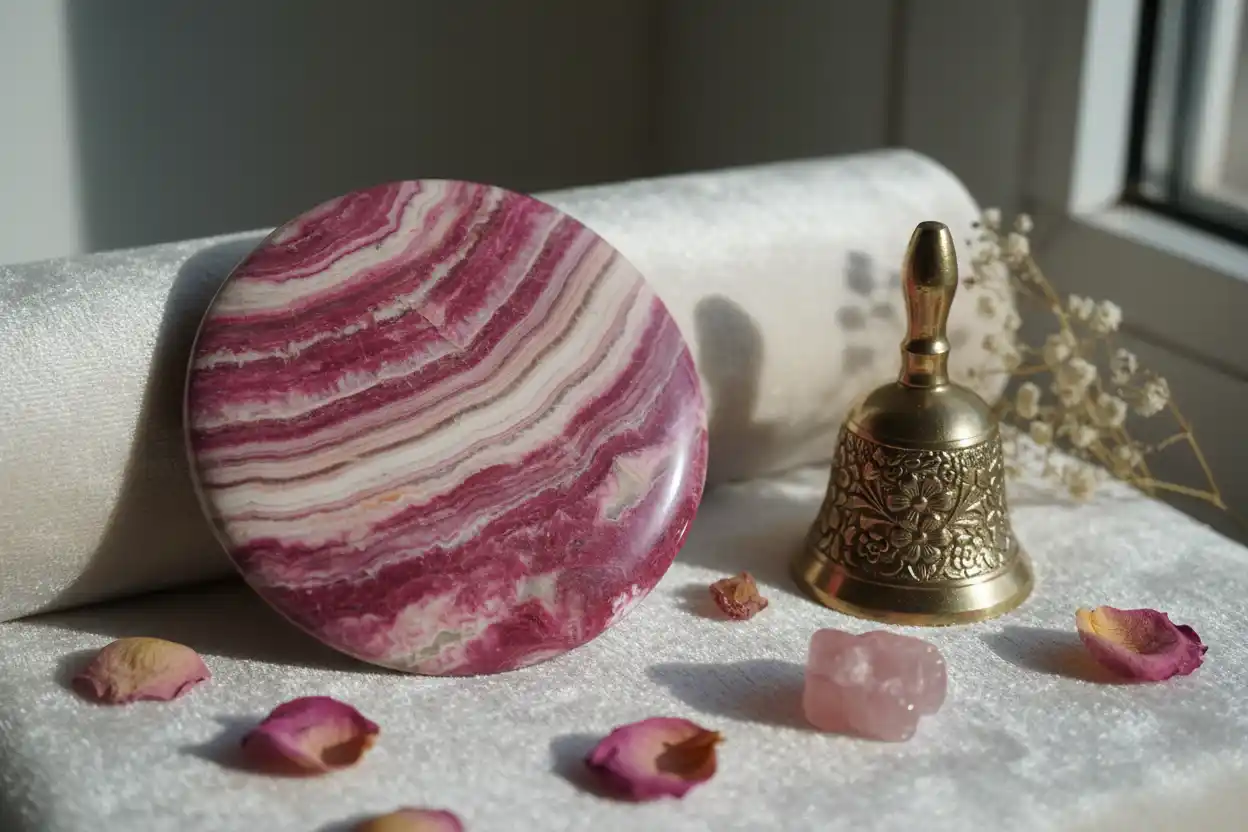
Argentine ornamental Rhodochrosite commonly displays pink, cream, white, gray, or brown bands formed in stalactitic or layered masses.
Transparent red or pink crystals may be faceted, although their softness and cleavage make them collector gems rather than carefree everyday jewelry.
Banded cabochons can be tougher in practical handling than an exposed transparent crystal, but neither is resistant to abrasion.
Thin slices may crack along bands or structural weaknesses. Crystal specimens can lose points or cleave under pressure.
When the object is a delicate crystal rather than a compact polished stone, use only non-contact methods.
Inspect the Rhodochrosite First
Examine the object beneath bright, indirect light.
Look for open fractures, fresh cleavage surfaces, chipped edges, cloudy glue, peeling coatings, color transfer, damaged drill holes, worn beads, loose settings, and powdery matrix.
White bands may be Rhodochrosite of different composition, Calcite, or another associated carbonate. They are not dirt.
Dark manganese oxides may also occur naturally around specimens.
Do not scrape black or brown areas, press against a cleavage line, or try to polish one color zone more strongly than another.
When the cloth catches against an edge, stop handling the piece.
Treatment and Impregnation
Rhodochrosite may be waxed, oiled, resin impregnated, stabilized, dyed, coated, backed, glued, reconstructed, or imitated.
Opaque ornamental materials are among the gem categories that may receive wax or polymer impregnation.
Treatment may improve apparent color or durability while increasing sensitivity to solvents, heat, prolonged moisture, and abrasion.
The broader treatment framework belongs to Gemstone Treatments Explained.
Do not apply acetone, alcohol, oil, heat, ultraviolet exposure, or scratching as an authenticity test.
Physical Cleaning Is Separate
Symbolic cleansing does not remove skin oil, cosmetics, dust, polishing compound, or setting residue.
A stable polished Rhodochrosite can be wiped with a very soft dry cloth.
When physical dirt requires moisture, use a cloth barely dampened with lukewarm water and a trace of mild soap, then dry the stone immediately.
Do not soak the piece.
Steam and ultrasonic equipment should never be used because vibration, heat, cleavage, treatments, and settings create substantial risk.
The broader equipment restriction belongs to Which Gemstones Can Go in an Ultrasonic Cleaner?.
Method 1: Cleanse Rhodochrosite with Sound
Place the stone on a thick folded cloth or padded tray.
Ring a bell, chime, tuning fork, or singing bowl nearby. You may also hum, chant, clap softly, or play gentle music.
Do not place the Rhodochrosite inside a hard bowl while striking it.
Direct vibration and contact may chip a crystal, split a cleavage-sensitive edge, or scratch a polished band.
Several gentle tones are sufficient.
Sound works for crystals, cabochons, beads, carvings, treated pieces, and antique jewelry.
Method 2: Use Intention
Leave the Rhodochrosite supported on a soft surface or hold a compact polished stone loosely above a cloth.
Choose one clear purpose. It might remind you to communicate honestly in a relationship, maintain a healthy boundary, address an unresolved conversation, or treat yourself and others with greater patience.
State the intention silently or aloud.
A specific behavior provides a more useful focus than unsupported promises of emotional or medical healing.
The stone does not need prolonged handling.
Method 3: Use Visualization
Place Rhodochrosite where it cannot roll or fall.
Imagine earlier associations fading while its pink-and-white bands become connected with your chosen purpose.
Some practitioners visualize pink, red, white, gold, or neutral light.
The imagery is symbolic and does not change the manganese-carbonate structure.
Continue for several slow breaths or a few minutes.
Visualization is especially suitable for transparent crystals, thin slices, repaired pieces, or valuable banded objects because it requires no contact.
Method 4: Use Gentle Breath
Keep the stone on a padded cloth.
Take several slow breaths and exhale gently toward it once or twice.
Avoid visible condensation around fractures, drill holes, glue seams, and settings.
Do not hold a crystal by a point or suspend a thin pendant by the stone.
State the intention afterward.
For a fragile specimen, direct breath toward the space above it rather than at the surface.
Method 5: Use Indirect Moonlight Indoors
Place Rhodochrosite indoors near a window on a padded tray or within an open lined jewelry box.
An hour, an evening, or overnight indoor placement may be used.
Outdoor placement introduces dew, rain, dirt, temperature changes, animals, and loss.
Indirect indoor moonlight also protects treatments, glue, stringing, and matrix from unpredictable environmental exposure.
The broader light comparison belongs to Which Crystals Can and Can’t Go in the Sun.
Method 6: Use a Written Dedication
Write one concise statement and place it beside the Rhodochrosite.
A practical statement might focus on having one honest conversation, maintaining a boundary, making time for an important relationship, or ending a repeated pattern respectfully.
Keep pens, clips, staples, and metal objects away from the soft surface.
Leave the arrangement for several minutes or an evening.
The method is suitable for delicate crystals because they remain supported and untouched.
Method 7: Use a Mindful Dry-Cloth Ritual
This method is appropriate only for a stable polished cabochon, carving, bead, or palm stone.
Place the object on a padded surface.
Wipe it once or twice with an exceptionally soft microfiber cloth while focusing on the chosen intention.
Use minimal pressure and stop if the cloth catches on a chip, cleavage edge, coating, or fracture.
Do not use a silver-polishing cloth, paper towel, jeweler’s rouge, toothpaste, or abrasive fabric.
Crystal specimens and powdery matrix should receive sound or visualization instead.
Method 8: Use a Companion Object with Separation
Rhodochrosite may be placed near Rhodonite, Rose Quartz, Mangano Calcite, Clear Quartz, a photograph, or a written intention.
Use separate cloths and leave physical space between all objects.
Quartz is much harder and can scratch Rhodochrosite. Metal chains, points, and rough stones may also chip the surface.
Direct contact is unnecessary.
The general method comparison belongs to How to Cleanse Crystals.
Rhodochrosite and Rhodonite
Rhodochrosite and Rhodonite can both appear pink, red, white, gray, brown, or black.
Rhodochrosite is a manganese carbonate, while Rhodonite is a manganese silicate.
Rhodonite is generally harder and often shows black manganese-oxide veining, whereas Rhodochrosite commonly displays cream-to-white banding and perfect carbonate cleavage.
The complete distinction belongs to Rhodochrosite vs Rhodonite.
The separate material profile belongs to the Rhodonite guide.
Cleaning response, acid, scratches, and destructive testing should never be used to identify a finished piece.
Rhodochrosite and Mangano Calcite
Rhodochrosite and Mangano Calcite are related carbonate materials that can overlap in pale pink color.
Mangano Calcite is Calcite containing manganese, while Rhodochrosite is manganese carbonate with possible substitution by calcium, iron, or magnesium.
The related material profile belongs to the Mangano Calcite guide.
Both are soft, brittle, cleavable, and acid sensitive.
The Calcite-specific ritual method appears in How to Cleanse and Charge Calcite.
When identity is uncertain, dry sound, intention, and visualization are suitable for either material.
Avoid Vinegar, Lemon Juice, and Acid
Rhodochrosite is a carbonate mineral and reacts with acids.
Vinegar, lemon juice, descaling products, bathroom cleaner, acid-based metal dips, and chemical test solutions may etch, pit, dull, or partially dissolve the surface.
Hot acids can react particularly strongly.
Fizzing, whitening, roughness, or color change indicates physical damage rather than successful cleansing.
Do not use acid to distinguish Rhodochrosite from Rhodonite or another pink mineral.
Avoid Prolonged Water Exposure
Neutral water does not react as aggressively as acid, but soaking still creates practical risks.
Water can enter cleavage openings, affect glue, mobilize unstable dye, leave deposits, weaken stringing, and expose differences between treated and untreated zones.
Wet Rhodochrosite is also slippery and easier to drop.
The broader water-selection framework belongs to Which Crystals Can and Can’t Go in Water.
Use a barely damp cloth only when physical dirt requires it.
Avoid Salt and Saltwater
Salt grains can scratch Rhodochrosite and lodge within cleavage openings, bands, fractures, drill holes, and settings.
Saltwater adds prolonged moisture and may affect glue, resin, wax, metal, stringing, and companion minerals.
Do not bury the stone directly in salt.
When salt carries personal symbolism, keep it in a separate bowl while the Rhodochrosite remains on a lined dish nearby.
Avoid Soil Burial
Soil contains Quartz grains, moisture, microorganisms, fertilizers, organic acids, and mineral debris.
These materials can scratch the surface, enter cleavage cracks, stain pale bands, and damage settings.
Outdoor burial also creates pressure and loss risks.
A nature-based alternative places Rhodochrosite near a plant while keeping it dry and separated from soil.
Avoid Heat, Steam, and Thermal Shock
Do not place Rhodochrosite near candles, incense coal, boiling water, radiators, fireplaces, steam cleaners, heated bowls, or repair torches.
Heat may affect glue, resin, wax, dye, coatings, and associated minerals.
Rapid temperature change can place stress on fractures and cleavage planes.
The pink color does not need heat or direct sun to become stronger.
Use Smoke Conservatively
A brief cool-smoke ritual may be used cautiously, but smoke can leave soot, oils, and fragrance residue on pale or porous surfaces.
Keep the stone away from flame, hot ash, and incense coal.
Removing smoke residue may require moisture and rubbing that the mineral does not tolerate well.
Sound, intention, and visualization provide cleaner alternatives.
Carbonate Comparisons
Aragonite is another calcium-carbonate mineral with different crystal structure and habits.
Its ritual care belongs to How to Cleanse and Charge Aragonite.
Malachite is a copper carbonate hydroxide rather than a member of the Calcite group, but it shares acid sensitivity. Its ritual boundaries appear in How to Cleanse and Charge Malachite.
The common practical rule across these minerals is to avoid vinegar, lemon juice, saltwater, and aggressive cleaning.
Buying and Visual Context
Purchase guidance belongs to Where to Buy Real Rhodochrosite.
Evaluate banding, color, transparency, cleavage damage, surface scratches, treatment, repairs, matrix condition, and seller disclosure.
The related buying guide for a pale pink comparison material is Where to Buy Real Mangano Calcite.
Rhodochrosite also belongs to the broader visual family in Pink Gemstones.
A cleansing ritual cannot restore a lost polish, repair cleavage, remove deep scratches, or prove that a pink stone is genuine.
Safety During Ritual Use
Do not lick, grind, burn, drill without controls, or place Rhodochrosite directly in drinking water.
Commercial objects may contain manganese-rich dust, associated sulfides, coatings, dye, resin, glue, or polishing residue.
Ordinary intact handling differs from deliberate ingestion or dust production.
The broader handling distinction belongs to the Toxic Crystals safety list.
Wash your hands after handling powdery, matrix-rich, or damaged specimens.
Frequently Asked Questions
1. What is the safest way to cleanse Rhodochrosite?
Sound, intention, visualization, gentle breath, a written dedication, and indirect indoor moonlight are safest.
2. Can Rhodochrosite be cleansed in water?
Avoid soaking. A stable polished stone may receive a brief damp wipe when physical cleaning is necessary.
3. Can Rhodochrosite be left in moonlight overnight?
Yes, when kept indoors on a stable padded surface.
4. Can Rhodochrosite be charged in sunlight?
Indirect indoor light is preferable because outdoor exposure adds heat, dirt, moisture, and treatment uncertainty.
5. Can Rhodochrosite be cleansed with salt?
No. Salt can scratch the mineral and lodge inside cleavage openings or settings.
6. Can Rhodochrosite be cleansed with smoke?
A brief cool-smoke ritual is possible, but sound or visualization avoids soot and residue.
7. Can vinegar clean Rhodochrosite?
No. Acids react with manganese carbonate and can etch or dissolve the surface.
8. Can Clear Quartz charge Rhodochrosite?
Some practitioners use it symbolically. Keep the stones separated because Quartz is much harder.
9. Is Rhodochrosite the same as Rhodonite?
No. Rhodochrosite is manganese carbonate, while Rhodonite is manganese silicate.
10. Why does Rhodochrosite break easily?
It is brittle, relatively soft, and has perfect rhombohedral cleavage.
11. How long should Rhodochrosite charge?
A few minutes or an evening is sufficient. There is no scientifically required duration.
12. Does cleansing change Rhodochrosite scientifically?
No established evidence shows that cleansing changes its carbonate structure, manganese content, health effects, or measurable physical energy.
Conclusion
Rhodochrosite’s pink bands and transparent crystals belong to a soft manganese carbonate whose beauty depends on avoiding abrasion, acid, and cleavage damage. Sound, intention, visualization, and protected moonlight provide meaningful rituals without forcing moisture or salt into its structure. A careful practice keeps every band, crystal edge, and polished surface physically unchanged.
Crystal cleansing and charging are spiritual or personal practices, not scientifically established methods for changing health, energy, or the physical properties of Rhodochrosite.