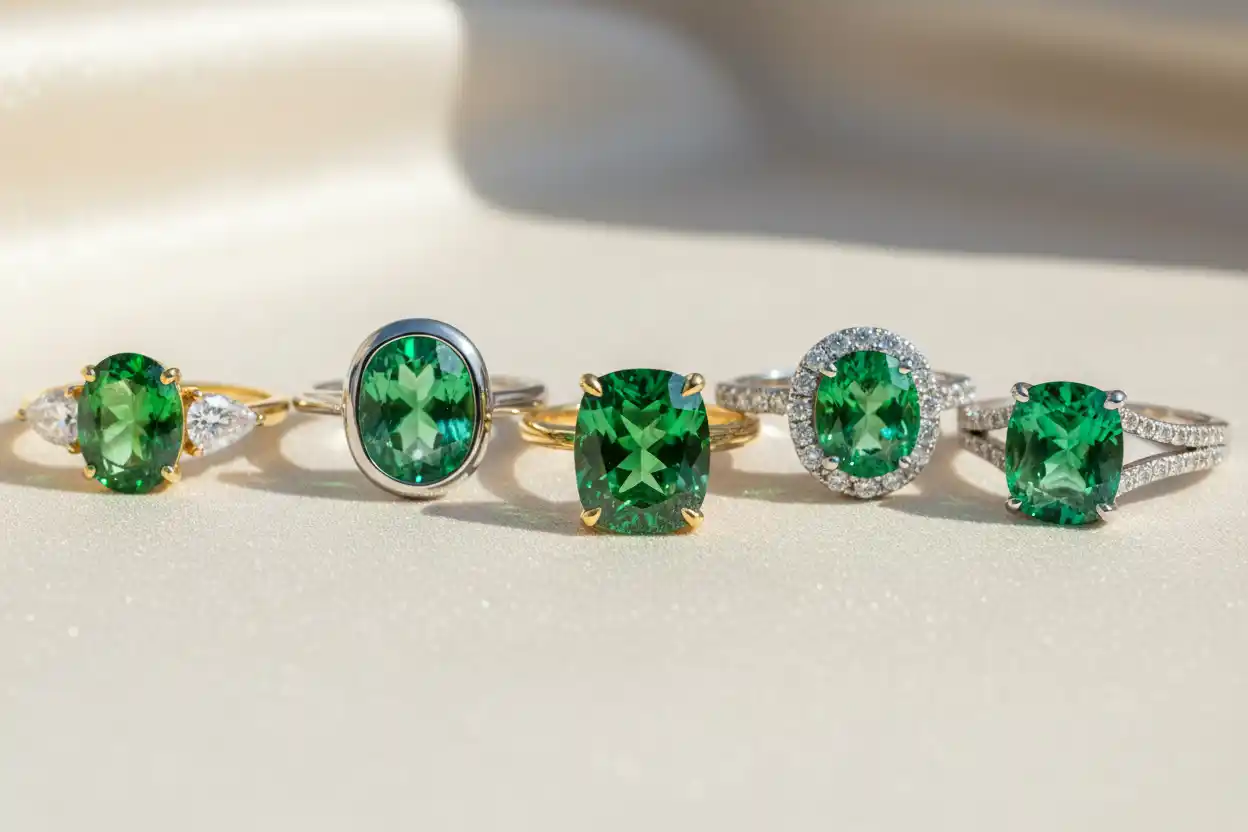
Tsavorite Rings: Styles and Buying Tips
Tsavorite rings combine vivid natural green with the brilliance and practical durability of Grossular Garnet. Fine stones can resemble Emerald in color while offering no cleavage, fair-to-good toughness and far fewer routine treatment concerns.
Those strengths make Tsavorite one of the more practical green center stones for rings. Nevertheless, it is not as hard or tough as Sapphire or Diamond. The hand remains a demanding environment, so setting protection, inclusion placement and realistic wear habits still matter.
A strong purchase begins with face-up color and cutting. It ends with a setting that holds the gem securely without exposing its girdle or corners to unnecessary impact.
Tsavorite Rings at a Glance
| Feature | What to Consider |
|---|---|
| Gem variety | Green Grossular Garnet |
| Typical colors | Yellowish green, vivid green and slightly bluish green |
| Main color agents | Vanadium, sometimes with chromium |
| Mohs hardness | Approximately 7–7.5 |
| Toughness | Fair to good |
| Cleavage | None |
| Popular ring styles | Solitaire, bezel, halo, three-stone, cluster and cocktail |
| Best protective setting | Low full or partial bezel |
| Engagement-ring suitability | Good with a protected setting and sensible wear |
| Treatment expectation | Usually untreated; rare fracture filling |
| Safe cleaning | Warm water, mild soap and a soft brush |
| Main ring concern | Impact, exposed girdles and surface-reaching fractures |
Is Tsavorite Good for Rings?
Tsavorite is a strong green ring choice.
Its hardness provides useful resistance to ordinary scratches, and the absence of cleavage removes one predictable breakage direction.
Fair-to-good toughness makes it suitable for regular jewelry when the stone is sound and the setting is protective.
The gem can still chip after a concentrated blow. Surface-reaching fractures and thin corners increase risk.
A low setting can support frequent wear, while very large or highly included stones are better reserved for controlled occasions.
The completed Tsavorite meaning guide owns mineral identity and symbolism. This page focuses on rings, settings and buying.
Tsavorite Solitaire Rings
A solitaire places one Tsavorite at the center.
Rounds produce strong brilliance. Ovals and cushions preserve rough efficiently while offering substantial face-up size.
Emerald cuts create clean geometric lines but reveal windowing and inclusions clearly. Pears provide a distinctive outline but need protection at the tip.
A high basket may allow more side light, although it increases impact and snagging.
A low setting generally offers stronger daily practicality. The center should remain stable rather than rotating constantly around the finger.
Bezel-Set Tsavorite Rings
A bezel surrounds most or all of the gemstone’s girdle.
This setting provides the strongest practical edge protection and creates a smooth profile.
Full bezels suit daily-wear rings and stones with minor inclusion concerns. Partial bezels expose more of the gem while leaving selected sides vulnerable.
The jeweler must close the metal gradually and evenly. Excessive pressure can damage a stone with a surface-reaching fracture.
Yellow gold creates warm contrast around green Tsavorite. White gold and platinum produce a cooler, sharper border.
Prong-Set Tsavorite Rings
Prongs expose more of the stone and allow more visible face-up area.
Four-prong settings create an open appearance but provide less redundancy. Six prongs offer additional security for larger round and oval gems.
Each prong should remain evenly tightened and positioned away from fractures.
Pear and marquise cuts require V-shaped protection. Trillions and emerald cuts also need reinforced corners.
Low substantial prongs are preferable to thin high claws that catch clothing or bend easily.
Halo Tsavorite Rings
A halo surrounds the Tsavorite with smaller accent stones.
Diamond and white Sapphire can intensify the center’s green and increase the complete outline.
The accents are harder than Tsavorite and must remain separated from the center’s girdle.
A low halo can provide partial impact protection. A tall double halo adds height and many prongs that require maintenance.
The center should remain visually dominant. An oversized surround may disguise weak Tsavorite color rather than complementing it.
Three-Stone Tsavorite Rings
Three-stone designs may use a Tsavorite center with Diamond, Sapphire or additional green Garnets.
Tapered baguettes provide a clean frame. Pear and round side stones create a softer composition.
Hard side gems require metal separation from the Tsavorite.
A ring using three Tsavorites can move from pale mint to vivid green or use closely matched colors.
The settings should keep the complete design low and comfortable between adjacent fingers.
Tsavorite Cluster Rings
Clusters use several small Tsavorites to create a broad visual surface.
This style can offer strong green coverage without requiring one rare large center.
Uniform clusters need stones matched in hue, tone and brilliance. A dark or heavily windowed gem will remain noticeable.
Every small stone creates another potential maintenance point.
The gallery should support the cluster while allowing access for cleaning.
Low clusters are more practical than tall floral arrangements for regular use.
Tsavorite Cocktail Rings
Tsavorite cocktail rings emphasize size, unusual cutting or elaborate settings.
Large fine Tsavorite is rare, making a substantial center a significant gemstone rather than merely a fashion component.
A high projecting gem remains vulnerable to impact even when its hardness is useful.
Broad shoulders and a stable shank help prevent rotation.
Cocktail designs should generally be removed for work, travel through crowded environments and activities involving hard surfaces.
Size should not compensate for weak color, excessive darkness or open fractures.
Tsavorite Engagement Rings
Tsavorite is a practical colored-gem engagement option when the wearer accepts appropriate care.
It offers vivid green, strong brilliance and limited routine treatment.
A low bezel, partial bezel or protective halo provides the safest foundation.
The wearer should remove the ring for weightlifting, gardening, cleaning, construction and work involving tools.
A separate activity ring may preserve a valuable center over decades of wear.
The planned green engagement-ring stones guide compares Tsavorite with Emerald, Sapphire, Tourmaline and other green options.
Evaluating Tsavorite Color
Color has the greatest effect on visual appeal.
Fine Tsavorite commonly shows vivid green or slightly bluish green with medium tone and strong saturation.
Yellowish-green stones can remain attractive when lively. Excessive gray, brown or darkness usually reduces demand.
Examine the stone in more than one light. A gem that looks brilliant under a concentrated spotlight may become nearly black indoors.
The completed Tsavorite buying guide owns the detailed selection process, while the completed Tsavorite price guide handles value.
Evaluating Clarity
Tsavorite may contain crystals, feathers, needles and fluid-related inclusions.
Small internal inclusions can confirm natural formation and may have little effect on wear.
Surface-reaching fractures near a prong, corner or girdle deserve more concern.
Inspect the ring from the side and beneath the setting. Metal can conceal fractures.
A fine ring stone should remain transparent and lively rather than hazy.
Rare fracture filling can improve apparent clarity and requires disclosure.
Evaluating Cut
A well-cut Tsavorite returns light evenly across its face.
Rounds are highly brilliant. Ovals and cushions often preserve valuable rough efficiently.
A shallow gem may show a transparent window. Excessive depth makes the stone look smaller and can create dark extinction.
Facet junctions should remain crisp and corners should remain intact.
The stone should sit straight in the setting. A tilted gem may reflect unevenly and apply pressure against one side of the mounting.
Carat Weight and Face-Up Size
Fine Tsavorite becomes progressively scarcer as size increases.
Carat weight alone does not determine visible impact. A deep stone may weigh more but appear smaller.
Compare length, width and depth in millimeters.
A bright, well-proportioned one-carat stone may look more impressive than a heavier dark or windowed gem.
Large centers also require stronger shanks and more protective settings.
Tsavorite Versus Emerald Rings
Tsavorite and Emerald are two important transparent green ring stones.
Tsavorite is Grossular Garnet with no cleavage and few routine treatment concerns. Emerald is green Beryl and commonly contains fractures enhanced with oil or resin.
Tsavorite often shows greater brilliance, while Emerald may display a deeper, softer green with characteristic inclusions.
The planned Tsavorite versus Emerald guide will own the direct mineralogical and buying comparison.
The completed Emerald ring guide explains Emerald-specific settings and maintenance.
Tsavorite Versus Demantoid Rings
Demantoid is green Andradite Garnet.
It has a higher refractive index and dispersion, which can produce stronger spectral flashes. Tsavorite is generally harder and may show a purer vivid green.
The completed Demantoid Garnet ring guide owns that variety’s design and care considerations.
The presence of a horsetail-like inclusion relates to certain Demantoids rather than Tsavorite.
Professional identification is appropriate when the variety name affects value.
Tsavorite Versus Green Sapphire
Green Sapphire is Corundum with a Mohs hardness of 9 and excellent toughness.
It can offer stronger durability for continuous hand wear, although its color character may appear grayer, bluer or less vivid than fine Tsavorite.
Tsavorite generally requires fewer routine treatments, while Sapphire is commonly heated.
Both can make practical engagement stones when accurately represented.
The completed Sapphire meaning guide provides broader Corundum context.
Tsavorite Within the Garnet Family
The planned Garnet ring guide covers Garnet varieties as a complete family.
The completed real-versus-fake Garnet guide explains imitation concerns.
The planned Garnet quality and grading guide will address the lack of a universal AAA grading scale.
Tsavorite’s ring guide remains focused on transparent green Grossular, its rarity and its suitability for hand wear.
Setting Height
Setting height directly affects impact exposure.
A low basket keeps the Tsavorite near the finger and reduces snagging.
High settings may provide a dramatic profile but place the girdle and pavilion closer to hard surfaces.
A very low design must still leave enough space beneath the gem to avoid pressure against the finger.
The ring should pass comfortably beneath sleeves and gloves used in ordinary life.
Setting Pressure
A jeweler should inspect the stone before tightening prongs or closing a bezel.
Pressure must be distributed evenly rather than concentrated near an inclusion.
Tension settings deserve caution because they depend on force against the gemstone.
Channel and flush-style settings may also stress girdles when designed or executed poorly.
A setting is protective because it shields the gem, not because it grips the stone with excessive force.
Choosing the Metal
Yellow gold provides warm contrast and suits yellowish or pure green Tsavorite.
White gold and platinum produce a cool, crisp frame.
Rose gold creates a more unusual pairing and may emphasize warm modifiers.
Sterling silver can hold small commercial stones, although its prongs and shank must remain substantial.
Metal hardness, allergy, maintenance and resizing options should be considered alongside color.
Ring Size and Comfort
Obtain an accurate finger measurement using a band with similar width.
Wide rings fit more tightly than narrow shanks.
A heavy center may rotate unless the shank is broad enough or fitted with sizing beads.
Try ordinary movements such as typing, gripping a cup and putting on a jacket.
The setting should not press painfully against neighboring fingers or catch repeatedly on clothing.
Resizing and Repair
Simple metal shanks can often be resized.
Full eternity designs, extensive pavé and complex halos have narrower adjustment limits.
The Tsavorite may need removal before torch work, especially when fractures or filling are present.
A jeweler should avoid steam and unnecessary ultrasonic cleaning during repair.
Discuss resizing limits before purchase, particularly when the center is custom cut.
January Birthstone Rings
Tsavorite belongs to the Garnet family, January’s birthstone.
The completed January birthstone guide explains Garnet’s diverse colors.
A Tsavorite ring offers an unexpected green alternative to traditional red Garnet.
The completed January birthstone jewelry guide compares ring gifts with earrings, necklaces and bracelets.
The birthstone connection does not change the ring’s need for protective design.
Comparing Other Tsavorite Jewelry
A completed Tsavorite bracelet guide creates a line of green stones but experiences more desk contact.
Tsavorite earrings offer low-impact wear and avoid sizing.
A Tsavorite necklace can display a larger gem with less abrasion.
Rings give the wearer maximum visibility and require the strongest daily-wear discipline.
Cleaning Tsavorite Rings
Use warm water, mild soap and a soft brush.
Work beneath the setting where soap and lotion accumulate. Rinse briefly and dry thoroughly.
Steam cleaning is not recommended.
Ultrasonic cleaning may be suitable for some sound Garnets, but it should be avoided when fractures or filling are present.
The completed guide to cleaning Tsavorite jewelry provides the detailed method.
Daily Wear
A protected Tsavorite ring can be worn regularly with sensible habits.
Remove it before weightlifting, gardening, cleaning and work with tools.
Avoid striking the stone against ceramic, stone or metal surfaces.
Do not stack it tightly beside Diamond, Sapphire or Topaz bands.
The completed gemstone hardness chart and gemstone toughness-versus-hardness guide explain why scratch resistance does not eliminate impact risk.
Storage
Keep the ring in a separate padded compartment.
Diamond, Sapphire and Topaz can scratch Tsavorite. Tsavorite can also scratch softer gemstones.
Do not allow several rings to move freely in one hard box.
Inspect the setting after a noticeable impact or whenever the stone begins to click.
Final Perspective
Tsavorite is one of the most practical vivid-green gemstones for rings because it combines attractive hardness, no cleavage, fair-to-good toughness and limited routine treatment.
Its durability still depends on the complete ring. A bright, sound stone in a low protective setting will usually outperform a larger gem with exposed edges, weak prongs or surface-reaching fractures.
Frequently Asked Questions
1. Is Tsavorite durable enough for a ring?
Yes. Its hardness of approximately 7–7.5, lack of cleavage and fair-to-good toughness support ring wear with reasonable care.
2. Can Tsavorite rings be worn every day?
Careful regular wear is possible, particularly in a low protective setting. Remove the ring for physical work and high-impact activity.
3. Which setting protects Tsavorite best?
A low full or partial bezel provides strong edge protection. Low halos and substantial prongs can also work.
4. Is Tsavorite suitable for an engagement ring?
Yes. It is one of the more practical green colored-gem choices when set protectively and worn responsibly.
5. What Tsavorite color is most valuable?
Vivid medium-tone green to slightly bluish green is generally highly prized, provided the stone remains bright rather than overly dark.
6. Is Tsavorite normally treated?
Routine treatment is uncommon. Rare fracture filling may occur and should be disclosed.
7. Is Tsavorite more durable than Emerald?
Tsavorite generally has no cleavage, fair-to-good toughness and fewer clarity-enhancement concerns, making it practical for many rings.
8. Is Tsavorite harder than Demantoid?
Tsavorite generally lies toward the harder side of the Garnet range, while Demantoid is somewhat softer.
9. Does Tsavorite scratch easily?
It resists many ordinary scratches but can be scratched by Topaz, Sapphire and Diamond.
10. Can a Tsavorite ring be resized?
Many simple shanks can be resized. Complex halos, eternity designs and filled stones may limit repair options.
11. Can Tsavorite be cleaned ultrasonically?
Warm soapy water is safer. Avoid ultrasonic cleaning when fractures or filling may be present.
12. How should a Tsavorite ring be stored?
Keep it in a separate padded compartment away from harder gemstones and inspect the setting after impact.