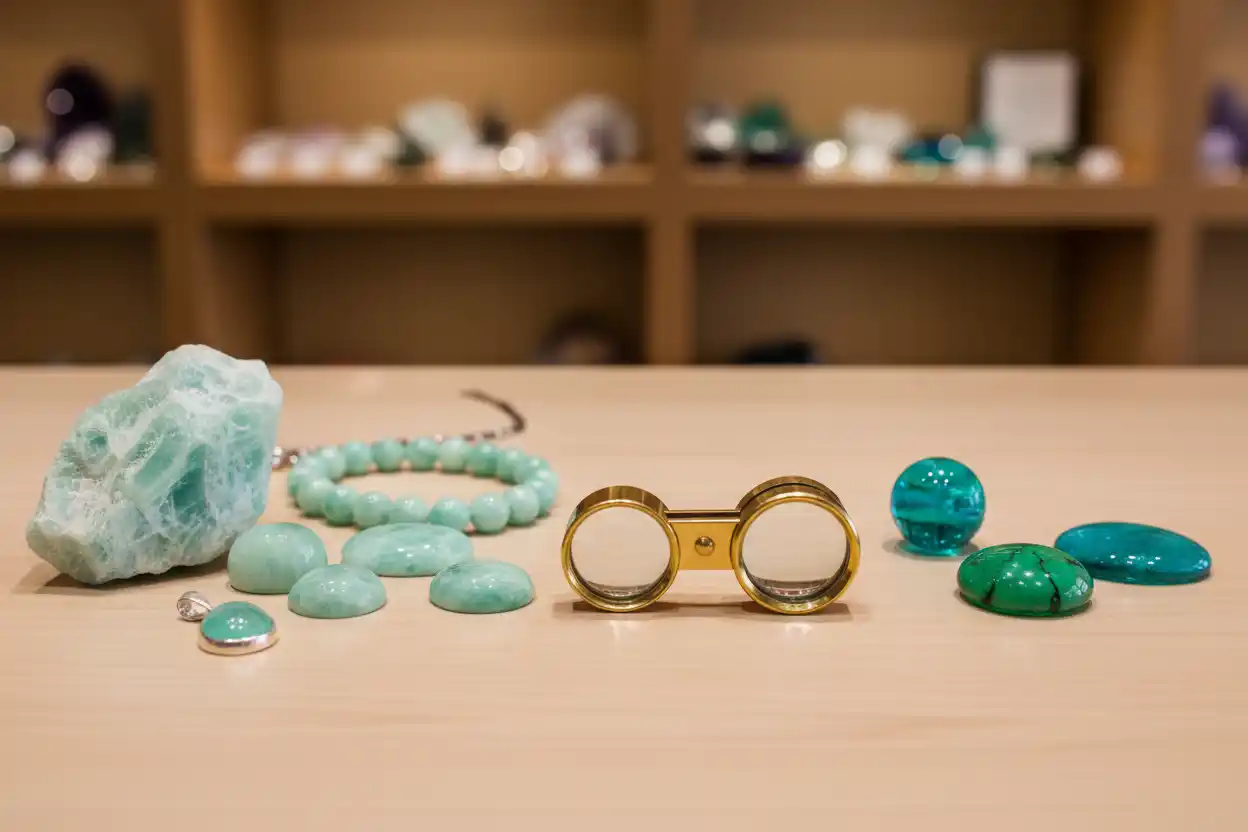
Where to Buy Real Amazonite (and Avoid Fakes)
Real Amazonite is available from specialist feldspar and mineral dealers, lapidary suppliers, gem shows, established rock shops, bead sellers and independent jewelry artists. The material is not exceptionally rare, but its blue-green color attracts imitations, inaccurate trade names and treatments intended to improve weak or fractured rough.
Amazonite is generally blue-to-green Microcline, a potassium feldspar. Natural material often shows white streaks, grid-like perthitic patterns, cloudy areas and cleavage-related texture. However, no single pattern proves identity, and unusually uniform products may still be genuine high-grade feldspar.
A reliable seller should identify the material as Amazonite or Microcline, disclose impregnation or dye, show the exact item and avoid claiming that every bright blue-green stone came from one famous mine.
Amazonite Buying Options at a Glance
| Buying source | Best for | Main caution |
|---|---|---|
| Mineral specialist | Crystals, matrix specimens and locality documentation | Collector specimens may be fragile or expensive |
| Lapidary supplier | Rough, slabs and cabochons | Cleavage and hidden fractures can reduce usable yield |
| Gem and mineral show | Direct comparison and seller questions | Locality claims may still rely on oral history |
| Established rock shop | Beginner pieces and physical inspection | Not every employee has feldspar expertise |
| Bead supplier | Strands and calibrated shapes | Stabilization, dye and mixed feldspar may be underdisclosed |
| Independent jewelry artist | Finished pendants, earrings, bracelets and rings | Confirm stone treatment and setting protection |
| Online mineral dealer | Exact specimens and documented inventory | Shipping can damage cleaved crystals |
| General marketplace | Broad selection and low prices | Glass, dyed stone and inaccurate descriptions |
| Estate dealer | Older jewelry and carvings | Trade terminology may be outdated |
| Direct lapidary seller | Individual cabochons and custom cutting | Return conditions may change after setting |
What Is Real Amazonite?
Amazonite is a blue-to-green variety of potassium feldspar, most commonly Microcline.
It may occur as opaque massive material, blocky crystals, rough pieces, cabochons, beads and occasional translucent gems.
White streaks and crosshatched patterns can result from feldspar intergrowth and internal structure. Color ranges from pale blue-green to strong turquoise-green.
The completed Amazonite meaning guide owns the mineral profile and symbolism. The broader Feldspar family guide explains how Amazonite relates to Moonstone, Sunstone, Labradorite and other feldspars.
Real Amazonite can be untreated, impregnated with polymer, dyed, backed or assembled. These categories should be described separately.
The Best Place to Buy Amazonite Specimens
Specialist mineral dealers are the strongest option for blocky crystals, matrix pieces and locality-specific specimens.
A collector listing should show crystal faces, cleavage, matrix and repairs. Amazonite crystals may be stabilized or glued back onto a matrix after mining, particularly when the specimen contains several fragile components.
Repair does not necessarily destroy collector value when disclosed.
Ask whether the piece is natural on matrix, repaired, reconstructed, acid cleaned, coated or stabilized.
A specimen sold with a famous locality name should retain its label and acquisition history.
Buying Amazonite at Mineral Shows
Gem and mineral shows let buyers compare color, crystal habit and matrix directly.
Natural Amazonite may look very different under warm hall lighting than in daylight. Carrying a small neutral flashlight can help reveal whether the color remains attractive.
Inspect the underside and matrix for adhesive. Repaired crystals may show glossy joining areas or colorless glue.
Ask whether the piece was mined recently or came from an older collection.
Keep the dealer’s written locality information with the specimen.
Buying Amazonite Rough
Amazonite rough is sold for cabochons, carvings, beads and decorative objects.
Its two strong cleavage directions can reduce yield. A large block may split during sawing or grinding if fractures follow those planes.
Request dry photographs of every surface. Wet images conceal cracks and make pale color look deeper.
Ask whether the rough is solid, weathered, stabilized or mixed with Quartz and other feldspar.
A buyer planning a large cabochon should not assume that the complete rough piece has uniform blue-green color inside.
Buying Amazonite Slabs
Slabs reveal color distribution and fracture condition better than unopened rough.
Look for open cleavage cracks, soft altered zones and white areas that may dominate the finished design.
Thickness should be sufficient for the intended cabochon or inlay.
Some Amazonite forms graphic intergrowths with Smoky Quartz. These can be attractive but cut differently from uniform feldspar.
A slab should not be priced solely by surface color. Usable pattern, soundness and cutting orientation determine practical value.
Buying Amazonite Cabochons
A good cabochon should show even polish, an intentional outline and enough thickness to survive setting.
Feldspar cleavage can create chips around corners and girdles. Inspect the edge carefully.
A low dome often suits opaque Amazonite, while translucent material can benefit from a slightly higher profile.
The back should remain flat and free from major cracks.
Request millimeter measurements and side photographs. Weight alone provides limited information because two cabochons of equal weight can have different visible dimensions.
Buying Amazonite Beads
Amazonite beads may be round, faceted, barrel-shaped, disk-shaped or irregular.
Inspect drill holes for chips and fractures. Feldspar can split outward from poorly drilled openings.
Natural color variation is common, but the strand should look intentionally matched.
Some commercial strands mix Amazonite with pale feldspar, dyed Quartzite or other blue-green stones.
Ask whether the beads have been impregnated or stabilized. Polymer treatment may improve durability and translucency but should be disclosed.
Buying Amazonite Jewelry
Amazonite is suitable for pendants, earrings and carefully worn bracelets.
Rings need greater protection because feldspar hardness is moderate and cleavage creates vulnerability.
A full or partial bezel protects cabochon edges better than thin prongs.
The setting should not place pressure directly across a visible cleavage crack.
For earrings and necklaces, inspect bails, posts and attachment loops. A secure stone can still be lost if the metal connection is weak.
The artisan should identify the metal and disclose any backing or adhesive.
Buying Amazonite Online
An online listing should show the exact product when natural pattern matters.
Request front, back and edge images. For crystals, ask for views of the base and matrix.
Color should appear under neutral lighting without excessive saturation.
A listing that uses the same photograph for dozens of pieces may be acceptable for inexpensive calibrated beads, but not for a supposedly unique collector specimen or cabochon.
Save the description and treatment claim before completing the order.
Marketplace Warning Signs
Be cautious when a seller calls every blue-green stone Amazonite without showing mineral structure.
Uniform glassy transparency, round bubbles and mold seams indicate that the item may be glass or resin.
Descriptions that combine Amazonite, Turquoise, Jade and Aquamarine as though they were interchangeable are unreliable.
Extreme claims such as “AAA healing-grade Russian Amazonite” need supporting definitions. AAA is not a standardized feldspar grade.
An origin name does not prove quality or authenticity.
What Good Amazonite Listings Include
A complete listing should state whether the item is a crystal, rough, slab, cabochon, bead or finished piece.
It should provide dimensions and weight, show the exact item and disclose known treatment, repairs and backing.
For a specimen, the seller should state whether the crystals have been reattached.
For jewelry, the description should identify the metal and setting type.
For beads, it should state whether the strand is natural color and whether any polymer, dye or coating was used.
Natural Amazonite Color
Amazonite ranges from pale bluish green to vivid turquoise-green.
Natural material may show white streaks, mottling and areas of uneven saturation.
Color alone cannot prove origin or treatment.
A very strong translucent blue may be natural, but it also deserves closer inspection because impregnated Amazonite has appeared in the gem market.
Natural color should extend through chips and edges rather than exist only as a surface layer.
The completed treated Amazonite guide explains enhancement evidence.
Polymer-Impregnated Amazonite
Porous or fractured Amazonite can be impregnated with plastic or resin.
The treatment may improve translucency, apparent color and durability.
Under magnification, polymer may appear in fractures, cavities or drill holes. Infrared spectroscopy provides stronger confirmation.
Impregnated material remains based on natural feldspar but belongs to a treated category.
Repair heat and solvents may affect the filler.
A seller should not describe strongly impregnated material as entirely untreated.
Dyed Amazonite and Dyed Feldspar
Pale feldspar, Quartzite, Magnesite and other porous materials may be dyed to imitate Amazonite.
Color concentrated in fractures and around drill holes provides a warning sign.
A chipped area may reveal a white or gray interior.
Some genuine Amazonite can also be dyed to produce more uniform color.
Do not use acetone as a home test because it can damage the object and remove legitimate treatments.
Glass and Resin Imitations
Glass can reproduce blue-green color and white swirls.
Possible clues include spherical bubbles, flow lines and mold seams.
Resin can contain pigments, glitter and crushed stone. It may be lighter, but subjective weight is not conclusive.
Manufactured products can be attractive when described as glass, resin or composite material.
They should not be sold as natural Amazonite.
The completed real-versus-fake Amazonite guide owns the detailed authentication workflow.
Amazonite Versus Turquoise
Amazonite and Turquoise overlap in blue-green color but belong to different mineral groups.
Amazonite is feldspar and commonly shows white perthitic streaks. Turquoise is a copper-aluminum phosphate, usually more porous and softer.
Dyed Howlite and Magnesite can imitate both materials.
The completed Amazonite versus Turquoise guide explains the physical and visual separation.
A seller should never use the two names interchangeably.
Amazonite Versus Aventurine
Green or blue-green Aventurine can resemble Amazonite in commercial beads.
Aventurine is Quartz-rich and may show reflective mica inclusions that create subtle sparkle.
Amazonite usually lacks aventurescence and may show blocky feldspar texture or white streaks.
Blue Aventurine sold online is often dyed Quartz or Quartzite, which adds another identification concern.
Hardness, refractive properties and microscopic texture can separate the materials professionally.
Amazonite Versus Larimar and Blue Calcite
Larimar is blue Pectolite and commonly shows white cloud-like patterns.
Blue Calcite is softer, often waxier and may show cleavage surfaces unlike Amazonite.
Both can appear in polished blue-green cabochons.
A visual photograph may be insufficient when the material lacks diagnostic patterning.
Professional testing should confirm high-value or unusual items.
Locality Claims
Amazonite occurs in several countries, including the United States, Brazil, Madagascar, Russia and other feldspar-producing regions.
Specific localities can develop collector reputations, especially when crystals occur with Smoky Quartz or distinctive matrix.
Color cannot prove geographic origin.
A seller offering locality material should provide labels, parcel records or collection history.
“Russian Amazonite” and “Colorado Amazonite” should be treated as provenance claims rather than color grades.
Colorado Amazonite
Colorado is famous for Amazonite crystals associated with Smoky Quartz in pegmatites.
Collector specimens can show strong blue-green Microcline crystals on contrasting dark Quartz and pale matrix.
Natural combinations can be repaired after mining because crystal clusters are fragile.
A repaired specimen can remain desirable when the work is disclosed.
The buyer should evaluate crystal termination, color, matrix balance, repair extent and documentation.
Madagascar Amazonite
Madagascar supplies rough, beads, cabochons and carvings.
Material can range from pale mottled blue-green to stronger color.
Country attribution should come from the supply chain rather than visual assumptions.
Commercial Madagascar rough may contain fractures and mixed feldspar areas that affect cutting yield.
A national label does not guarantee untreated status or a particular grade.
Evaluating Color Quality
The best color depends on personal preference and use.
Strong blue-green with good saturation is popular, but pale sea-green and white-patterned material can create attractive jewelry.
Excessive grayness or chalkiness may reduce visual appeal.
Color should remain convincing under daylight-equivalent and ordinary indoor light.
A backing, oil or polymer can make translucent material appear more saturated, so inspect edges and the reverse.
Evaluating Pattern and Texture
White lines and patches may form natural perthitic intergrowths within the feldspar.
Some buyers prefer relatively even blue-green, while others value graphic white patterning.
The pattern should appear integrated through the stone.
Painted lines, printed designs or surface-only color indicate imitation or coating.
A rough granular texture can signal alteration or low-quality polish rather than deliberate natural character.
Evaluating Clarity
Most Amazonite is opaque to translucent rather than transparent.
High translucency can be attractive but should be evaluated for impregnation.
Open fractures and cleavage cracks affect durability.
A cloudy interior is normal in many feldspars and does not alone prove low quality.
For cabochons and beads, sound edges matter more than internal optical clarity.
Amazonite Pricing
Amazonite is generally accessible, but prices vary according to color, translucency, crystal form, locality, size, cutting and specimen quality.
Fine collector crystals with strong provenance occupy a different market from commercial bead strands.
Large size alone does not create value when the material is fractured or pale.
Avoid investment promises. Most Amazonite is purchased for use, collection or decoration rather than predictable resale.
Seller Questions to Ask
Ask whether the stone is Microcline Amazonite, whether it has been dyed or impregnated and whether repairs or backing are present.
For a specimen, ask whether crystals have been reattached.
For rough, ask whether the photographs show the exact parcel and whether cracks are visible when dry.
For beads, ask whether the strand contains one material throughout.
A transparent seller should distinguish confirmed facts from uncertain supply-chain information.
Return and Shipping Policies
Amazonite crystals and cabochons can chip along cleavage.
A seller should package specimens so they cannot move inside the box.
Insurance and tracking become important for large collector pieces.
Review whether shipping damage must be reported immediately and whether photographs are required.
A reasonable return period permits inspection under ordinary light, although custom and altered items may be excluded.
Amazonite Care After Buying
Amazonite ranks about 6–6.5 on the Mohs scale and has cleavage, so it needs protection from impact.
Use a soft cloth and brief mild-soapy-water cleaning when the treatment and setting permit.
Avoid steam, ultrasonic vibration, heat and solvents.
The gemstone hardness chart and gemstone toughness-versus-hardness guide explain why moderate hardness does not eliminate cleavage risk.
The guide to which crystals can go in water provides broader material and treatment context.
Spiritual Marketing Claims
Amazonite is associated in modern spiritual traditions with communication, boundaries and calm expression.
These meanings should not be used as authenticity tests or justification for inflated prices.
The completed crystals for communication guide and drafted throat chakra guide own those symbolic themes.
A mineral does not become higher quality because a seller calls it activated, high vibration or healer selected.
Final Buying Perspective
Choose specialist mineral dealers for locality specimens, lapidary suppliers for rough and cabochons, established bead sellers for strands and transparent artists for finished jewelry.
Real Amazonite should be sold as feldspar rather than as a vague blue-green crystal.
Treatment, repair and origin should be described separately from natural mineral identity.
Amazonite also appears in the blue crystals guide, green crystals guide, blue gemstones guide, green gemstones guide, crystals beginning with A and gemstones beginning with A.
Frequently Asked Questions
1. Where is the best place to buy real Amazonite?
Specialist mineral dealers, established rock shops, gem shows and reputable lapidary suppliers provide the strongest opportunities for inspection and disclosure.
2. Is Amazonite expensive?
Most commercial Amazonite is accessible, although fine crystals, strong translucent material and documented collector specimens can cost more.
3. Is vivid blue Amazonite always fake?
No. Natural Amazonite can be strongly colored, but unusually vivid translucent material should be checked for impregnation or other treatment.
4. What mineral is Amazonite?
It is a blue-to-green potassium feldspar, usually Microcline.
5. Is stabilized Amazonite real?
It is treated natural feldspar when genuine Amazonite has been impregnated with polymer or resin.
6. How can glass Amazonite be recognized?
Round bubbles, flow lines, mold seams and perfectly repeated patterns may indicate glass.
7. Should Amazonite have white streaks?
Many pieces show white perthitic streaks, but their absence does not automatically mean the stone is fake.
8. Is Amazonite the same as Turquoise?
No. Amazonite is feldspar, while Turquoise is a copper-aluminum phosphate.
9. Are Amazonite beads commonly dyed?
Some genuine or imitation bead material may be dyed, so drill holes and fractures should be inspected carefully.
10. Do Amazonite crystals get repaired?
Yes. Collector clusters may be repaired after mining, particularly when crystals separated from the matrix. Repair should be disclosed.
11. Do I need a laboratory report?
Usually not for ordinary commercial pieces. Testing becomes more useful for unusually translucent, expensive or heavily claimed material.
12. What should a seller disclose?
The listing should identify Amazonite, dimensions, treatment, repair, backing, locality evidence and whether photographs show the exact item.