Where to Buy Real Blue Kyanite and Avoid Fakes
Real blue kyanite appears in several very different markets. Mineral collectors buy natural blades and matrix specimens, lapidaries choose translucent rough, while jewelry buyers may encounter cabochons or transparent faceted stones. Each form requires a different approach to authenticity, condition and value.
Kyanite is an aluminum silicate most commonly associated with metamorphic rocks. It is notable for directional hardness: the mineral resists scratching differently depending on the direction tested. At the same time, pronounced cleavage and brittle tenacity make crystals vulnerable to splitting during mining, cutting, setting and wear.
The blue kyanite meaning and properties guide covers the blue variety’s mineral identity and traditional symbolism. This page stays focused on selecting sellers, evaluating rough and finished stones, identifying common substitutes and obtaining meaningful treatment disclosure.
Decide Which Kind of Blue Kyanite You Need
The phrase “blue kyanite” can describe anything from an opaque fractured blade to a transparent faceted gem. Comparing those products by weight alone produces misleading results.
| Product form | Best source | Main buying concern |
|---|---|---|
| Natural crystal blade | Specialist mineral dealer | Repairs, broken terminations, coatings and locality accuracy |
| Matrix specimen | Mineral dealer or gem show | Reattached crystals, unstable matrix and concealed restoration |
| Faceting rough | Colored-stone rough dealer | Cleavage, color zoning, usable yield and treatment |
| Faceted gemstone | Specialist colored-stone dealer | Identification, windowing, fractures and sapphire substitution |
| Cabochon | Lapidary or gem dealer | Filling, backing, color zoning and weak polish |
| Beads | Established bead supplier | Dyed material, composites and drill-hole fractures |
| Pendant or earrings | Jeweler familiar with cleavable gems | Setting pressure, glue and exposed edges |
| Ring | Specialist jeweler | Impact risk and unsuitable everyday-wear claims |
A collector should prioritize natural crystal form and provenance. A jewelry buyer should concentrate on structural soundness, orientation, setting quality and return rights.
Where to Buy Genuine Blue Kyanite
Specialist mineral dealers
A reputable mineral dealer is usually the safest source for natural blades, radiating aggregates and matrix specimens. Good listings provide the exact dimensions, locality, condition, matrix minerals and repair history.
Request photographs of the front, back, base and terminations. Dark blue areas can hide fractures, while a carefully selected display angle may conceal a missing blade or a crystal glued back onto the matrix.
A seller should also distinguish natural contact points from fresh damage. A blade that grew against another mineral may have an incomplete end without being recently broken.
Colored-gem dealers
Transparent blue kyanite belongs in the colored-stone market rather than the ordinary crystal-tumble market. A knowledgeable dealer should provide weight, dimensions, color description, clarity information, cut quality and treatment disclosure.
For valuable stones, ask whether an independent gemological report is available. Since blue kyanite can resemble sapphire, tanzanite, iolite and blue glass in photographs, an unsupported shop certificate provides limited protection.
The kyanite versus sapphire guide owns the detailed identification comparison. This buying guide instead focuses on whether the seller provides enough evidence and recourse before purchase.
Gem and mineral shows
Shows allow you to compare crystal specimens, faceted stones and lower-grade lapidary material under consistent lighting. Move a blue blade beneath the light and examine how color changes across its length.
Blue kyanite commonly shows color zoning and pleochroism. Consequently, one part of a crystal may look deeper blue than another, and the stone can display different intensities from different directions.
Use a loupe to inspect cleavage, repaired corners, surface coatings and fractures. Do not scratch the stone to test its unusual directional hardness.
Established online gemstone shops
An online seller should show the exact item unless the listing clearly states that a comparable piece will be selected from a batch. Exact-item photography is particularly important for kyanite because color, fractures and blade completeness vary significantly.
The online gemstone buying guide explains seller verification, protected payment methods and return policies. For kyanite, also request a video in neutral daylight and a close-up of the girdle or crystal edges.
Independent lapidaries
A skilled lapidary understands how cleavage affects orientation and cutting yield. Ask whether the rough was stabilized and whether the finished stone contains filled fractures.
Hand-cut stones may have asymmetrical outlines chosen to preserve color or avoid cleavage. That decision is not automatically a defect, provided the finished proportions remain attractive and structurally sound.
What Genuine Blue Kyanite Looks Like
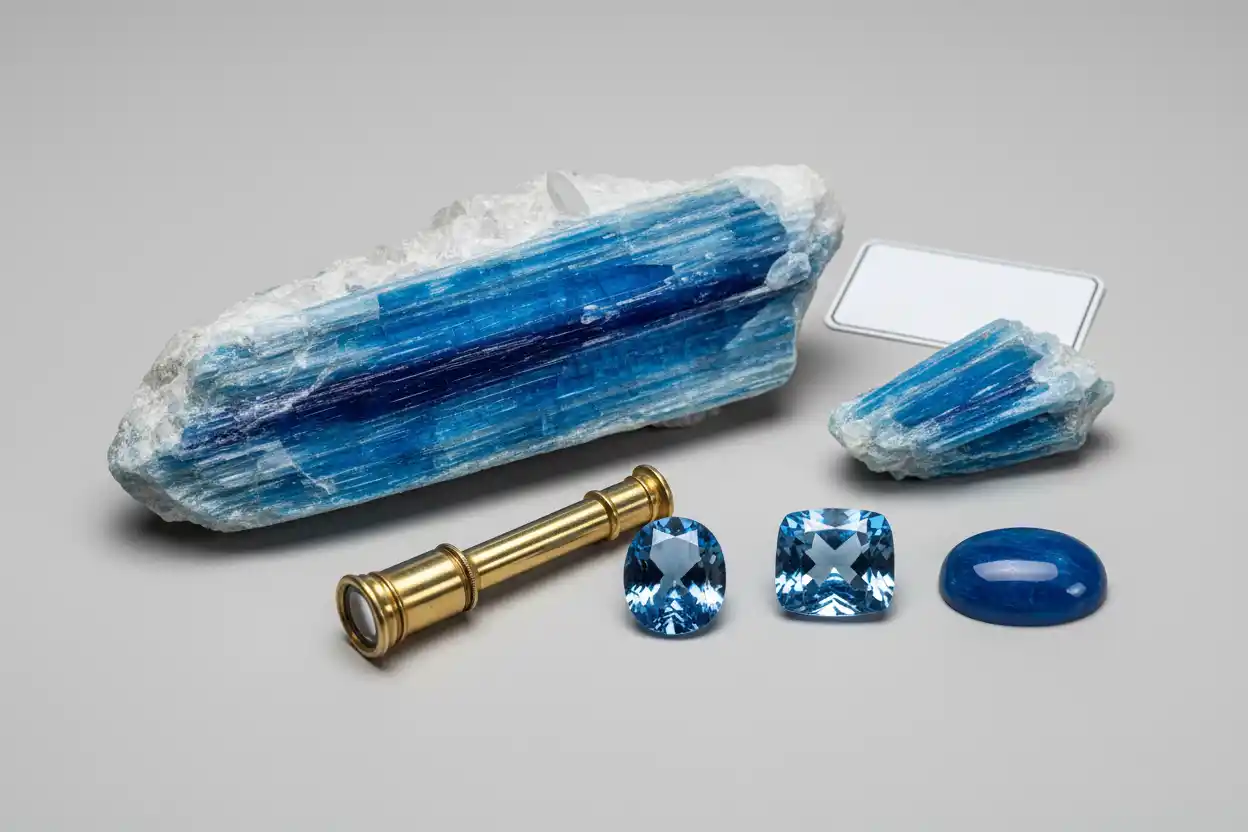
Blue kyanite most commonly forms elongated, flattened or bladed crystals. Color can range from pale blue and gray-blue to medium or deep blue, sometimes within the same crystal.
Natural blades often show parallel lengthwise features, uneven terminations, cleavage steps and matrix contacts. Their surfaces may be vitreous, pearly or partly dull where weathering or extraction affected the crystal.
Transparent gem material can show visible color zoning. A stone may contain pale areas, darker streaks or differently oriented blue sections. In a faceted gem, the cutter tries to position the strongest color face-up while managing cleavage and weight loss.
Perfectly uniform color is not required for authenticity. Conversely, zoning alone does not prove that a stone is kyanite.
The general kyanite guide provides broader mineralogical context, while the kyanite color guide keeps color symbolism separate from buyer verification.
Blue Kyanite Versus Black Kyanite
Blue and black kyanite belong to the same mineral species, but they enter different commercial markets. Blue material can be transparent enough for faceting, whereas black material is more commonly sold as opaque blades or radiating fans.
The black kyanite guide covers the dark variety. The completed guide to buying black kyanite addresses reconstructed fans, coatings and dark-mineral substitutes.
A seller should not describe black kyanite as a superior or inferior grade of blue kyanite. They are different appearance categories with separate quality factors.
Blue Kyanite Versus Sapphire
Sapphire is corundum and has Mohs hardness 9. Kyanite is much more directionally variable and has far stronger cleavage concerns.
Fine blue kyanite can resemble sapphire because both can show rich blue color and vitreous luster. However, kyanite commonly displays stronger directional color zoning, different refractive properties and more obvious cleavage-related features.
A home scratch test is unsafe and unnecessary. A gemologist can use refractive index, specific gravity, optic character and spectroscopy without damaging the stone.
Blue Kyanite Versus Tanzanite
Tanzanite is the blue-to-violet variety of zoisite. It can show pronounced pleochroism and may resemble transparent kyanite in photographs.
Both stones require impact protection, but their gemological properties differ. Refractive index, birefringence, optic character, absorption spectrum and inclusions can separate them.
Listings that call a stone “kyanite tanzanite” without explaining the phrase should be treated cautiously. It may describe color resemblance rather than mineral identity.
Blue Kyanite Versus Iolite
Iolite is gem-quality cordierite and frequently displays strong blue-to-violet pleochroism. Its hardness and cleavage behavior differ from kyanite, although both can be difficult to orient during cutting.
Face-up color alone cannot provide a reliable distinction. Ask whether the seller has gemological testing or merely purchased the stone under a wholesaler’s label.
Blue Kyanite Versus Glass and Synthetic Corundum
Blue glass can imitate translucent cabochons and inexpensive faceted stones. Round bubbles, flow lines, mold marks and abraded facet edges may support a glass identification.
Synthetic sapphire can imitate a more valuable transparent blue kyanite, although the motive is unusual because synthetic sapphire may itself be durable and attractive. More commonly, a seller may simply misidentify a blue faceted stone due to weak testing.
The fake-crystal buyer’s guide explains why one visual clue is rarely enough.
Misidentified Bladed Minerals
Sillimanite, amphiboles and other bladed metamorphic minerals can resemble kyanite in rough specimens. Dark inclusions or weathering may further obscure the distinction.
The mineral’s elongated shape should support an identification, not establish it by itself. When the exact species matters, Raman spectroscopy or X-ray diffraction is more dependable than photographs or destructive testing.
The crystal identification guide provides a broader approach based on habit, luster, cleavage, associations and measured properties.
Treatments and Repairs
Blue kyanite does not have one universally dominant treatment, but several enhancements can appear in the market:
- Resin or polymer impregnation
- Fracture filling
- Surface coating
- Oiling or waxing
- Backing beneath cabochons
- Reattachment of specimen crystals
- Assembly of multiple fragments
Impregnation can strengthen fractured material and make pale cracks less visible. A backed cabochon may show deeper apparent color, while coating can increase saturation or luster.
The seller should disclose both the natural origin and every known treatment. “Genuine kyanite” does not mean untreated.
The gemstone treatments guide explains why impregnation, filling and coating affect care and value differently.
How to Evaluate a Crystal Specimen
Blade completeness
Look for a recognizable crystal shape with intact or naturally contacted ends. Some extraction damage is common, but a major missing termination should affect the price.
Color distribution
Attractive crystals may show a rich blue central band, blue edges or layered zoning. Evaluate the specimen under ordinary light as well as strong directional illumination.
Luster
Fresh crystal faces can be vitreous to pearly. A uniformly plastic shine may indicate coating, while dull surfaces can result from natural weathering or harsh cleaning.
Repairs
Inspect the base and any abrupt change in crystal direction. Glossy adhesive, excess filler and a mismatched fracture line may reveal a reattached blade.
Matrix stability
Quartz, mica and other metamorphic minerals can form an attractive matrix. However, friable matrix should be stabilized or packed carefully.
Locality
Brazil, Nepal, India, Kenya, Tanzania, the United States and other regions have supplied blue kyanite. Appearance alone rarely proves a specific country or mine.
How to Evaluate Faceting Rough
Faceting rough should have enough transparent material between cleavage planes and fractures. Ask for transmitted-light videos from several directions because a blue surface can conceal a pale or included interior.
Color zoning may help or hinder cutting. A skilled cutter can orient the saturated zone face-up, but the final stone may lose substantial weight.
Request the rough dimensions rather than weight alone. A long flat blade can weigh enough to appear promising while remaining too thin for the desired cut.
If the seller has cut stones from the same parcel, ask to see them. Their yield, color and clarity provide useful evidence about the rough.
How to Evaluate a Faceted Stone
Color is usually the first quality factor. Desirable stones show an attractive blue face-up without turning excessively gray or nearly black.
Cut is equally important. Poorly positioned facets can create a large transparent window, while excessive depth may preserve weight but darken the center.
Inspect the girdle and corners for chips. Cleavage-related damage can begin at a sharp edge and spread under setting pressure.
Clarity standards should remain realistic. Some kyanite contains inclusions or zoning, but large fractures that reach the surface affect stability.
The planned general kyanite buying guide will cover the whole color and product market. This page remains specific to blue rough, blue specimens and blue gems.
Buying Cabochons and Beads
Cabochons can use translucent material that would not suit faceting. Look for an even dome, a stable base and color that remains attractive in normal light.
Check whether the back is natural stone, resin or another supporting material. A dark backing can deepen apparent color and should be disclosed.
Bead holes need careful inspection. Kyanite’s cleavage makes thin drilled areas vulnerable to splitting, particularly when a strand is pulled tight.
Expect variation in blue intensity across a natural strand. Perfectly identical beads may indicate heavy sorting, dye, glass or manufactured material.
Buying Blue Kyanite Jewelry
Kyanite can be worn successfully when the design respects its structure. Pendants, earrings and brooches usually face less impact than rings and bracelets.
A bezel or protective halo can reduce edge exposure. In contrast, high prongs can concentrate pressure on vulnerable corners if the setter lacks experience with cleavable gems.
The gemstone hardness chart helps explain kyanite’s unusual directional hardness. The toughness-versus-hardness guide explains why scratch resistance cannot predict whether a stone will split.
Daily-wear ring claims should be treated cautiously. A protected occasional-wear ring is more realistic than an exposed stone marketed as indestructible.
Price and Value Factors
Blue kyanite value depends on transparency, color, size, zoning, clarity, cut, crystal form, condition, locality and treatment.
Transparent faceted stones with attractive blue color and minimal windowing occupy a different price category from opaque blades. Similarly, a small complete specimen can be more collectible than a larger broken crystal.
Size premiums should reflect usable quality. A large dark stone with a broad window may be less desirable than a smaller well-cut gem.
Avoid relying on “AAA,” “museum grade” or “investment kyanite” labels. The gemstone pricing guide explains why observable characteristics and documentation matter more than seller-created grades.
Questions to Ask the Seller
Ask whether the stone was identified as kyanite through testing, locality knowledge or supplier labeling. For transparent gems, request the refractive-index result or an independent report when the price justifies it.
Confirm whether the material has been impregnated, filled, coated, waxed, oiled, backed or repaired. For specimens, request photographs of every termination and the base.
For rough, ask about fractures, thickness and successful cutting yield. For jewelry, determine whether the setting uses glue and whether the stone can be removed without damage.
Finally, obtain the return period and inspection terms in writing.
Professional Testing
A gemologist can use refractive index, birefringence, specific gravity, pleochroism and microscopy to identify transparent kyanite and separate it from sapphire, iolite, tanzanite and glass.
Raman spectroscopy and X-ray diffraction are useful for opaque blades or mixed specimens. Infrared spectroscopy may help identify some polymer impregnation.
Exact identification should involve the blue component itself. Testing only a white quartz matrix does not prove that the attached blade is kyanite.
Shipping and Returns
Crystal blades should be supported along their length rather than packed with pressure on their ends. Matrix specimens need immobilization inside a rigid inner box.
Faceted stones should travel in individual gem containers. Jewelry must be secured so chains and clasps cannot strike the kyanite.
Choose tracked and insured shipping for fine specimens or valuable gems. Photograph the package while opening it so that transit damage can be distinguished from pre-existing cleavage.
Responsible Sourcing
Ask whether the seller can identify the country, mining region or supplier. Mine-level traceability may not exist for ordinary commercial blades, but precise claims should have supporting documentation.
The ethical crystal sourcing guide offers practical questions about labor, legal collection and environmental claims.
A seller should separate verified sourcing from broad marketing language such as “direct from an ethical mine.”
Cleaning and Storage
Clean a sound untreated stone with lukewarm water, mild soap and a soft cloth. Avoid soaking fractured, filled, glued or matrix-mounted material.
Steam and ultrasonic cleaning are poor choices because heat and vibration can extend fractures or affect filler. The planned ultrasonic-cleaner guide explains why cleavage and treatment change cleaning safety.
Store blue kyanite separately from harder gems and protect crystal blades from sideways pressure. Rings should be removed before exercise, household cleaning and manual work.
Frequently Asked Questions
1. Is blue kyanite naturally occurring?
Yes. Blue is the best-known natural color of kyanite, although the mineral also occurs in black, green, orange, white and other colors.
2. Why does blue kyanite have two hardness values?
Its hardness changes with crystallographic direction. A blade can resist scratching differently along its length than across it.
3. Is blue kyanite the same as sapphire?
No. Kyanite is aluminum silicate, while sapphire is corundum. Sapphire is much harder and lacks kyanite’s pronounced directional hardness.
4. Can kyanite be fracture-filled?
Yes. Resin or polymer may enter fractures to improve stability or appearance. The treatment should be disclosed.
5. Is color zoning normal?
Yes. Natural blue kyanite frequently shows uneven saturation, bands and directional color differences.
6. Can blue glass imitate kyanite?
Yes. Glass can imitate polished stones and inexpensive faceted gems. Bubbles, flow lines and gemological testing help separate it.
7. Is a broken crystal termination proof of a fake?
No. Kyanite is brittle and commonly breaks during extraction. The damage affects condition and value, not necessarily authenticity.
8. Is blue kyanite suitable for everyday rings?
It is risky in exposed daily-wear settings because cleavage can cause splitting after impact. Protected occasional-wear designs are safer.
9. Does Brazilian origin guarantee quality?
No. Brazil produces blue kyanite, but quality depends on the individual crystal or gem. Origin also requires documentation.
10. Should every faceted kyanite have a certificate?
No. A report is most useful for high-value gems, uncertain identification or significant treatment claims.
11. Can I identify kyanite with a scratch test?
Do not scratch the stone. Directional hardness makes results difficult to interpret, and the test permanently damages the piece.
12. What is the clearest warning sign in a listing?
Be cautious when an expensive “sapphire-grade” blue stone has no measurements, treatment disclosure, return policy or evidence that it was identified as kyanite.
Choose the Stone That Survives Close Inspection
Blue kyanite can offer exceptional color without sapphire-level pricing, but the purchase should account for cleavage, zoning and seller knowledge. A trustworthy listing shows the complete stone and treats durability limitations as essential information rather than inconvenient details.
The types of gemstones guide, B crystal directory and B gemstone directory provide wider context. Buy the crystal or gem whose identity, condition and treatment remain convincing after the dramatic blue photography is removed.