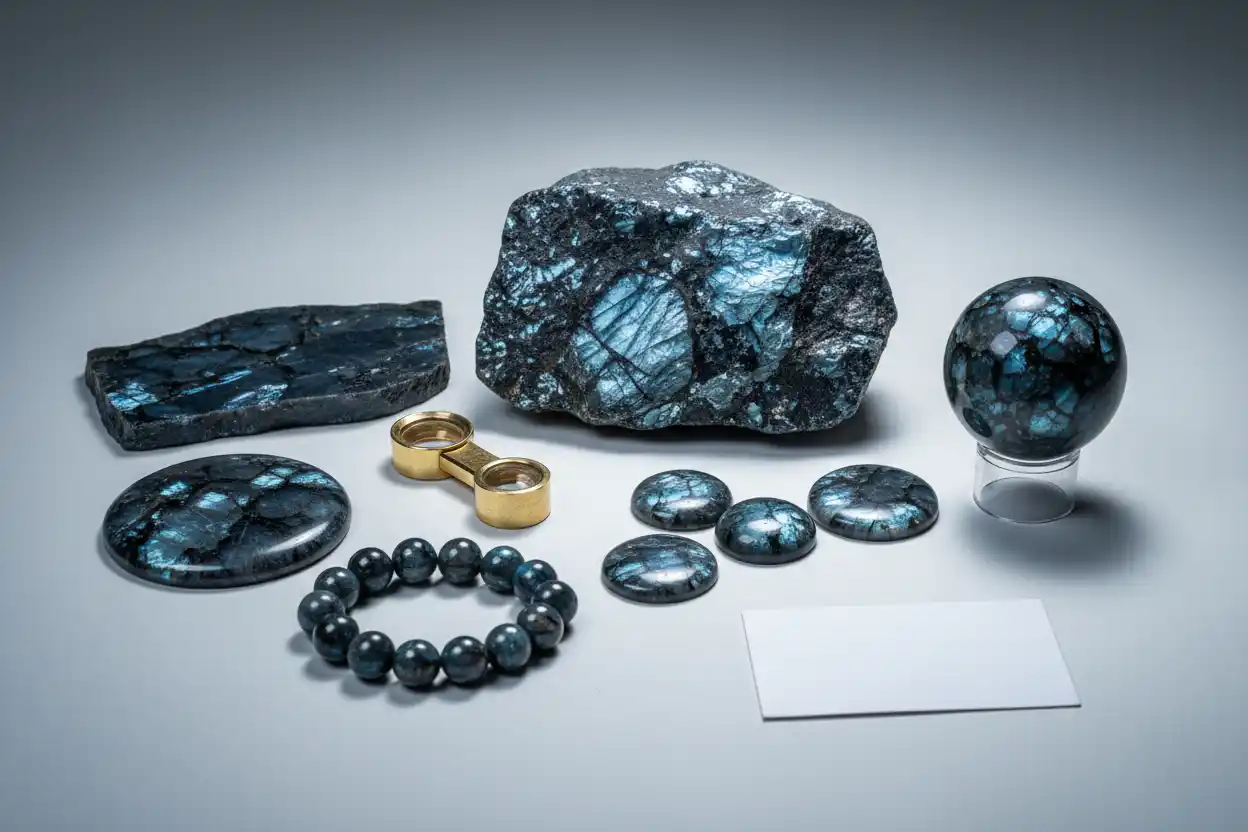
Where to Buy Real Larvikite and Avoid Labradorite or Glass Fakes
Real Larvikite is a dark, coarse-grained Norwegian igneous rock known for silver, blue-gray or steel-blue flashes from its feldspar crystals. It is widely cut into architectural slabs, countertops, spheres, beads, cabochons and carvings.
Although retailers sometimes describe it as a crystal, Larvikite is a multi-mineral rock rather than one mineral species. It is also not a dark variety of Labradorite, Black Moonstone or Granite, even though those names frequently appear in commercial listings.
Most buying problems involve loose trade terminology, unsupported Norwegian provenance, polished dark rocks with weak or artificial flash, resin composites and ordinary Labradorite sold under the Larvikite name. The Larvikite meaning and properties guide covers its geological identity and traditional symbolism. This guide focuses on sellers, composition, optical quality, construction, provenance and value.
Larvikite Is a Rock, Not a Single Crystal
Larvikite is a coarse-grained plutonic igneous rock associated with the Larvik Plutonic Complex in southern Norway. Depending on its precise composition, geologists classify it within the monzonite or syenite range.
Large feldspar crystals dominate the rock. Dark pyroxene, amphibole, mica, iron-rich minerals and small amounts of other components may occur between them.
Because Larvikite contains several minerals, it does not have one perfectly uniform hardness, cleavage or chemical composition. Its practical durability depends on how tightly the mineral grains interlock and whether fractures cross the polished object.
The feldspar family guide provides the parent-mineral context. However, Larvikite should remain classified as a rock rather than reduced to “a type of feldspar.”
What Creates Larvikite’s Blue-Silver Flash?
Larvikite’s most valuable visual feature is its metallic-looking iridescence or schiller. Light reflects and interferes within microscopic intergrowths inside the feldspar crystals, producing silver, blue-gray or blue flashes.
The effect appears from selected orientations rather than across every grain simultaneously. As a polished Larvikite object rotates, individual feldspar crystals should light up and fade at different angles.
A stone does not need rainbow colors to be genuine. Classic Larvikite generally shows cooler silver and blue flashes rather than the broad green, yellow, orange and blue display associated with high-quality Labradorite.
Cutting orientation matters. A slab cut across favorable feldspar planes can display much stronger flash than another slab from the same block.
Therefore, weak flash does not automatically indicate a fake. Nevertheless, a seller should not charge a premium for “high-flash Larvikite” when the effect appears only under extreme studio lighting.
Choose the Product Form Before Shopping
| Larvikite product | Best source | Main concern |
|---|---|---|
| Natural rough | Norwegian stone supplier or lapidary dealer | Provenance, fractures and visible flash orientation |
| Slab | Dimension-stone or lapidary supplier | Resin, backing, thickness and polished-face quality |
| Cabochon | Independent cutter | Flash placement, grain stability and polish |
| Bead strand | Established bead supplier | Labradorite substitution, dye and drill-hole fractures |
| Sphere | Experienced carving retailer | Weak reverse side, filler and internal cracks |
| Tower | Stone retailer with exact-item video | Repaired point, coating and carved-crystal language |
| Carving | Skilled lapidary seller | Joined pieces, resin and undercut mineral grains |
| Jewelry | Jeweler with treatment disclosure | Backing, glue and protected setting |
| Architectural remnant | Natural-stone fabricator | Commercial naming, sealant and whether it is authentic Norwegian stone |
| Collector specimen | Geological rock dealer | Unpolished texture, precise locality and original label |
A countertop remnant and a small polished cabochon may come from the same geological material, but their price structures differ substantially.
Where to Buy Genuine Larvikite
Norwegian natural-stone suppliers
A supplier connected to documented Norwegian quarries provides the strongest origin evidence.
Ask for the commercial stone name, quarry district, slab dimensions and finish. Architectural varieties may carry proprietary names based on color and quarry source.
A proprietary name does not indicate a separate mineral. Instead, it identifies a commercial grade or appearance within the wider Larvikite market.
Retain invoices and sample labels if Norwegian provenance affects your purchase.
Specialist lapidary suppliers
Lapidary suppliers are the best source for small rough, slabs and preforms.
Request dry photographs under one directional white light. Water and oil can deepen the dark body and improve apparent contrast.
A reliable seller should show several cutting orientations. Because flash depends on feldspar orientation, one polished window cannot represent every potential cabochon from a block.
Ask whether fractures or grain boundaries require resin stabilization.
Gem and mineral shows
Shows allow direct comparison with Labradorite, Black Moonstone, gabbro, dark Granite and glass.
Rotate the piece beneath one focused light. Natural Larvikite should show separate feldspar grains flashing at different moments.
Use a loupe to inspect grain boundaries, resin, coatings and chipped edges. A uniform molded body with no individual mineral grains is inconsistent with natural Larvikite.
Established online sellers
The online gemstone buying guide covers seller identity, protected payments and return rights.
Request exact-item video for cabochons, spheres and carvings. A stock photograph of exceptional material cannot represent every random piece.
Ask whether the seller altered contrast, saturation or highlights. Dark stones are especially easy to over-edit because lifting the highlights can manufacture an exaggerated blue flash.
Independent cutters and jewelers
A cutter who oriented the rough may understand which feldspar planes create the best display.
Ask for photographs before setting. Closed-backed jewelry can hide resin, an unattractive reverse or a thin decorative layer attached to another material.
For custom work, confirm whether the piece was cut from one solid block.
What Genuine Larvikite Looks Like
Natural Larvikite commonly has a dark gray, blue-gray, charcoal or nearly black background.
Individual feldspar grains may appear gray, pale blue, silver or blue-black. Their outlines are often visible because Larvikite has a coarse crystalline texture.
Dark minerals form irregular grains between the larger feldspars. Those dark areas should not resemble a printed pattern.
The flash normally appears within selected feldspar crystals. It should move as the viewing direction changes rather than sit like metallic paint across the surface.
Unpolished Larvikite can look comparatively plain. Polishing reveals the feldspar reflections and deepens the contrast.
Natural color and grain size vary among commercial quarry varieties. Therefore, one slab may look nearly black with concentrated blue flash, while another appears lighter gray with broader silver reflections.
Larvikite Versus Labradorite
Labradorite is a plagioclase feldspar mineral. Larvikite is a feldspar-rich multi-mineral rock.
The Labradorite buying guide covers color coverage, labradorescence and faceted or cabochon quality. The Labradorite price guide explains why broad multicolor flash commands premiums in that separate market.
Larvikite generally has a darker, visibly granular rock texture. Its flash tends to appear as separate silver-blue reflections within large feldspar grains.
Labradorite cabochons can show continuous fields of blue, green, gold or rainbow color. However, some dark Labradorite resembles Larvikite closely in photographs.
A seller should not use “Black Labradorite Larvikite” as though the names were scientifically interchangeable. The listing should identify whether the product is a rock or an individual feldspar mineral.
Larvikite Versus Black Moonstone
Black Moonstone is a commercial feldspar material commonly valued for pale, silver, peach or blue adularescence over a dark body.
Larvikite has a coarse multi-mineral texture, while Black Moonstone is marketed as a gem feldspar rather than an igneous rock.
The completed guide to buying real Black Moonstone covers feldspar identity, coating and variety-specific disclosure.
A polished Larvikite sphere can receive the name Black Moonstone when a seller relies on dark color and silver flash alone. Grain boundaries and rock texture provide important separation clues.
Larvikite Versus Rainbow Moonstone
Rainbow Moonstone is a white to colorless Labradorite variety that displays blue or rainbow labradorescence.
Its pale body differs markedly from classic dark Larvikite. However, both belong to the broader feldspar optical-effect market.
The real-versus-fake Moonstone guide owns detailed glass, coating and feldspar identification.
Larvikite Versus Granite
Larvikite is frequently marketed architecturally as Blue Pearl Granite, Emerald Pearl Granite or another granite-related name.
These are commercial dimension-stone terms rather than precise geological classifications. The building-stone industry uses “granite” broadly for hard, polishable crystalline rock.
True geological Granite contains substantial quartz and alkali feldspar. Larvikite generally belongs closer to monzonite or syenite and may contain little quartz.
A retailer can use the commercial slab name if the description also identifies the geological rock as Larvikite.
Larvikite Versus Gabbro
Gabbro is a dark, coarse-grained igneous rock rich in plagioclase and pyroxene.
Some gabbros show pale feldspar reflections or an attractive black-and-gray pattern. Nevertheless, they do not automatically qualify as Larvikite.
Larvikite’s Norwegian source identity and distinctive ternary feldspar structure separate it from generic dark gabbro.
A plain black-and-gray carving without blue-silver feldspar reflections may be genuine natural rock but not commercially valuable Larvikite.
Larvikite Versus Indigo Gabbro
Indigo Gabbro is a trade name used for dark Madagascan rock with pale, purple-gray or bluish patches.
The materials differ in source, geological identity and pattern. Indigo Gabbro generally lacks Larvikite’s coarse silver-blue feldspar schiller.
Retailers sometimes combine the names because both appear dark and mottled. Ask for country of origin and polished grain close-ups.
Glass and Resin Imitations
Glass can be manufactured with silver-blue particles or reflective foil.
Round bubbles, flow lines, mold seams and the absence of distinct interlocking mineral grains support glass construction.
Resin can contain crushed rock, metallic pigment or printed layers. Mold marks, soft scratches and repeated patterns may reveal it.
The fake-crystal buyer’s guide provides broader methods for evaluating glass, resin and composites.
Painted or Coated Flash
Metallic or iridescent coating can create blue reflections on dark stone, glass or resin.
Inspect chipped edges and high-wear areas. A coating may peel, scratch or stop abruptly at the back.
Natural Larvikite flash lies inside individual feldspar grains. It should remain visible beneath the polished surface and move with orientation.
A clear resin sealant may also enhance gloss without creating the flash. Architectural slabs are sometimes sealed, so ask whether the finish includes a surface product.
Resin Filling and Composite Construction
Large Larvikite carvings can contain resin-filled cracks, particularly where fractures cross several mineral grains.
Clear filler may reduce the visibility of fractures. Dark or color-matched resin can conceal missing material.
Two slabs or fragments may also be joined to create a thicker carving. Inspect edges for straight seams and adhesive bubbles.
The gemstone treatments guide explains filling, impregnation, backing and composite construction.
How to Evaluate Rough
Request photographs of both natural and sawn surfaces.
Look for visible feldspar grains that flash under directional light. Determine whether the effect continues across enough material for the intended cut.
Open fractures reduce yield. Because Larvikite contains several minerals, cracks may follow grain boundaries or pass directly through feldspar crystals.
Ask whether sample cabochons from the parcel hold an even polish without excessive resin.
How to Evaluate Slabs
A strong slab should show coherent grain distribution and attractive flash across more than one small section.
View the surface from several angles. Some feldspars may flash blue while neighboring grains appear silver or remain dark.
Inspect the back and edges for fiberglass backing, resin mesh, repaired cracks and joined sections.
Architectural reinforcement can be practical, but it should not be hidden when the slab is repurposed for jewelry or collectible objects.
How to Judge Cabochons
A skilled cutter orients the face to reveal several flashing feldspar grains rather than one narrow reflection.
The dome should have a consistent polish across light and dark minerals. Grain boundaries should not show deep undercutting.
Inspect the back for resin, a glued layer or weak fractures. A backed cabochon can remain usable when disclosed.
A cabochon with a dramatic photograph but no visible flash in ordinary movement should not receive a high optical-quality premium.
Buying Beads and Bracelets
Natural beads should show different feldspar grains and flash patterns from bead to bead.
Inspect drill holes for resin, chips and granular weakness. Dark coating or paint may appear concentrated inside the holes.
A strand described as Labradorite and Larvikite simultaneously needs clarification. The seller may have mixed two materials or used the names loosely.
Buying Spheres, Towers and Carvings
Request a complete rotation under one stationary light. The display side may contain much stronger flash than the reverse.
A sphere should have no straight equatorial seam or resin-filled cavity concealed beneath its stand.
Most Larvikite towers are carved. Their points did not grow naturally, even though the rock itself is natural.
Carvings should avoid thin projections across coarse mineral grains. Deep recesses can conceal filler or polishing compound.
Buying Larvikite Jewelry
Sound Larvikite can be suitable for pendants, earrings, bracelets and protected rings.
However, grain boundaries, existing fractures and protruding corners remain vulnerable. The gemstone toughness-versus-hardness guide explains why a durable architectural stone can still chip in a small jewelry setting.
A bezel supports cabochon edges more evenly than isolated prongs.
Ask whether the setting uses glue, backing or a thin Larvikite veneer over another substrate.
Provenance and Norwegian Origin
Larvikite takes its name from Larvik in southern Norway, and commercial dimension-stone production remains strongly associated with the surrounding Vestfold region.
A Norwegian claim should be supported by quarry information, supplier invoices or a recognized commercial stone name.
Sellers sometimes apply Larvikite to similar iridescent rocks from elsewhere. Those materials may be natural and attractive, but the geographic trade name should not be assumed from appearance.
The ethical gemstone sourcing guide provides practical questions about quarrying, fabrication labor and supply-chain records.
Price and Value
Larvikite is widely quarried as an architectural material, so ordinary small pieces are not rare.
Value increases with:
- Strong silver-blue flash
- Favorable cutting orientation
- Broad optical coverage
- Sound grain structure
- Good polish
- Attractive carving
- Large fracture-free dimensions
- Documented Norwegian provenance
- Minimal undisclosed resin or assembly
A small cabochon with several bright flashes may be more attractive than a large dark sphere with weak optical effect.
Architectural remnants can offer good value for lapidary work, although reinforcement, sealant and thickness must be considered.
The gemstone pricing guide explains why cutting skill and usable yield can outweigh raw-rock cost.
Questions to Ask the Seller
Ask whether the item is geological Larvikite, Labradorite, Black Moonstone, gabbro or another dark feldspar-rich rock.
Request the country, quarry region and basis for the Norwegian claim.
Confirm resin, coating, sealant, backing, glue, dye and crack filling.
For rough and slabs, request dry photographs from several angles. For cabochons and spheres, obtain continuous moving-light video.
Ask whether the pictured item will ship. Finally, confirm that the return policy allows examination under neutral lighting.
Professional Identification
Petrographic microscopy can reveal Larvikite’s interlocking rock texture and feldspar-dominated mineral assemblage.
Raman spectroscopy, X-ray diffraction and chemical analysis can identify individual minerals, while thin-section analysis provides a stronger rock classification.
One feldspar reading cannot classify the whole object. A proper assessment must consider the rock texture and several components.
Laboratory analysis may establish that a stone is Larvikite-like monzonite or syenite without proving one Norwegian quarry. Provenance records remain essential.
Cleaning and Storage
Clean Larvikite with lukewarm water, mild soap and a soft cloth. Dry the piece after cleaning.
Avoid strong acids, abrasive powders and prolonged soaking when resin, sealant or glue is present.
Do not use ultrasonic cleaning on fractured, filled or assembled jewelry. The ultrasonic-cleaner guide explains why internal fractures and mixed construction matter.
Store polished pieces away from harder gemstones that can scratch individual feldspar surfaces.
Frequently Asked Questions
1. Is Larvikite a mineral?
No. Larvikite is a coarse-grained igneous rock composed mainly of feldspar with several darker minerals.
2. Is Larvikite the same as Labradorite?
No. Labradorite is a feldspar mineral, while Larvikite is a multi-mineral rock. Both can display feldspar-related optical effects.
3. Is Larvikite a type of Moonstone?
No. Retailers sometimes call it Black Moonstone, but Larvikite has a distinct rock composition and Norwegian geological identity.
4. Why does Larvikite flash blue or silver?
Microscopic intergrowths inside its feldspar grains reflect and interfere with light, producing schiller or iridescence.
5. Is Blue Pearl Granite real Larvikite?
Blue Pearl is a commercial dimension-stone name commonly used for Larvikite. “Granite” is a trade classification rather than the precise geological rock name.
6. Does every genuine piece show strong flash?
No. Flash depends on feldspar structure and cutting orientation, so some authentic pieces appear comparatively subdued.
7. Can Larvikite be coated?
Yes. Clear sealants and artificial reflective coatings may be applied. Any coating should be disclosed.
8. Can Larvikite contain resin?
Yes. Fractures in slabs, carvings and cabochons may be filled or stabilized.
9. Does Norwegian origin prove high quality?
No. Norwegian provenance establishes source, but flash, structure, polish and treatment still determine quality.
10. Is Larvikite suitable for everyday jewelry?
Sound cabochons can be wearable, particularly in protective settings. Coarse grains and fractures still create chipping risks.
11. Do ordinary pieces need laboratory reports?
Usually not. Testing becomes more useful for expensive provenance claims, unusual material or wholesale identification disputes.
12. What is the biggest warning sign in a listing?
Be cautious when a uniformly blue-black object is sold as rare Norwegian Larvikite but shows no individual feldspar grains, moving flash or source information.
Buy the Rock, Orientation and Provenance Together
Larvikite’s appeal depends on an interaction between Norwegian geology, coarse feldspar texture and skilled cutting. A dark stone does not qualify merely because one photograph shows a blue reflection.
The L crystal directory, L gemstone directory and visual gemstone guide provide wider classification context. Choose the piece whose rock identity and natural flash remain clear from more than one angle.
Safety note: Larvikite contains feldspar and other silicate minerals. Cutting, drilling, sanding or grinding can create hazardous respirable mineral dust. Never dry-work the stone; use professional wet methods, effective local extraction and suitable respiratory and eye protection.