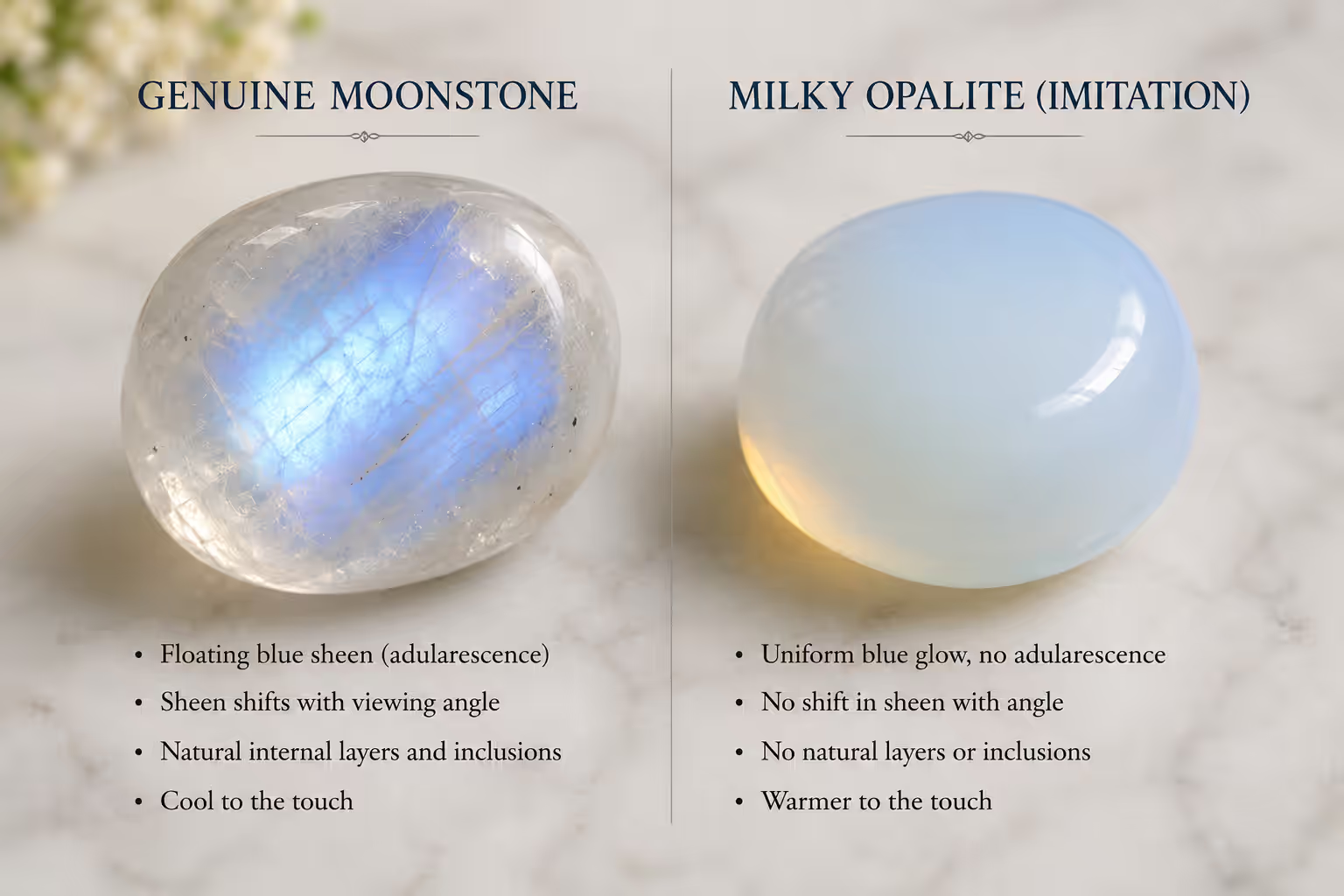
Real vs Fake Moonstone: Adularescence and Imitation Tests
Genuine moonstone is an adularescent feldspar. Its defining visual effect is a soft, mobile glow that appears to float below the surface as the stone or light source moves.
Traditional fine moonstone is commonly associated with orthoclase and albite feldspar intergrowths. Other feldspars can also show moonstone-like adularescence, including sanidine and labradorite. Rainbow moonstone is an accepted trade name for transparent adularescent labradorite rather than traditional orthoclase moonstone.
Imitations include opalite glass, ordinary milky glass, fiber-optic glass, coated quartz, synthetic spinel, resin, assembled doublets and pale stones with reflective backings. Some genuine moonstone may also be coated, filled, dyed or assembled.
Identification should therefore determine whether the material is feldspar, whether the sheen is natural adularescence and whether the stone has been treated or constructed from several layers.
Genuine Moonstone vs Common Imitations
| Feature | Genuine traditional moonstone | Rainbow moonstone | Opalite or ordinary glass | Coated or assembled imitation |
|---|---|---|---|---|
| Material | Commonly alkali feldspar, especially orthoclase-related material | Transparent adularescent labradorite feldspar | Manufactured glass | Variable base with coating, foil, glue or backing |
| Optical effect | Mobile blue, white or silver adularescence below the surface | Blue or multicolor labradorescent flash | Milky body, orange edge glow or fixed internal light | Surface sheen or reflection tied to the coating or backing |
| Mohs hardness | About 6–6.5 | About 6–6.5 | Commonly about 5–6 | Base-dependent |
| Refractive index | Commonly about 1.518–1.526 | Usually within a higher labradorite range | Variable, commonly lower or overlapping partially | Base-dependent |
| Specific gravity | Around 2.58 | Commonly denser than orthoclase moonstone | Glass-dependent | Construction-dependent |
| Cleavage | Perfect feldspar cleavage | Feldspar cleavage | No mineral cleavage | Base-dependent |
| Common inclusions | Centipede tension cracks, cleavage features and mineral inclusions | Cleavage, internal lamellae and transparent inclusions | Round bubbles and curved flow lines | Glue bubbles, join planes or coating wear |
| Effect during movement | Billowy glow travels across the dome | Directional blue or multicolor flash changes rapidly | Often diffuse, fixed or dominated by edge glow | May remain fixed to one surface |
| Strongest confirmation | Movement of effect plus RI, density, microscopy and Raman | Labradorite-range testing and Raman | Standard glass identification | Microscopy and construction analysis |
The mobile effect depends heavily on cutting. A poorly oriented genuine stone can show weak or narrow adularescence.
What Is Genuine Moonstone?
The completed moonstone meaning guide owns formation, symbolism, localities and general properties.
Moonstone belongs to the feldspar family, whose members make up a major part of Earth’s crust.
Traditional moonstone develops when feldspar components separate into extremely fine alternating layers during cooling.
Light scatters from those microscopic layers and produces adularescence—a glow that seems to billow beneath the polished surface.
The types-of-moonstone guide owns white, blue-sheen, peach, gray, black, cat’s-eye and rainbow trade categories.
What Real Adularescence Looks Like
Natural adularescence appears to come from inside the stone rather than from a metallic film on top.
As a cabochon rotates, the sheen travels across the dome. It may broaden, narrow, disappear and reappear according to the angle between light, internal layers and observer.
Fine blue moonstone can show an electric-blue band over a nearly colorless transparent body. More common material displays white, silver or diffuse pale-blue sheen.
The movement should remain integrated with the stone’s curvature. A painted or foil-backed reflection may stay fixed near one surface.
One photograph cannot demonstrate mobility. Video under a stable moving light is more useful for remote buying.
Adularescence Versus Opalescence
Moonstone is often called opalescent in ordinary language, but its classic effect is adularescence.
Precious opal produces play-of-color through ordered silica structures. Moonstone produces a billowy feldspar sheen.
The completed moonstone-versus-opal guide owns the full material comparison.
A white stone with colored flashes is not automatically opal or moonstone. Labradorite, glass coatings, foil and interference films can all create multicolor effects.
Rainbow Moonstone Is Not Fake Moonstone
Rainbow moonstone is generally transparent labradorite.
It belongs to the plagioclase side of the feldspar family rather than the traditional orthoclase category.
Its blue, green, yellow and orange flashes can be natural and highly attractive. The accepted trade name does not make it manufactured or imitation.
A seller should ideally disclose both terms: rainbow moonstone and transparent labradorite.
The completed where-to-buy-rainbow-moonstone guide owns the variety’s seller and imitation concerns.
Moonstone Versus Labradorite
Labradorite commonly has a darker gray, green or brown body with strong blue, green, gold or multicolor labradorescence.
Traditional moonstone is more often colorless, white, peach, gray or pale, with a softer billowy glow.
Rainbow moonstone creates overlap because it is labradorite sold under a moonstone trade name.
The completed labradorite-versus-moonstone guide owns the complete mineral and optical comparison.
A dark labradorite cabochon should not be mislabeled as rare black moonstone merely because both belong to feldspar.
Opalite Glass
Opalite is usually manufactured glass.
It commonly has a milky blue-white body in reflected light and a warm orange, yellow or pink glow along thin edges under transmitted light.
That color reversal can look attractive but differs from a mobile band of adularescence.
Opalite may display round bubbles, curved flow lines and a uniform internal body. Mold seams can appear on inexpensive beads or carvings.
The trade name is not a natural moonstone variety. A seller should identify it as manufactured glass rather than synthetic moonstone.
Milky Glass
Ordinary translucent glass can imitate low-grade white moonstone.
It may contain cloudy opacifiers, swirls and bubbles. A smooth homogeneous body can lack the layered movement of feldspar.
Some glass cabochons receive a reflective backing that creates an apparent blue sheen.
The effect may disappear when the backing is viewed from the side or removed from a setting.
The completed glass-versus-crystal guide explains standard separation through optical behavior and microscopy.
Fiber-Optic Glass
Fiber-optic glass contains aligned glass fibers that create a sharp cat’s-eye line.
It may be sold as cat’s-eye moonstone or luminous moonstone.
The bright line is often narrow, highly regular and fixed by the manufactured fiber direction. Under magnification, the material can reveal a honeycomb or bundled-fiber structure.
Natural moonstone can show chatoyancy, but its inclusion and feldspar properties differ.
A perfectly sharp line does not automatically prove higher-quality moonstone.
Coated Quartz
Colorless or milky quartz can receive a blue or iridescent coating.
The coating may imitate moonstone sheen, particularly when applied to the pavilion or back of a cabochon.
Inspect facet edges, scratches and drill holes for wear. Surface color may stop abruptly or reveal a colorless base beneath a chip.
Quartz is harder and has different refractive properties from feldspar.
The general gemstone-treatments guide explains coating as a separate process from laboratory growth.
Foil-Backed and Assembled Moonstone Imitations
A transparent dome can be mounted over blue foil, reflective paint or a thin iridescent layer.
The face-up result may resemble a floating sheen, especially in a closed-back setting.
Examine the side and girdle for a join plane, glue bubbles or abrupt changes in reflection.
A doublet may combine a natural feldspar top with another backing material. It can contain genuine moonstone while not being one solid untreated gem.
Assembled construction should be disclosed because repair, cleaning and value differ.
Resin and Plastic
Resin can be cast with blue pigment, pearlescent powder or interference particles.
Common clues include mold seams, casting bubbles, low weight, soft scratches and repeated swirl patterns.
Plastic can warm quickly in the hand, but temperature remains subjective and glass can also feel cool.
A hot-needle test should not be used because it damages the object and releases fumes.
Some products contain crushed feldspar suspended in resin. They should be described as composite material rather than solid moonstone.
White Synthetic Spinel
Colorless or milky synthetic spinel can be cut into cabochons and combined with internal or surface effects.
It is harder and has a different refractive index and density from moonstone.
Manufactured inclusions or backing may create a moonstone-like appearance.
The product is not synthetic moonstone because spinel has a different composition and crystal structure.
Synthetic should identify a laboratory-grown counterpart of the named gem, not any manufactured imitation.
Is Synthetic Moonstone Common?
True laboratory-grown feldspar capable of reproducing moonstone’s natural layered adularescence is not a common mainstream jewelry product.
Listings using laboratory moonstone, synthetic moonstone or created moonstone frequently describe glass, synthetic spinel, coated material or an assembled imitation.
The seller should name the actual base substance and treatment.
A laboratory-grown label does not prove chemical equivalence with feldspar.
Natural Moonstone Inclusions
Characteristic inclusions include small tension cracks known as centipedes.
They resemble short central lines with many fine perpendicular branches. Their shape results from stress within the feldspar.
Cleavage-related fractures, mineral crystals and fine internal lamellae may also occur.
A centipede can support natural moonstone identification but is not required in every stone.
Manufactured products can contain cracks or inclusions too. One line resembling a textbook photograph should not replace full testing.
Cleavage Clues
Moonstone has perfect cleavage in feldspar directions.
Existing cleavage planes may appear as straight internal lines, reflective steps or flat chips at damaged edges.
Do not break or scratch a stone to expose cleavage. A genuine moonstone can be damaged permanently.
Glass lacks mineral cleavage but can contain straight stress fractures or mold-related features that create confusion.
Cleavage contributes to identification only when combined with optical measurements.
Peach, White and Black Moonstone
Peach moonstone has a peach, cream, orange or pinkish body with white or silver sheen.
White moonstone ranges from translucent milky material to highly transparent gems with blue adularescence.
Black moonstone commonly has a gray, brown or nearly black body with silver, peach or pale-blue sheen.
Bodycolor does not change the requirement for natural mobile adularescence and feldspar properties.
Dyed and coated products can imitate all three categories, particularly in inexpensive beads.
Refractive Index
Traditional moonstone commonly measures around 1.518–1.526.
Rainbow moonstone usually falls in a higher labradorite range because it is a different feldspar composition.
Glass, quartz, synthetic spinel and resin produce different readings in many cases.
A curved cabochon usually requires a spot reading rather than the precise method used for a flat faceted stone.
Refractive index can confirm feldspar behavior but may need Raman spectroscopy to determine the specific feldspar variety.
Specific Gravity
Traditional moonstone has specific gravity near 2.58.
Labradorite rainbow moonstone is generally somewhat denser.
Glass and resin vary widely. Lightweight plastic may be rejected easily, while selected glass formulations can overlap more closely.
Hydrostatic weighing requires a loose stone without trapped air, adhesive or metal.
Touch-based heft is unreliable because cabochon proportions differ.
Hardness and Scratch Tests
Moonstone ranks about 6–6.5 on the gemstone-hardness chart.
It scratches more readily than quartz, topaz, sapphire and diamond.
The difference does not justify destructive testing. A scratch can damage genuine material and may test only a coating or filler.
The gemstone-toughness-versus-hardness guide and gemstone-cleavage guide explain why impact and structural breakage matter in addition to surface hardness.
Magnification
Use a 10× loupe under diffused light.
Look for centipede inclusions, cleavage features, mobile subsurface sheen and natural internal layering.
Check for glass bubbles, curved flow, mold seams, glitter, coating wear, glue and straight assembly planes.
Inspect the edge and back. A natural effect should remain connected with internal feldspar structure rather than a painted backing.
Clean the surface first because dried soap and skin oil can imitate cloudy layers.
Flashlight Movement Test
Place the cabochon under one small diffused light and rotate it slowly.
Natural adularescence should move across or within the stone rather than remain frozen in one location.
A poorly cut genuine moonstone may show the effect only through a narrow angle. A fixed artificial backing may also seem to move slightly because the polished surface reflects the lamp.
Therefore, movement is a strong screening clue but not conclusive proof.
Use several viewing directions and inspect from the side.
Polariscope and Optical Testing
Moonstone is doubly refractive feldspar.
A polariscope can confirm anisotropic crystalline behavior, although aggregate structure, internal strain and cutting orientation can complicate the pattern.
Ordinary glass is isotropic but may show anomalous strain.
Refractive index, density and microscopy provide a stronger conclusion when interpreted together.
Raman and X-Ray Identification
Raman spectroscopy can confirm feldspar and distinguish orthoclase, labradorite, quartz, glass and many other substitutes.
X-ray diffraction can identify crystalline phases in opaque or fine-grained material.
Spectroscopic testing is useful for rainbow moonstone because it can establish labradorite rather than traditional orthoclase identity without calling the trade material fake.
Infrared analysis may also reveal polymer, coating or adhesive.
Certificates and Seller Claims
A report should identify the material rather than merely print natural moonstone above a photograph.
For rainbow moonstone, a technically informative report may state natural labradorite with an adularescent or labradorescent effect.
The gemstone-certification guide explains identification reports. Use how to read a gem-lab report to compare dimensions, treatment wording and exact feldspar identity.
A retailer card containing chakra or birthstone information is not a gemological report.
Buying Genuine Moonstone
The completed moonstone buying guide owns bodycolor, adularescence, transparency, cut and seller evaluation.
The moonstone price guide explains premiums for strong mobile blue sheen, transparency, size and cutting.
Request a video of the exact stone moving beneath a stable light.
Ask whether the item is traditional moonstone, rainbow moonstone or another feldspar. Treatment, backing and composite construction should be disclosed.
For remote transactions, use how to buy gemstones online and preserve sufficient time for independent inspection.
Jewelry and Care
A moonstone ring needs a protective setting because feldspar can scratch and cleave.
A moonstone necklace or moonstone earrings generally receives less impact than a moonstone bracelet.
Use the completed moonstone jewelry cleaning guide rather than steam, ultrasonic vibration or abrupt temperature changes.
The completed moonstone healing-properties guide owns belief-based claims and should not be used as an authentication method.
A Safe Home Screening Sequence
Observe the clean stone from the front, back and side.
Move one light source slowly and determine whether the sheen billows below the surface.
Use a loupe to check for centipedes, cleavage, bubbles, mold seams, coating wear and assembly planes.
Compare the object with the stated variety. Rainbow moonstone should be evaluated as labradorite rather than rejected for not matching orthoclase readings.
Review millimeter dimensions, weight, treatment disclosure and return terms.
Stop before scratching, heating, applying solvents or using a hot needle.
When the value depends on natural feldspar identity, obtain refractive-index, density and Raman testing.
Frequently Asked Questions
1. What is the defining feature of genuine moonstone?
Its defining feature is mobile adularescence produced within feldspar rather than a fixed surface reflection.
2. Is rainbow moonstone fake?
No. It is generally transparent adularescent labradorite sold under an accepted moonstone trade name.
3. Is opalite natural moonstone?
No. Opalite is normally manufactured glass with a milky blue body and warm transmitted-light glow.
4. Does real moonstone always show blue sheen?
No. Natural adularescence can be white, silver, pale blue or other subdued colors.
5. Can genuine moonstone be completely transparent?
Yes. Fine material may be highly transparent while still displaying a strong mobile sheen.
6. Do bubbles prove a moonstone is glass?
Round gas bubbles support glass identification, but one rounded cavity should be examined in context.
7. What are centipede inclusions?
They are characteristic tension cracks with a central line and many short branching fractures found in some natural moonstones.
8. Can a fixed blue flash be real?
A genuine stone’s effect can appear through a limited angle, but a completely fixed surface-like flash raises concerns about coating or backing.
9. Is laboratory-grown moonstone widely available?
No standard mainstream synthetic feldspar counterpart dominates the market. Many “lab moonstones” are actually glass or other simulants.
10. Can a scratch test identify moonstone?
No. It damages the stone and cannot distinguish every feldspar, glass or coated imitation reliably.
11. How is rainbow moonstone confirmed?
Refractive index, density, microscopy and Raman spectroscopy can confirm labradorite feldspar.
12. When should moonstone receive laboratory testing?
Testing is useful for high-value blue-sheen material, disputed rainbow-moonstone identity, assembled stones or significant untreated claims.
Real moonstone does not need to look perfectly white or display one exact shade of blue. Its identity rests on feldspar structure and a mobile subsurface optical effect. Opalite, foil, coating and resin can reproduce a luminous appearance, but they do not reproduce the complete combination of adularescence, feldspar measurements, cleavage and natural inclusions.