Where to Buy Real Vanadinite and Avoid Glued Crystal Fakes
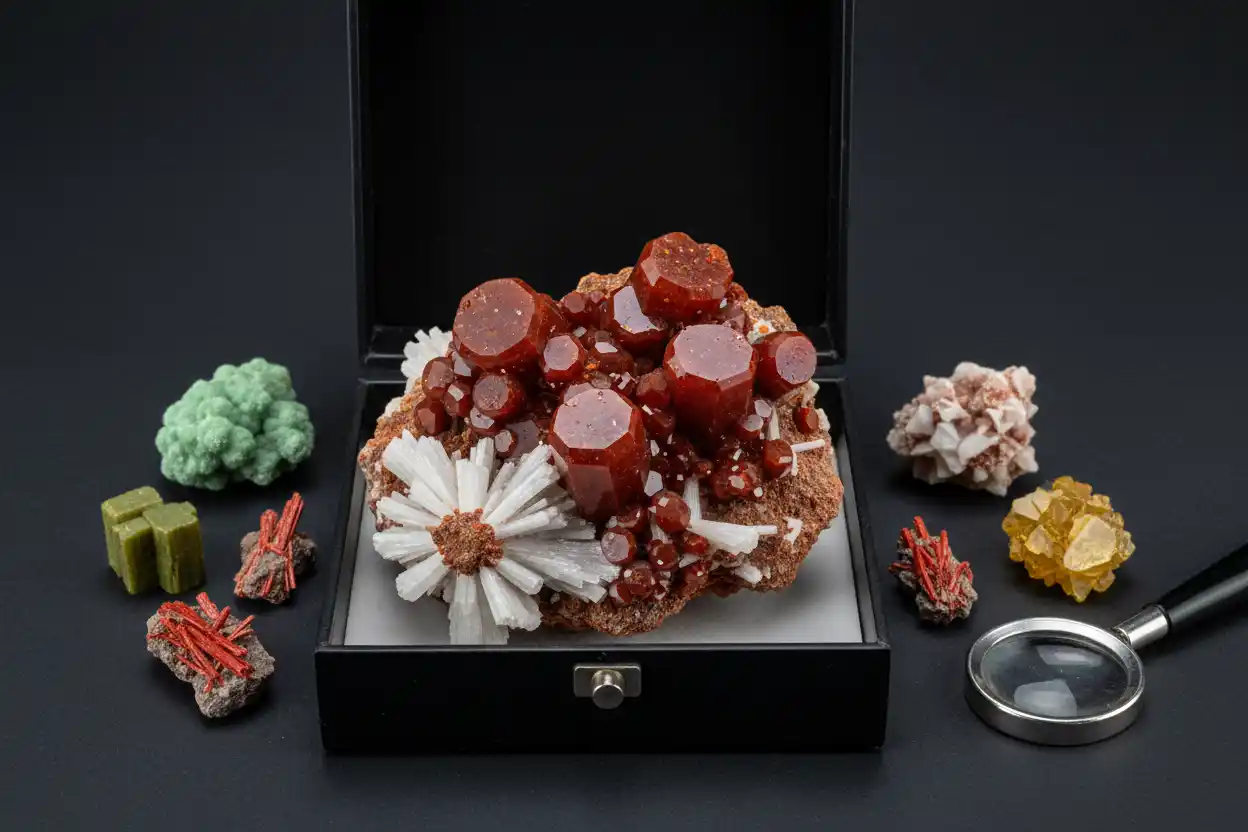
Real Vanadinite is a lead chlorovanadate mineral known for vivid red, red-orange, orange, brown-red and yellow hexagonal crystals. Fine specimens often consist of short barrel-shaped prisms covering Barite, Calcite, iron-rich matrix or altered lead-ore rock.
Vanadinite is primarily a collector mineral rather than a jewelry stone. It is soft, brittle, dense and lead-bearing, while its crystal clusters can shed small fragments after minor impact.
Most market specimens are natural. Nevertheless, individual crystals may be glued onto matrix, broken clusters may be reconstructed, and painted Calcite, resin, glass or unrelated lead minerals may be sold under incomplete descriptions.
Identification also overlaps with Mimetite and Pyromorphite because all three belong to the apatite structural group and can form similar hexagonal crystals.
The Vanadinite meaning and properties guide covers mineral identity and traditional symbolism. This buying guide focuses on crystal habit, sellers, locality, repairs, lookalikes, lead safety and collector value.
What Vanadinite Is
Vanadinite has the formula Pb5(VO4)3Cl.
It consists mainly of lead, vanadium, oxygen and chlorine. Its high lead content gives the mineral an unusually high density of approximately 6.9 relative to its size.
Vanadinite crystallizes in the hexagonal system and belongs to the apatite mineral group.
Its crystals commonly appear as:
- Short hexagonal barrels
- Long hexagonal prisms
- Flat hexagonal plates
- Hollow or cavernous crystals
- Parallel groups
- Acicular crystals
- Fibrous aggregates
- Rounded or globular forms
- Crusts covering matrix
The mineral has Mohs hardness approximately 2.5 to 3 and brittle tenacity. Consequently, sharp crystal edges can bruise or break easily.
How Vanadinite Forms
Vanadinite usually forms as a secondary mineral in the oxidized zones of lead-bearing deposits.
Groundwater and weathering alter earlier lead minerals. Vanadium released from surrounding rocks or ore material combines with lead and chloride to form Vanadinite under suitable chemical conditions.
Associated minerals may include:
- Mimetite
- Pyromorphite
- Wulfenite
- Descloizite
- Mottramite
- Cerussite
- Anglesite
- Calcite
- Barite
- Iron oxides
The Cerussite meaning and properties guide and Wulfenite meaning and properties guide cover two important lead-mineral associates.
A matrix specimen can contain several visually similar species. Testing one red crystal does not automatically identify every yellow, green or brown crystal on the same rock.
Choose the Product Form Before Shopping
| Vanadinite product | Best source | Main buying concern |
|---|---|---|
| Hexagonal crystal cluster | Specialist mineral dealer | Crystal identity, damage and glue |
| Vanadinite on Barite | Moroccan-mineral specialist | Natural association and reconstruction |
| Vanadinite on matrix | Fine-mineral dealer | Repairs, locality and mixed minerals |
| Individual crystal | Collector-mineral dealer | Complete faces, condition and provenance |
| Cabinet specimen | Established dealer | Shipping, crystal loss and restoration |
| Thumbnail specimen | Mineral specialist | Magnified condition and accurate locality |
| Micromount | Micromineral dealer | Species confirmation and label quality |
| Old collection specimen | Provenance-focused dealer | Original mine labels and restoration |
| Polished object | High-scrutiny specialist | Resin, reconstitution and lead exposure |
| Jewelry | Generally avoid | Softness, lead content and surface damage |
A loose cluster should be purchased for controlled display, not for frequent handling.
Where to Buy Genuine Vanadinite
Specialist mineral dealers
A mineral dealer is the most appropriate source.
The listing should include:
- Mine or district
- Country
- Dimensions
- Weight when relevant
- Crystal size
- Matrix minerals
- Damage
- Repairs
- Preparation
- Provenance
Request photographs of the base, reverse and every major crystal group.
Vanadinite crystals can detach during extraction and shipping. A repaired specimen may remain collectible, but the location and extent of adhesive should be disclosed.
Moroccan mineral specialists
Morocco supplies a large share of commercial Vanadinite, especially red-orange crystals from the Mibladen mining district and other lead-mineral localities.
A specialist should distinguish Mibladen, Taouz, Touissit and broader Moroccan labels rather than applying one famous locality to every specimen.
Ask whether pale blades beneath the Vanadinite are Barite and whether any crystals were transferred to a more attractive matrix.
A Moroccan origin is plausible but still requires dealer records for a substantial locality premium.
Gem and mineral shows
Shows allow comparison with Mimetite, Pyromorphite, Wulfenite, Crocoite and painted mineral clusters.
Inspect crystals without touching them. Use a loupe from a safe distance to examine:
- Hexagonal outlines
- Flat terminations
- Barrel shape
- Color zoning
- Broken edges
- Glue
- Coatings
- Matrix contacts
- Mixed species
Do not scratch, streak or dissolve the mineral. Vanadinite is soft and lead-bearing, while destructive testing creates hazardous dust.
Established online sellers
The online gemstone buying guide explains protected payment methods and return policies.
Request exact-item photographs under neutral light. Strong warm illumination can make brown material appear vivid scarlet.
Ask whether saturation and contrast were adjusted.
The dealer should photograph the specimen immediately before packing and explain how crystals will be protected without placing pressure on them.
Obtain written terms for shipping damage because detached crystals can substantially alter value.
What Genuine Vanadinite Looks Like
Natural colors include:
- Red-orange
- Scarlet red
- Deep red
- Brownish red
- Orange
- Yellow-orange
- Brownish yellow
- Pale straw yellow
- Gray-brown
- Mixed or concentrically zoned colors
Luster ranges from resinous to bright subadamantine.
Fine crystals can appear almost gem-like despite being subtransparent or opaque.
Hexagonal prisms may have flat terminations and sharp six-sided outlines. Some crystals are short and barrel-like, while others form longer rods.
Natural groups can contain several crystal sizes and incomplete contact faces.
One side of a crystal may be brighter or darker because of zoning, inclusions, weathering or light orientation.
Perfect identical barrels arranged at equal spacing across a matrix deserve inspection for artificial assembly.
Vanadinite on Barite
Barite is a dense barium sulfate mineral that commonly forms white, cream or pale blades.
Moroccan Vanadinite frequently occurs on Barite-rich matrix.
The contrast between red-orange hexagonal crystals and pale bladed Barite creates highly desirable specimens.
However, loose Vanadinite crystals can be glued onto separate Barite. Inspect each contact for:
- Clear adhesive
- Bubbles
- Smooth filler
- Color-matched putty
- Crystals sitting in artificial sockets
- Glue covering broken surfaces
- Matrix grains embedded in resin
A repaired natural association differs from a completely fabricated cluster, but both require disclosure.
Vanadinite Versus Mimetite
Mimetite is a lead chloroarsenate with the formula Pb5(AsO4)3Cl.
It shares the apatite-type structure and can form yellow, orange, brown or reddish hexagonal crystals.
Vanadinite and Mimetite can form compositional relationships, while one matrix may contain visually similar crystals.
Red-orange color favors Vanadinite but does not prove it. Mimetite can also be orange or brown.
Raman spectroscopy, X-ray diffraction or chemical analysis is the safest distinction.
Because Mimetite contains arsenic as well as lead, handling precautions remain necessary regardless of visual identity.
Vanadinite Versus Pyromorphite
Pyromorphite is lead chlorophosphate, Pb5(PO4)3Cl.
It commonly appears green, yellow, brown or orange and forms barrel-shaped hexagonal crystals similar to Vanadinite.
Green strongly suggests Pyromorphite in many specimens, but color boundaries overlap.
The two minerals can also form solid-solution relationships.
A rare red Pyromorphite or yellow Vanadinite should not be identified from color alone.
Laboratory analysis is appropriate when species identity affects collector price.
Vanadinite Versus Wulfenite
Wulfenite is lead molybdate.
It commonly forms thin square or tabular crystals in yellow, orange and red-orange colors.
Vanadinite usually forms hexagonal barrels or prisms rather than square plates.
Both minerals are soft, brittle and lead-bearing. They can occur together within oxidized lead deposits.
A broken Wulfenite plate may resemble an orange Vanadinite fragment from one angle, so crystal symmetry remains important.
Vanadinite Versus Crocoite
Crocoite is lead chromate.
It is famous for vivid orange-red prismatic crystals, particularly from Tasmania.
Crocoite commonly forms elongated monoclinic prisms or needles rather than short hexagonal barrels.
Its crystals can look more intensely scarlet and elongated, although color and habit vary.
Both species contain lead and require similar controlled handling.
Raman spectroscopy separates them without destructive chemical testing.
Vanadinite Versus Cerussite
Cerussite is lead carbonate and is commonly colorless, white, gray or pale brown.
It can form complex twins and prismatic crystals, while Vanadinite usually shows clearer hexagonal symmetry and warmer color.
Iron staining can make Cerussite orange or brown.
The minerals may occur on the same matrix.
Never use acid for identification. It would damage Cerussite and create unnecessary lead-bearing residue.
Vanadinite Versus Calcite
Calcite can form orange, red, honey or brown crystals.
Painted Calcite or resin-coated crystals can imitate colorful Vanadinite clusters.
Calcite commonly shows rhombohedral or scalenohedral forms rather than hexagonal barrels.
It is much less dense, but heft comparisons are difficult on matrix specimens.
The completed Calcite buying guide owns Calcite-specific glass, Aragonite and coating issues.
Do not test with acid. Use spectroscopy or X-ray diffraction.
Vanadinite Versus Red Glass
Red-orange glass can be molded into small hexagonal forms or attached to matrix.
Round bubbles, mold seams, glassy conchoidal chips and identical repeated crystals support manufacture.
However, not every glass contains visible bubbles.
Genuine Vanadinite should have mineral luster, appropriate density and natural growth relationships.
A laboratory can separate lead-bearing mineral crystals from soda-lime or resin glass safely.
Resin and Molded Imitations
Resin can be cast as red crystals, clusters or matrix coatings.
Warning signs include:
- Soft scratches
- Numerous bubbles
- Flexible thin points
- Mold seams
- Identical crystals
- Plastic-looking chips
- Pigment collecting at edges
- A uniform lightweight core
Mineral powder may be added to resin to increase weight.
A product containing Vanadinite fragments in binder should be labeled as a composite rather than a natural cluster.
The fake-crystal buyer’s guide provides broader manufactured-material checks.
Painted and Coated Crystals
Calcite, Barite, Quartz, resin or low-color Vanadinite may receive orange or red paint.
Inspect broken edges, protected recesses and the underside for color discontinuity.
Paint may pool at crystal bases, bridge adjacent crystals or coat matrix grains.
Natural Vanadinite color lies within the crystal and can show internal zoning.
Clear lacquer may be used as a consolidant or to improve luster. It should still be disclosed because it affects conservation.
Glued Crystal Clusters
Individual natural crystals may be attached to a natural or reconstructed matrix.
Inspect every large crystal base under magnification.
Natural contacts should show crystals penetrating matrix, emerging from cavities or growing coherently beside associated minerals.
A glossy adhesive halo, bubbles or a crystal sitting on top of dust suggests attachment.
Some repairs are difficult to avoid in fragile collector specimens. The issue is transparency rather than automatic rejection.
Repaired Specimens
A broken crystal, cluster section or matrix plate can be reattached.
A professional repair may preserve an important specimen’s appearance.
However, restoration affects value and should appear in the condition report.
Ask whether the specimen has:
- Reattached crystals
- Rejoined matrix
- Filled gaps
- Color-matched resin
- Rebuilt corners
- Coated surfaces
- A mounted base hiding repairs
A specimen described as “no repairs” should be returnable if adhesive is later discovered.
Reconstructed Matrix
Mineral fragments, sand, Barite, iron-rich rock and resin can be molded into a display base.
Genuine Vanadinite crystals may then be inserted into the artificial matrix.
Inspect the underside for:
- Uniform resin
- Sawed filler
- Mold impressions
- Painted rock texture
- Repeated cavities
- Embedded loose grains
- A chemical odor
A reconstructed display may be decorative, but it does not preserve the original geological association.
How to Evaluate Crystal Form
Count the sides of well-exposed crystals without touching them.
Vanadinite commonly shows six-sided outlines and flat basal terminations.
Short barrels may widen slightly near the center. Longer prisms can be straight-sided or subtly tapered.
Look for growth zoning and small differences among adjacent crystals.
A group of identical molded hexagons with no contact faces or growth variation deserves suspicion.
However, natural Vanadinite can form exceptionally regular crystals. Symmetry alone is not proof of manufacture.
How to Evaluate Condition
Crystal damage usually appears as:
- Pale fresh breaks
- Missing terminations
- Bruised edges
- Detached crystals
- Crushed crystal groups
- Powder beneath the specimen
- Repaired matrix
- Adhesive residues
Fine specimens should be evaluated under magnification.
A single broken crystal may have little effect on a dense cabinet specimen, while damage to the dominant central crystal can reduce value substantially.
Request a written map of significant damage rather than accepting “minor contacts” as a complete description.
Morocco and Mibladen Provenance
Mibladen in Morocco is internationally known for red-orange Vanadinite, often on Barite.
Fine pieces can carry bright hexagonal crystals with strong luster and good contrast.
However, not every Moroccan Vanadinite comes from Mibladen.
Taouz, Touissit and other localities can produce related lead minerals and Vanadinite specimens.
A locality claim should follow labels and dealer records rather than color or matrix alone.
Older collection labels can add value when their history is credible.
Mexican Vanadinite
Mexico has several important Vanadinite localities, including deposits in Chihuahua, Hidalgo and Sonora.
Material may range from red and orange crystals to brown, yellow or zoned specimens.
Mine-level provenance matters because form and associations differ.
A generic “Mexican Vanadinite” label is adequate for inexpensive specimens, but a famous-mine premium requires documentation.
United States and Namibian Material
Arizona and New Mexico contain historic Vanadinite occurrences within oxidized lead deposits.
Namibia has produced large crystals, including material from the Otavi mining district.
Older American and Namibian specimens may carry collection history beyond their visual appeal.
Do not assign provenance from crystal size alone. Large Moroccan crystals also occur, while small specimens can come from any major region.
Price and Value
Vanadinite value depends on:
- Crystal size
- Hexagonal form
- Color
- Luster
- Transparency
- Crystal coverage
- Matrix contrast
- Condition
- Repairs
- Associated minerals
- Locality
- Provenance
- Overall composition
A small thumbnail with one complete bright red barrel can be more valuable than a large brown cluster containing extensive damage.
Dense coverage is attractive, but a specimen with several distinct sharp crystals may show the mineral’s form more effectively.
Undefined labels such as museum grade or investment grade should not replace a condition report.
The gemstone pricing guide provides wider context on rarity, condition and documentation.
Questions to Ask the Seller
Ask how Vanadinite was distinguished from Mimetite and Pyromorphite.
Request the mine, district and country.
Ask whether Barite, Calcite or other matrix minerals were identified.
Confirm glue, crystal reattachment, matrix repair, coating, resin and reconstruction.
Request high-resolution images of the base, reverse and every major crystal contact.
Ask how the specimen will be immobilized during shipping.
Confirm that the seller accepts returns for undisclosed repairs or misidentification.
Finally, ask for safe-handling and packaging information because the mineral contains lead.
Professional Identification
Raman spectroscopy can distinguish Vanadinite from many associated lead minerals.
X-ray diffraction confirms its crystal structure and separates it from Mimetite and Pyromorphite.
X-ray fluorescence or electron-microprobe analysis can detect lead, vanadium, chlorine, arsenic, phosphorus and other diagnostic elements.
Microscopy can reveal natural growth, coatings, resin and glue.
Several crystals may require analysis on a mixed specimen.
Lead-based pigments or glass can produce strong elemental readings, so chemistry should be interpreted together with crystal structure.
Safe Display and Storage
Display Vanadinite inside a closed cabinet.
Use a stable acrylic or museum-grade support rather than balancing the specimen on fragile crystals.
Do not place it where children or pets can reach it.
Keep the specimen away from food-preparation surfaces, kitchens and dining tables.
Avoid direct airflow that could move dust or detached crystals.
Store labels and packaging with the specimen because they may also contain mineral dust after shipping.
Cleaning Vanadinite
Routine cleaning should be minimal.
Use a hand-operated air bulb from a safe distance if loose dust must be removed. Do not use compressed-air cans, which can fracture crystals or spread particles.
Avoid water, steam, ultrasonic cleaning, acids and solvents.
Do not scrub the specimen.
When substantial conservation is required, consult a mineral conservator rather than attempting household cleaning.
Wash hands with soap and water after handling the specimen or its packaging.
Frequently Asked Questions
1. What is Vanadinite made of?
Vanadinite is lead chlorovanadate with the formula Pb5(VO4)3Cl.
2. Does Vanadinite contain lead?
Yes. Lead is a major structural component of the mineral.
3. What crystal shape does Vanadinite form?
It commonly forms short or elongated hexagonal prisms, barrels and flat-ended crystals.
4. What colors can Vanadinite be?
Natural colors include red, red-orange, brown-red, orange, yellow and pale straw yellow.
5. Is Vanadinite the same as Mimetite?
No. Mimetite contains arsenate rather than vanadate, although their crystal forms and colors can overlap.
6. Is Vanadinite the same as Pyromorphite?
No. Pyromorphite is a lead phosphate mineral with a related apatite-type structure.
7. Is Vanadinite safe to touch?
Brief careful handling followed by thorough handwashing presents less risk than generating dust, but enclosed display and minimal contact are preferable.
8. Can Vanadinite be washed in water?
Routine washing is not recommended because it can damage the specimen, spread residue and affect matrix or repairs.
9. Are Vanadinite crystals commonly glued to matrix?
Repairs and fabricated clusters occur, so every major crystal contact should be inspected.
10. Can red glass imitate Vanadinite?
Yes. Glass or resin can be molded and attached to matrix, though mineral testing can separate them.
11. Is Vanadinite suitable for jewelry?
No. It is soft, brittle, lead-bearing and unsuitable for skin-contact or handling-heavy jewelry.
12. What is the biggest warning sign in a listing?
Be cautious when identical red crystals sit in glossy material and the seller provides no locality, base photographs, repair disclosure or lead-safety guidance.
Buy the Mineral Specimen with Its Condition and Safety History
A fine Vanadinite specimen should combine natural hexagonal growth, convincing matrix relationships and complete restoration disclosure. Its vivid color never overrides the need for controlled handling.
The red crystals guide, orange crystals guide, red gemstones guide, orange gemstones guide, V crystal directory and V gemstone directory provide wider comparisons.
Safety note: Vanadinite contains a high proportion of lead. Keep it away from children, pets, food and drinking water. Avoid dust, licking, grinding, drilling, washing and frequent handling. Display it in a closed case and wash hands thoroughly after touching the specimen or its packaging.