Amber Necklace: Styles, Settings & Buying Guide
An amber necklace can deliver far more visual presence than its weight suggests, because amber is exceptionally light compared with most mineral gemstones and can therefore be worn as broad pendants, substantial beads, graduated strands, or sculptural pieces without automatically becoming uncomfortable. That advantage makes amber particularly well suited to necklaces, yet the material also demands thoughtful construction because its approximately 2–2.5 Mohs hardness, poor toughness, sensitivity to heat and chemicals, and susceptibility to scratching are very different from the durability profile of quartz, sapphire, or many conventional jewelry stones.
Choosing a good amber necklace consequently involves more than deciding whether honey, cognac, butterscotch, reddish, or greenish material looks attractive. The pendant or beads need to be genuine and accurately disclosed, drill holes should be smooth and structurally sound, a bail must support the piece without concentrating stress, the chain or cord should match the dimensions of the jewelry, and clasps, knots, jump rings, adhesives, and metal edges all deserve inspection.
This guide focuses specifically on those necklace decisions rather than repeating amber’s complete geological history. The broader amber meaning guide covers the organic gem’s formation, properties, history, inclusions, and symbolism, while the wider Jewelry & DIY collection explores how different gemstones behave in different forms of jewelry.
Amber Necklace at a Glance
| Feature | What matters for an amber necklace |
|---|---|
| Material | Fossilized plant resin; an organic gem rather than a mineral crystal |
| Mohs hardness | About 2–2.5 |
| Toughness | Poor; protect against impacts, chips, cracks, and abrasion |
| Cleavage | Mineral-style cleavage is not applicable because amber is amorphous |
| Main advantage | Large pieces remain unusually lightweight |
| Common forms | Pendants, bead strands, graduated necklaces, stations, collars, carved pieces |
| Common treatments | Heating, clarification, dyeing, backing, pressing, reconstruction |
| Key pendant concern | Bail, drilled hole, bezel, adhesive, and attachment security |
| Key strand concern | Drill holes, knots, cord wear, clasp strength, and bead-to-bead abrasion |
| Best everyday position | Necklaces generally face less impact than rings and bracelets |
| Main care risks | Heat, strong light, perfume, hairspray, solvents, scratches, harsh cleaners |
| Buyer priority | Accurate material and treatment disclosure plus sound construction |
Why Amber Works So Well in a Necklace
The central advantage of an amber necklace is low density. A large amber pendant or a strand of substantial beads can create the visual scale of much heavier jewelry while placing relatively little weight on the neck, which is particularly useful for statement pieces, graduated strands, carved pendants, and vintage-inspired designs.
Low weight does not mean high durability, however, and that distinction should shape every buying decision. Amber is soft enough to be scratched by many objects encountered in ordinary life, while poor toughness means a hard blow, vulnerable drilled edge, pre-existing crack, or thin carved section can still produce damage. The difference between resistance to scratching and resistance to breaking is important throughout jewelry selection, and the broader gemstone toughness versus hardness guide explains why those two properties should never be treated as interchangeable.
Neck placement partly compensates for these limitations. An amber necklace normally receives fewer direct knocks than an amber ring or bracelet, while a pendant can hang freely without constantly striking desks, door handles, tools, or countertops. Clothing, other necklaces, cosmetics, metal findings, and accidental drops still create risks, so good design reduces exposure rather than pretending the material is tougher than it is.
Amber Pendants vs Beaded Amber Necklaces
The first useful decision is whether you want an amber necklace built around one focal piece or a strand composed of multiple pieces, because the construction risks are different.
Amber Pendant Necklaces
A pendant-style amber necklace concentrates attention on one piece of amber and usually minimizes amber-to-amber contact. This format is especially effective when the material has attractive transparency, unusual internal flow patterns, an interesting natural shape, a carving, or a visually important inclusion.
A pendant also makes inspection relatively straightforward. You can examine the front, back, edges, attachment point, setting, drill hole, polish, internal fractures, and relationship between the amber and metal without having to assess dozens of separate beads.
The weakness is concentrated at the attachment. If an amber necklace uses a drilled pendant, there should be enough material around the hole to support movement without creating a thin wall that can chip or crack. If it uses a metal cap or glued bail, the joint should sit squarely without visible gaps, loose movement, excess adhesive, or sharp metal edges rubbing against the resin.
Beaded Amber Necklace
A beaded amber necklace distributes visual interest across an entire strand and can show natural variation in color, transparency, shape, and inclusion patterns. Round, oval, barrel, nugget, faceted, flattened, and graduated beads are all possible, but the quality of the strand depends heavily on drilling, stringing, spacing, and clasp construction.
Each bead introduces two vulnerable areas around its drill hole, and those openings deserve close examination. Chipped rims, cracks extending from the hole, rough drilling, or sharp internal edges can weaken the bead and abrade the cord over time.
Individually knotted construction is particularly useful for a valuable amber necklace because knots reduce direct bead-to-bead rubbing and limit how many beads can scatter if the strand breaks. Knotting also improves articulation, although poor knots can become bulky, uneven, dirty, or loose, so workmanship matters as much as the technique itself.
Choosing the Right Amber Necklace Length
Length changes how an amber necklace sits, moves, interacts with clothing, and distributes its visual weight, so selecting by a style name alone is less reliable than checking actual measurements.
| Approximate length | Typical position | Often suits |
|---|---|---|
| 14–16 inches | High neck to collarbone | Small beads, collars, compact pendants |
| 18 inches | Around collarbone | Versatile everyday pendants |
| 20 inches | Upper chest | Medium pendants and layering |
| 22–24 inches | Mid-chest | Larger carvings and statement pendants |
| 28+ inches | Lower chest | Long strands and dramatic silhouettes |
Actual placement varies with neck circumference, body proportions, neckline, pendant dimensions, and whether an extender is attached. Before purchasing an expensive amber necklace online, compare the stated measurement with a necklace you already own or use a flexible tape around the neckline where you want the piece to fall.
Pendant drop deserves separate attention from total chain length. A 20-inch chain carrying a long carved amber pendant may finish considerably lower than a 20-inch strand of small beads, while a wide collar can occupy much more vertical space despite having a shorter circumference.
An adjustable amber necklace offers useful flexibility, but an oversized extender or heavy clasp can create an unexpected problem: because amber itself is so light, excessive hardware at the back may pull the chain rearward and cause a lightweight pendant to creep upward or rotate.
Pendant Size, Balance, and Flipping
Amber allows designers to create large pendants without extreme mass, although dimensions still influence stability. A wide, flat piece may rest securely against the chest, while a narrow pendant with significant depth can rotate as the wearer moves.
Flipping is especially common when the bail is positioned poorly relative to the pendant’s center of gravity. Before buying an amber necklace, examine side-view photographs whenever possible and look at where the bail attaches, how far the pendant projects from the body, and whether decorative treatment appears only on one surface.
A double-sided pendant is less troublesome when it turns, whereas a backed, foiled, painted, or strongly asymmetrical piece may look noticeably different from the reverse. If color depends partly on dark backing, flipping can also change the appearance more dramatically than expected.
Bails and Attachment Points
The bail is one of the smallest components of an amber necklace but one of the most important, because it transfers the motion and load of the entire pendant to the chain or cord. It should be large enough for the chain and end fittings to pass through comfortably, strong enough for the pendant, and positioned so the amber hangs without twisting.
A drilled amber pendant may use a simple metal loop through the material, but the hole should not sit dangerously close to a thin edge. Small surface cracks around the opening are worth taking seriously because repeated swinging can gradually enlarge a vulnerable area.
Metal caps and adhesive-mounted bails avoid some drilling problems, yet the bond itself becomes the critical point. Amber is heat-sensitive, so conventional high-temperature jewelry operations that are routine around durable gemstones cannot simply be performed against the resin; repairs and mounting methods need to account for the material before heat is applied.
A bezel can provide useful edge protection on an amber necklace, provided the setting is smooth and not excessively tight. Amber does not have mineral cleavage planes like crystalline gemstones, so cleavage is not the principal concern; scratching, poor toughness, localized fractures, crazing, thin edges, and stress around holes or mountings are more relevant.
Chains, Cords, and Hardware
Because amber is light, buyers sometimes underestimate the importance of the chain. A delicate chain can look proportionate with a small pendant, but a broad carved amber necklace still needs a chain strong enough to withstand snagging, repeated flexing, and the leverage created by the pendant even if its actual weight is modest.
Cable, curb, box, wheat, rope, and other chain constructions can work when their gauge suits the design. The objective is not simply to choose the strongest possible chain, because disproportionately heavy hardware may alter how a lightweight amber necklace hangs.
Leather and textile cords create a softer, organic appearance and can work particularly well with rustic or sculptural amber, yet rough knots and unfinished cord ends should not repeatedly rub against the polished surface. When the cord passes directly through an amber drill hole, inspect the hole for sharp edges that could gradually cut the fiber.
Metal spacers also require caution in bead strands. Hard-edged spacers can abrade softer amber every time the necklace flexes, so smooth separators or individual knots often make more sense than aggressive faceted components immediately beside the resin.
Choosing a Clasp for an Amber Necklace
A clasp should match the construction, length, value, and intended wearer of the amber necklace rather than being chosen merely because it is convenient. Spring-ring and lobster clasps work well for many lightweight designs when their connecting rings are properly closed, while box clasps can complement substantial graduated strands and may include a secondary safety mechanism.
Magnetic clasps are easy to operate, which can be useful for people with limited dexterity, but convenience comes with a trade-off because a strong sudden pull can separate them. A magnetic clasp therefore deserves more caution on a valuable or irreplaceable amber necklace than on an inexpensive fashion piece.
Traditional screw-style clasps also appear on amber bead strands. Check that the threads engage smoothly and that twisting the clasp does not cause the necklace cord to wind, bind, or place unnecessary stress on the adjacent beads.
Whatever mechanism is used, inspect the jump rings and connections around it. A strong clasp attached through a thin open ring is only as secure as that weakest connection.
Natural, Pressed, Reconstructed, and Imitation Amber
An amber necklace can contain one-piece natural amber, pressed or reconstructed amber made from smaller fragments, treated natural material, younger resin such as copal, or an imitation made from plastic, glass, or modern resin. Those materials can differ substantially in commercial value even when photographs make them appear similar.
Pressed amber still contains amber, but it is not equivalent to a bead or pendant cut from one continuous naturally formed piece. Buyers who care about construction should therefore ask specifically whether the jewelry contains solid natural amber, pressed amber, reconstructed material, composites, or other resin.
The real vs fake amber guide explains the identification boundaries in more depth, including why visual inspection and common household tests have limits. Do not burn, scratch, puncture with a hot needle, or apply aggressive solvents to an amber necklace simply to determine whether it is genuine; destructive tests can ruin authentic jewelry as easily as they expose an imitation.
Treatments Matter More Than Many Buyers Realize
Heating, pressure treatment, clarification, dyeing, backing, surface modification, and reconstruction can change the appearance of amber. Treatment does not automatically make an amber necklace undesirable, but disclosure is important because an attractive color or internal feature may not represent the material’s untreated appearance.
Bright green, deep red, highly transparent, or visually uniform pieces deserve careful questions rather than automatic suspicion. Some appearances can occur naturally, while others may be produced or intensified by treatment, which is why color alone cannot establish natural origin.
The detailed treated amber guide explains these processes separately. For an amber necklace buyer, the practical rule is simpler: ask what the material is, whether it has been treated or reconstructed, and whether the description reflects those facts clearly.
Amber Colors in Necklaces
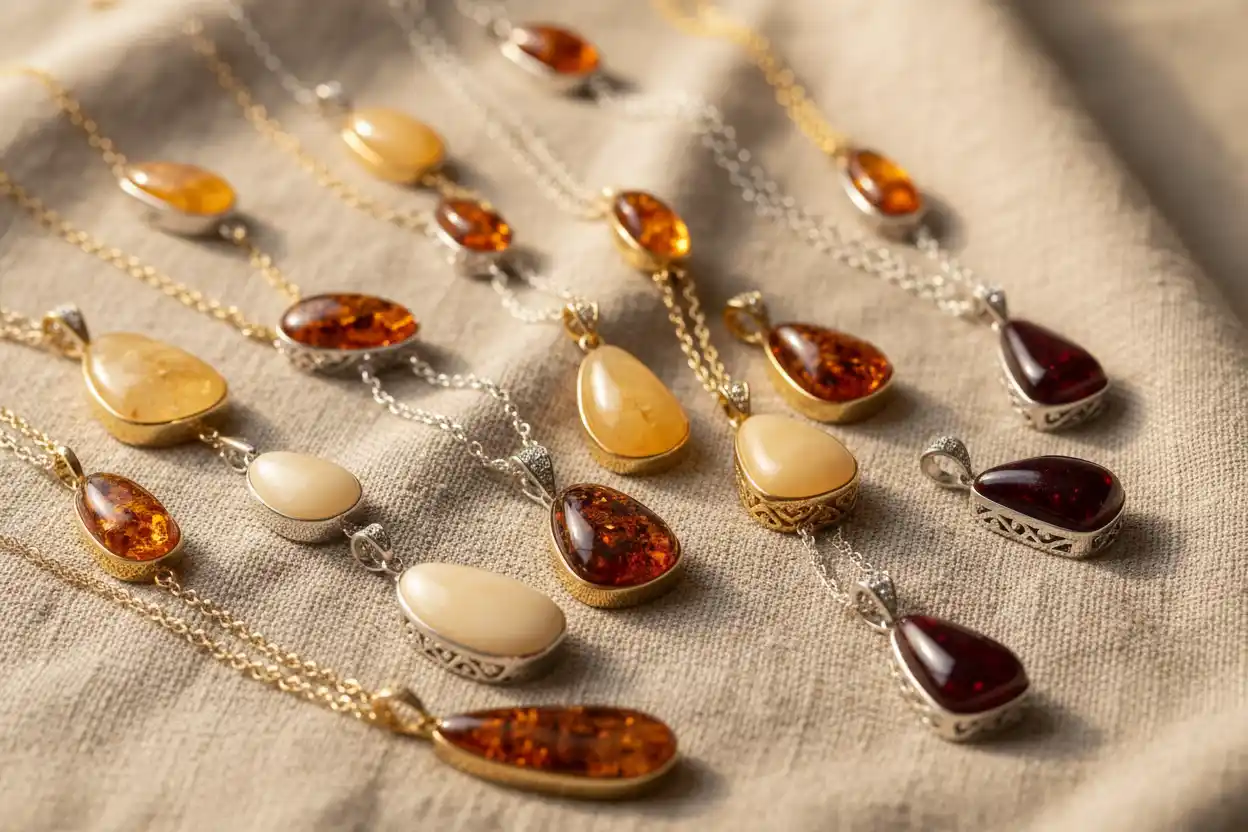
Honey and golden amber remain popular because backlighting can make translucent pieces appear almost luminous, especially in pendants that move in front of different clothing colors. Cognac and reddish-brown material creates deeper contrast, while opaque cream and butterscotch amber can produce a softer, sculptural look that works particularly well in broad beads and vintage-inspired strands.
Greenish and blue-effect amber can be visually striking, but rare-color terminology requires careful interpretation because treatment, backing, fluorescence, lighting, and photography can all influence appearance. The physical and commercial distinctions among Baltic, Dominican, butterscotch, blue, green, and other varieties are covered in the types of amber guide.
For a necklace, matching does not necessarily mean uniformity. Natural color variation can look intentional across a graduated strand when the transition is balanced, while one noticeably different bead in an otherwise highly uniform set may look like a replacement unless the design deliberately emphasizes contrast.
Inclusions in an Amber Pendant
An inclusion-bearing amber necklace can be compelling because transparent fossil resin may preserve bubbles, plant material, debris, or organisms from ancient environments. A well-positioned inclusion adds visual interest, but the presence of an insect does not automatically make a piece rare or expensive.
Condition and placement are particularly important in pendants. An inclusion close to a drill hole, surface cavity, or existing fracture can coincide with a structurally weaker area, while a deep inclusion surrounded by clear material may be easier to view and protect.
Extraordinary inclusions should receive stronger verification, especially when they contribute significantly to price. A laboratory report can be worthwhile for valuable material, and the gemstone certification guide explains what independent reports can and cannot establish.
Comparing Amber Necklace and Amber Earrings
Necklaces and earrings both take advantage of amber’s low weight and generally expose the material to fewer knocks than hand jewelry, but their construction priorities differ. An amber necklace depends heavily on chain length, pendant balance, bail strength, bead drilling, stringing, clasp security, and clothing contact, whereas amber earrings require matched pairs, suitable total earring weight, secure posts or hooks, dependable backs, and attention to movement beside hair and cosmetics.
Buying advice should therefore remain specific to the form. A beautifully matched pair of amber drops tells you little about whether a graduated necklace is well knotted, just as a secure necklace clasp says nothing about earring-back reliability.
How Clothing and Layering Affect Amber
The chest may be safer than the hand, but an amber necklace still spends hours rubbing against collars, zippers, embroidery, sequins, buttons, rough wool, metallic threads, and other jewelry. A highly polished pendant worn over smooth fabric may experience little abrasion, while the same piece repeatedly striking a metal zipper can develop scratches.
Layering also deserves restraint. Amber can look attractive beside plain gold or silver chains, but harder gemstones with sharp facets or textured metal links can repeatedly hit its surface as the wearer moves.
If you want to layer an amber necklace, create enough length difference that the pieces do not constantly overlap. This preserves the layered appearance while reducing contact.
Buying an Amber Necklace: What to Inspect
A seller should provide enough information for you to judge both the amber and the necklace construction, especially when the purchase is expensive. Start with identity: determine whether the material is natural solid amber, pressed or reconstructed amber, copal, composite material, or an imitation, then ask about treatments when color, clarity, or structure suggests modification may matter.
Next, inspect the jewelry as jewelry. For a pendant, evaluate the attachment, bail, drilled area, edges, backing, repairs, and any fractures; for a bead strand, inspect drill holes, knotting, cord condition, spacing, clasp, end connections, and consistency of workmanship.
Dimensions should be stated rather than inferred from close-up photography. Ask for total necklace length, pendant dimensions, bead sizes, extender length where applicable, total weight, and metal composition when those details are missing.
The more comprehensive amber buying guide covers material selection and seller disclosure beyond necklace construction. An amber necklace page, however, should always bring the decision back to whether the specific piece will hang securely, fit comfortably, and tolerate the way you intend to wear it.
Price and Value Factors
The price of an amber necklace can reflect considerably more than the amount of resin it contains. Natural versus pressed construction, treatment, color, transparency, inclusion rarity, provenance, age, craftsmanship, carving quality, matching across a strand, metal content, clasp quality, condition, and documentation can all affect what buyers are willing to pay.
A large necklace is not automatically valuable because amber is light and relatively easy to fashion compared with many harder gems. Likewise, a perfectly clear piece is not necessarily superior to opaque or inclusion-bearing material; the relevant quality factors depend on the type of amber and the purpose of the jewelry.
Be cautious when a seller justifies a premium mainly through claims about spiritual strength, therapeutic power, or “energy.” Those ideas are not recognized gemological quality grades and do not establish material rarity.
Wearing an Amber Necklace Every Day
An adult can wear an amber necklace regularly when the design is sound and the piece is treated with appropriate care, but everyday wear should be adapted to the material rather than based only on the fact that the jewelry hangs around the neck.
Put the necklace on after perfume, hairspray, lotions, sunscreen, and other cosmetics have dried. Remove it before swimming, showering, strenuous exercise, household cleaning, or situations involving significant heat, chemicals, impact, or snagging.
The gemstone hardness chart helps place amber’s low scratch resistance in context. Harder stones and ordinary abrasive particles can mark the surface, which is why separate storage and gentle handling matter even when there has been no obvious impact.
How to Clean an Amber Necklace
Routine cleaning should be conservative. Use lukewarm water, a small amount of mild soap when necessary, and a very soft lint-free cloth, then dry the amber carefully rather than leaving moisture around drill holes, knots, adhesive joints, or metal fittings.
Avoid steam and ultrasonic cleaning, aggressive brushes, abrasive polishing compounds, alcohol, acetone, household solvents, and strong chemical jewelry cleaners. Heat can damage amber, while chemicals may alter the surface or affect some treatments and adhesives.
Because a necklace includes hardware as well as amber, the safest technique must suit the complete object rather than the resin alone. The dedicated guide to cleaning amber jewelry covers the procedure and material-specific precautions in greater depth.
Storing an Amber Necklace
Store an amber necklace separately from harder jewelry, preferably in a soft-lined compartment or individual pouch where metal findings and neighboring gemstones cannot scrape the polished resin. A pendant chain should be arranged so it does not knot around or repeatedly rub the amber.
Beaded strands are generally better stored flat or in a relaxed curve rather than compressed tightly into a small container. Vintage strings deserve periodic inspection because cord can weaken long before the amber itself shows an obvious problem.
Avoid prolonged storage beside radiators, heat-generating electronics, direct strong sunlight, or inside very hot vehicles. Amber naturally changes with age, but unnecessary heat and light can accelerate deterioration or color change.
Amber Necklace Meaning and Symbolism
Some people choose an amber necklace for symbolism as well as appearance, particularly because fossilized resin naturally lends itself to ideas of preservation, memory, resilience, warmth, and continuity through change. Those meanings can add sentimental depth to an heirloom, personal milestone gift, or everyday pendant without changing the material requirements for safe wear.
If spiritual interpretation is important to you, the evidence-aware discussion of amber healing properties separates reflective traditions from unsupported medical claims. Wearing an amber necklace can serve as a personal reminder or symbolic object, but it should not be presented as a treatment for pain, inflammation, anxiety, disease, or another health condition.
Amber Necklaces and Infant Teething Safety
Amber necklace marketing occasionally extends into infant teething claims, but a necklace should not be placed around a baby or young child as a therapeutic device. Necklaces, beads, cords, and clasps create strangulation and choking hazards, and the supposed medicinal benefit often used to justify that risk is not an appropriate basis for child healthcare decisions.
This issue is fundamentally different from an adult choosing amber as jewelry. An attractive adult amber necklace can be appreciated for its organic material, craftsmanship, history, or symbolism without extending those qualities into unsafe infant use.
FAQs About Amber Necklaces
Is an amber necklace good for everyday wear?
An amber necklace can be worn regularly by an adult when its construction is secure and the wearer protects it from scratches, chemicals, excessive heat, strong impacts, and snagging. Necklaces are generally a more forgiving jewelry form for amber than rings because the material encounters fewer hard surfaces.
Is an amber necklace heavy?
Usually not. Amber has very low density compared with most mineral gemstones, so even a substantial amber necklace can feel surprisingly light relative to its visual size.
What is the best length for an amber necklace?
There is no universal best length. An 18-inch amber necklace works well for many everyday pendants, but actual placement depends on neck circumference, pendant drop, bead size, clothing, and personal proportions.
Should amber necklace beads be knotted?
Individual knotting is advantageous for valuable bead strands because it reduces bead-to-bead rubbing and helps prevent every bead from scattering if the cord breaks. The knots should still be even, properly tensioned, and made from a cord suitable for the drill holes.
Is pressed amber suitable for a necklace?
Yes, provided it is accurately disclosed. Pressed or reconstructed amber contains amber material that has been consolidated from smaller pieces, but it is commercially different from a pendant or bead cut from one continuous natural piece.
How can I tell whether an amber necklace is real?
Visual examination can reveal clues, but plastic, copal, reconstructed amber, and modern resin can imitate natural amber effectively. Valuable jewelry is better evaluated through non-destructive professional testing than through burning, scratching, solvents, or hot-needle tests.
Can an amber necklace contain genuine insect inclusions?
Yes. Natural amber can preserve insects and other biological material, but dramatic inclusions are also commonly imitated. A rare or expensive specimen deserves stronger evidence than an ordinary decorative piece.
What metal works best with amber?
Gold, silver, platinum, and other appropriate jewelry metals can all work aesthetically, provided the setting is smoothly finished and structurally suitable. Warm yellow metals complement honey and cognac colors, while silver-toned metals create stronger contrast.
Can I layer an amber necklace with other jewelry?
Yes, but keep harder gemstones, sharp facets, and rough metal surfaces from repeatedly rubbing against amber. Separating necklace lengths helps preserve the layered look while reducing abrasion.
Can an amber necklace get wet?
Brief contact during gentle cleaning is generally manageable, but prolonged soaking, swimming, hot water, and repeated exposure to chemicals should be avoided. Stringing materials, adhesives, metal fittings, and treatments may introduce additional concerns beyond the amber itself.
Can I clean an amber necklace with alcohol?
No. Alcohol and other solvents can damage amber or affect surface treatments and adhesives, so mild soap, lukewarm water, and a soft cloth are safer choices.
Does an amber necklace need a special setting?
Not necessarily, but the setting must respect amber’s softness, poor toughness, and sensitivity to heat. Smooth bezels, carefully drilled attachments, secure caps, and appropriately sized bails are generally more important than elaborate metalwork.
Are amber necklaces safe for babies?
An amber necklace should not be used as an infant teething remedy or placed around a baby for supposed health benefits. Necklaces and loose beads create choking and strangulation hazards.
Choosing a Necklace That Respects the Material
A well-made amber necklace takes advantage of everything the material does exceptionally well without ignoring where it is vulnerable. Amber can produce large, luminous pendants and substantial bead strands that remain unusually light, yet those same pieces depend on smooth drill holes, appropriate settings, secure bails, reliable clasps, sensible chain or cord selection, and careful protection from abrasion, heat, chemicals, and harder jewelry.
The strongest buying decision therefore combines material disclosure with construction. Determine whether the amber is natural, pressed, reconstructed, treated, or imitated; examine how the pendant or beads are attached; verify the actual dimensions and length; inspect the clasp and surrounding hardware; and choose a design that fits the way you intend to wear it.
When those factors are handled properly, an amber necklace does not need exaggerated claims to be distinctive. Its low weight, warm color, organic origin, natural variation, fossil inclusions, and long history as an ornamental material already give it qualities that few other forms of jewelry can reproduce.