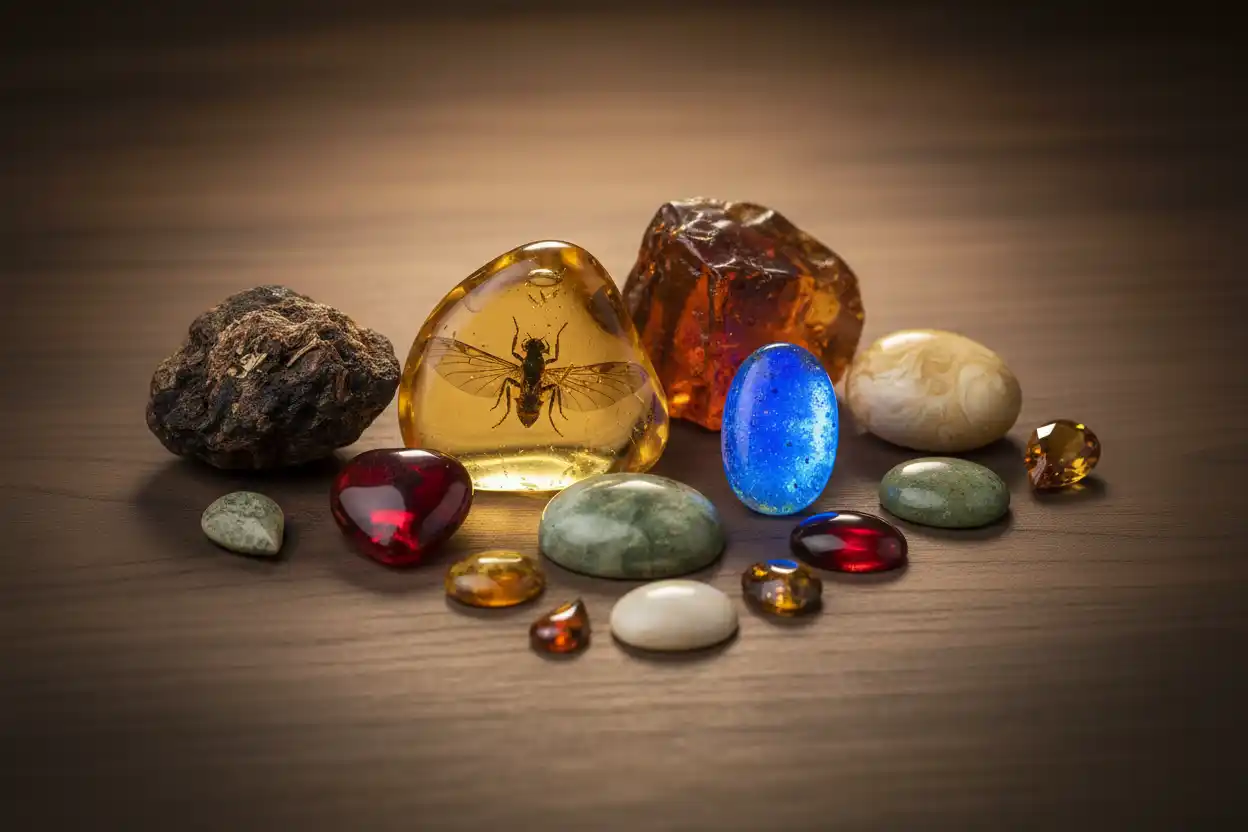
Types of Amber: Colors and Varieties Explained
Amber is fossilized plant resin rather than a crystalline mineral. Its varieties are classified by geological source, resin chemistry, color, transparency, inclusions, degree of weathering, and any processing used to clarify, darken, press, or reconstruct the material.
Baltic succinite dominates the jewelry market, but Dominican, Mexican, Burmese, Indonesian, Romanian, Sicilian, Lebanese, Japanese, and other ambers can differ substantially in age, botanical origin, fluorescence, inclusions, texture, and availability. Commercial color names such as cognac, cherry, butterscotch, beeswax, green, blue, and black describe appearance rather than separate biological species.
Amber at a Glance
| Property | Amber |
|---|---|
| Material type | Fossilized plant resin; organic gem material |
| Composition | Complex polymerized organic compounds derived from ancient plant resins |
| Color range | Colorless, pale yellow, gold, honey, orange, cognac, brown, red, green, blue-fluorescent, cream, white, and nearly black |
| Structure | Amorphous and noncrystalline |
| Transparency | Transparent to opaque |
| Luster | Resinous, waxy, or dull before polishing |
| Approximate hardness | About 2–2.5, varying among deposits |
| Specific gravity | Commonly close to 1.05–1.10 |
| Fracture | Conchoidal to uneven; brittle |
| Common forms | Beads, cabochons, carvings, pendants, specimens, inclusion pieces, pressed blocks |
| Main care concern | Scratching, solvents, heat, oxidation, pressure, adhesives, and reconstructed material |
What Counts as Amber?
Amber forms when plant resin undergoes burial, polymerization, oxidation, loss of volatile compounds, and other chemical changes over geological time. The resulting material is more stable than fresh resin or young copal, although it remains softer and more heat-sensitive than most mineral gemstones.
The Amber parent guide owns its general formation, properties, history, and symbolism. This page focuses specifically on the different varieties encountered in jewelry, fossil collecting, and the gem trade.
Amber belongs to the organic and fossil-derived materials included in types of gemstones. Its related materials include Jet, Pearl, Mother of Pearl, and Abalone Shell, although each forms through a different biological and geological process.
It also appears in the crystals that start with A and gemstones that start with A directories.
How Amber Types Are Classified
Amber varieties fall into four overlapping systems.
Geographic names identify the deposit or producing region, such as Baltic, Dominican, Mexican, or Burmese Amber.
Chemical classifications divide Amber according to molecular structure and diagnostic compounds. Succinite, for example, is the principal Baltic variety.
Color names describe appearance, including cognac, cherry, beeswax, butterscotch, green, blue, white, and black Amber.
Manufacturing descriptions identify natural solid Amber, clarified Amber, heat-darkened Amber, pressed Amber, reconstructed Amber, doublets, and imitation products.
One object can fit several categories simultaneously. A transparent golden bead may be heat-clarified Baltic succinite, while a blue-fluorescent cabochon may be natural Dominican Amber with a dark backing.
Main Types of Amber by Origin
| Amber type | Typical appearance | Approximate geological age | Main distinction |
|---|---|---|---|
| Baltic Amber | Yellow, honey, cognac, cream, white, red-brown | Roughly 34–48 million years | Large deposits, succinite chemistry, broad jewelry use |
| Dominican Amber | Transparent yellow, honey, red, blue-fluorescent | Mainly Miocene | Exceptional clarity, insects, strong blue fluorescence |
| Mexican Amber | Golden, red, brown, greenish, blue-fluorescent | Mainly Miocene | Chiapas source, transparent material, diverse inclusions |
| Burmese Amber | Yellow, orange, red, brown, root-like material | About 99 million years | Cretaceous age and scientifically important inclusions |
| Indonesian Amber | Brown, greenish, blue-fluorescent, nearly black | Variable, mainly Cenozoic | Strong fluorescence in selected material |
| Romanian Amber | Brown, red-brown, blackish, cloudy | Mainly Oligocene | Historically called rumanite |
| Sicilian Amber | Orange-red, reddish brown, dark honey | Mainly Miocene | Historic simetite trade material |
| Lebanese Amber | Yellow to dark brown, often fossil-bearing | Early Cretaceous | Very old scientific material, rarely used in jewelry |
| Japanese Amber | Yellow, orange, brown, cloudy | Mainly Late Cretaceous | Kuji deposits and regional carving history |
| Ukrainian Amber | Yellow, honey, white, cognac | Eocene | Related to the wider Baltic-region succinite deposits |
Baltic Amber
Baltic Amber is the most commercially important Amber variety. It occurs around the Baltic Sea region, including Poland, Lithuania, Latvia, Russia, Germany, and neighboring areas.
Most Baltic material belongs to the chemical variety succinite. The name reflects its measurable succinic-acid-related chemistry rather than its color.
Natural Baltic Amber can be transparent, cloudy, opaque, pale yellow, golden, cognac, orange, reddish, cream, white, or brown. The same deposit therefore supplies several color grades and textures.
Gas bubbles and microscopic particles create cloudy and opaque material. Transparent zones may preserve insects, leaves, pollen, bark, fungi, or other biological inclusions.
Baltic Amber has been worked for beads, carvings, amulets, boxes, decorative objects, and jewelry for thousands of years. However, its long history has also encouraged extensive treatment and imitation.
Modern Baltic jewelry may contain solid natural Amber, heated Amber, clarified material, pressed blocks, reconstructed chips, or resin imitations. Origin alone does not establish whether a finished object remains untreated.
Succinite
Succinite is the dominant chemical type of Baltic Amber and the material most people mean when they refer to genuine Baltic Amber.
It commonly displays a characteristic infrared absorption pattern that helps laboratories distinguish it from many other fossil resins.
Succinite occurs in marine redeposited sediments and terrestrial deposits. Pieces can be found in mines, coastal sediments, and material washed onto beaches.
Its color and transparency vary too widely for visual confirmation. A bright golden bead and an opaque cream carving can both be succinite.
The term should not be used as a quality grade. Succinite can be natural, treated, pressed, weathered, included, or nearly flawless.
Dominican Amber
Dominican Amber comes primarily from deposits in the Dominican Republic. Much of it formed from resin produced by extinct relatives of modern tropical trees.
It is commonly more transparent than Baltic Amber and is especially known for well-preserved insects and plant inclusions.
Typical body colors include pale yellow, gold, honey, orange, reddish brown, and nearly colorless material. Selected pieces show blue or greenish-blue fluorescence over a yellow body.
Dominican Blue Amber does not normally have a uniformly blue body when viewed in ordinary transmitted light. Instead, its surface or reflected appearance can glow blue against a dark background or under ultraviolet-rich illumination.
Transparent Dominican material can preserve flies, ants, termites, beetles, spiders, flowers, leaves, seeds, and other inclusions. Complete or behaviorally interesting inclusions are far rarer than common isolated insects.
A perfect modern-looking insect suspended centrally in a flawless cabochon deserves careful laboratory examination because imitations can be manufactured from resin or copal.
Mexican Amber
Mexican Amber is associated mainly with Chiapas in southern Mexico. It developed in tropical forest environments during the Miocene.
Its appearance overlaps with Dominican Amber. Transparent yellow, honey, orange, red-brown, greenish, and blue-fluorescent pieces occur.
Some Chiapas material displays strong greenish-blue fluorescence in sunlight or ultraviolet illumination. Nevertheless, not every Mexican specimen shows the effect.
Plant fragments, insects, spiders, and other inclusions occur, although quality and abundance vary by deposit.
Traditional and modern Mexican artisans carve Amber into beads, figurines, pendants, and cabochons. Surface treatments, polishing compounds, backing, and reconstruction should still be disclosed.
Dominican and Mexican Blue Amber can be difficult to separate visually. Fluorescence spectra, infrared testing, inclusion assemblages, and provenance provide stronger evidence than color alone.
Burmese Amber
Burmese Amber, commonly called burmite, is best known from northern Myanmar. It is substantially older than Baltic and Dominican Amber, dating to the mid-Cretaceous period.
Its colors include yellow, orange, red, brown, cloudy cream, and dark root-like varieties. Red and reddish-brown tones are especially associated with commercial Burmese material.
Burmese Amber has exceptional paleontological importance because it can preserve insects, plants, feathers, fungi, and other organisms from approximately 99 million years ago.
The material can contain natural flow lines, opaque clouds, mineral-filled fractures, weathered skins, and internal debris.
Root Amber is a commercial description often used for opaque, marbled, brown, cream, and blackish material. Some root Amber is natural, while other products are pressed from Amber fragments or imitated with plastic.
Precise provenance is important for both scientific credibility and responsible purchasing. A country name without mine, dealer, collection, or export documentation provides limited assurance.
Indonesian and Sumatran Amber
Indonesian Amber includes material from Sumatra, Borneo, and other islands. Its geological ages and resin sources vary among deposits.
Commercial pieces may appear brown, reddish brown, greenish, dark honey, or nearly black. Some show vivid blue or green-blue fluorescence.
The darkest specimens can look opaque until viewed at a thin edge or under strong transmitted light.
Fluorescent Indonesian Amber is sometimes marketed as Blue Amber even when the ordinary body color is brown. The same distinction applies to Dominican and Mexican material: fluorescence should not be confused with a permanently blue body.
Coal, lignite, plant debris, and mineral matter may remain associated with the resin. Highly included rough can be more difficult to polish evenly.
Romanian Amber
Romanian Amber is traditionally called rumanite. Historic deposits occur in the Carpathian region, especially around Colți.
Rumanite commonly appears brown, reddish brown, dark red, blackish, or cloudy. Some pieces show layered or smoky internal patterns.
The material may contain less succinic-acid-related chemistry than Baltic succinite and can have different infrared characteristics.
Historic Romanian objects and older collection specimens can carry provenance value beyond their raw material weight.
The name should not be applied to any dark European Amber without documentation.
Sicilian Amber
Sicilian Amber, traditionally called simetite, is associated with Sicily and nearby Mediterranean deposits.
It is particularly known for orange-red, red-brown, dark honey, and garnet-like colors.
Historic simetite was used for beads and carved objects, although modern supply is limited.
Oxidation can deepen the surface color, while polishing may reveal a lighter interior.
Because true Sicilian material is uncommon, provenance is essential. Darkened Baltic Amber, dyed resin, and other fossil resins can imitate its warm appearance.
Lebanese Amber
Lebanese Amber is one of the oldest important insect-bearing fossil resins, dating mainly to the Early Cretaceous.
It is highly significant for scientific research into early flowering plants, insects, and ancient ecosystems.
Most pieces are small, fractured, dark, cloudy, or preserved in sediment rather than suitable for ordinary jewelry cutting.
Scientific inclusions and documented locality often matter more than polish, size, or color.
A specimen prepared for research should not be treated as ordinary carving rough. Cutting can destroy irreplaceable biological evidence.
Japanese Amber
Japanese Amber is best known from the Kuji area in Iwate Prefecture.
Colors include yellow, orange, honey, brown, cream, and cloudy tones. Inclusions and natural flow structures occur.
The material has supported regional carving, collecting, and museum traditions.
Japanese provenance can raise interest, particularly for documented older specimens or locally crafted objects.
However, the Japanese cutting location does not prove the geological origin of imported Amber used by a modern workshop.
Ukrainian Amber
Ukrainian Amber occurs in northwestern Ukraine and belongs broadly to the Eocene succinite-bearing region connected with Baltic deposits.
It can appear yellow, honey, cognac, orange, cream, white, and brown.
Natural material may contain bubbles, plant fragments, insects, or weathered crusts.
The name identifies geographic origin rather than a separate resin chemistry guaranteed by color.
Source documentation is especially important when rough has moved through several cutting and wholesale centers.
Amber Types by Color
Amber’s natural palette extends far beyond yellow-orange. Nevertheless, commercial color descriptions are not standardized and can hide treatment.
Yellow and Golden Amber
Yellow and golden Amber are the most familiar types. They range from pale lemon and straw to rich gold and honey.
Transparent material may have few visible bubbles, while semi-transparent golden Amber can contain flow lines, particles, or light clouds.
Heat clarification can make cloudy Amber more transparent, so clarity alone does not prove natural appearance.
Cognac Amber
Cognac Amber describes warm orange-brown to dark honey material resembling the beverage’s color.
Some cognac tones are natural, particularly in oxidized or iron-rich pieces. Others result from controlled heating.
The name is a commercial color grade, not a locality or resin species.
Cherry and Red Amber
Cherry Amber ranges from deep red-brown to translucent wine red.
Natural red Amber occurs, particularly in Burmese and some Mediterranean material, but intense uniform cherry color can also result from heat, surface oxidation, dye, or backing.
A dark red skin over a lighter interior may indicate natural aging or artificial heat-darkening. Laboratory examination is required to distinguish them reliably.
White and Beeswax Amber
White Amber ranges from ivory and cream to pale yellow. Beeswax Amber is opaque or semi-opaque and contains dense microscopic bubbles or particles.
Fine natural beeswax material can show swirls, marbling, butterscotch zones, and soft transitions rather than perfectly uniform opacity.
Hydrothermal treatment can introduce artificial microbubbles into clearer Amber to imitate natural beeswax texture.
The label “old beeswax” is especially prone to marketing exaggeration. Dark yellow color does not prove antiquity.
Butterscotch Amber
Butterscotch Amber is an opaque cream, yellow, caramel, or orange material traditionally associated with older Baltic beads and carvings.
Oxidation can darken the surface while leaving a paler interior.
Some modern butterscotch products are heat-treated, pressed, dyed, or artificially aged.
Wear, drill-hole shape, tool marks, surface oxidation, and provenance must all be considered when an object is sold as antique.
Green Amber
Natural Amber can display olive, mossy, or greenish tones because of plant debris, mineral particles, oxidation, fluorescence, or backing.
However, bright transparent yellow-green Amber is commonly produced through heat and pressure treatment or by placing dark backing beneath a thin Amber layer.
Green color alone does not indicate a rare natural variety.
Blue Amber
Blue Amber is valued for blue or green-blue fluorescence and reflected color, especially from the Dominican Republic, Mexico, and Indonesia.
The ordinary transmitted body may remain yellow, brown, or honey.
Fine Blue Amber can appear dramatically different against white and black backgrounds. Sellers should show both conditions.
Coatings, dark backing, fluorescence-enhancing photography, and ultraviolet lighting can exaggerate the effect.
Black Amber
Black Amber is usually very dark brown material containing abundant plant debris, carbonized material, soil, lignite, or mineral matter.
Thin edges may transmit brown, red, or yellow light.
Some black beads are pressed from dark Amber fragments or reconstructed with resin.
Jet and dark Amber can resemble each other, although their botanical origin, structure, density, and fracture differ.
Inclusion-Bearing Amber
Amber inclusions can be divided into biological, geological, fluid, and structural features.
Biological inclusions include insects, spiders, plant fragments, pollen, flowers, seeds, fungi, feathers, hair, and microorganisms.
Geological inclusions include soil, pyrite, iron oxides, clay, sand, and mineral particles introduced during burial or later fracturing.
Gas bubbles, fluid droplets, flow lines, stress fractures, and layered resin flows provide evidence of the original resin behavior.
Common insects do not automatically add major value. Completeness, rarity, visibility, preservation, behavior, scientific importance, and authenticity matter more than the mere presence of an insect.
Amber with fossils should not be confused with mineral-replaced materials such as Fossil Coral or Orthoceras Fossil, which are lithified remains rather than fossil resin.
Copal Versus Amber
Copal is younger resin that has undergone less complete geological maturation than Amber.
No single age boundary works perfectly across every scientific classification, but copal generally remains chemically less polymerized and less stable.
Copal may soften more readily with solvents or heat and can develop a sticky surface during testing.
Fresh-looking insects are frequently inserted into copal or modern resin to imitate valuable Amber inclusions.
Destructive solvent, hot-needle, flame, and scratch tests can permanently damage both materials. Infrared spectroscopy offers a safer and more dependable distinction.
Natural Solid Amber
Natural solid Amber is cut from one geological piece without pressing fragments together.
It may still be heated, clarified, dyed, backed, filled, or coated, so “solid” does not automatically mean untreated.
Natural flow lines, bubbles, weathered skins, oxidation, inclusions, and irregular fractures can remain visible.
Large clean solid pieces command more interest because most raw Amber contains fractures, clouds, inclusions, or thin usable zones.
Pressed and Reconstructed Amber
Pressed Amber is manufactured by heating and compressing small natural Amber fragments until they bond into a larger block.
It is also called reconstructed Amber, consolidated Amber, or ambroid.
The product contains genuine fossil resin but no longer represents one intact natural piece.
Flow boundaries, flattened bubbles, fragment outlines, stretched inclusions, and swirled color can reveal the process.
Pressed material normally sells for less than comparable solid natural Amber and should be disclosed clearly.
Construction principles overlap with the broader guide to gemstone doublets and triplets, although pressed Amber is consolidated rather than layered in the same way.
Clarified Amber
Clarification uses heat and sometimes pressure to reduce the visibility of bubbles and clouds.
Tiny gas inclusions collapse or migrate, making previously cloudy Amber more transparent.
Circular stress fractures called sun spangles can form during heating. These reflective discs are attractive but do not prove natural untampered Amber.
Clarified pieces may subsequently be darkened, dyed, backed, or coated.
Treatment is common enough that transparent golden Amber should not automatically receive an untreated premium.
Hydrothermally Treated Amber
Hydrothermal treatment can introduce large numbers of tiny bubbles into clearer Amber, producing a milky or beeswax-like appearance.
The process effectively reverses the visual purpose of ordinary clarification.
Treated material may display unusually uniform opacity, disk-shaped bubbles, white diffusion patterns along cracks, and altered flow textures.
It remains natural Amber at the molecular level but has an artificially created inclusion scene.
Detailed treatment boundaries belong on treated Amber and the broader gemstone treatments explained guide.
Amber Imitations
Plastic, epoxy, acrylic, phenolic resin, polyester, glass, copal, pressed plant material, and reconstructed Amber can all imitate natural solid Amber.
Modern insects may be embedded in resin or copal. Perfect centering, unnatural posture, fresh color, large air gaps, and no surrounding disturbance can raise suspicion.
Glass is generally heavier and colder than Amber. Plastic can feel similarly light but may show mold seams, bubbles, and uniform texture.
Saltwater floating tests are unreliable on mounted, backed, drilled, or heavily included pieces.
The dedicated real vs fake Amber guide owns the full authentication process. Laboratory infrared testing remains appropriate for valuable material.
The distinction among genuine natural material, reconstructed products, and unrelated simulants also follows the principles described in lab-grown vs natural gemstones, although fossil resin is not commercially “grown” like synthetic crystals.
Amber Value and July 2026 Asking Prices
Detailed valuation belongs on the dedicated Amber price page because locality, size, natural state, treatment, inclusions, age, and craftsmanship create a wide market.
As of July 2026, small commercial Baltic cabochons commonly carry asking prices around $10–$30 per stone.
Standard polished beads and ordinary loose Amber often appear around $2–$8 per gram, while premium natural Baltic beads, opaque white material, and finely matched carving stock may ask approximately $7–$15 per gram.
Transparent Dominican or Mexican inclusion pieces can range from tens to several hundred dollars, depending on size, clarity, fossil content, and documentation.
Fine Blue Amber, rare natural colors, scientifically important inclusions, historic objects, and exceptional carvings can reach hundreds or thousands of dollars.
A high price should not be justified by an insect alone. Laboratory identity, biological authenticity, legal provenance, preparation, condition, and treatment disclosure remain essential.
Buying the Right Amber Type
The dedicated Amber buying guide owns detailed seller and transaction guidance.
Ask for locality, weight in grams, exact dimensions, natural or pressed construction, treatment disclosure, fossil description, and photographs under neutral light.
Blue Amber should be shown against both light and dark backgrounds. Green material should be photographed from the side so backing and surface treatment can be assessed.
Inclusion pieces deserve magnified video and an independent report when the fossil materially affects the price.
Jewelry construction should also match the material’s softness. Lower-impact pieces such as Amber earrings and an Amber necklace generally protect the resin better than exposed rings or bracelets.
Cleaning and Storage
Detailed care belongs on how to clean Amber jewelry.
Use a soft dry or slightly damp cloth. When necessary, apply a small amount of mild soap and lukewarm water, then dry the piece immediately.
Avoid alcohol, perfume, hairspray, sanitizer, acetone, acids, ammonia, bleach, jewelry dips, steam, ultrasonic equipment, and hot water.
Amber can scratch against metal edges and harder gems. Store it in a padded compartment away from sunlight and dry heat.
Oxidation and gradual surface darkening are natural aging processes. Aggressive repolishing removes the aged surface and should not be undertaken casually on historic objects.
Frequently Asked Questions
1. What is the most common type of Amber?
Baltic succinite is the most abundant and commercially important jewelry Amber.
2. Is Baltic Amber always yellow?
No. It can be transparent, golden, cognac, red-brown, cream, white, cloudy, or opaque.
3. Which Amber most often contains insects?
Dominican Amber is especially known for transparent insect-bearing material, although fossils occur in Baltic, Mexican, Burmese, and other ambers.
4. Is Blue Amber naturally blue?
Its body is usually yellow or brown, while strong blue or green-blue fluorescence creates the blue reflected appearance.
5. Is Green Amber natural?
Natural greenish material exists, but bright transparent green Amber is often heat-and-pressure treated or enhanced with backing.
6. What is beeswax Amber?
It is opaque or semi-opaque cream-to-yellow Amber whose appearance comes from dense microscopic bubbles and particles.
7. Is butterscotch Amber always antique?
No. Natural aging can create butterscotch surfaces, but modern material can be heated, pressed, dyed, or artificially aged.
8. Is pressed Amber genuine?
It contains genuine Amber fragments, but it is reconstructed rather than one natural solid piece.
9. Is copal a type of Amber?
Copal is younger, less polymerized resin and is normally classified separately from fully fossilized Amber.
10. Can insects be inserted into fake Amber?
Yes. Modern insects can be embedded in copal, plastic, or synthetic resin to imitate fossil inclusions.
11. Which Amber type is most valuable?
Fine Blue Amber, rare natural colors, large untreated solid pieces, important fossils, and documented historic material can be highly valuable.
12. What should an Amber report identify?
It should address natural fossil resin, geographic or chemical type where supportable, pressed construction, treatment, and the authenticity of important inclusions when examined.
Amber types become meaningful when they identify a geological source, resin chemistry, natural color, inclusion class, or manufacturing process. A transparent Baltic bead, Dominican Blue Amber specimen, Burmese fossil, and pressed beeswax-style carving may all be Amber-based materials, but their history, authenticity, rarity, and value differ substantially.
Amber is combustible organic material. Cutting, drilling, sanding, and high-speed polishing can create fine dust, heat, and irritating fumes. Use low-speed wet or carefully controlled methods, effective ventilation, eye protection, suitable respiratory protection, and strict separation from flame or high heat.