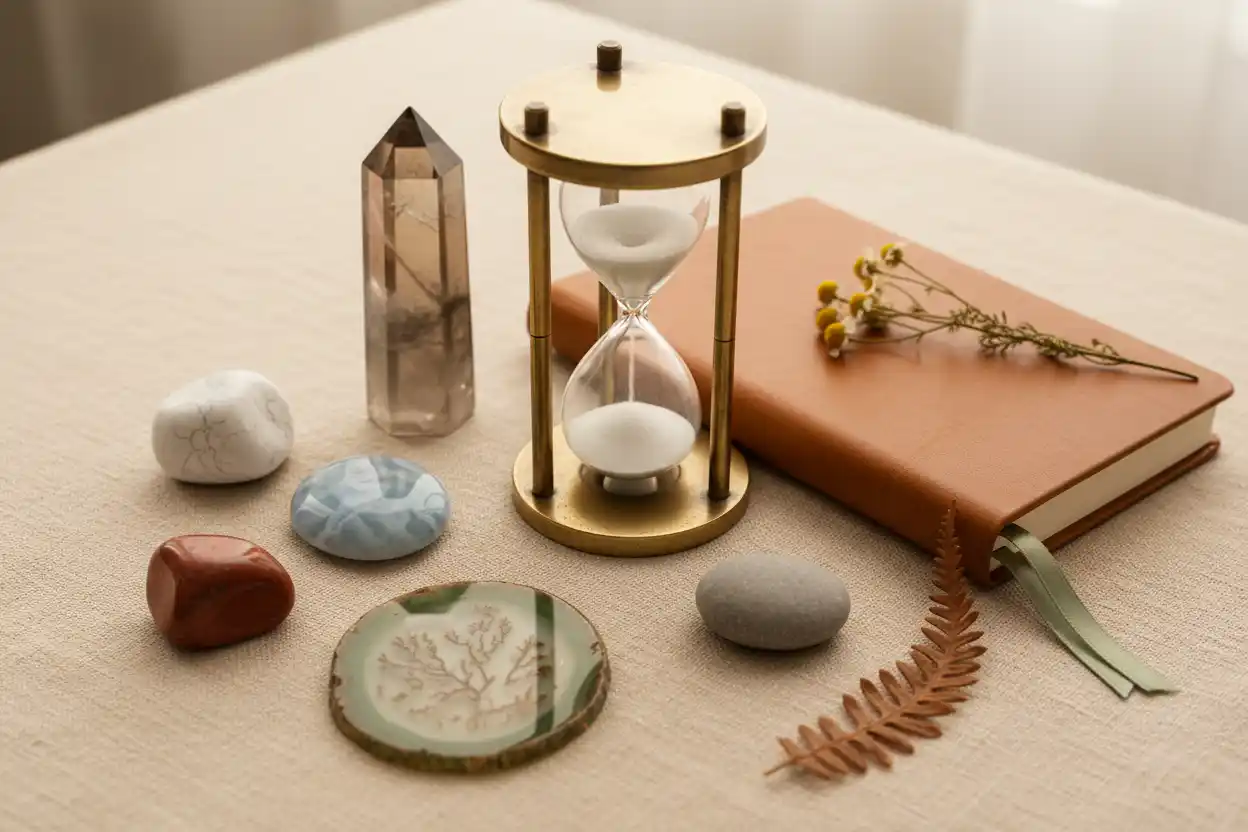
Best Crystals for Patience and Calm: Top 10 Stones
Crystals for patience are traditionally used as reminders to slow reactive responses, tolerate reasonable delays and remain engaged with gradual processes. They cannot remove frustration or make an unfair situation acceptable, but they may support a practical pause before words or actions create additional problems.
Howlite is one of the strongest general patience stones, while blue lace agate supports measured communication. Smoky quartz brings attention back to present facts, red jasper represents steady effort and moss agate suits progress that develops slowly.
Top 10 Crystals for Patience at a Glance
| Rank | Crystal | Traditional patience theme | Best practical use |
|---|---|---|---|
| 1 | Howlite | Patience, awareness and reduced reactivity | Pausing before responding |
| 2 | Blue lace agate | Calm and considerate communication | Difficult conversations and interruptions |
| 3 | Smoky quartz | Grounding and practical perspective | Tolerating uncertainty and delays |
| 4 | Red jasper | Stability, endurance and steady action | Long-term or repetitive work |
| 5 | Moss agate | Gradual growth and natural cycles | Waiting for slow progress |
| 6 | Moonstone | Cycles and emotional awareness | Accepting fluctuating capacity |
| 7 | Sodalite | Logic and organized thought | Separating facts from impatient assumptions |
| 8 | Aquamarine | Calm courage and clear expression | Addressing a delay directly |
| 9 | Lepidolite | Transition and simplification | Patience during major change |
| 10 | Tiger’s eye | Discernment and balanced confidence | Deciding when to wait and when to act |
What Patience Really Means
Patience is the ability to tolerate delay, difficulty or frustration without responding in a way that makes the situation worse. It does not require emotional numbness.
A patient person may still feel irritated. The difference lies in whether that irritation controls the next action.
Patience also does not mean accepting mistreatment, endless delay or avoidable incompetence. Sometimes the correct response is a clear question, boundary, escalation or change of plan.
The most useful crystal practice therefore asks two questions: what deserves more time, and what requires action now?
1. Howlite for the Pause Before Reaction
Howlite is traditionally associated with patience, awareness and calm. Its quiet white-and-gray appearance makes it a natural focal object during moments of irritation.
Place howlite near a phone, computer or another location where rushed responses often occur. Before replying, take one natural breath and read the message again.
Identify the factual issue, the emotion and the desired outcome. Then decide whether an immediate response is necessary.
A pause does not mean avoiding the issue. It creates enough distance to respond intentionally rather than transferring frustration.
Howlite is porous and commonly dyed, so it should not be soaked or exposed to oils and harsh cleaners.
2. Blue Lace Agate for Patient Communication
Blue lace agate is traditionally associated with calm speech and thoughtful communication. It suits situations where impatience appears through interruption, sarcasm or increasingly broad accusations.
Before speaking, state the main issue in one sentence. Allow the other person enough time to answer without preparing the next argument while they are talking.
Blue lace agate can also support patient teaching and explanation. When someone does not understand immediately, try a different example rather than repeating the same words more loudly.
Patience should remain reciprocal. A calm tone does not require continuing a conversation where the other person is threatening or abusive.
3. Smoky Quartz for Uncertainty and Delays
Smoky quartz is traditionally connected with grounding, release and practical perspective. It may be useful when a person has completed the available action and must now wait.
Write down what has already been done, when follow-up becomes appropriate and what remains outside personal control.
Smoky quartz can mark the decision not to check repeatedly before that point. The delay may still feel uncomfortable, but it no longer needs to occupy every available moment.
This approach works well for applications, test results, approvals and messages where another person now controls the next step.
4. Red Jasper for Long-Term Effort
Red jasper is traditionally associated with stability, endurance and practical action. It suits patience with processes that require repetition.
Learning, rehabilitation, saving money and building a business rarely produce dramatic results every day. Red jasper can remain beside a progress tracker as a reminder that consistent effort still matters.
Choose a sustainable minimum action. Completing that action regularly may produce more value than intense effort followed by long interruptions.
Patience does not mean continuing a plan that clearly fails. Review the process at defined intervals and use evidence to decide whether it needs adjustment.
5. Moss Agate for Gradual Growth
Moss agate is traditionally connected with natural cycles, patience and slow development. Its plant-like inclusions make it one of the clearest visual symbols of gradual growth.
Use moss agate with projects whose early progress remains difficult to see. Record small indicators rather than evaluating success only through final outcomes.
A new habit may become slightly easier. A plant may produce one new leaf. A relationship may develop trust through several ordinary interactions.
Moss agate supports appreciation for that quieter movement without pretending that every delay is beneficial.
6. Moonstone for Patience with Changing Capacity
Moonstone is traditionally associated with cycles, emotional awareness and transition. It suits patience directed toward oneself during changing energy or emotional capacity.
One difficult day does not erase previous progress. Likewise, a productive day does not guarantee identical capacity tomorrow.
Track patterns in sleep, workload, health and emotional demands. This information may reveal whether expectations need adjustment or professional input.
Moonstone can symbolize working with changing conditions rather than judging every fluctuation as a personal failure.
7. Sodalite for Checking Impatient Assumptions
Sodalite is traditionally associated with logic, truth and coherent thinking. It may help when impatience is driven by conclusions that have not been verified.
For example, a delayed reply may be interpreted as disrespect even though the reason remains unknown. A slow project may seem abandoned when work is occurring out of view.
Separate the known facts from interpretations and unanswered questions. Then decide whether clarification is needed.
Sodalite supports patience through accurate information, not passive guessing.
8. Aquamarine for Calm, Direct Action
Aquamarine carries traditional associations with courage, calm and clear communication. It suits situations in which patience should include a direct question.
Ask for an update, clarify the expected timeline or explain how the delay affects other responsibilities.
A respectful inquiry can reduce uncertainty without becoming aggressive. Use precise language and a realistic response deadline.
Aquamarine’s role is not to encourage indefinite waiting. Instead, it symbolizes communicating calmly when additional information is necessary.
9. Lepidolite for Patience During Transition
Lepidolite is traditionally associated with transition, steadiness and simplification. Major changes often require patience because routines and expectations are still developing.
Sort responsibilities into essential, helpful and optional. Temporarily reducing nonessential demands may prevent the transition from becoming more difficult than necessary.
Lepidolite contains lithium within its mineral structure, but holding it does not provide medication or treat anxiety or another health condition.
Because the stone is relatively soft, keep it dry and protected from harder materials.
10. Tiger’s Eye for Knowing When to Stop Waiting
Tiger’s eye is traditionally linked with discernment, confidence and practical judgment. It adds an important limit to patience.
Before waiting longer, define the evidence that would justify continuing and the condition that would trigger action.
For example, a person may wait until an agreed deadline, then send one follow-up. If no response arrives after another defined period, they may pursue an alternative.
Tiger’s eye helps distinguish constructive patience from indefinite delay caused by fear of making a decision.
Choosing a Patience Crystal by Situation
| Situation | Recommended crystals | Practical response |
|---|---|---|
| Waiting for a reply | Smoky quartz and sodalite | Set a reasonable follow-up time |
| Difficult conversation | Blue lace agate and howlite | Pause, listen and state one issue |
| Long-term project | Red jasper and moss agate | Track consistent small actions |
| Changing life circumstances | Moonstone and lepidolite | Adjust expectations and simplify |
| Teaching or explaining | Blue lace agate and aquamarine | Change the explanation rather than escalating |
| Frustration with oneself | Moonstone and rose quartz | Use a fair, evidence-based standard |
| Repeated interruptions | Howlite and black tourmaline | Pause and establish a boundary |
| Unclear delay | Sodalite and aquamarine | Ask for specific information |
| Deciding whether to wait | Tiger’s eye and smoky quartz | Define a deadline and alternative |
| Slow recovery | Moss agate and red jasper | Follow an appropriate gradual plan |
Patience Versus Passivity
Patience allows a process enough time to develop. Passivity avoids action even when the situation requires it.
| Constructive patience | Unhelpful passivity |
|---|---|
| Uses an agreed or reasonable timeline | Waits without any review point |
| Continues useful action | Avoids necessary communication |
| Accepts factors outside personal control | Assumes nothing can be changed |
| Reviews evidence periodically | Ignores worsening conditions |
| Maintains boundaries | Tolerates repeated harm |
| Changes course when appropriate | Remains attached from fear |
A crystal should never be used to persuade someone to tolerate abuse, unsafe work or serious medical symptoms.
Patience and Anger
Impatience often appears as anger when something moves more slowly than expected. However, anger may also signal disrespect, unfairness or an important boundary violation.
The completed guide to crystals for anger and calm focuses on reducing reactivity and choosing an appropriate response.
A patience practice should not automatically dismiss anger. First determine what information it contains. Then decide whether the situation needs time, communication or protective action.
Patience and Inner Peace
Inner peace concerns the broader relationship someone has with uncertainty, conflict and personal values. Patience is the narrower skill of remaining deliberate during delay or difficulty.
The completed guide to crystals for inner peace explores acceptance and stable responses more fully.
Howlite, smoky quartz and blue lace agate appear in both intentions because pausing and grounding can support each one. The behavior attached to the stone determines the actual purpose.
Patience During Anxiety and Stress
Waiting can intensify worry, especially when the outcome affects health, work or relationships. Grounding may help, but a crystal cannot treat an anxiety disorder.
The completed guide to crystals for anxiety and stress relief provides a wider framework for worry-oriented routines.
When anxiety causes repeated checking, set a specific review time. Put the relevant information away until then and direct attention toward another responsibility.
Persistent or severe distress deserves qualified support.
Patience in Relationships
Healthy relationships require patience with differences in communication, pace and emotional processing. They do not require accepting contempt, manipulation or broken agreements without response.
Blue lace agate and aquamarine can support a calm conversation about expectations. Sodalite helps separate facts from assumptions, while tiger’s eye can define a reasonable timeline for change.
A person should not be pressured to wait indefinitely for trust or safety to improve. Observable behavior matters more than promises alone.
Patience in Parenting, Teaching and Caregiving
Children, students and people receiving care may require repetition and adapted communication. Patience helps preserve dignity and reduce unnecessary escalation.
However, caregivers and educators also have limits. Exhaustion, inadequate support and unrealistic demands can reduce available patience.
Use howlite as a cue to pause, while blue lace agate can represent changing the explanation. When capacity is too low, seek assistance rather than attempting to force calm.
Patience is a skill supported by resources, not a moral test that someone must pass while overwhelmed.
Patience with Recovery and Healing
Physical and emotional recovery can progress unevenly. Moss agate and moonstone provide suitable symbolism for gradual change.
Follow the care plan provided by qualified professionals and report symptoms or setbacks appropriately. Patience should not mean ignoring worsening pain or new problems.
The completed guide to crystals for healing explains the limited symbolic role crystals may play alongside genuine care.
A slower timeline does not make the effort meaningless, but medical concerns require medical assessment.
A One-Minute Patience Practice
Choose one smooth stone and notice its weight and temperature.
State the current frustration in factual language. Then ask whether the situation requires waiting, clarification, action or a boundary.
When waiting is appropriate, define the next review time. When action is needed, choose the smallest constructive step.
The practice should end with a decision rather than becoming a prolonged ritual.
Building a Three-Crystal Patience Set
A balanced set can include one stone for pausing, one for communication and one for sustained effort.
Howlite, blue lace agate and red jasper form a practical combination. Howlite represents the pause, blue lace agate supports measured speech and red jasper symbolizes consistent work.
For uncertainty, smoky quartz, sodalite and tiger’s eye may be more suitable. Their roles involve grounding, accurate thinking and deciding when to act.
Keep the purposes distinct so the set remains easy to use.
Wearing Patience Crystals
A bracelet, pendant or smooth pocket stone can provide a tactile cue during waiting or difficult conversations.
Avoid handling the stone continuously when that becomes distracting. A brief touch should redirect attention rather than replace the conversation or task.
Remove jewelry around machinery, sports equipment and activities where it may catch. Fragile stones also need protective settings.
Placing Patience Crystals at Home or Work
Place howlite near a phone or computer used for difficult communication. Red jasper may remain beside a long-term project tracker, while moss agate can accompany a plant or gradual habit.
Keep all specimens on stable surfaces. Heavy and pointed stones should not rest above beds, chairs or busy work areas.
A visible reminder works best when it appears near the situation where impatience usually occurs.
Cleansing Patience Crystals
There is no scientific requirement to cleanse crystals on a fixed schedule. Clean each stone physically according to its composition.
Howlite and lepidolite require gentle dry care, while aquamarine and quartz varieties tolerate normal handling more readily.
The completed guide to cleansing crystals safely explains low-contact symbolic options.
Reset the crystal’s intention when the associated situation or goal changes.
When Impatience Signals a Real Problem
Impatience may be useful information when a process lacks transparency, a boundary is being ignored or an urgent need remains unmet.
Seek clarification rather than assuming that patience is always the correct response.
Medical symptoms, threats, financial fraud and unsafe conditions require timely action. A calming ritual should never delay help.
Likewise, persistent irritability may relate to pain, sleep deprivation, stress or a health condition that deserves assessment.
Conclusion
The best crystals for patience support deliberate choices during delay and frustration. Howlite encourages a pause, blue lace agate supports measured communication and smoky quartz grounds attention in present facts. Red jasper and moss agate reflect sustained effort and gradual growth, while tiger’s eye helps determine when waiting should end.
Patience is not passivity. A grounded practice allows enough time where time is useful and takes clear action when boundaries, safety or reliable information require it.
Frequently Asked Questions
1. What is the best overall crystal for patience?
Howlite is one of the strongest general choices because it symbolizes pausing and reduced reactivity. Blue lace agate may be better when communication is the main challenge.
2. Which crystal supports patience while waiting?
Smoky quartz helps ground attention, while sodalite can separate facts from assumptions during an uncertain delay.
3. Which stone is suitable for patience in relationships?
Blue lace agate supports calm communication, while tiger’s eye helps define when a situation needs action rather than more waiting.
4. Which crystal is helpful for anger and impatience?
Howlite, smoky quartz and blue lace agate can provide pause and grounding cues. They cannot treat persistent aggression or a mental-health condition.
5. Which crystal supports patience with long-term goals?
Red jasper and moss agate symbolize steady effort and gradual growth.
6. Can crystals make someone more patient?
Crystals cannot change behavior automatically. They may act as reminders to pause, review facts and choose a deliberate response.
7. Can several patience crystals be combined?
Yes. A useful set might include howlite for pausing, blue lace agate for communication and red jasper for persistence.
8. Where should patience crystals be placed?
Keep them near the situation where impatience appears, such as a phone, desk, classroom or long-term project tracker.
9. Is patience always the right response?
No. Unsafe conditions, ignored boundaries and urgent medical or practical concerns may require immediate action.
10. Can patience crystals help with anxiety?
They may support a grounding routine, but they cannot treat an anxiety disorder. Persistent distress requires appropriate support.
11. How should patience crystals be cleansed?
Use a method compatible with the mineral. Howlite and lepidolite should not be soaked indiscriminately.
12. When should persistent irritability be evaluated?
Qualified support may be useful when irritability is severe, worsening or connected with pain, sleep disruption, aggression or major functional problems.
Disclaimer: Crystals cannot treat anxiety, anger disorders, pain, sleep problems or another medical or psychological condition. Patience practices should never delay urgent care, safety action or enforcement of necessary boundaries.