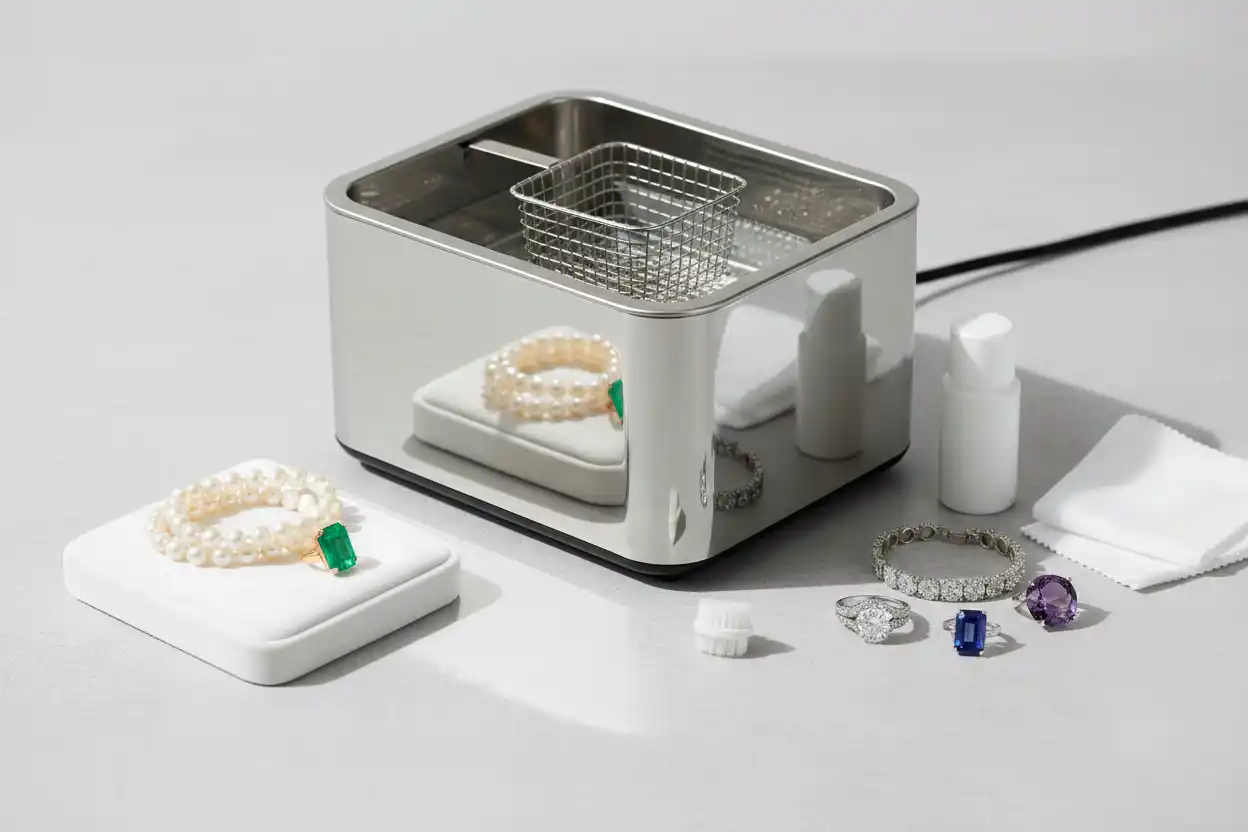
Which Gemstones Can Go in an Ultrasonic Cleaner?
Ultrasonic cleaners can remove grime from tiny spaces around settings, but they are not universally safe for gemstones. The machine creates rapid vibrations in a liquid bath, and those vibrations can worsen fractures, disturb fillings, damage delicate organic materials or even shake a loose gemstone out of its setting.
A gemstone that is theoretically compatible with ultrasonic cleaning may still be unsafe because of treatment, inclusions, cracks or jewelry construction. Therefore, the correct question is not simply “Is this mineral hard?” but “Is this particular stone, treatment and setting suitable for ultrasonic cleaning?”
Ultrasonic Gemstone Safety at a Glance
| Gem or Material | General Ultrasonic Guidance | Important Condition |
|---|---|---|
| Alexandrite | Usually safe | Avoid fracture-filled stones |
| Amethyst | Usually safe | Avoid dyed or fracture-filled material |
| Aquamarine | Usually safe | Avoid stones with fractures or liquid inclusions |
| Garnet | Usually safe | Avoid fractured or fracture-filled stones |
| Ruby | Usually safe in many cases | Avoid fracture/cavity-filled or dyed material |
| Sapphire | Usually safe in many cases | Avoid fracture/cavity-filled or dyed material |
| Diamond | Stone itself is durable, but home ultrasonic use needs caution | Loose settings or treatments change safety |
| Emerald | Generally avoid | Fracture filling is common |
| Opal | Avoid | Heat, treatment and structural sensitivity |
| Pearl | Never use | Organic and delicate |
| Amber | Never use | Organic and heat-sensitive |
| Coral | Never use | Organic and porous |
| Moonstone | Avoid | Feldspar, poor toughness and heat sensitivity |
| Tanzanite | Avoid | Cleavage and thermal-shock risk |
| Topaz | Avoid | Perfect cleavage |
| Turquoise | Avoid | Porous and commonly treated |
| Lapis lazuli | Avoid | Porous/intergrown and commonly treated |
| Malachite | Avoid | Soft and sensitive |
| Fluorite | Avoid | Soft with strong cleavage |
| Kunzite | Avoid | Cleavage and heat sensitivity |
| Zircon | Avoid | Brittle and heat-sensitive |
| Iolite | Avoid | Temperature-change sensitivity |
“Usually safe” never means automatically safe.
The condition of the actual jewelry must be checked first.
How an Ultrasonic Cleaner Works
An ultrasonic cleaner uses high-frequency sound energy transmitted through liquid.
That process creates microscopic bubbles that form and collapse rapidly—a phenomenon called cavitation.
The resulting agitation can reach places that brushes cannot easily access, including:
under gemstones, around prongs, inside small links and within intricate metal surfaces.
This makes ultrasonic cleaning effective for suitable jewelry.
The same mechanical action, however, can stress weaknesses.
A fracture, loose prong, filler or delicate surface treatment may respond badly even when an untreated flawless example of the same mineral could tolerate the machine.
Hardness Does Not Determine Ultrasonic Safety
Mohs hardness describes resistance to scratching.
It does not tell you whether a gemstone can withstand vibration, heat, cleavage stress or treatment damage.
Topaz illustrates the problem well.
It has Mohs hardness 8, yet it also has perfect cleavage. A hard impact or unfavorable stress can split it despite its high scratch resistance.
Moonstone is another example. Its hardness is moderate, but toughness and heat sensitivity make ultrasonic cleaning inappropriate.
The completed Gemstone Toughness vs Hardness article explains why these properties must be evaluated separately.
Likewise, Gemstone Cleavage Explained covers the structural weakness that makes some apparently hard gemstones vulnerable.
Alexandrite
Alexandrite is among the more durable colored gemstones.
It has Mohs hardness 8.5, excellent toughness and no cleavage.
Ultrasonic and steam cleaners are generally considered suitable for normal untreated alexandrite.
The exception is fracture-filled material.
Fillers can be damaged, so fracture-filled alexandrite should receive only gentle warm-soapy-water cleaning.
For routine care outside a machine, How to Clean Alexandrite Jewelry Safely provides the gemstone-specific procedure.
Amethyst
Amethyst is another gemstone that can usually tolerate ultrasonic cleaning when untreated and structurally sound.
Its Mohs hardness is 7, and it has good toughness.
However, dyed or fracture-filled amethyst should not be placed in an ultrasonic cleaner.
Abrupt temperature changes are also undesirable.
Therefore, a vintage or poorly documented purple quartz piece should not be assumed ultrasonic-safe simply because the stone looks like amethyst.
The conservative alternative is covered in How to Clean Amethyst Jewelry Safely.
Aquamarine
Aquamarine is normally durable enough for ultrasonic cleaning.
However, GIA specifically notes that stones with fractures or liquid inclusions should not be cleaned ultrasonically.
This qualification matters because aquamarine can contain internal features that are not obvious to an untrained observer.
Rare fracture-filled material also requires warm soapy water instead.
For expensive aquamarine with uncertain inclusions, professional evaluation is preferable before mechanical cleaning.
Garnet
Garnets generally tolerate ultrasonic cleaning well when they do not contain significant fractures.
Fracture filling is rare but does occur.
A fracture-filled garnet should be cleaned gently rather than ultrasonically.
Because garnet represents a mineral group rather than one single species, its hardness varies, yet GIA’s care guidance is consistent: warm soapy water is universally conservative, while ultrasonic cleaning is usually acceptable only when fractures are absent.
The dedicated How to Clean Garnet Jewelry Safely maintains the detailed routine-care workflow.
Ruby
Untreated ruby is highly durable.
Heat-treated and lattice-diffusion-treated ruby are also generally considered suitable for ultrasonic cleaning.
The major exception is material that has been fracture filled, cavity filled or dyed.
Lead-glass-filled ruby in particular requires much greater care because the filler can be damaged.
Do not infer treatment from appearance alone.
If a ruby’s history is uncertain, use a gentler method or have the jewelry assessed first.
The site’s How to Clean Ruby Jewelry Safely provides the complete ruby-specific guidance.
Sapphire
Sapphire follows a similar pattern to ruby because both are corundum.
Untreated, heat-treated and lattice-diffusion-treated sapphire can generally tolerate ultrasonic cleaning.
Fracture-filled, cavity-filled and dyed sapphire should not.
Star sapphires deserve additional caution because their inclusions create the optical phenomenon and broad ultrasonic-cleaner guidance is more conservative with phenomenal stones.
When treatment or structure is uncertain, warm soapy water is the lower-risk choice.
Detailed sapphire maintenance belongs to How to Clean Sapphire Jewelry Safely.
What About Diamonds?
Diamond is exceptionally hard, but that does not make every diamond ring safe for a consumer ultrasonic machine.
The first issue is setting security.
Ultrasonic vibration can expose or worsen a loose prong, potentially allowing a stone to leave the mounting.
The second issue is treatment.
Fracture-filled diamonds can be damaged under inappropriate cleaning conditions.
For these reasons, GIA consumer guidance advises caution with home ultrasonic cleaners and notes that jewelry professionals inspect pieces for loose stones before using such equipment.
The safer everyday approach is covered in How to Clean Diamond Jewelry Safely.
Why Emerald Should Usually Stay Out
Emerald is hard enough to surprise some owners—it ranks roughly 7.5–8 Mohs—but it is frequently fractured and commonly treated with oil, resin or wax.
Those treatments improve apparent clarity by reducing the visibility of surface-reaching fractures.
Ultrasonic vibration and cleaning solutions can disturb fillings or increase the risk associated with existing fractures.
As a practical consumer rule, emerald should not be placed in an ultrasonic cleaner unless a qualified professional has specifically evaluated that individual stone and procedure.
For ordinary home care, follow How to Clean Emerald Jewelry Safely.
Never Ultrasonic-Clean Organic Gems
Organic gem materials require particularly conservative care.
Examples include:
pearl, coral and amber.
They can be soft, porous or vulnerable to heat and cleaning chemicals.
Ultrasonic cleaning is inappropriate.
Pearls are especially delicate and should generally be wiped gently rather than exposed to aggressive jewelry-cleaning methods.
The tracker provides separate procedures for How to Clean Pearl Jewelry Safely and other organic materials because their care requirements differ fundamentally from crystalline gemstones.
Opal
Opal should remain outside the ultrasonic cleaner.
Its internal water content, structural characteristics and the existence of treated, assembled and fracture-prone material make mechanical cleaning unnecessarily risky.
Some opals are also impregnated or otherwise treated.
Doublets and triplets introduce adhesive layers that further complicate cleaning.
Warm soapy water and appropriate hand cleaning are preferable for suitable solid opal.
The complete procedure is maintained in How to Clean Opal Jewelry Safely.
Turquoise
Turquoise is porous compared with many transparent gemstones and is frequently stabilized, impregnated, waxed or dyed.
Ultrasonic cleaning can damage the material or its treatment.
It also exposes turquoise unnecessarily to cleaning solutions that may alter surface appearance.
Avoid the machine.
The tracker-approved How to Clean Turquoise Jewelry Safely provides the material-specific alternative.
Moonstone and Other Feldspars
Moonstone should not be placed in an ultrasonic cleaner.
Its poor toughness and sensitivity to high heat or temperature change make warm soapy water the better choice.
Other feldspar gems may have different details, but the family includes materials where cleavage and internal structures deserve caution.
Consequently, “hard enough to wear” should not be translated automatically into “safe for ultrasonic cleaning.”
Tanzanite
Tanzanite has perfect cleavage and can be damaged by sudden temperature changes.
Ultrasonic cleaning is not recommended.
This is particularly important because tanzanite can look durable in a polished ring even though its crystal structure contains a direction of significant weakness.
The conservative care procedure is maintained in How to Clean Tanzanite Jewelry Safely.
Topaz
Topaz is another classic example of hardness failing as a cleaning guide.
Although it ranks Mohs 8, it has perfect cleavage.
Ultrasonic vibration introduces unnecessary risk, particularly when the gemstone already contains an internal fracture.
Avoid the ultrasonic cleaner and use appropriate hand cleaning instead.
The completed How to Clean Topaz Jewelry Safely owns its complete maintenance process.
Coated and Impregnated Gemstones
A coating can be much less durable than the gemstone underneath it.
Likewise, oil, wax, plastic or resin impregnation may respond badly to vibration, heat or cleaning chemicals.
This means a mineral that normally tolerates ultrasonic cleaning may become unsuitable after treatment.
Before using a machine, identify not only the gemstone but also the treatment.
The broader Gemstone Treatments Explained guide provides the treatment framework needed to understand those exceptions.
Mixed-Gem Jewelry
A ring containing sapphire and pearl should be treated according to the most vulnerable component, not the most durable one.
The same principle applies to:
diamond-and-emerald jewelry, ruby-and-opal pieces, multi-gem bracelets and jewelry containing enamel or adhesives.
Metal settings can also contain construction details that respond poorly to prolonged ultrasonic exposure.
Therefore, never decide based solely on the center stone.
Evaluate the entire object.
Loose Settings Are a Major Risk
Even when every gemstone is ultrasonic-compatible, the jewelry itself may not be.
Vibration can reveal a setting that was already loose.
Before professional ultrasonic cleaning, jewelers commonly inspect:
prongs, bezels, pavé stones, channel settings, clasps and soldered components.
A consumer may not recognize subtle movement.
If a stone clicks, rocks or catches because a prong is raised, do not place the piece in the machine.
Repair should come first.
A Conservative Home Decision Rule
Use an ultrasonic cleaner only when all of the following are known:
the gemstone identity is certain; the treatment status is compatible; there are no significant fractures; the stone does not contain risky liquid inclusions; every other material in the jewelry is compatible; and the setting is secure.
If even one factor is unknown, hand cleaning with an appropriate gemstone-specific method is usually safer.
Warm soapy water is a valid option for many durable gemstones, but even that method needs modification for certain porous, organic or assembled materials.
The Gemstone Hardness Chart can help identify physical properties, but it should never be used as a standalone ultrasonic-safety chart.
Frequently Asked Questions
1. Can all hard gemstones go in an ultrasonic cleaner?
No. Hardness measures scratch resistance, not resistance to vibration, cleavage, heat, fractures or treatment damage.
2. Can amethyst go in an ultrasonic cleaner?
Usually yes when the stone is untreated and not fracture filled or dyed.
3. Can sapphire go in an ultrasonic cleaner?
Untreated, heat-treated and many lattice-diffusion-treated sapphires are usually compatible. Fracture-filled, cavity-filled or dyed sapphires are not.
4. Can ruby go in an ultrasonic cleaner?
Many untreated and heat-treated rubies can, but fracture-filled, cavity-filled or dyed ruby should not.
5. Can diamonds go in an ultrasonic cleaner?
Diamond itself is highly durable, but home ultrasonic cleaning can loosen vulnerable settings and may be unsuitable for treated stones. Jewelry should be inspected first.
6. Can emerald go in an ultrasonic cleaner?
Generally no. Emeralds commonly contain fractures and clarity-enhancing fillers that can be damaged or disturbed.
7. Can pearls go in an ultrasonic cleaner?
No. Pearls are organic, soft and chemically sensitive.
8. Can opal go in an ultrasonic cleaner?
No. Opal’s structure, treatments and sensitivity make ultrasonic cleaning unnecessarily risky.
9. Can turquoise go in an ultrasonic cleaner?
No. Turquoise is often porous and treated with waxes, resins, dyes or other materials that can be damaged.
10. Can garnet go in an ultrasonic cleaner?
Usually yes if it has no significant fractures or fracture filling.
11. What if my jewelry contains several different gemstones?
Clean according to the most vulnerable gemstone or material in the piece. One ultrasonic-safe stone does not make the entire item safe.
12. What should I do if I do not know whether my gemstone is treated?
Do not use an ultrasonic cleaner. Choose the appropriate gentle hand-cleaning method or have the piece evaluated by a qualified jeweler or gemologist.
Conclusion
Ultrasonic cleaning is useful precisely because it is aggressive enough to reach places ordinary cleaning cannot. That same strength explains why it should be used selectively.
Alexandrite, amethyst, aquamarine, garnet, ruby and sapphire can often tolerate ultrasonic cleaning under the right conditions. Emerald, pearl, amber, coral, opal, turquoise, moonstone, tanzanite, topaz and several other sensitive materials generally should not.
Most importantly, treatment and jewelry construction can override the rule for the underlying mineral. A filled fracture, liquid inclusion, coating, loose prong or delicate companion gemstone can turn an otherwise compatible stone into a poor ultrasonic candidate.
When the material history is uncertain, gentle gemstone-specific cleaning is the safer choice.
Disclaimer: Ultrasonic cleaning can damage gemstones, treatments and jewelry settings or loosen stones. This guide provides general material-care information, not an inspection of a specific piece. Valuable, antique, treated, fractured or uncertain jewelry should be evaluated by a qualified jeweler or gemologist before ultrasonic cleaning.