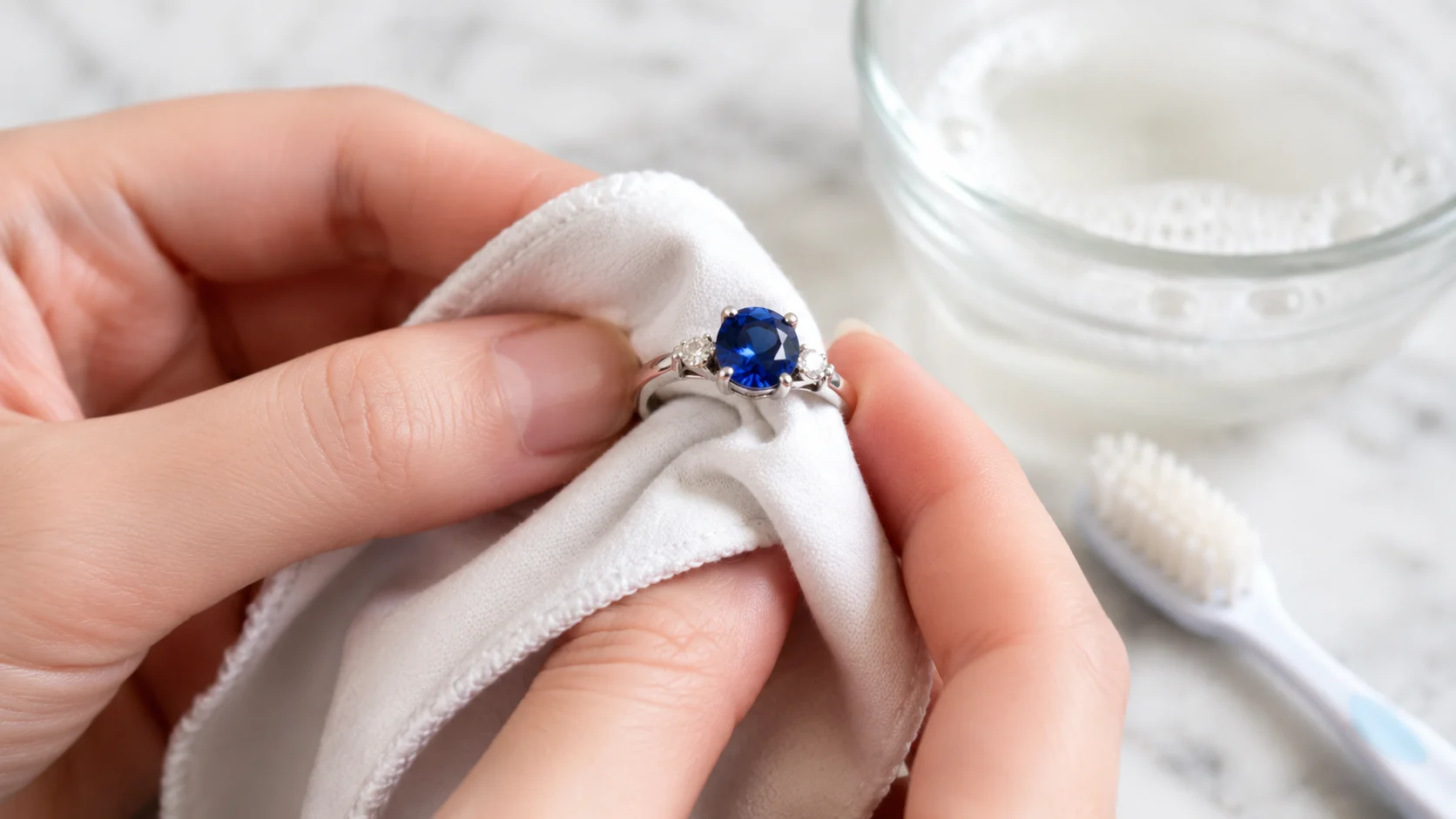
How to Clean Sapphire Jewelry Safely: Water, Soap & Care Guide
Knowing how to clean sapphire jewelry safely begins with a reassuring fact: sapphire is one of the most durable gemstones used in jewelry. For most sound untreated, conventionally heated, or stable diffusion-treated sapphire, lukewarm water, mild liquid soap, a soft brush, a brief rinse, and careful drying are enough to remove ordinary skin oil, lotion, cosmetics, and soap residue.
However, how to clean sapphire jewelry changes when the gemstone is fracture-filled, cavity-filled, dyed, coated, glued, heavily fractured, or mounted alongside more delicate materials. Laboratory-grown sapphire also shares natural sapphire’s basic corundum durability, while rare Padparadscha sapphire needs particular attention to treatment, value, color stability, and documentation.
That means the safest cleaning decision should be based on the whole jewel rather than sapphire’s hardness alone.
The broader sapphire meaning profile explains corundum’s mineral properties, colors, geology, history, and symbolism, while types of sapphire separates blue, pink, yellow, white, green, Padparadscha, star, color-change, parti-colored, and laboratory-grown material.
At Gems Lore, how to clean sapphire jewelry is treated as a material-care question based on gemstone condition, treatment, construction, and setting security. Physical cleaning is separate from spiritual cleansing or symbolic practices.
How to Clean Sapphire Jewelry at a Glance
| Method | General recommendation |
|---|---|
| Soft lint-free cloth | Excellent for routine wiping |
| Lukewarm water | Safe for most sound sapphire |
| Mild liquid soap | Best general home cleaner |
| Soft-bristled brush | Good for settings and pavilion residue |
| Short soaking | Acceptable for many sound uncomplicated pieces |
| Long soaking | Usually unnecessary |
| Ultrasonic cleaner | Conditional |
| Steam cleaner | Conditional |
| Boiling water | Avoid |
| Sudden temperature change | Avoid |
| Vinegar or lemon juice | Avoid |
| Toothpaste | Avoid |
| Baking soda scrub | Avoid |
| Bleach | Avoid |
| Unknown jewelry dip | Avoid |
| Strong solvents | Avoid unless professionally assessed |
| Professional cleaning | Best for valuable, filled, damaged, antique, or complex pieces |
The most reliable answer to how to clean sapphire jewelry is therefore not simply “sapphire is hard.” Sapphire ranks 9 on the Mohs scale, but the gemstone hardness chart measures scratch resistance rather than every type of damage.
Sapphire also has excellent practical toughness and no easy cleavage, yet hard impacts can still chip exposed corners, thin girdles, or existing fractures. The distinction is explained in gemstone toughness vs hardness.
What You Need
You need only a few basic items to learn how to clean sapphire jewelry properly:
- A shallow bowl
- Lukewarm clean water
- Mild liquid soap
- A very soft toothbrush or jewelry brush
- A lint-free cloth
- A folded towel
Avoid cleaning directly over an uncovered sink. Even when the sapphire itself is secure, a loose accent stone, earring back, or small component can disappear down a drain.
Use only a small amount of soap. Stronger concentration does not make how to clean sapphire jewelry more effective.
Step 1: Inspect the Entire Piece
The first step in how to clean sapphire jewelry is inspection.
Look at the stone under bright neutral light. Check its girdle, facet junctions, corners, surface, and visible fractures. Natural inclusions such as rutile silk, crystals, fingerprints, healed fissures, or color zones are not dirt and should not be scrubbed away.
Then inspect the mounting.
Look closely at:
- Prongs
- Bezel edges
- Pavé
- Halo stones
- Channel walls
- Chain links
- Hinges
- Clasps
- Bails
- Solder joints
- Enamel
- Glue
- Bead holes
Touch the sapphire gently. Do not twist it. If it clicks, rocks, moves, or shows a gap between the stone and setting, stop cleaning.
Knowing how to clean sapphire jewelry includes recognizing when a jeweler needs to repair the piece first.
Step 2: Identify the Treatment
Treatment status can completely change how to clean sapphire jewelry.
Sapphire may be untreated, conventionally heated, lattice-diffused, fracture-filled, cavity-filled, dyed, coated, irradiated, assembled, or subjected to combinations of these processes.
The treated sapphire overview explains why treatments should be separated rather than treated as one category.
Untreated Sapphire
Sound untreated sapphire usually tolerates mild soapy water extremely well. Ultrasonic and steam cleaning may also be appropriate when there are no significant fractures and the setting is secure.
Conventionally Heated Sapphire
Heat treatment is common in the sapphire market and can improve color, clarity, or both.
Proper conventional heat treatment is generally stable. A sound heated sapphire can normally be cleaned like an untreated sapphire.
Diffusion-Treated Sapphire
Lattice diffusion can introduce color-producing elements under high temperature. Titanium diffusion is associated with some blue material, while beryllium diffusion can create or modify yellow, orange, and pink-orange colors.
Routine mild washing does not remove diffusion color.
How to clean sapphire jewelry containing stable diffusion-treated stones can therefore remain similar to ordinary sapphire cleaning, although significant repolishing or recutting may affect shallow surface-related color.
Fracture-Filled or Cavity-Filled Sapphire
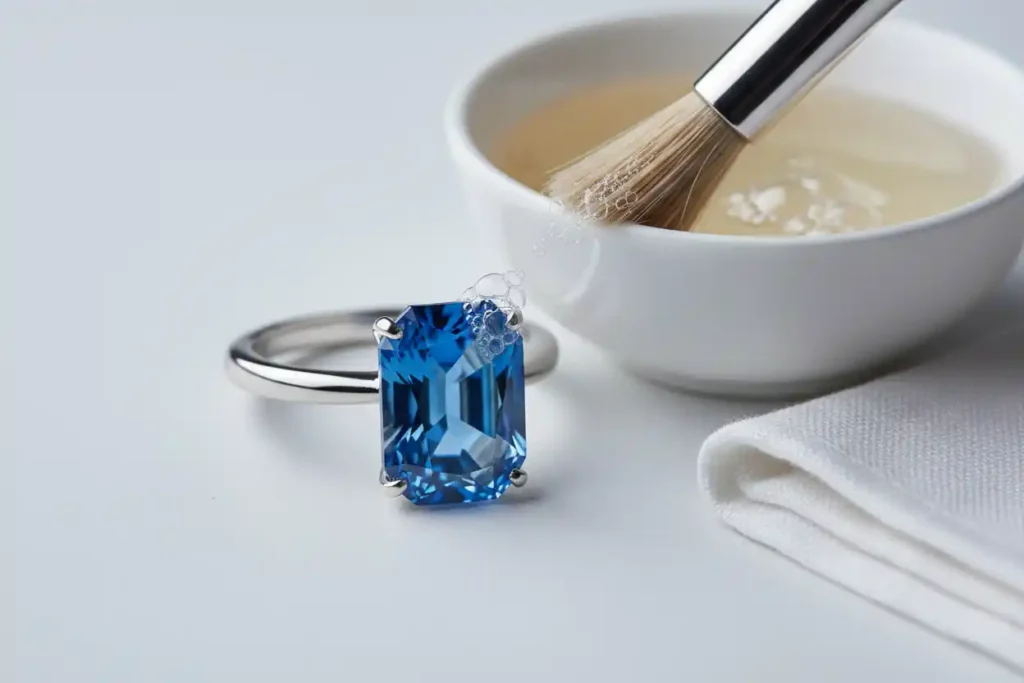
Filled sapphire requires much greater caution.
Glass-like or other fillers may occupy surface-reaching fractures or cavities. Heat, acids, solvents, vibration, and strong cleaners may damage the filling material.
For these stones, how to clean sapphire jewelry should usually mean careful damp-cloth cleaning rather than soaking, steam, or ultrasound.
Dyed or Coated Sapphire
Dye and coatings may be less stable than corundum itself.
Use a soft damp cloth, avoid prolonged soaking, and keep the piece away from aggressive chemicals, solvents, abrasives, steam, and ultrasonic equipment.
When treatment is unknown, choose the conservative method.
Step 3: Prepare Lukewarm Soapy Water
Fill the bowl with lukewarm—not hot—water and add a few drops of mild liquid soap.
How to clean sapphire jewelry safely does not require boiling water, concentrated detergent, ammonia, vinegar, lemon juice, or abrasive cleaning paste.
If the jewelry has recently been exposed to cold outdoor temperatures or strong heat, allow it to return gradually to room temperature before cleaning.
Although sapphire is stable, avoiding rapid thermal change also protects settings, fillers, adhesives, and companion gems.
Step 4: Let Ordinary Residue Loosen
For a sound untreated, heated, or suitable diffusion-treated sapphire, place the jewelry briefly in the mild solution.
A few minutes is usually enough.
Lotion, soap film, sunscreen, skin oil, and cosmetics often accumulate beneath faceted stones. This residue can make sapphire appear darker, cloudier, or less brilliant.
When learning how to clean sapphire jewelry, remember that dirt beneath the pavilion can affect appearance more dramatically than dirt on the visible top surface.
Do not soak fracture-filled, coated, dyed, glued, or uncertain pieces.
Step 5: Brush Gently
Use a soft-bristled brush and light pressure.
For rings, focus on the pavilion and gallery beneath the center stone. For earrings, clean behind the gemstone and around the basket. Pendants may accumulate skin oil behind the setting, while bracelets often collect residue around links and multiple mounts.
How to clean sapphire jewelry effectively depends on reaching those hidden surfaces rather than aggressively scrubbing the top.
Never use pins, needles, knives, toothpicks with sharp ends, or metal tools beneath a setting. They can damage metal, loosen stones, or scratch other materials.
A natural inclusion cannot be removed by brushing.
Step 6: Rinse Carefully
Rinse sound sapphire jewelry in clean lukewarm water.
A second bowl is safer than holding a valuable piece beneath a running faucet.
For filled, coated, dyed, glued, or otherwise delicate jewelry, remove soap with another clean damp cloth rather than immersing the piece.
How to clean sapphire jewelry should always follow the most vulnerable component in the design.
A sapphire surrounded by pearls, opals, emeralds, or another care-sensitive gem cannot automatically be treated like a sapphire-only ring.
Step 7: Dry Thoroughly
Blot the jewelry with a lint-free cloth and allow hidden moisture to evaporate naturally at room temperature.
Do not dry sapphire jewelry with:
- A hair dryer
- A radiator
- An oven
- Direct flame
- Very hot sunlight
- A heat gun
Once the piece is dry, inspect the setting again.
How to clean sapphire jewelry properly finishes with checking whether any prong, clasp, or accent stone became visibly loose during handling.
Can Sapphire Go in Water?
Yes, most sound sapphire can tolerate ordinary water.
Sapphire is corundum and is not water-soluble under normal jewelry conditions. Brief contact with lukewarm water does not normally damage untreated or conventionally heated material.
The complication is the complete jewelry piece.
Glue, filler, coatings, dyes, antique components, thread, elastic, enamel, and companion stones can impose stricter limits.
So when deciding how to clean sapphire jewelry, distinguish between a sapphire gemstone being water-resistant and an entire jewel being safe to soak.
Should You Soak Sapphire Jewelry?
A short soak can help loosen accumulated oil on sound uncomplicated sapphire jewelry, but prolonged soaking is unnecessary.
An overnight soak provides little advantage.
Avoid soaking when the piece contains:
- Fracture filling
- Cavity filling
- Dye
- Coatings
- Glue
- Unknown treatment
- Antique construction
- Delicate accent stones
- Damaged metalwork
How to clean sapphire jewelry safely is about controlled exposure, not keeping the piece underwater for as long as possible.
Can Sapphire Go in an Ultrasonic Cleaner?
Sometimes.
Untreated, conventionally heated, and many diffusion-treated sapphires can tolerate ultrasonic cleaning when they are structurally sound and securely mounted.
However, an ultrasonic cleaner should not be treated as the automatic answer to how to clean sapphire jewelry.
Avoid ultrasound for:
- Fracture-filled sapphire
- Cavity-filled sapphire
- Dyed sapphire
- Coated sapphire
- Surface-reaching fractures
- Loose settings
- Delicate pavé
- Glued components
- Antique jewelry
- Uncertain treatments
Vibration can aggravate an existing fracture, disturb filler, or reveal a weak setting.
Manual cleaning is sufficient for most household care.
Can Sapphire Be Steam Cleaned?
Sound untreated, conventionally heated, and some diffusion-treated sapphires can generally tolerate professional steam cleaning.
That does not mean steam is needed at home.
When considering how to clean sapphire jewelry, steam should be avoided if the piece contains filler, dye, coatings, glue, vulnerable accent gems, damaged settings, or uncertain treatment.
Heat can also create problems during jewelry repair. Tell the jeweler about known treatments before soldering, retipping prongs, resizing, or resetting an important sapphire.
Warm soapy water remains the safer everyday method.
How to Clean Lab-Grown Sapphire Jewelry
One of the most important distinctions in how to clean sapphire jewelry concerns origin.
Laboratory-grown sapphire is synthetic corundum. It has essentially the same aluminum-oxide composition, crystal structure, Mohs hardness, and general durability as natural sapphire.
The lab-grown sapphire profile explains flame-fusion, flux, hydrothermal, and pulled-crystal production methods.
Laboratory origin does not make a sound stone physically delicate.
For ordinary untreated lab-grown sapphire, how to clean sapphire jewelry remains straightforward: lukewarm water, mild soap, soft brushing, brief rinsing, and complete drying.
Does Growth Method Change Cleaning?
Usually not by itself.
Flame-fusion, flux-grown, hydrothermal, and pulled sapphire remain corundum. Their manufacturing history changes origin, internal growth features, rarity, and market value more than routine cleaning requirements.
What matters more is what happened after growth.
Lab-grown sapphire may still be:
- Heated
- Diffusion treated
- Irradiated
- Dyed
- Coated
- Fracture filled
- Cavity filled
- Assembled
- Backed
Therefore, how to clean sapphire jewelry containing lab-grown material should be based on post-growth treatment and jewelry construction rather than assuming “lab-grown” automatically means untreated.
Lab-Grown Star Sapphire
Synthetic sapphire can be manufactured with asterism.
A lab-grown star is a genuine optical phenomenon in manufactured corundum, but the piece should still be sold as laboratory-grown.
Manual cleaning is a sensible choice for cabochons, especially when backing, glue, treatment, or construction is uncertain.
Lab Sapphire vs Imitation Sapphire
Glass, cubic zirconia, synthetic spinel, and other materials may imitate sapphire without being corundum.
The real vs fake sapphire comparison separates natural sapphire, laboratory-grown corundum, treated material, and unrelated imitations.
How to clean sapphire jewelry should begin with accurate identification when the material itself is uncertain.
How to Clean Padparadscha Sapphire Jewelry
Padparadscha is a rare pinkish-orange to orangy-pink sapphire whose accepted color range is relatively narrow.
The Padparadscha sapphire profile explains the lotus-associated name, corundum identity, color, inclusions, durability, and major treatment issues.
Because Padparadscha is sapphire, its fundamental cleaning properties remain those of corundum. A sound untreated or conventionally heated stone can normally be cleaned with lukewarm water, mild soap, and a soft brush.
However, how to clean sapphire jewelry containing Padparadscha deserves extra caution because treatment and color classification can have substantial effects on value.
Conventional Heat
Heat treatment is common in sapphire.
A conventionally heated Padparadscha can remain durable and suitable for normal mild-soap cleaning. Heated natural sapphire is still natural corundum.
Beryllium Diffusion
Beryllium diffusion can create or modify orange, yellow, and pink-orange colors.
Routine washing does not remove deeply diffused color, although significant recutting or repolishing can affect shallow treatment.
The cleaning issue is therefore less about water and more about knowing what treatment the stone has received.
Fracture Filling
A Padparadscha sapphire containing filler should be handled much more conservatively.
Use a damp soft cloth and avoid ultrasonic cleaners, steam, strong solvents, acids, and abrasive polishing.
Color Stability
Some pink-orange sapphire can show changes related to unstable color centers and exposure conditions.
Do not experiment with intense UV lamps, prolonged heating, or chemical tests to determine whether a stone qualifies as Padparadscha.
The Padparadscha sapphire buying information explains why treatment and color-stability documentation matter when the name carries a significant premium.
For a high-value stone, knowing how to clean sapphire jewelry includes preserving its laboratory report and treatment history.
Cleaning Star Sapphire
Star sapphire displays asterism caused by oriented inclusions interacting with light.
The star is an internal optical effect. It cannot be scrubbed brighter.
How to clean sapphire jewelry containing a star cabochon is best kept conservative because such stones may be included, fracture-filled, backed, glued, or mounted in closed settings.
Use mild soapy water and a soft cloth or brush when the piece is structurally sound.
Avoid home repolishing. Changing the cabochon dome can alter the quality, centering, or visibility of the star.
Cleaning White Sapphire
White sapphire is colorless or near-colorless corundum.
Its care is not fundamentally different from blue sapphire, but white sapphire shows grease and residue particularly easily.
When someone asks how to clean sapphire jewelry because a white stone looks cloudy, first clean the underside of the stone thoroughly. Skin oil beneath the pavilion can dramatically reduce brightness.
If the stone remains dull after proper cleaning, the cause may be inclusions, scratches, poor cutting, or abrasion rather than dirt.
Cleaning Yellow Sapphire
Yellow sapphire shares corundum’s strong durability.
Its yellow color can have natural causes or may be influenced by treatment, including heating and diffusion.
How to clean sapphire jewelry made with yellow sapphire therefore depends more on treatment than color.
Sound untreated or heated material can usually receive mild soapy cleaning. Filled, dyed, or coated stones need greater caution.
How to Clean a Sapphire Ring
A sapphire ring receives constant exposure to soap, lotion, sanitizer, food, dust, and impact.
How to clean sapphire jewelry in ring form should begin with the prongs.
Inspect every setting point, then clean beneath the gemstone with mild soapy water and a soft brush. Residue hidden under the sapphire often causes the greatest loss of brilliance.
Remove sapphire rings before gardening, heavy cleaning, weight training, mechanical work, or activities likely to strike the stone or bend the setting.
Sapphire may be durable, but a bent prong can still release it.
How to Clean a Sapphire Engagement Ring
A sapphire engagement ring worn every day needs more than occasional washing.
How to clean sapphire jewelry used as an engagement ring should include periodic setting checks, especially for halo designs, pavé, pointed cuts, and high settings.
Inspect:
- Center-stone prongs
- Halo beads
- Accent stones
- Gallery rails
- Shank
- Solder joints
A valuable natural sapphire with a laboratory report should remain matched to its documentation before major repair or resetting.
For daily-wear jewelry, construction quality matters as much as gemstone hardness.
How to Clean Sapphire Earrings
Sapphire earrings collect skin oils, cosmetics, hairspray, and residue behind basket settings.
Remove detachable backs when appropriate and clean posts, hooks, baskets, and pavilion surfaces gently.
How to clean sapphire jewelry in earring form should also account for glue and plating. Avoid strong disinfectants on the gemstone if filler, coating, or adhesive may be present.
If an ear piercing is inflamed or infected, cleaning the sapphire does not treat the medical problem.
How to Clean a Sapphire Necklace
A sapphire necklace commonly picks up perfume, sunscreen, skin oils, and cosmetics.
Apply those products before putting the necklace on and allow them to dry.
How to clean sapphire jewelry in necklace form depends on whether you are cleaning a single pendant, chain-mounted stones, or an entire strand.
A solid sapphire pendant in a secure metal setting can usually tolerate gentle washing. A necklace with glued gems, thread, pearls, opals, or other delicate materials requires a method suitable for the weakest component.
Support the setting rather than pulling on the gemstone itself.
How to Clean a Sapphire Bracelet
A sapphire bracelet faces more repeated impact than earrings or pendants because wrists contact desks, door frames, countertops, and other objects.
How to clean sapphire jewelry in bracelet form should include inspection of every link, clasp, hinge, setting, and stone.
Work on one section at a time.
After cleaning, run a fingertip gently along the settings to detect raised or rough metal. Do not wear the bracelet if a stone moves.
A sapphire tennis bracelet can contain dozens of potential failure points even though every gemstone is durable.
Can You Clean Sapphire With Vinegar?
Vinegar is unnecessary.
Acidic household cleaners may affect filler, coatings, solder, metal finishes, and companion gems.
How to clean sapphire jewelry does not require an acid simply because corundum itself is chemically resistant under many conditions.
Mild soap is safer and sufficient.
Can You Use Lemon Juice?
No useful sapphire-cleaning advantage comes from lemon juice.
Its acidity creates the same problem as vinegar: the complete jewel may contain materials much less resistant than sapphire.
Avoid it.
Can You Clean Sapphire With Toothpaste?
No.
Toothpaste may contain abrasive particles that can scratch metal, wear plating, accumulate beneath settings, and damage softer accent materials.
A sapphire’s hardness does not protect the entire ring.
How to clean sapphire jewelry safely means using a product intended to loosen dirt rather than mechanically scour the jewel.
Can You Use Baking Soda?
Avoid abrasive baking-soda pastes.
Even if sapphire itself resists scratching, metal surfaces, coatings, fillers, enamel, and adjacent gemstones may not.
Gentle brushing with mild soap produces better-controlled results.
Can You Use Bleach?
Do not use household bleach as a routine sapphire cleaner.
Bleach can attack metals and other components and provides no useful advantage for ordinary jewelry residue.
If a piece requires chemical treatment beyond mild soap, professional evaluation is safer.
What About Hand Sanitizer?
Frequent hand sanitizer can leave film on sapphire rings and repeatedly expose metals, coatings, adhesives, or fillers to alcohol and additives.
When practical, remove valuable rings before heavy sanitizer use and replace them after the hands are dry.
If buildup develops, return to the standard how to clean sapphire jewelry method rather than escalating to stronger solvents.
Why Sapphire Still Looks Cloudy After Cleaning
If careful how to clean sapphire jewelry methods do not restore the expected brilliance, the problem may not be dirt.
Possible causes include:
- Internal inclusions
- Rutile silk
- Surface abrasion
- Scratched facet junctions
- Chips
- Windowing
- Extinction
- Poor polish
- Fracture filler
- Coating deterioration
- Setting obstruction
- Remaining residue inaccessible from home
Natural inclusions cannot be removed by cleaning.
A professional can determine whether the stone needs additional cleaning, repolishing, repair, or simply has an intrinsic appearance that cleaning will not change.
How Often Should Sapphire Jewelry Be Cleaned?
There is no fixed schedule.
Frequently worn rings may need gentle cleaning every few weeks when oils become visible. Earrings and pendants usually need less frequent washing.
Knowing how to clean sapphire jewelry also means reducing how quickly dirt accumulates.
Put sapphire jewelry on after applying:
- Lotion
- Sunscreen
- Makeup
- Perfume
- Hair products
Wipe the piece with a clean cloth after wearing it.
Swimming, Showering, and Housework
Remove sapphire jewelry before swimming, showering, cleaning, gardening, and heavy household work.
The sapphire itself may tolerate water, but chlorine, salt, soap, impact, loose settings, and other materials make routine exposure unnecessary.
How to clean sapphire jewelry is much easier when preventable grime and chemical exposure are minimized.
Never rely on the stone’s Mohs hardness as a reason to keep a valuable ring on during every activity.
Jewelry Repair and Heat
Sapphire is heat resistant compared with many gems, but treatment and inclusions can change what a jeweler can safely do.
Before resizing, soldering, retipping prongs, or resetting a sapphire, disclose any known treatment.
Fracture filler, coatings, glue, and certain treatment-related features may react poorly to repair heat or chemicals.
For important stones, retain laboratory documentation.
The sapphire buying information explains why treatment and documentation should remain part of a sapphire’s long-term ownership record rather than being forgotten after purchase.
How to Store Sapphire Jewelry
Dry the piece completely before storage.
Because sapphire ranks 9 on the Mohs scale, it can scratch many other gemstones. Keep it separated from softer materials.
Diamond can scratch sapphire.
Store valuable pieces in individual padded compartments, soft pouches, or fitted boxes. Avoid piling several rings together where gemstones and metal settings rub against one another.
How to clean sapphire jewelry protects the surface temporarily; proper storage helps preserve it between cleanings.
Sapphire is also September’s traditional birthstone, so sentimental jewelry may be worn for decades. The September birthstone context helps explain why careful long-term maintenance matters for inherited or commemorative pieces.
Physical Cleaning vs Spiritual Cleansing
How to clean sapphire jewelry means removing real substances such as oil, dust, cosmetics, and soap film.
Symbolic cleansing is a separate personal or spiritual practice.
The how to cleanse sapphire discussion separates traditions involving intention, sound, visualization, or other rituals from physical gemstone maintenance.
Sapphire does not scientifically accumulate negative energy that must be removed.
If symbolic cleansing matters to you, choose a method that does not compromise treatment, settings, or companion stones.
When Professional Cleaning Is Better
Professional assessment is sensible when:
- The sapphire moves in its setting
- Prongs are worn
- The stone is fracture filled
- The treatment is unknown
- The piece is antique
- There is extensive pavé
- The jewelry contains sensitive companion gems
- The sapphire is highly valuable
- A Padparadscha designation significantly affects value
- The stone has an important laboratory report
- A star sapphire has visible damage
- A coating appears worn
- The gemstone remains dull after careful cleaning
Knowing how to clean sapphire jewelry includes knowing when home care has reached its limit.
A professional can distinguish removable residue from worn polish, setting damage, treatment deterioration, or internal gem features.
Frequently Asked Questions
What is the safest way to clean sapphire jewelry?
The safest general answer to how to clean sapphire jewelry is lukewarm water, mild liquid soap, a soft-bristled brush, brief rinsing, and complete drying. Filled, dyed, coated, glued, fractured, or uncertain stones need more conservative treatment.
Can sapphire get wet?
Yes. Sound sapphire normally tolerates water well. The setting, filler, coating, glue, or companion stones may still make soaking inappropriate.
Can I soak sapphire jewelry overnight?
There is no practical need. A short soak can loosen residue on sound uncomplicated jewelry, but extended immersion adds little benefit.
Can sapphire go in an ultrasonic cleaner?
Untreated, conventionally heated, and many diffusion-treated sapphires may tolerate ultrasonic cleaning when structurally sound. Avoid it for filled, coated, dyed, fractured, glued, antique, or loosely mounted pieces.
Can sapphire be steam cleaned?
Some sound untreated and heated sapphire can tolerate steam. For ordinary home care, however, warm soapy water is sufficient and carries less risk.
How do I clean lab-grown sapphire?
How to clean sapphire jewelry made with sound lab-grown corundum is essentially the same as natural sapphire: lukewarm water, mild soap, a soft brush, brief rinsing, and drying. Post-growth treatments can require additional caution.
Is laboratory-grown sapphire less durable?
No. Lab-grown sapphire is corundum and shares natural sapphire’s basic hardness and crystal structure. Individual treatment, fractures, and setting construction still matter.
How do I clean Padparadscha sapphire?
How to clean sapphire jewelry containing Padparadscha generally involves mild soap, lukewarm water, and gentle brushing when the stone is sound. Filled or coated stones need more conservative care, while expensive examples should retain treatment and color-stability documentation.
Can heat-treated sapphire be cleaned normally?
Yes. Conventional heat treatment is generally stable under routine warm-soapy-water cleaning.
Can diffusion-treated sapphire get wet?
Yes, routine water contact does not normally remove lattice diffusion. Surface repolishing or recutting is a different issue, particularly for shallow diffusion.
How should fracture-filled sapphire be cleaned?
Use a soft cloth lightly dampened with mild soapy water, then another damp cloth to remove residue. Avoid ultrasound, steam, strong solvents, acids, and abrasive cleaning.
Can star sapphire be cleaned with soap and water?
Yes, when the stone and setting are sound. Conservative manual cleaning is preferable because star cabochons may contain significant inclusions, fractures, filling, glue, or backing.
Can I use vinegar to clean sapphire?
No. Vinegar provides no useful advantage and may affect filler, metal, solder, coatings, or companion stones.
Can I clean sapphire with toothpaste?
No. Toothpaste can abrade jewelry metal and leave residue. Mild liquid soap is safer.
Why does my sapphire look dull after cleaning?
The cause may be inclusions, worn polish, scratches, chips, poor cutting, treatment, or hidden residue that home cleaning cannot reach.
How often should sapphire jewelry be cleaned?
Clean it when visible oil or cosmetics reduce brilliance. Frequently worn rings generally require more maintenance than earrings or pendants.
Is sapphire safe to wear every day?
Sound sapphire is among the best colored gemstones for frequent wear because of its hardness and toughness. The setting still needs protection and periodic inspection.
When should I take sapphire jewelry to a professional?
Professional care is appropriate for valuable, loose, filled, coated, damaged, antique, complex, or uncertain jewelry, especially when cleaning may affect a significant gemstone or treatment record.
Keep Sapphire Cleaning Simple and Treatment-Aware
The best approach to how to clean sapphire jewelry combines sapphire’s excellent natural durability with realistic caution about treatments and jewelry construction.
For a sound untreated, conventionally heated, or suitable diffusion-treated sapphire, mild soap, lukewarm water, soft brushing, careful rinsing, and complete drying are generally enough. There is little reason to make the process more aggressive.
How to clean sapphire jewelry becomes more conservative when filler, dye, coatings, glue, significant fractures, delicate companion stones, or antique construction are involved. In those cases, a lightly damp cloth or professional care is safer than ultrasound, steam, chemicals, or prolonged soaking.
Natural and laboratory-grown sapphire share the same fundamental corundum structure, so origin by itself does not create a different basic cleaning method. Padparadscha sapphire also remains corundum, but its rarity, treatment possibilities, color stability, and documentation justify particularly careful handling.
Ultimately, knowing how to clean sapphire jewelry is less about testing the limits of a hard gemstone and more about preserving the complete jewel. Use the gentlest method that removes ordinary residue, inspect the setting before and after cleaning, understand treatment where possible, and let a professional handle valuable or uncertain pieces.