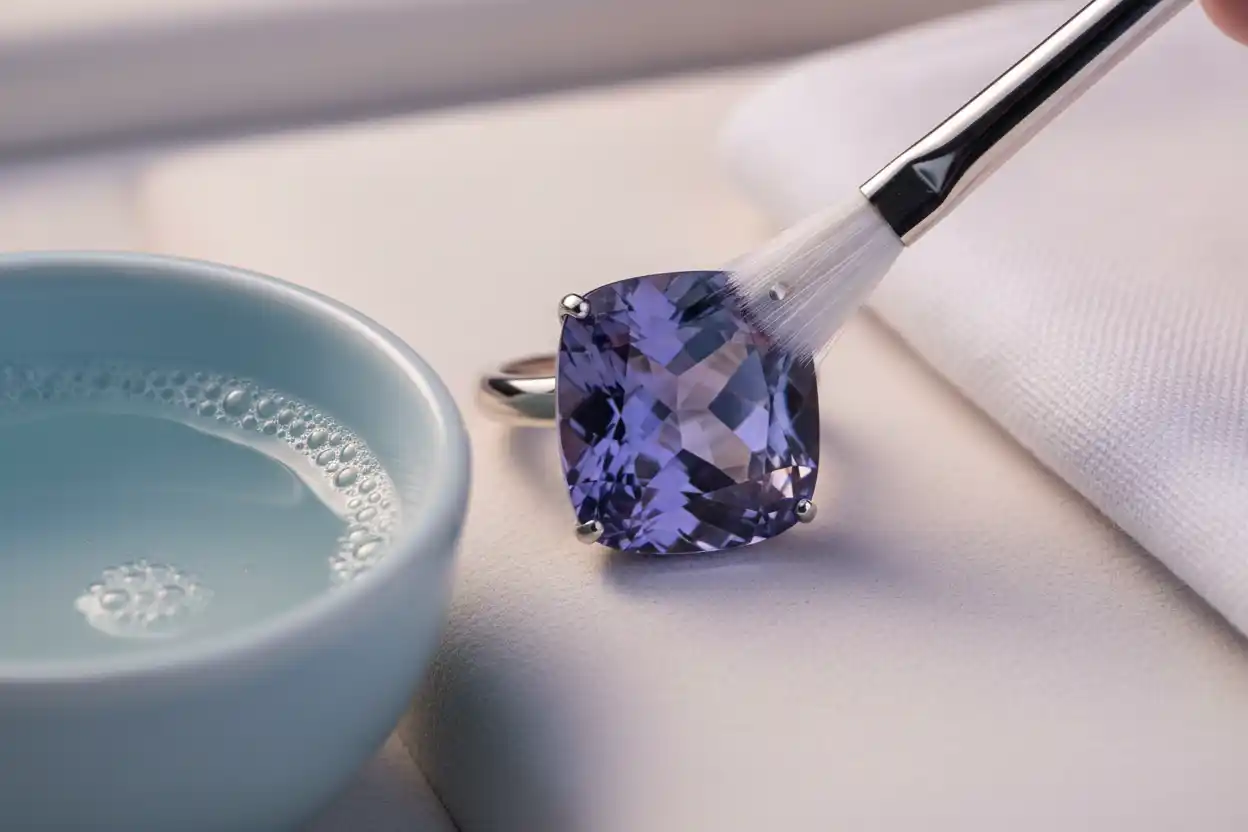
How to Clean Tanzanite Jewelry Safely
Tanzanite jewelry should be cleaned with lukewarm water, mild liquid soap, and a very soft brush or cloth. Ultrasonic and steam cleaners should never be used because Tanzanite has fair-to-poor toughness and a pronounced cleavage that can cause it to split after impact, vibration, heat, pressure, or sudden temperature change.
Routine heat treatment used to produce Tanzanite’s blue-to-violet color is stable and does not create an additional cleaning concern. However, rare coatings, fracture filling, glue, worn settings, and surface-reaching fissures require particularly conservative care.
Why Tanzanite Needs More Care Than Sapphire
Tanzanite is the blue-to-violet gem variety of zoisite. Its material properties, color, source, history, and symbolism belong to the broader Tanzanite guide.
Its parent mineral species is covered in the Zoisite guide. Ruby in Zoisite is a different ornamental rock containing red corundum crystals in a green zoisite-rich matrix, covered separately in Ruby in Zoisite.
Tanzanite ranks approximately 6 to 7 on the Mohs scale. Its toughness ranges from fair to poor, and cleavage creates a specific direction along which the stone can split.
| Property | Cleaning implication |
|---|---|
| Mineral species | Zoisite |
| Gem variety | Tanzanite |
| Typical color | Blue, violet-blue, bluish violet, or violet |
| Mohs hardness | Approximately 6 to 7 |
| Toughness | Fair to poor |
| Cleavage | Pronounced |
| Safest routine cleaning | Lukewarm water, mild soap, and a very soft brush |
| Ultrasonic cleaning | Never recommended |
| Steam cleaning | Never recommended |
| Main risks | Cleavage, impact, thermal shock, coatings, filling, and loose settings |
The gemstone hardness chart explains why Tanzanite scratches more readily than Sapphire, Ruby, Spinel, and Topaz.
More importantly, hardness does not describe its tendency to split after a blow. The distinction appears in Gemstone Toughness vs Hardness and Gemstone Cleavage Explained.
Tanzanite Comes from One Commercial Source
Commercial Tanzanite comes from the Merelani mining area in northern Tanzania.
This limited geographic source contributes to the gemstone’s market identity and scarcity narrative. However, locality does not make every stone equally valuable or structurally sound.
Color, tone, saturation, clarity, cut, size, treatment, and setting quality remain central.
Cleaning cannot establish geographic origin. Documentation, trace-element analysis, spectroscopy, and professional gemological examination are required for identification and disclosure.
Routine Heat Treatment Is Stable
Much Tanzanite begins with a brownish, greenish, yellowish, or mixed appearance and is heated to produce a predominantly blue-to-violet color.
This treatment is routine and stable under normal wearing conditions. It does not make lukewarm washing unsafe or require a specialized cleaning solution.
Nevertheless, Tanzanite should not be exposed to extremely high temperature or sudden temperature change. The concern comes from the gem’s cleavage and structural durability, not from instability of conventional heat-treated color.
The broader enhancement framework belongs to Gemstone Treatments Explained.
Coated Tanzanite Requires Stricter Care
Some Tanzanite has been coated to alter or intensify its apparent color.
A surface coating may scratch, abrade, peel, or become damaged through normal wear, repolishing, harsh chemicals, and machine cleaning.
Coating is rare but should not be ignored when a stone has unusually concentrated surface color, patchy iridescence, or visible wear along facet junctions.
The complete treatment-identification workflow belongs to How to Spot Treated or Synthetic Tanzanite.
Coated Tanzanite should receive only gentle manual cleaning and should not be polished at home.
Rare Fracture Filling
Tanzanite can occasionally be fracture filled to reduce the appearance of surface-reaching fissures.
The filler may change over time or react to heat, solvents, vibration, or repair procedures.
A fracture-filled stone should receive lukewarm soapy-water or damp-cloth cleaning only.
Tell the jeweler about filling before resizing, soldering, retipping prongs, repolishing, or resetting the gem.
Inspect the Tanzanite Before Washing
Examine the jewel beneath bright, indirect light.
Look for loose prongs, bezel gaps, movement in the stone, chipped corners, abraded facet junctions, surface-reaching fractures, missing accent stones, cloudy glue, and damaged metal.
Tanzanite is commonly cut as oval, cushion, pear, emerald, radiant, and mixed shapes. Pointed ends and corners deserve close inspection because an impact near the cleavage direction can cause significant damage.
Touch the stone gently without twisting it. Clicking or movement means the jewel needs repair before cleaning.
Do not wash a cracked, loose, coated, or visibly unstable Tanzanite at home.
Pleochroism Is Not Dirt or Uneven Cleaning
Tanzanite is strongly pleochroic. It can display different blue, violet, purple, and sometimes other color components when viewed from different crystal directions.
Cutters orient the rough to balance face-up color, weight retention, and brightness.
A clean gemstone may therefore look bluer from one direction and more violet from another. Warm indoor lighting can also strengthen purple tones, while cooler daylight may emphasize blue.
Cleaning cannot remove pleochroism or make every viewing direction identical.
Prepare a Padded Cleaning Area
Place a thick folded towel beneath the jewel. Tanzanite can chip or split if it falls onto a hard sink, tile, or countertop.
Fill a shallow bowl with lukewarm water and add a few drops of mild liquid dish soap.
Prepare a second bowl of clean water at approximately the same temperature.
Use a very soft toothbrush, fine jewelry brush, soft makeup brush, or lint-free cloth.
Avoid cleaning directly over an uncovered drain.
Clean Tanzanite Briefly
Dampen the brush or cloth with the mild solution.
Clean the crown, pavilion, girdle, gallery, bezel, prongs, and setting openings using light movements.
Residue beneath the pavilion can make Tanzanite appear darker, grayer, or less saturated.
Do not press against pointed ends, corners, visible fissures, or thin girdles.
A brief wash is sufficient. Prolonged soaking provides no benefit and may affect filler, coating, glue, antique repairs, stringing, plating, or companion gems.
Rinse Without Thermal Shock
Rinse the jewel briefly in clean lukewarm water or remove soap using a second damp cloth.
Keep the rinse temperature close to the wash temperature.
Blot the gemstone rather than rubbing forcefully. Allow hidden moisture to evaporate naturally.
Do not use a hair dryer, radiator, steam jet, heated cabinet, intense lamp, or sudden cold rinse.
Inspect every prong after the jewel is dry.
Never Use an Ultrasonic Cleaner
Tanzanite should never enter an ultrasonic cleaner.
Vibration can stress its cleavage, enlarge fissures, disturb filler, damage a coating, or release the gemstone from a weakened mounting.
The machine may also warm its cleaning solution, adding thermal stress.
The wider equipment restrictions belong to Which Gemstones Can Go in an Ultrasonic Cleaner?.
Never Steam Clean Tanzanite
Steam combines concentrated heat, pressure, and rapid temperature change.
These conditions may cause Tanzanite to split or fracture. They can also damage filling, coatings, glue, enamel, plating, soldered repairs, and companion materials.
Lukewarm manual cleaning is sufficient for routine care.
Avoid Strong Acids and Harsh Chemicals
Tanzanite can be attacked by hydrochloric and hydrofluoric acids.
Keep it away from acidic metal dips, descaling products, bathroom cleaners, drain products, and professional etching chemicals.
Do not use vinegar or lemon juice. Although these household acids are weaker, they provide no cleaning advantage and may damage metal, filler, coatings, glue, or accent stones.
Bleach, ammonia, acetone, alcohol, and abrasive powders should also remain away from the gemstone unless a professional has confirmed compatibility with every component.
Cleaning a Tanzanite Ring
A Tanzanite ring faces greater impact than earrings or a pendant.
Clean around the stone without pressing on the crown, corners, or girdle. Check each prong and protective bezel edge after drying.
Remove the ring before gardening, exercise, household cleaning, swimming, washing dishes, bathing, and handling luggage.
Tanzanite can be worn in a ring, but low-profile protective settings and careful habits are important.
Cleaning Tanzanite Earrings
Tanzanite earrings are among the safer jewelry formats because they receive relatively little impact.
Clean posts, hooks, backs, baskets, and hinges separately.
Keep alcohol-based disinfectant on compatible metal fittings and away from the Tanzanite, filling, coating, glue, and plating.
Store each earring separately so its post cannot scratch or strike the other gemstone.
Cleaning a Tanzanite Necklace
A Tanzanite necklace or pendant protects the gemstone better than an exposed ring while displaying its pleochroic color effectively.
Apply perfume, sunscreen, lotion, and hairspray before putting on the necklace.
Prevent the chain from rubbing against the Tanzanite. Support a pendant by its setting rather than gripping the gemstone.
Large pendants should not swing freely against metal clasps or other jewelry.
Cleaning a Tanzanite Bracelet
A Tanzanite bracelet exposes the gemstone to repeated wrist contact.
Inspect every stone, prong, link, hinge, clasp, and protective setting before cleaning.
Support the bracelet flat and clean one section at a time.
Remove it before desk work, exercise, cleaning, travel handling, and activities that repeatedly strike the wrist against hard surfaces.
Tanzanite Versus Sapphire
Tanzanite and Sapphire can both appear blue or violet-blue, but they have very different durability profiles.
Sapphire is corundum with Mohs hardness 9, excellent toughness, and no cleavage. Tanzanite is softer and cleavage sensitive.
The complete visual and gemological distinction belongs to Tanzanite vs Sapphire.
The comparison matters during cleaning: sound Sapphire may tolerate ultrasonic and steam equipment, while Tanzanite should never enter either machine.
Tanzanite Versus Iolite
Tanzanite and Iolite can overlap in blue-violet color and strong directional color effects.
Iolite is cordierite, while Tanzanite is zoisite. Their refractive properties, inclusions, hardness, cleavage, value, and typical treatments differ.
The full distinction belongs to Iolite vs Tanzanite.
Cleaning response is not an identification test because both materials require cautious manual care.
Buying, Price, and Authentication
The Tanzanite buying guide covers blue-to-violet color, tone, saturation, pleochroism, clarity, cut, heat treatment, coatings, size, and setting quality.
Market factors belong to the Tanzanite price guide.
Glass, synthetic materials, Iolite, Sapphire, and other blue-violet stones may imitate or be confused with Tanzanite.
The complete authentication workflow belongs to Real vs Fake Tanzanite.
Tanzanite is one of December’s recognized birthstones, covered in the December birthstone guide.
Reports and Documentation
A laboratory report can identify Tanzanite as zoisite and may disclose detectable coating or filling.
The report does not grade the jewel’s setting condition or confirm that every prong remains secure.
The gemstone certification guide explains laboratory services, while How to Read a Gem Lab Report covers identity, measurements, treatment comments, and limitations.
Keep the report, invoice, treatment disclosure, photographs, and repair history with an important jewel.
Frequently Asked Questions
1. What is the safest way to clean Tanzanite?
Use lukewarm water, mild liquid soap, and a very soft brush or cloth, then rinse briefly and dry naturally.
2. Can Tanzanite get wet?
Brief washing is normally safe for a sound stone. Avoid prolonged soaking when filler, coating, glue, watches, or delicate settings are present.
3. Can Tanzanite go in an ultrasonic cleaner?
No. Vibration can stress its cleavage, fractures, filler, coating, and setting.
4. Can Tanzanite be steam cleaned?
No. Steam introduces heat, pressure, and thermal shock that may split or fracture the gemstone.
5. Is heat-treated Tanzanite safe to clean?
Yes. Routine heat treatment is stable and does not prevent lukewarm soapy-water cleaning.
6. Does heat treatment make Tanzanite stronger?
No. Heat changes color but does not remove its cleavage or improve its toughness.
7. Can vinegar clean Tanzanite?
No. Acid provides no advantage and may damage the gemstone, filler, coating, metal, or glue.
8. Can toothpaste polish Tanzanite?
No. Toothpaste can scratch its facets, wear metal, and leave residue around the setting.
9. Why does Tanzanite look blue in one light and purple in another?
Strong pleochroism, cut orientation, and the color temperature of the light affect its appearance.
10. Is Tanzanite suitable for an everyday ring?
It can be worn in a protected setting, but it is better suited to careful wear because of its cleavage and fair-to-poor toughness.
11. How often should Tanzanite jewelry be cleaned?
Wipe it after wear and wash it when oils or cosmetics visibly reduce its brilliance.
12. When should Tanzanite receive professional care?
Professional attention is appropriate for fractures, coatings, filling, loose settings, valuable reported stones, chipped facets, or unexplained color changes.
Conclusion
Tanzanite’s blue-violet beauty comes with a care profile governed by cleavage rather than by the stability of its routine heat treatment. Lukewarm soapy water removes surface film without exposing the stone to vibration or thermal shock. When Tanzanite remains dull after cleaning, examine its pavilion, facet wear, inclusions, and setting instead of escalating to ultrasound or steam.