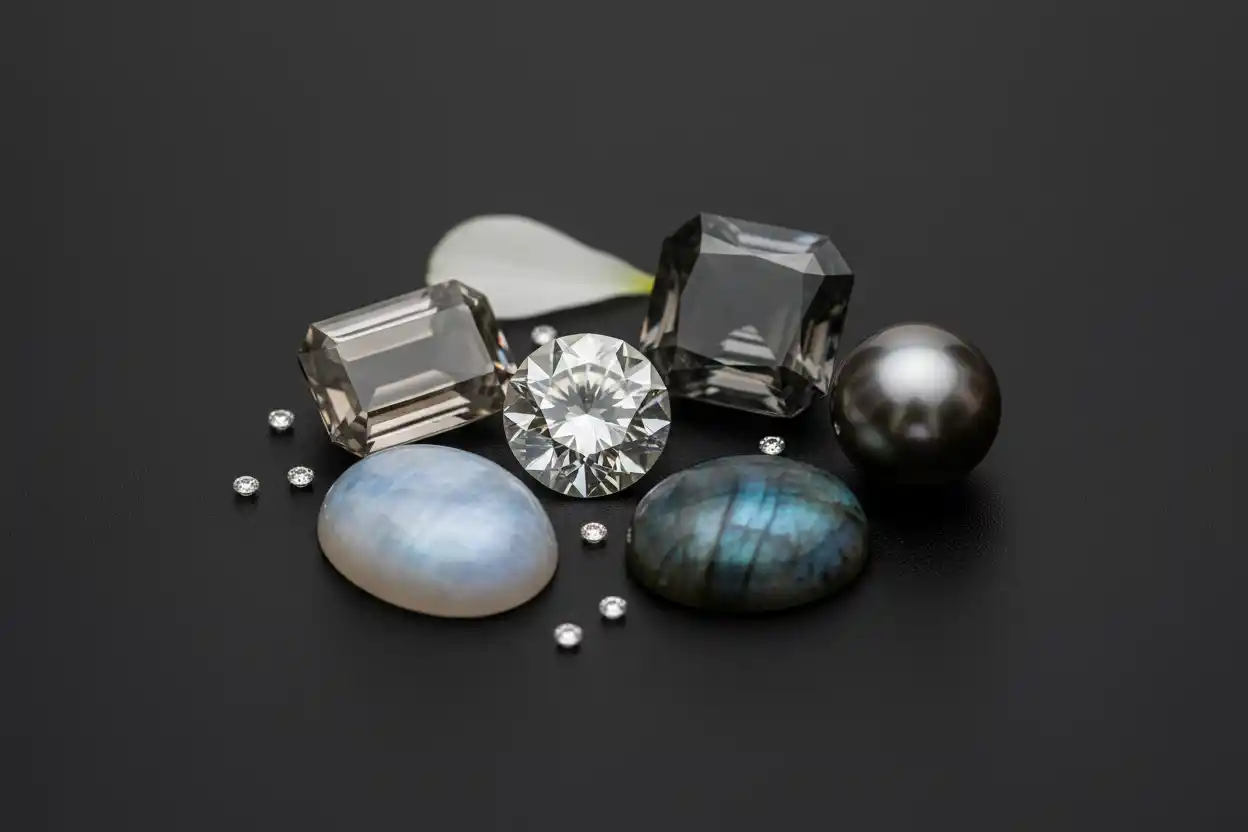
Gray Gemstones: Names, Meanings and Uses
Gray gemstones range from brilliant transparent diamonds and spinels to smoky quartz, luminous moonstone, iridescent labradorite and silvery pearls. Some are naturally neutral gray, while others carry blue, violet, brown, green or black undertones that become more obvious as lighting changes.
For jewelry, gray is especially versatile because it functions almost like a neutral metal color while still allowing unusual optical effects and textures. However, different gray gemstones vary dramatically in hardness, toughness, rarity and care requirements, so color alone should never determine where or how a stone is worn.
Gray Gemstones at a Glance
| Gray Gemstone | Approx. Mohs Hardness | Typical Appearance | Common Jewelry Use |
|---|---|---|---|
| Gray Diamond | 10 | Transparent gray to blue-gray | Rings, earrings, fine jewelry |
| Gray Sapphire | 9 | Gray to blue-gray, sometimes star-bearing | Rings, pendants, earrings |
| Gray Spinel | 8 | Transparent neutral to bluish gray | Rings, earrings, fine jewelry |
| Gray Tourmaline | 7–7.5 | Smoky or steely gray | Rings, pendants |
| Smoky Quartz | 7 | Transparent smoky gray to brown-gray | Rings, pendants, large cuts |
| Gray Agate | 6.5–7 | Banded gray and white | Cabochons, beads |
| Gray Chalcedony | 6.5–7 | Translucent soft gray | Cabochons, beads |
| Labradorite | 6–6.5 | Gray base with spectral flashes | Cabochons, pendants |
| Gray Moonstone | 6–6.5 | Gray with white, silver or blue sheen | Cabochons, pendants |
| Larvikite | About 6–6.5 | Dark gray with blue-silver flashes | Cabochons, beads |
| Hematite | About 5.5–6.5 | Steel gray, metallic | Beads, cabochons |
| Silver Sheen Obsidian | About 5–5.5 | Dark gray-black with silver sheen | Cabochons, pendants |
| Gray Pearl | About 2.5–4.5 | Soft gray with orient or overtones | Necklaces, earrings |
| Gray Jasper | About 6.5–7 | Opaque mottled gray | Cabochons, beads |
The separate Gray Crystals guide focuses more heavily on symbolic and collector-oriented use, while this page emphasizes gemstone identity, jewelry suitability and practical applications.
Why Gray Gemstones Are Distinctive
Gray occupies an unusual position in jewelry.
It can appear cool, warm or almost perfectly neutral.
A blue-gray spinel may look crisp beside platinum, while smoky quartz introduces warmer brown-gray tones. Labradorite can appear subdued until a blue or green flash suddenly dominates the stone.
This versatility makes gray suitable for:
minimalist jewelry, alternative engagement rings, monochrome styling and designs centered on texture rather than intense bodycolor.
Because gray is comparatively neutral, the cut and optical behavior of the gemstone often become more noticeable.
Gray Diamond
Diamond can occur naturally in gray and in combinations such as blue-gray or gray-blue.
Natural fancy-color gray diamonds receive their color from several possible causes, including structural defects and microscopic inclusions depending on the material.
Some gray diamonds have a soft smoky appearance, while others look steely or blue-gray.
Jewelry Use
Diamond’s Mohs hardness of 10 gives it unmatched scratch resistance among natural gems.
That makes gray diamond suitable for:
engagement rings, wedding jewelry, everyday rings and high-wear settings.
Toughness and setting security still matter; hardness does not make a diamond impossible to chip.
Gray Diamond Meaning
Modern symbolism often connects gray diamond with endurance, composure and understated commitment.
These meanings are interpretive rather than scientific properties.
Gray Sapphire
Sapphire can occur in gray, gray-blue and related low-saturation colors.
Some specimens contain inclusions that produce a star when cut as cabochons.
At Mohs 9, sapphire is one of the strongest choices for frequently worn gray gemstone jewelry.
Jewelry Use
Gray sapphire works especially well in:
engagement rings, signet-style rings, stud earrings and durable everyday jewelry.
Its high hardness provides excellent resistance to surface scratching.
Gray Sapphire Meaning
Symbolic traditions around sapphire commonly involve loyalty, wisdom and discipline.
Gray sapphire can add modern themes of restraint and thoughtful neutrality.
Gray Spinel
Spinel has become particularly notable for fashionable gray material.
Some stones are almost neutral, while many contain slight blue or violet modifiers.
Transparent gray spinel can display excellent brilliance, giving buyers a neutral gem that still looks lively.
Jewelry Use
At Mohs 8 with good durability, spinel works well in:
rings, engagement jewelry, earrings and pendants.
Larger fine neutral gray stones are less common than small commercial material.
Gray Spinel Meaning
Modern symbolism often associates gray spinel with resilience, composure and quiet confidence.
Because gray spinel’s market popularity is relatively modern, these meanings should not be presented as ancient universal traditions.
Gray Tourmaline
Tourmaline occurs across an enormous color range.
Some material can appear smoky gray, steel gray or gray with blue, green or brown undertones.
Tourmaline is also strongly pleochroic, meaning its apparent color may vary depending on viewing direction.
Jewelry Use
With hardness around 7–7.5, tourmaline is suitable for:
pendants, earrings and rings with sensible protection.
Strong thermal shock and rough handling should still be avoided.
Gray Tourmaline Meaning
Modern crystal symbolism often connects tourmaline with boundaries and protection.
For gray stones, those ideas can be interpreted as balance and measured responses rather than supernatural shielding.
Smoky Quartz
Smoky Quartz is one of the most accessible transparent gray gemstones.
It ranges from pale gray through brown-gray to dark smoky shades.
Because large clean quartz crystals occur naturally, sizable faceted smoky quartz can remain relatively affordable.
Jewelry Use
At Mohs 7, smoky quartz works well in:
pendants, earrings, cocktail rings and large statement cuts.
Frequently worn rings will show abrasion sooner than sapphire or spinel.
Smoky Quartz Meaning
Modern symbolic associations typically involve grounding, perspective and stability.
Those meanings make it one of the most frequently used gray stones in contemporary crystal practice.
Gray Agate
Agate consists of banded chalcedony and appears naturally in numerous gray-white combinations.
Its patterns can range from fine parallel lines to broad cloudy bands.
Some commercial agate is dyed, so treatment disclosure matters when color looks unusually uniform or intense.
Jewelry Use
Gray agate works especially well in:
cabochons, beads, pendants and carved jewelry.
Its hardness around 6.5–7 makes it reasonably durable.
Gray Agate Meaning
Gray agate is often associated symbolically with balance, patience and steadiness.
Its layered pattern also makes it a natural metaphor for complexity and gradual change.
Gray Chalcedony
Chalcedony is microcrystalline quartz and can occur in translucent gray or blue-gray material.
Its smooth polish and relatively even bodycolor distinguish it visually from strongly banded agate.
Jewelry Use
Gray chalcedony is frequently cut into:
cabochons, beads, carvings and smooth geometric forms.
At roughly Mohs 6.5–7, it provides good practical wear for many jewelry formats.
Gray Chalcedony Meaning
Modern symbolism tends to connect gray chalcedony with calm communication and composure.
That interpretation remains part of personal or spiritual tradition rather than a demonstrated psychological effect.
Labradorite
Labradorite is often gray before its labradorescence becomes visible.
When moved under light, blue, green, gold, orange or violet flashes can appear against the gray body.
The effect results from light interacting with fine internal feldspar structures.
Jewelry Use
Labradorite is most successful in cabochons because the cut can maximize the orientation of the optical effect.
It is suitable for:
pendants, earrings and occasional-wear rings with protection.
At Mohs 6–6.5 and with feldspar cleavage, it requires more care than sapphire or spinel.
Labradorite Meaning
Modern symbolism commonly connects labradorite with adaptability, perspective and transformation.
The changing flash makes those themes visually intuitive even for someone approaching the stone symbolically rather than metaphysically.
Gray Moonstone
Moonstone naturally occurs with gray bodycolor as well as colorless, white, peach, green and brown.
Its defining optical effect is adularescence—a moving billowy sheen that can appear white, silver or blue.
Jewelry Use
Gray moonstone is commonly fashioned as:
cabochons, beads, pendants and earrings.
At Mohs 6–6.5 with cleavage and relatively modest toughness, it deserves protection in rings.
Gray Moonstone Meaning
Moonstone traditions commonly emphasize cycles, intuition and change.
Gray stones add symbolism of transition and reflection.
These are cultural and personal associations rather than measurable effects.
Larvikite
Larvikite is not a single mineral but a feldspar-rich igneous rock.
Its dark gray body can display attractive blue or silver reflections from feldspar crystals.
It is commonly polished for decorative and jewelry use.
Jewelry Use
Larvikite works well as:
cabochons, beads, pendants and larger statement pieces.
Because it is a rock composed of multiple minerals, individual pieces can vary somewhat in durability and polish.
Larvikite Meaning
Modern crystal traditions commonly associate larvikite with grounding and introspection.
Its gray body and hidden reflective flashes reinforce that symbolism visually.
Hematite
Hematite is iron oxide and can display a distinctive steel-gray metallic luster.
Polished material is significantly denser than many ordinary gemstone beads, giving it a characteristic heft.
Not all hematite looks metallic gray; earthy forms can be reddish brown.
Jewelry Use
Hematite is frequently used for:
beads, cabochons, signet-style pieces and polished decorative elements.
It can be brittle, so thin components need protection from impacts.
Hematite Meaning
Crystal traditions often associate hematite with stability and grounding.
Those interpretations should remain symbolic; claims that hematite treats blood, circulation or other medical conditions are unsupported.
Silver Sheen Obsidian
Silver Sheen Obsidian is natural volcanic glass rather than a crystalline mineral.
Its dark body shows a silver-gray reflective sheen created by internal structures within the glass.
Jewelry Use
At approximately Mohs 5–5.5, obsidian scratches more readily than quartz or sapphire.
It is best used in:
cabochons, pendants, earrings and protected rings.
Sharp edges can form if obsidian chips, so damaged jewelry should be handled carefully.
Silver Sheen Obsidian Meaning
Modern symbolism commonly centers on introspection and boundaries.
The shifting silver surface provides a natural visual metaphor for seeing a situation from another angle.
Gray Pearl
Pearl is an organic gem rather than a mineral.
Gray is particularly important among Tahitian cultured pearls, many of which are actually shades of gray rather than true black.
Green, purple, blue, pink and other overtones can appear over the gray body.
Jewelry Use
Pearls are ideal for:
necklaces and earrings where abrasion remains limited.
Their surface is soft and sensitive to chemicals, cosmetics, acids and rough cleaning.
They require much gentler care than crystalline gray gemstones.
Gray Pearl Meaning
Pearl symbolism often includes sincerity, wisdom and maturity.
Gray varieties add modern associations with elegance, restraint and composure.
Gray Jasper
Jasper is opaque microcrystalline quartz-rich material found in many patterns and colors.
Gray jasper can contain white, black, brown or cream markings.
Jewelry Use
Its hardness around 6.5–7 makes jasper suitable for:
cabochons, beads, pendants and casual rings.
Polished gray jasper is particularly effective when its natural pattern is allowed to dominate the design.
Gray Jasper Meaning
Modern symbolic traditions usually connect jasper with steadiness, persistence and practical grounding.
Which Gray Gemstone Is Best for an Engagement Ring?
For frequent engagement-ring wear, durability becomes a major factor.
The strongest gray options include:
gray diamond, gray sapphire and gray spinel.
Diamond provides maximum scratch resistance.
Sapphire offers Mohs 9 durability and a broad range of subtle gray-blue colors.
Spinel provides attractive brilliance at Mohs 8.
Gray tourmaline can also work with a protective design.
Moonstone, labradorite, obsidian and pearl require substantially greater care and are less forgiving of constant high-contact wear.
The Gemstone Hardness Chart provides the wider comparison.
Which Gray Gemstone Is Most Affordable?
Smoky quartz, gray agate, chalcedony, jasper and many feldspar materials are generally accessible.
Gray diamond can be substantially more expensive, although price depends strongly on color origin, size and quality.
Gray sapphire and spinel occupy broad ranges depending on transparency, cut and market demand.
“Gray” by itself never determines value.
A commercially common gray stone can be inexpensive while an exceptional neutral gray spinel or natural fancy-color diamond can command substantial prices.
Which Gray Gemstones Are Best for Everyday Wear?
For rings and bracelets, prioritize:
diamond, sapphire, spinel and appropriately set tourmaline.
Smoky quartz and chalcedony are practical but may show wear sooner.
Labradorite and moonstone need more protection because feldspar cleavage increases vulnerability.
Pearl is best reserved for lower-abrasion jewelry and must be protected from chemicals.
Obsidian can chip and scratch more readily.
Matching jewelry design to the actual gem is more important than choosing by color.
Cool Gray vs Warm Gray Gemstones
Not every gray is neutral.
Cool gray gemstones may contain:
blue, violet or green undertones.
Gray spinel, sapphire, moonstone and labradorite often fall into this group.
Warm gray materials may lean:
brown, taupe or smoky.
Smoky quartz and some tourmalines provide good examples.
These undertones affect how the gemstone coordinates with metal.
White gold and platinum can emphasize cool grays, while yellow or rose gold can create attractive contrast with warmer gray stones.
Transparent vs Opaque Gray Gemstones
Transparent gray gems include diamond, spinel, sapphire, tourmaline and smoky quartz.
Their appearance depends heavily on cutting and internal light return.
Opaque or translucent gray materials include hematite, jasper, many agates, larvikite and silver sheen obsidian.
Moonstone and labradorite occupy an intermediate category where translucency and optical phenomena matter more than conventional faceted brilliance.
This distinction should influence cutting style.
Transparent gems are often faceted, while patterned or phenomenal stones usually perform better as cabochons.
How to Choose a Gray Gemstone
Start with jewelry format.
For a daily ring, durability should receive priority.
For a pendant, softer or cleavage-prone stones become much easier to use.
Next, choose whether you prefer:
neutral gray, blue-gray, warm smoky gray, metallic silver or iridescent gray.
Then evaluate the material-specific quality factors.
For example, labradorite depends heavily on the strength and orientation of its flash, while spinel depends more on transparent color, cut and clarity.
A universal “gray gemstone grade” does not exist.
Are Gray Gemstones Naturally Gray?
Many are.
Gray moonstone, spinel, diamond, sapphire, quartz and other gems can develop natural gray color.
However, treatments, coatings and dyes also exist across the gemstone market.
An unusual or expensive color claim should therefore be supported by accurate disclosure.
This matters especially when natural color is a major part of the price.
For high-value diamonds or other significant gems, laboratory documentation can be useful.
Gray Gemstone Symbolism
Across modern color traditions, gray frequently represents:
balance, neutrality, wisdom, transition and restraint.
Individual gemstones add their own historical or modern symbolism.
Diamond may represent endurance.
Moonstone may represent transition.
Smoky quartz is commonly associated with grounding.
Spinel can symbolize resilience.
Pearl often carries associations with wisdom and composure.
These meanings are interpretive traditions rather than physical properties of color or mineral composition.
Frequently Asked Questions
1. What gemstones are naturally gray?
Natural gray gemstones include diamond, sapphire, spinel, tourmaline, smoky quartz, moonstone, labradorite, agate, chalcedony and several other materials.
2. What is the most durable gray gemstone?
Diamond is the hardest at Mohs 10, followed by sapphire at Mohs 9 and spinel at Mohs 8.
3. Are gray diamonds real?
Yes. Natural diamonds can occur with gray as the dominant color or combined with modifiers such as blue.
4. Is gray spinel natural?
Yes. Natural spinel can be neutral gray or show blue and violet undertones.
5. Is moonstone available in gray?
Yes. GIA recognizes gray as one of moonstone’s natural bodycolors.
6. Why does labradorite look gray until it moves?
Its body can be gray while internal layered structures produce labradorescence, revealing strong reflected colors only at suitable angles.
7. Are black Tahitian pearls actually gray?
Many Tahitian cultured pearls commonly called black pearls have gray bodycolors with green, purple, blue or other overtones.
8. Which gray gemstone is best for an engagement ring?
Gray diamond, sapphire and spinel are among the most practical choices because of their comparatively high hardness and durability.
9. What is an affordable gray gemstone?
Smoky quartz, gray agate, chalcedony, jasper and many labradorites are generally affordable compared with rare fine gray diamonds or spinels.
10. Are gray gemstones good for everyday jewelry?
Some are. Diamond, sapphire and spinel are strong everyday options, while moonstone, pearl, labradorite and obsidian require more protective wear.
11. What do gray gemstones symbolize?
Modern color and gemstone traditions commonly connect gray with neutrality, balance, maturity, composure and transition. These meanings vary by stone and tradition.
12. Are all gray gemstones crystals?
No. Pearl is organic, obsidian is natural glass, larvikite is a rock and several other gem materials do not fit the strict mineralogical definition of a crystal.
Conclusion
Gray gemstones offer far more variety than a neutral color label suggests. Diamond, sapphire and spinel provide transparent brilliance and excellent durability; smoky quartz introduces warm transparent gray; moonstone and labradorite add moving optical effects; hematite supplies metallic silver; while pearl, obsidian, agate and jasper emphasize luster, pattern and texture.
For jewelry, the best choice depends primarily on wear conditions.
A gray diamond or sapphire can tolerate demanding ring use, whereas a pearl or moonstone is better suited to jewelry that receives less abrasion.
Symbolically, gray is often associated with balance, transition and restraint. Those meanings can add personal significance to a piece, but the gemstone’s real mineralogical properties should determine how it is bought, set, cleaned and worn.
Disclaimer: Gemstone symbolism and metaphysical meanings are cultural, spiritual or personal interpretations rather than scientifically established effects. They should not be used as medical, psychological, financial or safety guidance.