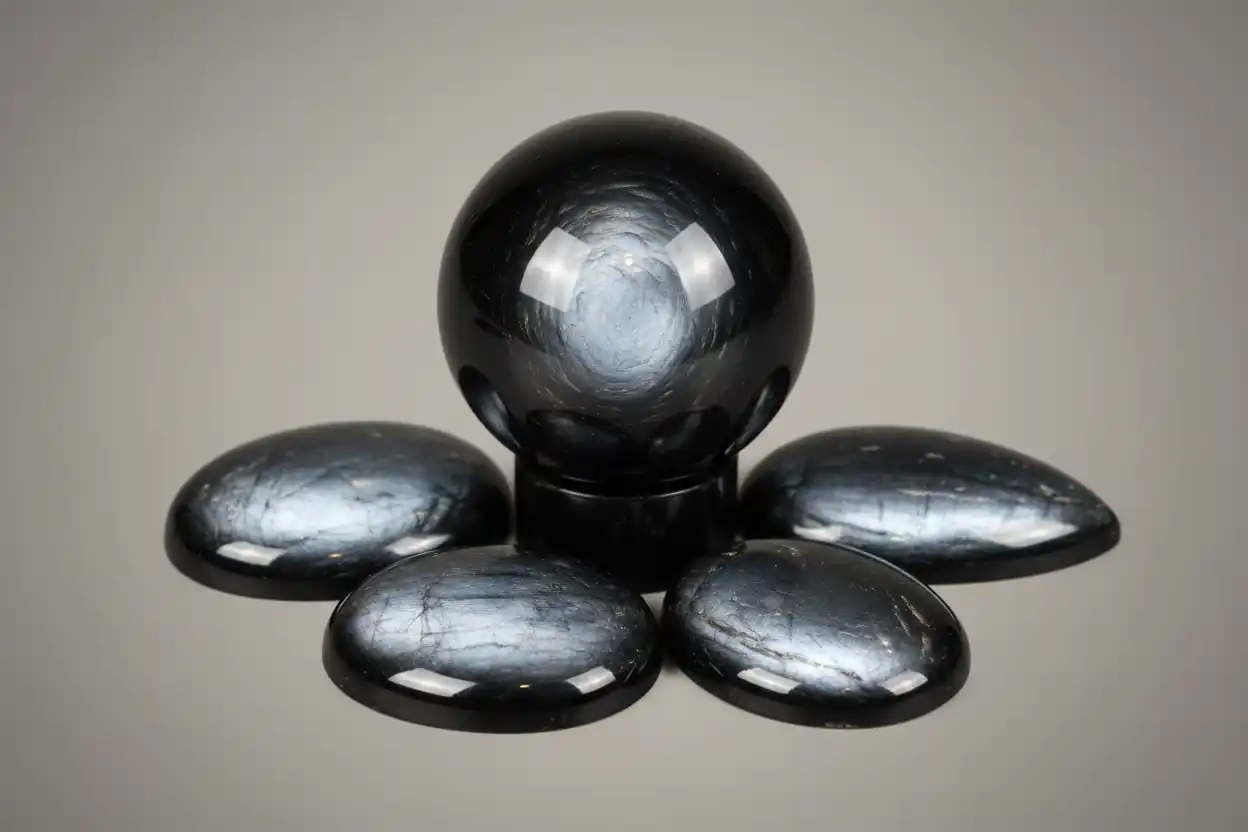
Silver Sheen Obsidian: Meaning, Properties & Uses
Silver sheen obsidian is a variety of natural volcanic glass that displays a broad silver, grey, or silvery-blue reflection over a black body. The effect develops when tiny gas-filled structures become stretched and aligned within flowing silica-rich lava before rapid cooling freezes them into the glass.
It is neither a crystalline mineral nor black stone containing metallic silver. Its appeal depends on orientation: a well-cut piece can show a bright moving halo, wave, eye, or circular flash, while the same rough cut in the wrong direction may look like ordinary black obsidian.
Silver Sheen Obsidian at a Glance
| Property | Silver Sheen Obsidian |
|---|---|
| Composition | Silica-rich volcanic glass with aluminum, sodium, potassium, iron, and other elements |
| Group or type | Obsidian; natural volcanic glass and mineraloid |
| Color | Black, dark brown-black, smoky black, with silver, grey, or silvery-blue sheen |
| Crystal system or texture | Amorphous, commonly flow-banded |
| Habit | Massive volcanic glass, nodules, blocks, lenses, or flow layers |
| Luster | Vitreous with reflective sheen |
| Transparency | Opaque face-up; translucent at thin edges |
| Mohs hardness | Approximately 5–5.5 |
| Cleavage | None |
| Tenacity | Brittle |
| Common uses | Cabochons, spheres, carvings, beads, pendants, display slabs, ornamental objects |
| Primary care concern | Sharp conchoidal fracture, chipping, scratches, thermal shock, and cutting dust |
What Is Silver Sheen Obsidian?
Silver sheen obsidian belongs to the larger obsidian family. Obsidian forms when silica-rich lava cools too quickly for most atoms to organize into mineral crystals.
The resulting material is a glass rather than a crystalline rock. It may contain microscopic crystals, bubbles, flow layers, and other inclusions, but the continuous host remains amorphous.
Silver sheen is a variety name based on optical appearance. The body is generally black, while reflective internal structures create a silver or grey flash at specific angles.
The sheen does not come from silver metal. It results primarily from light reflecting and scattering from aligned microscopic vesicles or inclusions inside the glass.
The types of obsidian guide owns the family-wide comparison. This page remains focused on silver sheen formation, identification, cutting, care, and symbolism.
Silver sheen obsidian also appears in the crystals that start with S and gemstones that start with S directories.
How Silver Sheen Obsidian Forms
The process begins with silica-rich magma, usually rhyolitic or closely related in composition. High silica content makes the melt viscous, slowing the movement of gas bubbles and atoms.
After eruption, the lava flows across the ground or fills a volcanic dome. Cooling must occur rapidly enough to prevent large-scale crystallization.
Gas bubbles trapped in the moving lava become elongated and flattened along flow layers. When the glass solidifies, these tiny aligned vesicles remain frozen in position.
Light entering the polished stone reflects from many similarly oriented structures. Their combined reflection creates the broad silver sheen.
The effect depends on the angle between the structures, polished surface, light source, and viewer. A piece can look almost entirely black until it reaches the correct orientation.
Composition and Glass Structure
Silver sheen obsidian does not have one exact formula. Most material contains a high proportion of silica, with aluminum, sodium, potassium, iron, calcium, magnesium, titanium, and trace elements.
Iron-bearing particles and oxidation states contribute to the dark body color. Minute crystals or nanoparticles may also occur within the glass.
Unlike quartz, obsidian lacks a repeating crystal lattice. It therefore has no crystal system or cleavage.
Its amorphous structure breaks conchoidally, producing smooth curved surfaces and extremely sharp edges.
Small amounts of water remain dissolved or trapped inside natural obsidian. Over geological time, hydration and devitrification can alter parts of the glass.
What Causes the Silver Sheen?
The strongest explanation involves aligned, flow-stretched hollow vesicles or flattened gas bubbles. Their surfaces reflect light collectively when the stone is viewed from the correct angle.
Modern gemological descriptions classify bright silver and golden sheen as an aventurescent effect because eye-visible reflections arise from numerous internal structures.
The pattern varies with bubble size, concentration, spacing, and flow orientation. Consequently, the sheen may appear as a broad sheet, narrow eye, concentric ring, crescent, wave, or irregular patch.
A strong sheen should move or change intensity as the stone tilts. A painted or foil-backed imitation may remain fixed unnaturally.
Different zones in one block can produce silver, gold, or weak grey reflections. The boundary between silver sheen and golden obsidian is therefore based on dominant appearance rather than a separate mineral composition.
Silver Sheen, Golden Sheen, and Rainbow Obsidian
Golden sheen obsidian displays warm gold, bronze, or coppery reflection. Similar aligned vesicles commonly create the effect, although bubble dimensions, oxidation, absorption, and lighting influence the color.
Rainbow obsidian produces multicolored bands rather than one broad silver reflection. Its optical structures and interference behavior are more complex.
Black obsidian may contain bubbles and flow lines without a strong oriented sheen. It remains primarily glossy black under ordinary movement.
Mahogany obsidian contains red-brown iron-rich patches and bands. Its pattern arises mainly from color zoning rather than silver reflection.
Snowflake obsidian contains pale spherulites formed through partial crystallization of the glass. Those white or grey “snowflakes” remain visible from most angles and do not behave like a moving sheen.
Colors and Sheen Patterns
The black body may appear jet black, smoky black, dark brown, or grey-black. Thin edges can transmit brown, greenish, or grey light.
Silver reflection ranges from cool white and pale grey to steel blue and soft charcoal. Warm lighting may shift it toward champagne or bronze.
Common cutting patterns include a circular halo, central eye, crescent, wave, broad flash, or two opposing reflective areas.
Spheres may reveal rings or changing cloud-like reflections as they rotate. Cabochons often show a concentrated eye or fan.
A weak flash is not necessarily fake. It may indicate poor orientation, low bubble concentration, surface scratches, or lighting that is too diffuse.
Silver sheen obsidian belongs within collections of black crystals and black gemstones, but its reflective phenomenon should remain the main grading feature.
Important Sources
Mexico is the principal source associated with commercial silver sheen obsidian. Mexican volcanic regions contain extensive silica-rich obsidian deposits with varied black, gold, silver, rainbow, and greenish appearances.
Jalisco and neighboring parts of western and central Mexico are frequently cited in the lapidary trade. However, a finished product’s exact quarry may not be documented.
Sheen-bearing obsidian can form in other volcanic regions where suitable silica-rich glass contains aligned bubbles. Not every black obsidian deposit produces commercially useful silver sheen.
The broader geological sources of obsidian include the United States, Armenia, Iceland, Italy, Japan, Turkey, New Zealand, and other volcanic areas. These localities should not automatically be claimed as sources of the specific silver sheen material seen in retail stock.
A seller who charges an origin premium should provide more than the generic label “Mexican obsidian.”
Inclusions and Internal Features
Flow banding is common and may appear as curved lines, parallel layers, or subtle changes in transparency.
Elongated bubbles form the principal reflective structures. Under magnification, some may appear as flattened, stretched, or lens-shaped voids.
Microlites of feldspar, pyroxene, magnetite, cristobalite, or other minerals may also occur. Their presence and arrangement vary by deposit and glass chemistry.
Internal stress creates fractures, healed-looking lines, and strain patterns. Small chips may extend from the girdle of a cabochon.
Devitrification produces crystalline patches where the original glass has begun to reorganize. In snowflake obsidian, this process creates conspicuous spherulites, but subtle alteration can occur without a snowflake pattern.
How to Identify Silver Sheen Obsidian
Begin by observing the stone under one small moving light. Genuine sheen should brighten, fade, shift, or reveal a structured pattern as the viewing angle changes.
The surface should have a glassy luster. Thin edges may transmit smoky brown or grey light, while the interior appears opaque.
Obsidian has a hardness around 5–5.5. It scratches more easily than quartz but resists most fingernail and copper-coin testing. Destructive scratch tests should be avoided.
A chipped edge commonly shows conchoidal fracture. Fresh breaks can become sharp enough to cut skin.
Magnification may reveal flow lines, elongated bubbles, microlites, natural fractures, and small pits. Molding seams and rounded gas bubbles may indicate manufactured glass, although natural obsidian also contains bubbles.
Raman spectroscopy, refractive-index testing, specific gravity, and chemical analysis can confirm volcanic glass when the item’s value warrants examination. The how to identify crystals guide gives the general testing framework.
Common Lookalikes and Imitations
Manufactured black glass is the most direct imitation. Foil, metallic powder, or internal coatings can create a reflective flash.
Glass containing glitter or mica usually shows distinct sparkles rather than a broad integrated sheen. Regularly distributed bubbles and mold seams may expose mass production.
Black onyx can resemble the body color but lacks volcanic flow texture and silver flash. The onyx vs obsidian comparison covers the structural and hardness differences.
Labradorite can produce a broad silver or blue reflection, yet it is a crystalline feldspar with cleavage and a different body texture.
Hematite-rich glass and dark slag may show metallic areas. Slag commonly contains abundant rounded bubbles, mixed colors, industrial residue, or irregular metallic inclusions.
The black tourmaline vs obsidian guide addresses another common naming and appearance confusion.
Treatments and Surface Enhancement
Natural silver sheen normally requires no color treatment. Cutting and polishing reveal an effect already present inside the rough.
Oil, wax, or polymer can conceal scratches and deepen the black body color temporarily. Resin may fill fractures or pits.
A dark backing can improve contrast in thin cabochons. Foil backing may create an artificial metallic flash and should be disclosed.
Surface coatings can add silver, rainbow, or iridescent effects. Coated material may show concentrated color at scratches or facet edges.
Laser engraving, metallic paint, and resin overlays are also used on decorative carvings. These methods do not convert ordinary black glass into natural silver sheen obsidian.
The gemstone treatments explained guide covers coating, filling, impregnation, and assembly terminology.
Synthetic Material and Manufactured Glass
Obsidian is natural glass, so “synthetic obsidian” is not equivalent to a laboratory-grown version of a crystalline mineral.
Manufacturers can melt silica and other ingredients to create black glass with bubbles, layers, glitter, metallic inclusions, or reflective foil. Such products are glass simulants.
Some commercial materials use volcanic ash or obsidian powder mixed with resin. They should be described as reconstructed or composite.
Slag glass may be natural-looking because it cools from a molten state, yet it is an industrial byproduct rather than volcanic obsidian.
The lab-grown vs natural gemstones guide explains why manufactured glass belongs in the imitation category rather than the lab-grown gemstone category.
Cutting and Polishing Behavior
Orientation is the most important cutting decision. A lapidary must find the plane that reveals the strongest and most centered reflection.
A cut made parallel to the wrong flow direction can eliminate the visible sheen. Rough is therefore examined wet or under a bright light before sawing.
Cabochons usually have broad domes or flat-to-low curved surfaces. Spheres can display circular patterns because their curved surface intersects many viewing angles.
Obsidian grinds and polishes efficiently but chips readily. Excessive pressure can create shell-shaped fractures or sharp flakes.
Facet cutting is possible, though cabochons and carvings display the sheen more effectively. Very sharp facet junctions also abrade and chip with wear.
Polishing must remove fine scratches because they scatter light and reduce contrast between the black body and silver flash.
Durability and Jewelry Suitability
Silver sheen obsidian has no cleavage, but it remains brittle. Conchoidal fracture produces sharp chips rather than predictable cleavage planes.
A hardness of 5–5.5 provides moderate scratch resistance. Quartz dust, masonry, sand, harder gemstones, and some metal tools can damage the polish.
Pendants, earrings, beads, brooches, and occasional-wear rings are practical when the stone has a protective setting.
Daily rings and bracelets receive more impact and abrasion. Thin points, exposed girdles, and high domes chip most easily.
Thermal shock is another concern. Rapid movement between hot and cold conditions can open internal fractures.
Silver Sheen Obsidian Value and July 2026 Asking Prices
Silver sheen obsidian is attractive but not geologically scarce enough to command precious-gem pricing. Cut quality and strength of effect matter more than carat weight.
As of July 2026, small tumbled stones and commercial cabochons commonly carry asking prices around $3–$20. Better individual cabochons with a centered, bright flash often appear around $15–$50.
Small carvings and matched cabochon lots commonly range from $20–$50. Palm stones and freeforms often ask $15–$60, depending on polish and sheen.
Spheres measuring roughly 40–60 millimeters commonly appear around $30–$90. Large display spheres near 100–115 millimeters may ask approximately $150–$300.
Designer jewelry, exceptional carving, archaeological provenance, or documented lapidary artistry can add more value than the raw material itself.
For seller selection, authenticity, and return terms, the dedicated where to buy obsidian guide owns the transactional intent.
Buying Silver Sheen Obsidian
Request a video showing the piece rotating beneath one fixed light. The sheen should move naturally and remain integrated with the glass.
Ask whether the photographs show the exact item. Representative images are inadequate when each cabochon or sphere has a different pattern.
Inspect the surface for chips, flat spots, pits, scratches, coatings, and filled fractures. A strong flash does not compensate for poor polishing.
Confirm that the object is solid natural glass rather than backed, coated, reconstructed, or resin-bound.
For a sphere, request the diameter and weight. A stable stand should support it securely because a fall onto tile or stone can cause catastrophic fracture.
The how to buy gemstones online guide explains photography, dimensions, return policies, and unsupported grade terminology.
Cleaning and Storage
Clean silver sheen obsidian with lukewarm water, mild soap, and a soft cloth. A soft brush can be used around a sturdy jewelry setting.
Avoid abrasive cleaners, polishing powder, toothpaste, bleach, and strong chemicals. They can scratch the glass or affect treatments and metalwork.
Ultrasonic cleaning is not recommended for fractured, coated, filled, or intricately carved pieces. Steam and abrupt temperature changes should also be avoided.
Brief water contact is generally acceptable for untreated intact obsidian, but repeated soaking offers no care advantage. The crystals you can put in water guide separates safe cleaning from unnecessary immersion.
Store each item in a padded compartment away from quartz and harder gemstones. Wrap spheres and carvings so they cannot roll or strike one another.
Silver Sheen Obsidian Meaning and Symbolism
The symbolism attached specifically to silver sheen obsidian is largely modern, although obsidian itself has a long history as a material for tools, mirrors, ornaments, and ceremonial objects.
The black body is commonly interpreted as a symbol of boundaries, depth, protection, and confronting difficult truths. Its silver reflection may represent perspective, discernment, self-observation, or finding useful information within an unclear situation.
Because the flash appears only at certain angles, some people use the stone as a metaphor for examining events from more than one viewpoint.
Modern crystal traditions may associate silver sheen obsidian with grounding, responsible decision-making, honest self-assessment, patience, and learning from earlier choices.
These meanings are cultural and personal interpretations. Scientific evidence does not show that silver sheen obsidian treats disease, predicts the future, or provides guaranteed emotional protection.
Frequently Asked Questions
1. Is silver sheen obsidian a mineral?
No. It is silica-rich natural volcanic glass and therefore a mineraloid rather than a crystalline mineral.
2. Does silver sheen obsidian contain silver?
No. Its metallic-looking reflection comes from internal optical structures, not silver metal.
3. What creates the silver flash?
Light reflects from aligned microscopic vesicles and inclusions stretched along flow layers in the cooling lava.
4. Why does the sheen disappear at some angles?
The reflective structures have a preferred orientation, so they return light only when the stone, light, and viewer align correctly.
5. Is silver sheen obsidian the same as golden sheen obsidian?
They are closely related sheen varieties, but one displays predominantly silver-grey reflection and the other gold or bronze.
6. How does silver sheen obsidian differ from rainbow obsidian?
Silver sheen usually produces one broad pale reflection, while rainbow obsidian displays multiple iridescent color bands.
7. Is snowflake obsidian a type of silver sheen obsidian?
No. Snowflake obsidian contains pale crystalline spherulites formed through devitrification rather than an oriented silver flash.
8. Can ordinary black obsidian be polished into silver sheen?
Only if aligned reflective structures already exist in the rough. Polishing cannot create a natural internal sheen where none formed.
9. Is synthetic silver sheen obsidian common?
Manufactured black glass can imitate it, but such material is a simulant rather than synthetic natural obsidian.
10. Is silver sheen obsidian suitable for a daily ring?
It can be worn in a protective setting, but daily impact and abrasion may chip or scratch the glass.
11. What lighting shows the sheen best?
One small directional light against a darker environment usually reveals the flash better than broad diffuse lighting.
12. What most affects silver sheen obsidian value?
A bright centered flash, attractive pattern, accurate orientation, smooth polish, useful size, minimal chips, and quality craftsmanship determine value.
A good silver sheen obsidian piece should not need extreme editing or carefully hidden angles to appear impressive. Its reflective structure should reveal itself naturally as the finished stone moves through ordinary light.
Broken obsidian can produce edges sharp enough to cut skin, while sawing and grinding create fine silica-bearing glass dust. Handle fractured rough with gloves and use wet cutting, local exhaust ventilation, eye protection, and suitable respiratory protection during lapidary work.