Green Gemstones: Names, Meanings and Uses
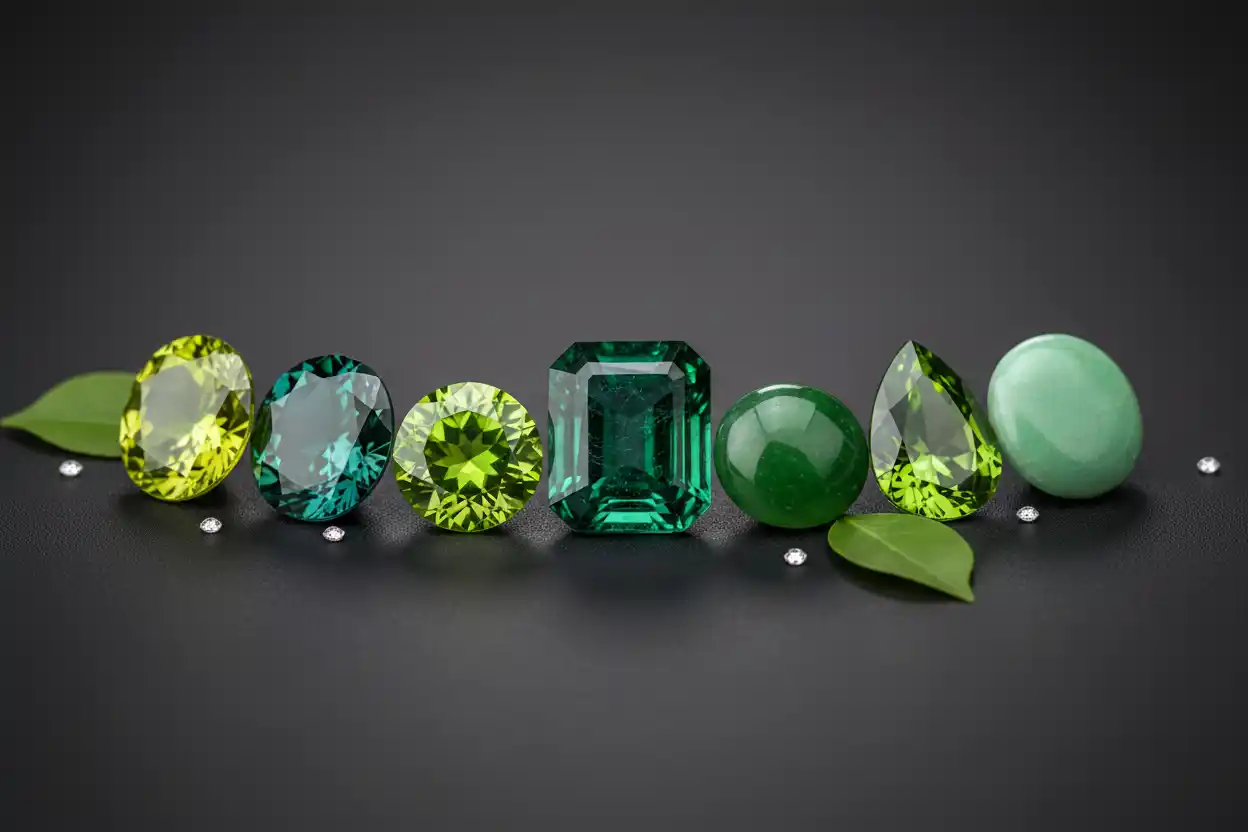
Green gemstones range from transparent emerald, sapphire and tsavorite to smooth jade, apple-green chrysoprase and patterned malachite. Their colors can come from chromium, vanadium, iron, nickel, copper or other causes depending on the mineral, so stones that look similar can have completely different composition, durability and value.
Across symbolism and crystal traditions, green commonly represents growth, renewal, balance, prosperity and connection with nature. Those meanings are cultural or personal interpretations rather than scientifically demonstrated effects, while each gemstone’s hardness, treatments and care requirements remain measurable physical facts.
Green Gemstones at a Glance
| Green Gemstone | Material | Mohs Hardness | Typical Appearance | Common Use |
|---|---|---|---|---|
| Emerald | Beryl | 7.5–8 | Vivid green to bluish green | Fine jewelry |
| Green Sapphire | Corundum | 9 | Yellow-green to blue-green | Rings, earrings |
| Tsavorite | Grossular garnet | 7–7.5 | Bright transparent green | Fine jewelry |
| Demantoid | Andradite garnet | 6.5–7 | Green with strong fire | Collector jewelry |
| Green Spinel | Spinel | 8 | Gray-green to bluish green | Fine jewelry |
| Peridot | Olivine | 6.5–7 | Yellow-green to green | Jewelry |
| Green Tourmaline | Tourmaline | 7–7.5 | Pale to forest green | Rings, pendants |
| Jadeite | Jadeite | 6.5–7 | Smooth, often translucent green | Cabochons, carvings |
| Nephrite | Amphibole jade | 6–6.5 | Creamy to deep green | Carvings, jewelry |
| Chrysoprase | Chalcedony | 6.5–7 | Apple green | Cabochons, beads |
| Prasiolite | Quartz | 7 | Pale transparent green | Faceted jewelry |
| Green Aventurine | Quartz-rich material | 6.5–7 | Green with subtle sparkle | Beads, cabochons |
| Malachite | Copper carbonate | 3.5–4 | Banded light and dark green | Cabochons, carvings |
| Prehnite | Prehnite | 6–6.5 | Pale yellow-green | Cabochons, beads |
| Green Fluorite | Fluorite | 4 | Transparent to translucent green | Collecting, pendants |
| Moss Agate | Chalcedony | 6.5–7 | Green dendritic inclusions | Cabochons |
| Green Onyx | Trade material | Varies | Even or banded green | Beads, decorative jewelry |
| Dioptase | Copper silicate | 5 | Intense emerald green | Mineral collecting |
The related Green Crystals directory casts a wider net across spiritual and collector materials, while this page concentrates on gemstones, jewelry suitability and how the major green choices differ.
Why Are Gemstones Green?
There is no single chemical cause of green gemstone color.
Different minerals become green through different mechanisms.
Emerald receives its color mainly from chromium, vanadium or both within beryl. Peridot’s green is intrinsic to iron in olivine rather than a trace impurity added to an otherwise colorless host.
Chromium also produces intense green in tsavorite garnet.
Nickel-related components help create chrysoprase’s apple-green color, while copper is responsible for the striking colors of minerals such as malachite and dioptase.
Green sapphire can develop through combinations involving iron and other trace elements.
Because the mechanisms differ, color alone cannot identify an unknown green stone.
Emerald
Emerald is the most historically famous transparent green gemstone.
It is the green to bluish-green variety of beryl and has been used in jewelry for thousands of years.
Fine emerald emphasizes color above almost every other quality factor.
Rich saturation is highly desirable, although stones that become too dark lose brightness.
Most natural emerald contains inclusions and surface-reaching fractures. Consequently, clarity enhancement with oil, resin or other fillers is widespread.
Emerald Meaning
Emerald has been associated symbolically with renewal, wisdom, loyalty and spring.
Its May birthstone status reinforces its connection with growth and new beginnings.
These themes belong to cultural tradition rather than proven therapeutic effects.
Best Uses
Emerald works in rings, pendants and earrings, although fracture-rich stones need thoughtful protection.
Its dedicated Emerald Buying Guide is the better resource when evaluating an individual purchase.
Green Sapphire
Sapphire is corundum in every color except red.
Green sapphire can appear yellow-green, olive, forest green, blue-green or combinations produced by color zoning.
At Mohs 9 with excellent toughness, it is one of the strongest natural green gemstones for jewelry.
Green Sapphire Meaning
Sapphire symbolism traditionally includes loyalty, discipline, sincerity and wisdom.
Modern interpretations of green sapphire often add growth, patience and balanced decision-making.
Best Uses
Green sapphire performs particularly well in rings and other jewelry that receives frequent wear.
That durability is why it features prominently in Green Gemstones for Engagement Rings.
Tsavorite Garnet
Tsavorite is green grossular garnet.
Fine stones can display exceptionally vivid, clean green with strong brilliance.
Tsavorite is generally untreated, which is attractive to buyers who prefer gemstones whose color has not routinely been modified.
Large fine stones become increasingly scarce.
Tsavorite Meaning
Modern symbolism often links tsavorite with vitality, confidence, renewal and prosperity.
These themes derive primarily from green color symbolism and contemporary gemstone traditions.
Best Uses
Tsavorite is durable enough for rings, earrings and pendants with reasonable care.
It is especially appealing to buyers who want an emerald-like color combined with a different inclusion and treatment profile.
Demantoid Garnet
Demantoid is green andradite garnet.
Its name relates to its diamond-like dispersion, and fine stones can display strong flashes of spectral color.
Some demantoid contains characteristic horsetail inclusions, particularly material associated historically with Russia.
Demantoid Meaning
Modern symbolic associations include vitality, creativity and renewal.
However, demantoid is primarily prized as a rare collector gemstone rather than for an ancient independent metaphysical tradition.
Best Uses
Because it is somewhat softer than sapphire or spinel, rings should use secure protective settings.
Fine demantoid is particularly suited to collector jewelry where color, dispersion and provenance receive close attention.
Green Spinel
Spinel occurs in many colors, including less familiar greenish and bluish-green material.
Natural strongly saturated green spinel is not as commonly encountered as red, pink or blue spinel.
At Mohs 8 with good toughness, it remains highly practical for jewelry.
Green Spinel Meaning
Contemporary symbolism commonly emphasizes resilience, renewal and quiet confidence.
These associations are modern rather than a standardized historical tradition.
Best Uses
Spinel works extremely well in rings, pendants and earrings.
Its combination of brilliance and durability makes it especially useful for buyers seeking an unconventional green fine-jewelry stone.
Peridot
Peridot is gem-quality olivine.
Unlike many gemstones whose green arises from minor impurities, peridot’s iron is part of the mineral chemistry responsible for its characteristic yellow-green to green appearance.
It is also August’s birthstone.
Peridot Meaning
Peridot has accumulated symbolism involving renewal, optimism and releasing resentment.
Its bright green color naturally lends itself to themes of growth and freshness.
Best Uses
Peridot works well for earrings, pendants and carefully worn rings.
It is less scratch-resistant than sapphire or spinel, so high-contact jewelry deserves additional protection.
Green Tourmaline
Tourmaline offers one of the broadest green palettes.
Stones may range from pale yellow-green through bright grass green to dark forest green and blue-green.
Tourmaline is strongly pleochroic, so one crystal can show different color intensity along different viewing directions.
Green Tourmaline Meaning
Modern traditions commonly connect green tourmaline with growth, compassion, balance and renewal.
Best Uses
With hardness around 7–7.5, it is practical for most jewelry.
Because tourmaline can be sensitive to thermal shock, unnecessary high heat should be avoided during cleaning and repair.
Jadeite
Jade includes two distinct materials: jadeite and nephrite.
Jadeite can produce some of the most valuable green ornamental gemstones, particularly fine translucent material with vivid even color.
Its interlocking crystal structure gives it exceptional toughness.
Jadeite Meaning
Jade symbolism varies strongly across cultures.
Common themes include harmony, longevity, prosperity, virtue and protection.
These associations deserve cultural context rather than being reduced to generic “crystal healing.”
Best Uses
Jadeite works beautifully in cabochons, bangles, beads and carved pieces.
Treatment disclosure matters because bleached, polymer-impregnated and dyed jadeite occupies a different market from untreated material.
Nephrite
Nephrite is the other traditional jade material.
It generally has a slightly lower Mohs hardness than jadeite but extraordinary toughness due to its fibrous interlocking structure.
Its greens range from pale creamy tones to dark spinach green.
Nephrite Meaning
Like jadeite, nephrite carries culturally varied themes of endurance, protection, harmony and continuity.
Best Uses
Its toughness makes it excellent for carvings, bangles and durable ornamental objects.
Transparency, texture and craftsmanship can matter more than conventional faceted brilliance.
Chrysoprase
Chrysoprase is nickel-colored green chalcedony.
Fine material can show a remarkably even apple-green color with attractive translucency.
Its appearance can superficially resemble jade, but the mineralogy is different.
Chrysoprase Meaning
Modern traditions commonly associate chrysoprase with openness, renewal and emotional honesty.
Best Uses
Its microcrystalline quartz structure makes it useful for cabochons, beads, rings and carvings.
Strong color and translucency generally increase visual appeal.
Prasiolite
Prasiolite is transparent green quartz.
It is frequently marketed as “green amethyst,” although prasiolite is the preferred gem name once quartz has become green.
Much material in commerce owes its green appearance to heat treatment or irradiation of suitable quartz.
Prasiolite Meaning
Modern symbolic traditions link it with clarity, renewal and measured growth.
Best Uses
At Mohs 7, prasiolite can be faceted into large affordable gemstones for pendants, earrings and careful ring wear.
Its pale color often works particularly well in larger cuts.
Green Aventurine
Green Aventurine is quartz-rich material containing reflective mica inclusions, commonly fuchsite.
Its shimmer distinguishes it from most transparent green gemstones.
Green Aventurine Meaning
Modern crystal traditions famously associate it with opportunity, growth, optimism and luck.
Those themes should be treated as symbolism rather than claims that the material changes probability or financial outcomes.
Best Uses
Aventurine works well in beads, cabochons, carvings and casual jewelry.
Its affordability makes it especially popular in bracelets and polished stones.
Malachite
Malachite is a copper carbonate mineral recognized instantly by its bands of light and dark green.
Its pattern rather than transparency creates most of its visual appeal.
At Mohs 3.5–4, it is much softer than emerald, sapphire or quartz.
Malachite Meaning
Modern traditions often associate malachite with transformation, boundaries and change.
Best Uses
Cabochons, pendants, earrings and decorative pieces suit malachite better than high-contact unprotected rings.
Polished pieces can be worn normally, although cutting and grinding dust should be handled with appropriate mineral-working precautions.
Prehnite
Prehnite commonly appears pale yellow-green to apple green.
Its translucent, soft-looking appearance distinguishes it from strongly saturated emerald and tsavorite.
Prehnite Meaning
Contemporary crystal traditions often connect prehnite with preparation, reflection and calm organization.
Best Uses
Prehnite is commonly fashioned as cabochons, beads and occasional faceted stones.
Its moderate hardness makes pendants and earrings especially practical.
Green Fluorite
Green Fluorite can range from very pale mint to strong transparent green.
Fluorite is famous for its crystal forms and perfect cleavage.
At Mohs 4, it is considerably softer than most mainstream jewelry gemstones.
Green Fluorite Meaning
Modern symbolism commonly emphasizes organization, discernment and clearing mental clutter.
These associations are not established cognitive effects.
Best Uses
Green fluorite is particularly well suited to mineral collections and protected pendants rather than heavily worn rings.
Moss Agate
Moss Agate is chalcedony containing green dendritic or moss-like structures.
The inclusions create landscape-like patterns that make every cabochon different.
Moss Agate Meaning
Nature, patience and gradual growth dominate its modern symbolism.
Best Uses
Moss agate is especially attractive in cabochons, rings, pendants and one-of-a-kind jewelry where the natural pattern becomes the design.
Green Onyx
Green Onyx is a trade name that needs careful interpretation because commercial usage varies.
Material sold under the name can include chalcedony-family stones and other ornamental products, sometimes with treatment.
Green Onyx Meaning
Modern traditions commonly associate it with steadiness, confidence and emotional balance.
Best Uses
It is widely fashioned into cabochons, beads, carvings and decorative jewelry.
Always confirm what a seller means mineralogically by “green onyx” before paying a rarity premium.
Dioptase
Dioptase produces some of the most intensely green natural crystals in mineral collecting.
Copper creates its extraordinary emerald-like color.
However, the mineral has perfect cleavage and only moderate hardness.
Dioptase Meaning
Contemporary spiritual traditions sometimes connect it with compassion and emotional insight.
Best Uses
Fine crystals are generally better suited to mineral collections than daily-wear jewelry.
A fragile natural crystal should not be sacrificed simply because its color resembles a conventional gemstone.
Green Gemstones for Jewelry
Color alone should never determine jewelry suitability.
For demanding rings, sapphire, spinel and durable garnets are among the stronger transparent choices.
Emerald can perform successfully but often needs greater protection because fractures are common.
Tourmaline and peridot are practical with sensible care.
Jade benefits from exceptional toughness, while malachite and fluorite belong in more protected designs.
The freshly reconciled Green Gemstones for Engagement Rings compares the strongest choices specifically for long-term daily ring wear.
Green Gemstone Meanings
Despite their different mineralogy, several symbolic themes repeat because the stones share green color.
Growth is the most obvious.
Renewal follows from green’s association with spring and vegetation.
Prosperity appears frequently in jade, aventurine and emerald traditions.
Balance and compassion are also common in modern heart-chakra symbolism.
These overlaps should not be mistaken for evidence that green minerals share one physical “energy.”
Their geology is completely different.
The symbolism comes from culture, color association and personal interpretation.
Frequently Asked Questions
1. What are the most popular green gemstones?
Emerald, jade, peridot, green sapphire, tsavorite, tourmaline, chrysoprase and green aventurine are among the best-known.
2. What is the most valuable green gemstone?
Exceptional emerald, green diamond and certain rare collector stones can command very high prices. Value depends on quality, rarity, treatment and market demand rather than color alone.
3. What is the hardest green gemstone?
Green diamond is Mohs 10. Among more widely available colored gemstones, green sapphire is Mohs 9.
4. What green gemstone looks like emerald?
Tsavorite garnet, green tourmaline, green sapphire and some spinels can occupy overlapping green color ranges, although their physical properties differ.
5. What is an affordable green gemstone?
Green aventurine, prasiolite, moss agate, chrysoprase and many peridots can provide attractive green color at accessible prices.
6. What is the best green gemstone for everyday rings?
Green sapphire is among the strongest choices because corundum combines high hardness with excellent toughness.
7. Is jade always green?
No. Jadeite and nephrite occur in several colors. Green is simply the most famous commercial appearance.
8. Are green gemstones naturally colored?
Many are, but treatment is common in parts of the gemstone market. Heat, irradiation, dye, impregnation and fracture filling may affect certain materials.
9. What green gemstone has sparkles?
Green aventurine displays aventurescence from reflective mineral inclusions.
10. Which green gemstone has bands?
Malachite is especially famous for light- and dark-green banding, while some agates also show patterned green material.
11. What do green gemstones symbolize?
Common modern themes include growth, renewal, balance, prosperity and nature. Individual traditions vary by gemstone.
12. Can green gemstones heal health conditions?
There is no reliable evidence that green gemstones treat medical or psychological conditions. Their healing associations belong to cultural, spiritual or personal traditions.
Conclusion
Green gemstones share a color but not a mineral identity. Emerald is beryl, sapphire is corundum, tsavorite is garnet, peridot is olivine, jade represents jadeite or nephrite, while malachite is a copper carbonate.
Those geological differences determine hardness, treatment, value and appropriate jewelry use.
Symbolically, the green palette has long encouraged themes of growth, renewal and prosperity. These meanings can add personal significance, but they should remain separate from claims about medical or financial effects.
For buying and wearing, identify the actual gemstone first. Once its durability, treatment and care requirements are understood, color and symbolism can guide the more personal part of the choice.
Disclaimer: Green-gemstone healing, prosperity, chakra and metaphysical associations are cultural, spiritual or personal traditions rather than scientifically established medical, psychological or financial effects.