White Calcite Meaning, Properties, Identification and Value
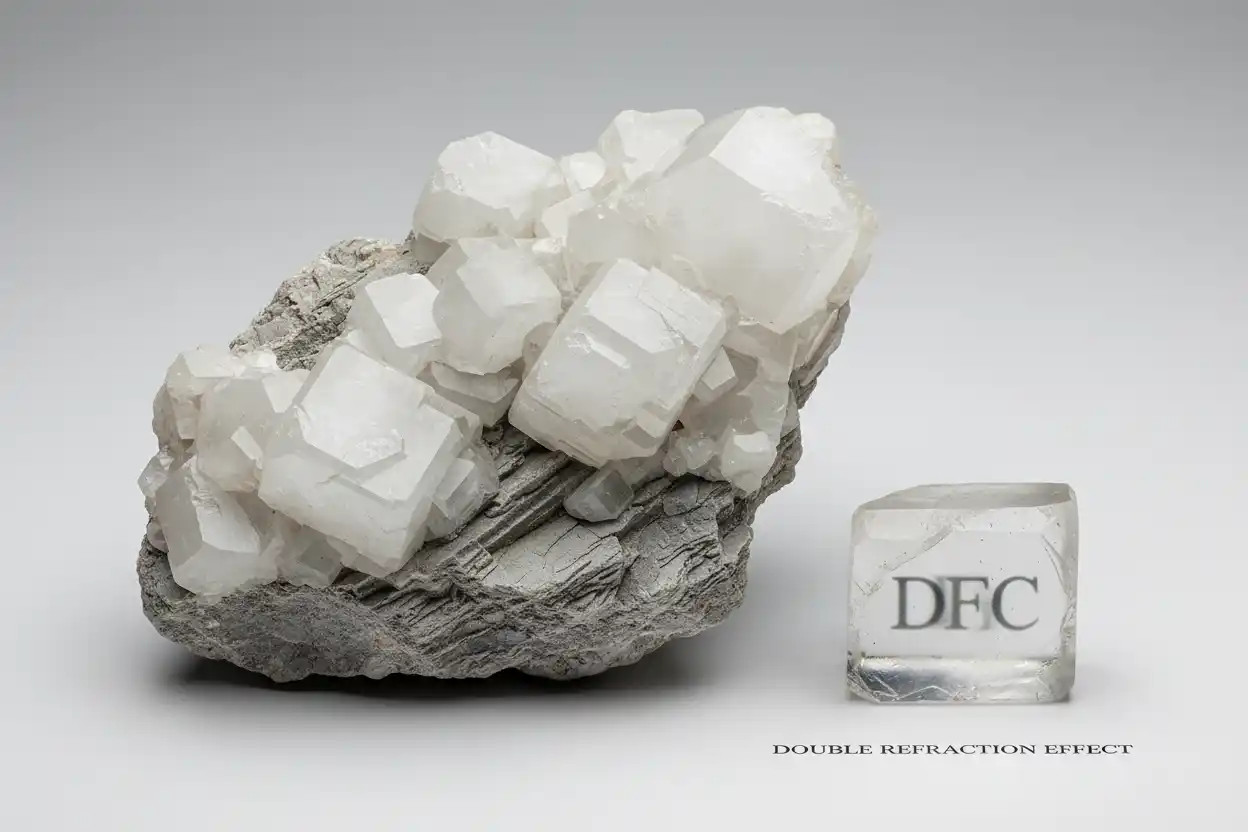
White calcite is the white, milky or nearly colorless expression of calcium carbonate. It ranges from translucent rhombohedral crystals and white cave formations to opaque masses used for carvings, decorative towers and mineral specimens.
Although white calcite belongs to the broader calcite family, this page focuses on its pale appearance, strong double refraction, identification, market terminology and particularly cautious care requirements.
White Calcite at a Glance
| Property | White Calcite |
|---|---|
| Mineral class | Carbonate |
| Chemical formula | CaCO₃ |
| Crystal system | Trigonal |
| Typical colors | Colorless, white, milk white, cream, pale gray and white with colored inclusions |
| Common habits | Rhombohedral, scalenohedral, tabular, prismatic, fibrous, stalactitic, granular and massive |
| Luster | Vitreous on crystal faces; pearly on cleavage surfaces |
| Transparency | Transparent to opaque |
| Refractive indices | Approximately 1.486 and 1.658 |
| Birefringence | Very strong, approximately 0.172 |
| Optical character | Uniaxial negative |
| Specific gravity | Approximately 2.71 |
| Mohs hardness | 3 |
| Cleavage | Perfect rhombohedral cleavage in three directions |
| Tenacity | Brittle |
| Acid reaction | Effervesces readily in dilute acid |
| Common use | Mineral specimens, carvings, decorative objects, optical demonstrations and occasional protected jewelry |
| Main care concern | Scratches easily, cleaves readily and reacts with acids and harsh cleaners |
What Is White Calcite?
White calcite is calcium carbonate with little intense trace-element coloration. It is not a separate mineral species from blue, green, orange or honey calcite.
Calcite is one of Earth’s most widespread rock-forming minerals. It forms limestone, marble, chalk, cave deposits, shells and many hydrothermal veins.
Pure calcite is colorless. White appearance usually develops because microscopic inclusions, fine crystal boundaries, pores, fractures or internal scattering prevent light from passing through cleanly.
Therefore, the label white calcite describes appearance rather than a fixed chemical variety. Its mineral identity remains CaCO₃.
The broader range of colors and trade varieties belongs to Types of Calcite, while color-based symbolism remains with the calcite color meaning guide.
Why Does Calcite Look White?
A perfectly transparent calcite crystal allows much of the visible light to pass through it. However, numerous microscopic boundaries scatter that light in many directions, making the specimen look milky or opaque.
Fine-grained aggregates are particularly likely to appear white. Each tiny crystal has a different orientation, so light reflects and refracts repeatedly before leaving the material.
Fluid inclusions, healed fractures and microscopic cavities can create additional cloudiness.
Pale clay, quartz, dolomite or other mineral inclusions may also influence the tone. Consequently, some commercial white calcite is not chemically pure even though calcite remains the dominant phase.
Weathering can create chalky white surfaces on crystals that were originally transparent. A fresh break may reveal greater translucence beneath the altered exterior.
White Calcite Versus Clear Calcite
Clear calcite is transparent enough for its strong double refraction to become immediately visible. When a clear cleavage fragment is placed over printed text, two images may appear.
This transparent optical material is often called Iceland spar, although not every clear calcite specimen comes from Iceland.
White calcite is cloudier because inclusions, fractures or fine-grained texture scatter the light. It may still show double refraction along thin translucent edges, but the effect becomes less obvious as opacity increases.
Clear and white calcite share the same hardness, cleavage, chemical composition and acid sensitivity.
A seller should not describe ordinary opaque white material as optical calcite merely because it belongs to the same mineral species.
White Calcite Crystal Forms
Rhombohedral Calcite
Rhombohedra have six sloping faces and resemble distorted cubes. Because calcite cleaves in the same general form, broken pieces may also appear rhombohedral.
A flat face does not always represent original crystal growth. Cleavage surfaces often show a pearly luster and fine internal steps.
Dogtooth or Scalenohedral Calcite
Scalenohedral crystals form pointed, toothlike shapes. White dogtooth calcite commonly grows over limestone, sulfide ore or earlier calcite generations.
Sharp points can be attractive but chip easily because of the mineral’s low hardness and cleavage.
Tabular and Bladed Calcite
Thin white tablets may form rosettes, stacked plates or broad blades. These forms can resemble barite, gypsum or aragonite.
Fibrous and Satin Calcite
Parallel fibrous calcite can show a silky sheen or cat’s-eye-like line after cutting.
Some fibrous white material is incorrectly sold as satin spar, a name more properly associated with fibrous gypsum. Hardness and acid reaction separate the minerals.
Stalactitic and Cave Calcite
Calcite precipitated from dripping groundwater forms stalactites, stalagmites, flowstone and cave pearls.
Fresh cave formations should never be removed from protected caves. Commercial pieces require legal and documented provenance.
Massive White Calcite
Massive material lacks obvious individual crystals. Lapidaries shape it into bowls, towers, spheres, carvings and decorative slabs.
Its texture may include fractures, color bands and small cavities. Some objects sold as white onyx or Afghan jade consist largely of banded calcite rather than true quartz onyx or jade.
Double Refraction
Calcite has exceptionally strong birefringence. Light entering the crystal divides into two rays traveling at different speeds and directions.
As a result, transparent material can produce two images of an object viewed through it.
The effect varies with orientation. Looking directly along the optic axis can reduce or eliminate visible doubling, while other directions produce dramatic separation.
White cloudiness may obscure the effect, but a translucent cleavage fragment can still show doubled edges.
Double refraction offers a useful identification clue, although other minerals also show birefringence. It should be combined with hardness, cleavage and chemical testing.
Fluorescence and Phosphorescence
Some white calcite fluoresces under ultraviolet light, while other specimens remain inert.
Responses may include red, orange, pink, cream, white, blue or green. Manganese commonly activates red or orange fluorescence, whereas iron can suppress luminescence.
Different zones within one crystal may react differently because trace-element concentrations changed during growth.
Phosphorescence also occurs in some calcite, allowing the mineral to glow briefly after the ultraviolet source is switched off.
Fluorescence cannot prove that a white specimen is calcite. Associated minerals, coatings and adhesives can also glow.
How White Calcite Forms
Calcite forms in sedimentary, metamorphic, hydrothermal, igneous and biological environments.
In marine settings, organisms build shells and skeletons from calcium carbonate. Accumulated carbonate sediment eventually forms limestone.
Metamorphism recrystallizes limestone into marble. Larger calcite grains develop as heat and pressure reorganize the rock.
Groundwater dissolves calcium carbonate and redeposits it inside caves, fractures and pores. Repeated precipitation creates stalactites, veins and crystal-lined cavities.
Hydrothermal fluids form calcite beside quartz, fluorite, barite and metallic ore minerals. Changes in temperature, pressure or dissolved carbon dioxide trigger crystallization.
Some igneous rocks, including carbonatites, contain abundant calcite crystallized through unusual magma and fluid processes.
Important Sources
White calcite occurs worldwide, so locality matters mainly when it produces an unusual crystal form, mineral association or historic specimen.
Mexico supplies rhombohedral, scalenohedral and fluorescent calcite from numerous mines.
China has produced large white and colorless crystals, complex twins and specimens associated with fluorite, quartz and sulfide minerals.
Pakistan and Afghanistan supply milky rhombohedra, stacked crystals and decorative massive material.
Romania, Bulgaria, Kosovo and other European mining districts are known for calcite over sulfide-rich matrix.
The United States contains notable occurrences in Missouri, Tennessee, New York, New Mexico, Michigan and many additional states.
Iceland is historically important for transparent optical calcite rather than ordinary opaque white material.
Associated Minerals and Inclusions
White calcite commonly occurs with quartz, dolomite, barite, fluorite, pyrite, galena, sphalerite and numerous secondary minerals.
Metallic inclusions can create dramatic contrast. Nevertheless, they may introduce separate oxidation or handling concerns.
Iron oxides produce yellow, brown or orange stains along cracks and crystal surfaces.
Clay and sediment can become trapped between crystal generations. Removing them aggressively may damage the softer calcite.
Fluid inclusions are common in transparent crystals and can record the temperature and chemistry of mineral-forming fluids.
Cleavage planes may appear as broad reflective lines. These are structural weaknesses rather than conventional inclusions.
White Calcite Versus Other Calcite Colors
Blue calcite typically shows pale to medium blue caused by inclusions, defects or light-scattering effects.
Green calcite receives color from trace elements or included minerals and should not be identified solely by a pale green tint.
Honey calcite ranges from golden yellow to warm brown and often has greater transparency.
Orange calcite commonly contains iron-related coloration.
Red calcite contains stronger red or reddish-orange tones rather than white material with minor staining.
Mangano calcite is manganese-bearing pink calcite, while cobaltocalcite contains cobalt and may show vivid pink or magenta color.
White calcite should not absorb the search intent of these established color pages. Its defining subject is colorless-to-white calcite, its optical behavior and its specific identification risks.
White Calcite Versus Selenite
White calcite and selenite can both appear milky, translucent or fibrous.
Selenite is gypsum, with a hardness of approximately 2. A fingernail can scratch it more easily than calcite.
Gypsum often forms tabular blades, clear sheets or fibrous satin spar. Calcite commonly forms rhombohedra and scalenohedra.
Calcite effervesces readily in dilute acid, whereas gypsum does not.
Neither mineral should undergo destructive home testing when it is a valuable finished piece.
White Calcite Versus Quartz
Milky quartz is harder, lacks calcite’s rhombohedral cleavage and does not fizz in ordinary dilute acid.
Quartz measures 7 on the Mohs scale, whereas calcite measures only 3.
Calcite can often be scratched by a copper coin or steel point, but destructive testing should be restricted to inconspicuous rough material.
Quartz crystal points usually show six-sided prisms. Calcite can produce many shapes but does not share quartz’s characteristic hexagonal prism termination.
White Calcite Versus Aragonite
Calcite and aragonite share the composition CaCO₃ but have different crystal structures.
Calcite is trigonal, while aragonite is orthorhombic.
Aragonite often forms needle clusters, pseudohexagonal twins, branching forms and fibrous masses. Calcite more commonly shows rhombohedral cleavage.
Aragonite is slightly harder and denser, but both minerals react with acid.
Laboratory analysis may be necessary for massive or fine-grained material because visual appearance can overlap.
White Calcite Versus White Jade
True white jade consists of white nephrite or white jadeite rather than calcium carbonate.
Jade is substantially tougher and generally harder than calcite. Calcite carvings scratch and chip far more readily.
Low-cost white calcite objects are sometimes marketed as Afghan jade, Pakistan jade or mountain jade. These are trade names, not proof of jade mineralogy.
The distinction is covered in greater detail in Jade vs Jadeite and Jadeite vs Nephrite.
Identifying White Calcite
The most useful non-destructive clues are low hardness, perfect rhombohedral cleavage, strong birefringence in transparent sections and relatively low density.
A gemologist may record two refractive indices around 1.486 and 1.658. The large difference confirms exceptional birefringence.
A drop of dilute acid produces vigorous bubbling as carbon dioxide escapes. However, acid testing permanently marks polished surfaces and should be performed only on disposable rough by a knowledgeable person.
Raman spectroscopy and X-ray diffraction can confirm calcite and separate it from aragonite, dolomite, gypsum and quartz.
The general sequence in How to Identify Crystals helps prevent overreliance on color and seller terminology.
Treatments, Coatings and Imitations
Most natural white calcite is untreated because it is abundant and naturally pale.
Wax, oil or resin may improve the appearance of porous carvings and hide small scratches.
Resin can stabilize heavily fractured massive material. Filled areas may show bubbles, different luster or concentrated material inside cracks.
Bleaching can remove surface staining, although aggressive chemical cleaning may also etch the calcite.
Dye is more relevant to strongly colored decorative calcite, but white pieces can be coated or painted to create a uniform surface.
Reconstituted products combine calcite powder with resin. They may show repeated patterns, mold seams and a plastic-rich polish.
Manufactured glass and resin are also used to imitate white crystals. Their lack of rhombohedral cleavage and acid reaction helps separate them.
The broad terminology appears in Gemstone Treatments Explained.
Cutting and Polishing
Calcite cuts easily because of its softness, but it can also break easily because of perfect cleavage.
A lapidary must orient the rough so pressure does not split the stone during sawing, grinding or polishing.
Massive material becomes cabochons, beads, towers, spheres and carvings. Transparent material may be faceted for collectors, although it is unsuitable for conventional wear.
Polishing can create flat spots where cleavage planes open. Excessive pressure may tear small sections from the surface.
Different mineral inclusions can undercut or remain raised. For example, harder quartz grains may protrude from a softer calcite background.
Dry cutting should be avoided because carbonate and associated mineral dust can irritate the respiratory system. Wet methods also control heat.
Hardness, Cleavage and Durability
Calcite has a Mohs hardness of 3, as shown in the gemstone hardness chart.
Household dust commonly contains quartz, which can scratch polished calcite during ordinary wiping.
Hardness does not measure resistance to splitting. The difference explained in gemstone toughness versus hardness matters because calcite cleaves readily.
Its three perfect cleavage directions are discussed within gemstone cleavage explained.
Calcite is unsuitable for engagement rings, daily bracelets or exposed jewelry.
Protected pendants, earrings and brooches can work for occasional wear, especially when the stone is thick and free from major fractures.
Natural crystal specimens should be handled by their matrix rather than by individual points.
White Calcite Prices in 2026
White calcite is common, so ordinary polished and rough material remains affordable.
Small tumbled stones, cleavage fragments and simple pieces commonly retail for approximately $2–$10.
Small carved shapes, towers and palm stones often cost $10–$40.
Attractive thumbnail and miniature crystal specimens generally range from approximately $15–$100.
Fine specimens with sharp crystals, unusual twinning, strong fluorescence or attractive mineral associations can sell for $100–$600.
Large cabinet specimens and important locality pieces may exceed $600–$1,500. Exceptional museum-grade calcite can command much more, even though the mineral species itself is abundant.
Transparent optical calcite is priced according to clarity, size and freedom from internal fractures rather than white color alone.
What Determines White Calcite Value?
Crystal form matters more than color rarity. Sharp, complete rhombohedra, scalenohedra or unusual twins receive stronger demand.
Transparency and luster influence value. A translucent white crystal with bright faces usually commands more than a dull chalky mass.
Mineral associations can create substantial premiums. White calcite perched over amethyst, fluorite, metallic sulfides or contrasting matrix may have far greater specimen value than isolated calcite.
Condition is critical because calcite chips easily. Cleaved tips, etched surfaces and repaired crystals reduce value unless the specimen remains historically important.
Fluorescence can add appeal, especially when the response is bright and visually zoned.
Locality and old labels also matter for collector specimens.
Buying Guidance
Determine whether the seller offers a mineral specimen, carving, optical crystal or decorative object.
Inspect crystal points and edges for cleavage breaks. Fresh breaks can look smooth enough to be mistaken for natural faces.
Ask whether a carving has been waxed, coated, resin-filled or assembled.
Be cautious with names such as Afghan jade, white onyx or marble calcite. These labels may describe appearance or source rather than precise mineral identity.
For specimens, request exact dimensions and locality. Photographs should show all sides rather than hiding a heavily damaged back.
Use price comparisons from similar calcite forms rather than comparing a common tower with a fine collector specimen.
Cleaning, Water and Acid Safety
Use a hand air blower or an extremely soft dry brush for routine specimen cleaning.
For a solid, untreated polished piece, wipe briefly with a damp cloth and dry immediately.
Do not soak calcite. Although pure water does not cause immediate dramatic dissolution, prolonged contact can enter fractures, affect coatings and leave surface deposits.
The broad guidance in Which Crystals Can and Cannot Go in Water should be applied conservatively.
Avoid vinegar, lemon juice, bathroom cleaner, jewelry dip and other acids. Even weak acids etch calcite rapidly.
Ultrasonic and steam cleaners are inappropriate because vibration, heat and cleavage increase breakage risk. The general limitations appear in gemstones in ultrasonic cleaners.
Natural white color is generally stable under ordinary light. Nevertheless, coatings, glue and associated minerals may change during prolonged heat or sunlight.
The wider display considerations appear in crystals that fade in sunlight.
For belief-based cleansing practices, follow the dry and low-contact options in How to Cleanse and Charge Calcite.
Meaning and Symbolism
Modern crystal traditions associate white calcite with clarity, simplicity, reflection and creating mental space before making a decision.
Its optical doubling has inspired symbolic interpretations involving more than one perspective or the need to examine an issue from several angles.
White coloring also supports modern associations with renewal, calm and honest intention.
These meanings are spiritual, cultural or personal rather than scientifically demonstrated effects.
White calcite may appear in collections of white crystals and white gemstones, although its low hardness means it functions better as a specimen or carving than as a conventional durable gem.
Frequently Asked Questions
1. Is white calcite a separate mineral species?
No. It is colorless-to-white calcite, with the same calcium-carbonate composition as other calcite colors.
2. Why is calcite white instead of clear?
Microscopic grains, pores, fractures, fluid inclusions and associated minerals scatter light and create a milky appearance.
3. Is white calcite the same as Iceland spar?
No. Iceland spar is exceptionally transparent optical calcite. White calcite is usually cloudier or opaque.
4. Does white calcite show double refraction?
Transparent and translucent sections can show strong image doubling. Opaque material may hide the effect.
5. Is white calcite the same as white onyx?
Some retail white onyx is banded calcite, but true quartz onyx is chalcedony. The trade name alone does not establish composition.
6. Is Afghan jade actually white calcite?
Some products sold as Afghan jade consist of calcite or another soft carbonate. The name does not prove true jade.
7. Can white calcite go in water?
Brief wiping may be acceptable, but soaking is not recommended because of fractures, coatings and surface sensitivity.
8. Can white calcite be cleaned with vinegar?
No. Vinegar contains acid and will etch or dissolve the calcite surface.
9. Does white calcite fluoresce?
Some specimens fluoresce red, orange, pink, cream, blue or other colors, while others do not react.
10. Is white calcite suitable for rings?
It is not recommended for regular rings because hardness 3 and perfect cleavage make it easy to scratch and chip.
11. How much is white calcite worth?
Ordinary pieces cost only a few dollars, while attractive crystal specimens commonly range from $15 to several hundred dollars. Exceptional locality specimens can exceed $1,000.
12. Does white calcite have scientifically proven healing properties?
No. Its symbolism may hold personal meaning, but scientific evidence does not establish healing effects from the mineral.
White calcite reveals more than a plain pale surface. Its rhombohedral cleavage, dramatic birefringence and ability to form in caves, limestones, marbles and ore veins make it one of the clearest demonstrations of how one simple chemical compound can produce extraordinary geological variety.
White calcite appears in Crystals That Start With W and Gemstones That Start With W.