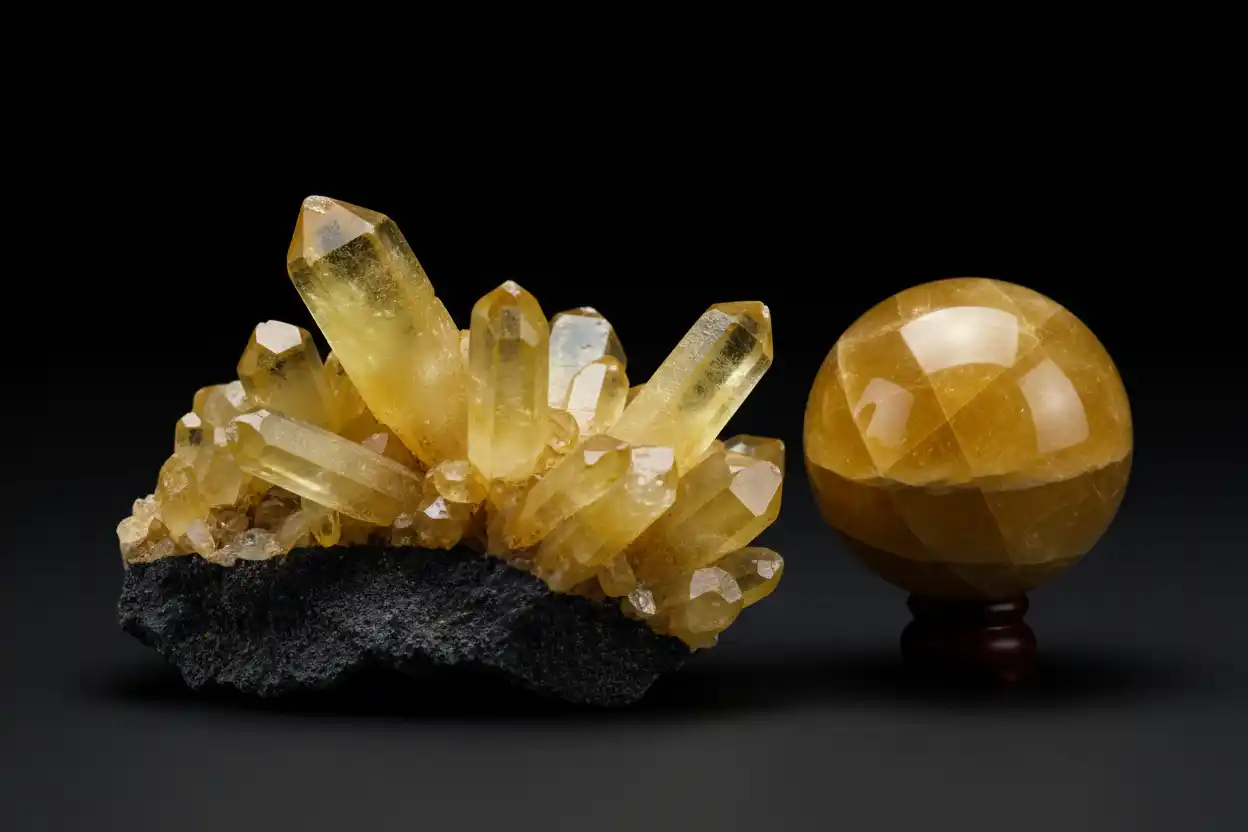
Yellow Calcite: Meaning, Properties & Symbolism
Yellow calcite is calcium carbonate whose body color ranges from pale lemon and straw yellow to golden, mustard and yellow-brown. Iron-related impurities, microscopic inclusions and structural defects commonly contribute to its color, although one universal coloring mechanism does not apply to every deposit.
The page’s scope is limited to yellow calcite as a mineral and lapidary variety. Family-level mineralogy remains with calcite, while the broader range of named colors belongs to Types of Calcite.
Yellow Calcite at a Glance
| Property | Yellow Calcite |
|---|---|
| Mineral species | Calcite |
| Chemical formula | CaCO₃ |
| Mineral class | Carbonate |
| Typical colors | Pale lemon, straw yellow, golden yellow, honey yellow, mustard, amber-yellow and yellow-brown |
| Common coloring factors | Iron substitution, iron oxides, organic inclusions, lattice defects and microscopic particles |
| Crystal system | Trigonal |
| Common habit | Rhombohedral, scalenohedral, tabular, prismatic, fibrous, botryoidal and massive |
| Luster | Vitreous to pearly |
| Transparency | Transparent to opaque |
| Refractive indices | Approximately 1.486 and 1.658 |
| Birefringence | Extremely strong, approximately 0.172 |
| Optical character | Uniaxial negative |
| Specific gravity | Approximately 2.71 |
| Mohs hardness | 3 |
| Cleavage | Perfect rhombohedral cleavage in three directions |
| Tenacity | Brittle |
| Common use | Mineral specimens, carvings, spheres, palm stones, cabochons and optical demonstrations |
| Main care concern | Softness, cleavage and rapid reaction with acids |
What Is Yellow Calcite?
Yellow calcite is a color variety of calcite rather than a separate mineral species.
Its essential composition remains CaCO₃ regardless of whether the body color is pale yellow, golden, brownish or nearly orange.
Pure calcite is colorless. Trace impurities and microscopic structures alter which wavelengths are absorbed or scattered, producing visible color.
Iron is commonly associated with yellow or golden calcite, but iron can occur as a substitution within the structure, an included oxide, a surface stain or a component of trapped sediment.
The exact cause may therefore require chemical and spectroscopic testing rather than a visual assumption.
Yellow Calcite Versus Calcite Color Meaning
The Calcite Color Meaning and Symbolism page compares the traditional associations assigned to several calcite colors.
This page instead owns yellow calcite’s specific mineral appearance, formation, identification, treatments, value and care.
The two pages should not repeat complete sections. Color symbolism is summarized here only enough to serve readers seeking the meaning of yellow calcite.
Yellow Calcite Colors
Pale Lemon Calcite
Pale lemon material ranges from nearly colorless to soft yellow.
Transparent crystals can show pronounced image doubling and internal reflections.
Commercial sellers sometimes call this lemon calcite, although the term has no formal mineralogical boundary.
Golden Calcite
Golden calcite displays a richer yellow or yellow-orange tone.
It may overlap commercially with honey calcite, particularly when the stone is translucent and polished.
Mustard and Ochre Calcite
Mustard-yellow and ochre colors often reflect stronger iron-oxide content, fine inclusions or surface alteration.
This material is commonly opaque and used for carvings rather than transparent gems.
Yellow-Brown Calcite
Yellow-brown material may grade into amber, caramel or earthy brown.
Sellers sometimes use names such as amber calcite, golden honey calcite or root-beer calcite without consistent definitions.
Color-Zoned Yellow Calcite
One crystal may contain colorless, yellow, orange and brown zones.
These bands record changes in fluid chemistry, impurity concentration and growth conditions.
Zoning can increase specimen appeal when the boundaries remain sharp and the crystal form is strong.
What Causes the Yellow Color?
Iron is the most frequently cited contributor to yellow and golden calcite.
Ferric iron can replace small amounts of calcium or occur in microscopic oxide and hydroxide inclusions.
Organic compounds, sulfur-related impurities and structural defects may also influence color in particular deposits.
Surface iron staining can create a yellow appearance without affecting the crystal’s interior. A chipped edge may reveal nearly colorless calcite beneath the coating.
Some specimens have been coated or dyed commercially. Therefore, yellow color should be evaluated together with fracture concentrations, surface wear and laboratory data.
Yellow Calcite Versus Honey Calcite
Honey Calcite generally refers to transparent or translucent calcite with a warm honey, amber or golden-brown appearance.
Yellow calcite is the broader color category and includes paler lemon and straw tones that may not resemble honey.
The names overlap in the retail market because no laboratory boundary separates them.
A practical description should state the observed color, transparency, locality and treatment rather than presenting honey and yellow as separate species.
Honey calcite often receives a higher price when it is transparent, richly colored and well cut, but the trade name alone does not establish quality.
Yellow Calcite Versus Orange Calcite
Orange Calcite has a dominant orange, peach or reddish-orange body color.
Yellow-orange material can sit between the two commercial categories.
A neutral-light photograph provides a more accurate comparison than heavily warm retail lighting.
Both varieties share hardness, cleavage and acid sensitivity because they remain calcite.
Yellow Calcite Versus White Calcite
White Calcite lacks a dominant yellow body color.
White material may contain faint cream or beige undertones, while yellow calcite shows recognizable lemon, straw or golden coloration.
Iron staining can turn part of a white calcite specimen yellow without creating uniformly colored material.
The distinction is descriptive rather than chemical.
Yellow Calcite Versus Citrine
Citrine is yellow quartz with a hardness of 7.
Yellow calcite measures only 3 and has perfect rhombohedral cleavage.
Calcite reacts readily with dilute acid, while quartz does not.
Transparent calcite also shows much stronger visible double refraction.
Color alone cannot distinguish them, particularly in polished cabochons and carvings.
A low-priced yellow tower marketed under vague crystal terminology should be tested before being labeled citrine.
Yellow Calcite Versus Yellow Fluorite
Yellow fluorite is calcium fluoride rather than calcium carbonate.
Fluorite has hardness 4 and perfect octahedral cleavage, while calcite has hardness 3 and rhombohedral cleavage.
Calcite effervesces in acid. Fluorite does not show the same immediate carbonate reaction but should still never be exposed to strong acids.
Fluorite commonly forms cubes and octahedra, whereas calcite produces rhombohedra, dogtooth scalenohedra and many other forms.
Yellow Calcite Versus Aragonite
Aragonite has the same CaCO₃ composition as calcite but an orthorhombic structure.
Aragonite often forms radiating needles, branching clusters and pseudohexagonal twins.
Calcite has perfect rhombohedral cleavage and commonly shows stronger optical doubling in transparent pieces.
Aragonite is slightly harder and denser.
Raman spectroscopy or X-ray diffraction may be necessary for massive yellow material because the colors overlap.
Crystal Habits
Rhombohedral Crystals
Rhombohedral yellow calcite resembles a distorted cube with sloping faces.
Some apparent rhombohedra are cleavage fragments rather than complete natural crystals.
Fresh cleavage surfaces may show a pearly reflection and strong internal doubling.
Dogtooth Calcite
Scalenohedral or dogtooth crystals taper into sharp points.
Yellow dogtooth clusters are popular collector specimens but their tips chip easily.
Tabular and Pagoda Calcite
China has produced layered or stacked yellow calcite crystals described commercially as pagoda or fish-scale calcite.
These names refer to habit and appearance rather than formal varieties.
Botryoidal Calcite
Rounded yellow aggregates can resemble grapes or bubbly crusts.
Botryoidal surfaces may contain fibrous internal structure and can trap dirt between rounded forms.
Massive Yellow Calcite
Massive material lacks visible crystal faces and is widely carved into spheres, towers, hearts, bowls and palm stones.
It can contain fractures, white areas and brown iron-rich veins.
How Yellow Calcite Forms
Yellow calcite forms wherever calcium carbonate precipitates in the presence of color-producing impurities.
Hydrothermal veins can deposit calcite beside fluorite, barite, quartz and metallic sulfides.
Groundwater creates calcite inside limestone cavities and caves.
Sedimentary processes form limestone and fossil-rich carbonate rock that may later recrystallize.
Metamorphism transforms limestone into marble and can create coarse yellow calcite grains.
Oxidized ore deposits introduce iron-rich water that stains or colors calcite crystals.
Different growth episodes can produce clear inner zones, yellow bands and later white coatings within one specimen.
Important Sources
Mexico
Mexico supplies transparent yellow rhombohedra, scalenohedral clusters and massive golden material.
Some specimens occur with fluorite, quartz and sulfide minerals.
United States
Missouri’s lead-zinc districts have produced yellow calcite on sphalerite, dolomite and other matrix.
Elk Creek in South Dakota is known for golden calcite associated with barite and fluorescent responses.
Tennessee, Oklahoma and several additional states contain collectible yellow calcite.
China
Fujian, Hunan, Sichuan and other Chinese provinces supply yellow scalenohedra, pagoda habits and calcite associated with quartz, pyrite and fluorite.
Commercial availability is broad, though exact mine information is sometimes omitted.
Pakistan and Afghanistan
These regions produce yellow-to-honey calcite crystals and combinations with celestite, fluorite and other minerals.
Namibia
Tsumeb and related mining regions have produced yellow calcite in complex secondary-mineral associations.
Europe and Other Regions
Romania, Bulgaria, Spain, Morocco and several other countries contain notable yellow calcite occurrences.
Locality should remain attached to original labels because similar-looking crystals occur worldwide.
Fluorescence and Phosphorescence
Some yellow calcite fluoresces under ultraviolet light.
Possible responses include red, orange, cream, white, yellow and green.
Manganese commonly activates red or orange fluorescence, while iron can suppress it.
One specimen may contain fluorescent and nonfluorescent zones corresponding to different growth stages.
Some material phosphoresces briefly after the lamp is turned off.
Ultraviolet response cannot prove the mineral’s identity because coatings and associated minerals may also glow.
Inclusions and Internal Features
Yellow calcite can contain iron oxides, clay, quartz, pyrite, fluid inclusions and organic material.
Pyrite creates metallic gold-colored inclusions that may be confused with yellow body color.
Siderite and dolomite may form brown or cream associated carbonates.
Fluid inclusions and growth zoning can document hydrothermal conditions.
Cleavage planes appear as broad reflective surfaces and represent structural weaknesses.
Iron staining often concentrates along fractures and outer crystal faces.
Identifying Yellow Calcite
Calcite’s hardness of 3, rhombohedral cleavage and strong birefringence provide useful evidence.
Transparent material can double printed text when viewed from suitable directions.
A dilute-acid test produces rapid effervescence, but it permanently etches polished calcite and should be restricted to disposable rough.
A gemologist can measure two widely separated refractive indices near 1.486 and 1.658.
Raman spectroscopy and X-ray diffraction confirm calcite and separate it from aragonite, quartz, fluorite and gypsum.
The general workflow in How to Identify Crystals should be used instead of relying on color or seller terminology.
Treatments, Coatings and Imitations
Most inexpensive yellow calcite is naturally colored, but treatment can occur.
Dye may enter fractures, porous masses and drill holes.
Surface coatings can create uniform golden color or improve luster.
Oil and wax deepen color and hide scratches temporarily.
Resin stabilization strengthens fractured carvings and can improve translucence.
Bleaching may remove unwanted brown staining before another treatment is applied.
Reconstituted calcite combines powder or fragments with resin.
Glass, resin, yellow fluorite and dyed quartz can imitate the appearance.
The broader disclosure framework appears in Gemstone Treatments Explained.
Cutting and Polishing
Calcite cuts quickly because it is soft, but perfect cleavage complicates every stage.
Excess pressure can split a cabochon or expose a cleavage step.
Massive material becomes spheres, towers, carvings and palm stones.
Transparent yellow crystals are occasionally faceted for collectors. Strong birefringence creates dramatic facet doubling but can reduce visual sharpness.
A fine complete crystal generally carries more specimen value than a small cut stone.
Polishing compounds must be used carefully because trapped hard particles can scratch the surface.
Dry cutting should be avoided to control dust and heat.
Hardness, Cleavage and Jewelry Suitability
Yellow calcite measures 3 on the gemstone hardness chart.
Quartz-bearing household dust can scratch it during ordinary wiping.
It also cleaves readily in three directions.
The distinction between scratch resistance and breakage resistance appears in Gemstone Toughness vs Hardness.
The structural risk is explained further in Gemstone Cleavage Explained.
Rings and bracelets are unsuitable for regular wear.
Protected pendants, brooches and earrings can be worn occasionally, although surface abrasion remains likely.
Mineral specimens and carvings are the most practical uses.
Yellow Calcite Prices in 2026
Small rough pieces and tumbled stones commonly retail for approximately $2–$10.
Commercial palm stones, small spheres and simple carvings generally range from $10–$40.
Small-to-medium crystal clusters commonly sell for approximately $15–$75.
Current retail examples include ordinary yellow calcite around $10–$30, while larger Chinese, Pakistani and American specimens frequently fall between $40 and $175.
Fine fluorescent clusters, sharp dogtooth crystals and attractive mineral associations can range from $100–$500.
Large, historic or museum-quality calcite specimens may exceed $500–$2,000, although these prices reflect form, locality and association rather than yellow color alone.
Faceted yellow calcite has no standardized per-carat market and is purchased primarily as a collector novelty.
What Determines Value?
Crystal form is the primary specimen factor.
Sharp complete scalenohedra, rhombohedra and unusual stacked habits receive stronger demand than broken masses.
Transparency and luster improve visual appeal.
Color should be attractive and natural-looking rather than muddy or artificially uniform.
Mineral association can create major premiums, especially when yellow calcite contrasts with barite, fluorite, pyrite or dark sulfide matrix.
Fluorescence and phosphorescence add collector interest.
Damage, acid etching, glue and undisclosed coating reduce value.
Buying Guidance
Use Where to Buy Real Calcite for the broader seller checklist.
Ask whether the material is yellow calcite, honey calcite, orange calcite or another carbonate.
Request neutral-light photographs because warm bulbs intensify yellow and orange tones.
Inspect points and edges for cleavage damage.
Ask about dye, resin, wax, coating and matrix repair.
A claim of rare golden calcite should include locality, crystal quality and supporting evidence rather than color alone.
For polished objects, check for uneven pits, filler and scratches hidden by oil.
Cleaning, Water, Heat and Sunlight
Clean polished untreated calcite with a slightly damp soft cloth and dry it promptly.
Do not soak the stone.
The conservative guidance in Which Crystals Can and Cannot Go in Water is appropriate because water can enter fractures and affect coatings or matrix.
Never use vinegar, lemon juice, acid-based cleaners or jewelry dips.
Ultrasonic and steam cleaning are inappropriate.
Natural iron-related color is generally stable under ordinary indoor light. However, dyes, resins and coatings can change under heat and prolonged sunlight.
The broader display guidance appears in Crystals That Fade in Sunlight.
For symbolic cleansing, use the gentle options in How to Cleanse and Charge Calcite.
Meaning and Symbolism
Modern crystal traditions associate yellow calcite with optimism, confidence, practical planning and renewed motivation.
Its bright color encourages symbolism involving attention, learning and identifying the next manageable step in a complicated task.
Golden material is sometimes connected with prosperity and achievement, although the stone cannot guarantee financial outcomes.
These meanings are cultural, spiritual or personal rather than scientifically demonstrated effects.
Yellow calcite appears in collections of yellow crystals and yellow gemstones, though its softness keeps it closer to a collector mineral than a durable jewelry gem.
Frequently Asked Questions
1. Is yellow calcite a separate mineral species?
No. It is yellow-colored calcite with the same CaCO₃ composition as other calcite varieties.
2. What makes calcite yellow?
Iron-related impurities, iron oxides, organic inclusions, structural defects and surface staining can contribute to yellow color.
3. Is yellow calcite the same as honey calcite?
The names overlap. Honey calcite usually describes richer amber or honey-colored translucent material, while yellow calcite includes paler lemon and straw shades.
4. Is yellow calcite the same as citrine?
No. Citrine is quartz with hardness 7, while yellow calcite has hardness 3, rhombohedral cleavage and an acid reaction.
5. How can yellow calcite be distinguished from yellow fluorite?
Fluorite is harder, has octahedral cleavage and forms cubes more commonly. Calcite shows rhombohedral cleavage and effervesces in dilute acid.
6. Does yellow calcite fluoresce?
Some specimens fluoresce or phosphoresce, but the response varies by locality and impurity content.
7. Is yellow calcite treated?
Much material is untreated, although dye, coatings, wax, oil, resin and assembled products can occur.
8. Is yellow calcite suitable for rings?
No. Its softness and perfect cleavage make it impractical for regular ring wear.
9. Can yellow calcite go in water?
Brief wiping is usually acceptable, but soaking should be avoided, especially for fractured, porous or treated material.
10. Can yellow calcite be cleaned with vinegar?
No. Vinegar is acidic and will etch or dissolve the surface.
11. How much is yellow calcite worth?
Small pieces often cost under $20, while attractive clusters commonly range from $30 to $175. Fine collector specimens can sell for several hundred dollars or more.
12. Does yellow calcite have scientifically proven healing properties?
No. Its symbolism may be personally meaningful, but scientific evidence does not establish healing effects.
Yellow calcite is best evaluated as calcite first and a color variety second. Its softness, rhombohedral cleavage and strong birefringence remain constant whether the body is pale lemon, honey gold or iron-stained brown, while crystal form and locality usually determine more value than color terminology.
Yellow calcite appears in Crystals That Start With Y and Gemstones That Start With Y.