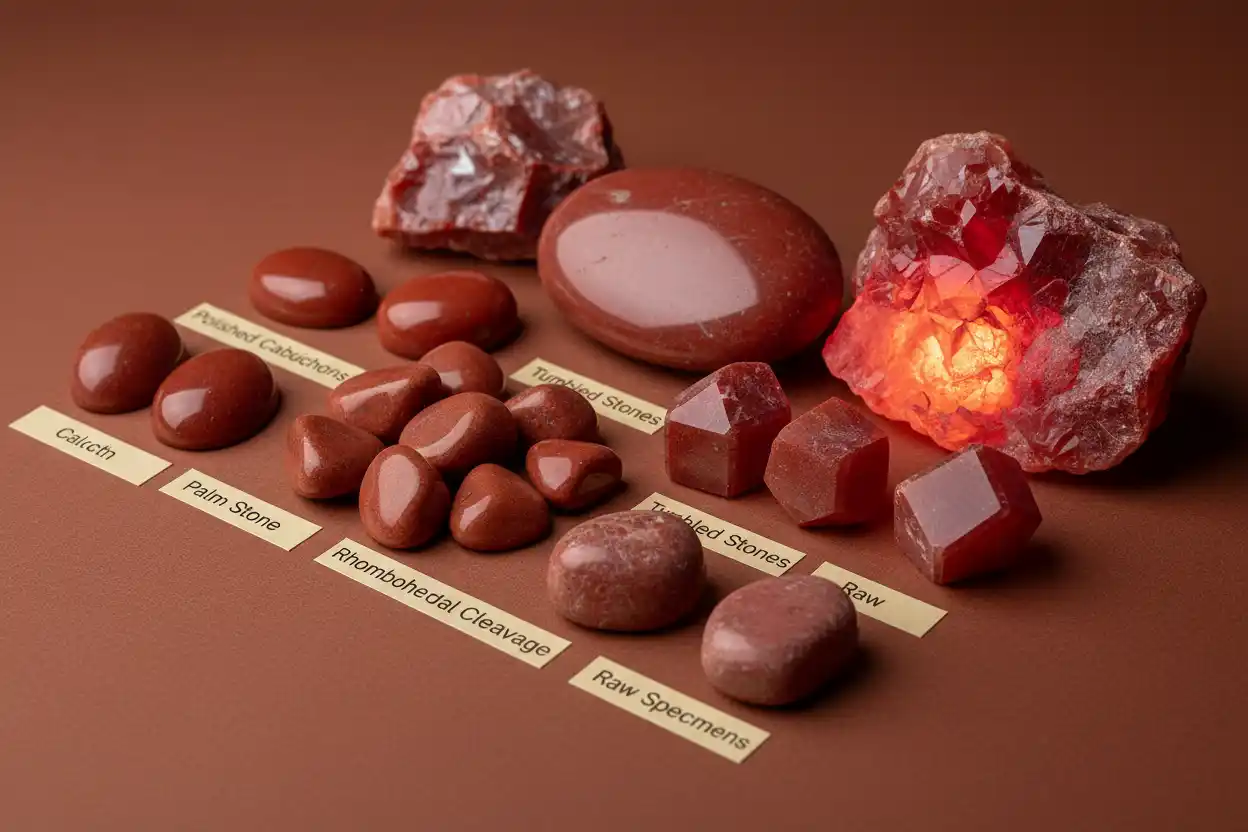
Red Calcite Meaning, Properties, Identification & Value
Red Calcite is a red, brick-red, rust, scarlet, orange-red, or reddish-brown variety of calcite, the calcium-carbonate mineral CaCO₃. Its color commonly comes from hematite inclusions, iron-rich clay, iron-oxide staining, or related mineral particles distributed through the crystals or massive material.
The name is commercial rather than a separate mineral species. Moreover, it is applied inconsistently to hematite-rich calcite, dark Orange Calcite, pink manganese-bearing calcite, dyed carbonate, and banded decorative stone.
Red Calcite at a Glance
| Property | Red Calcite |
|---|---|
| Material type | Red color variety of calcite |
| Composition | Calcium carbonate, CaCO₃, with iron-rich or other color-producing inclusions |
| Traditional variety name | Hematoconite for blood-red calcite colored by hematite |
| Common colors | Brick red, rust, scarlet, red-orange, brown-red, pink-red, and white-red |
| Crystal system | Trigonal |
| Typical habit | Rhombohedral, scalenohedral, prismatic, tabular, fibrous, stalactitic, massive, and banded |
| Luster | Vitreous to pearly |
| Transparency | Transparent to opaque |
| Mohs hardness | 3 |
| Cleavage | Perfect rhombohedral cleavage in three directions |
| Tenacity | Brittle |
| Fracture | Conchoidal to uneven outside cleavage |
| Specific gravity | Approximately 2.71 |
| Optical character | Uniaxial negative with very strong birefringence |
| Common uses | Mineral specimens, cabochons, carvings, spheres, palm stones, beads, inlay, and low-impact decorative jewelry |
| Main care concern | Scratches, cleavage, acid etching, dye, resin, prolonged water contact, and mixed-mineral inclusions |
Red Calcite within the Calcite Family
Red Calcite remains ordinary calcite structurally and chemically.
The parent Calcite guide owns the mineral’s general formation, widespread geological role, optical properties, and family-level symbolism.
The guide to types of Calcite separates blue, green, orange, honey, white, manganese-bearing, cobalt-bearing, optical, banded, and other commercial varieties.
Meanwhile, Calcite color meaning owns broad symbolism by hue.
This page focuses narrowly on red coloration, iron-rich inclusions, identity risks, lookalikes, durability, and buying.
What Creates Red Calcite’s Color?
Hematite is the most important red color source.
Fine Fe₂O₃ particles can become trapped while Calcite grows, producing red clouds, phantoms, zones, coatings, and nearly opaque crystals.
Mineralogical references use hematoconite for blood-red Calcite colored by hematite inclusions.
Iron-rich mud or clay can also become enclosed within Calcite. Such material may appear brick red, rust, brown-red, or red-gray.
Goethite and other iron oxyhydroxides contribute yellow-brown and orange tones.
Manganese can produce pink-to-red coloration in some Calcites, although manganese-dominant pale-pink material belongs more naturally within the Mangano Calcite market.
Cobalt creates vivid pink, magenta, and purplish-red Cobaltocalcite.
Therefore, color alone cannot identify the element responsible.
Hematite-Included Calcite
Hematite may occur as microscopic particles, thin red plates, surface coatings, phantoms, or separate crystals within Calcite.
Transparent crystals can show red internal zoning while retaining strong vitreous luster.
Opaque massive material may contain so much iron-rich matter that the white calcite host becomes difficult to recognize.
Some specimens have a clear later generation of Calcite growing over an earlier hematite-rich core.
Others show red hematite concentrated on one face because changing fluids introduced iron during a specific growth stage.
The inclusion pattern can provide more scientific and collector interest than a uniformly red polished stone.
Hematite remains a separate iron-oxide mineral even when it supplies Calcite’s bodycolor.
How Red Calcite Forms
Calcite occurs in sedimentary, hydrothermal, metamorphic, cave, and biological environments.
In hydrothermal veins, calcium-carbonate-bearing fluids enter fractures and deposit Calcite as temperature, pressure, and chemistry change.
Iron-bearing particles or fluids can arrive during the same stage, producing red crystals.
Sedimentary and cave deposits may incorporate red clay, iron oxides, and weathering products.
Metamorphism recrystallizes limestone into marble and can redistribute iron-rich minerals into red or brown bands.
Oxidized ore deposits frequently contain Calcite with hematite, goethite, sulfides, fluorite, barite, quartz, and other minerals.
Repeated growth creates clear outer crystals, red phantoms, white bands, and contrasting mineral layers.
Crystal Forms and Double Refraction
Calcite forms more crystal shapes than almost any common mineral.
Red specimens may occur as pointed scalenohedra, commonly called dogtooth Calcite, or as rhombohedra, plates, prisms, and complex twins.
Its perfect rhombohedral cleavage can break any crystal into fragments bounded by sloping faces.
Transparent Calcite displays very strong double refraction. Text viewed through a clear cleavage piece appears doubled because light splits into two rays.
Iron-rich inclusions can obscure that effect but do not remove Calcite’s underlying birefringence.
The optical behavior provides a useful distinction from glass, Jasper, and many red quartz materials.
Red Calcite and Orange Calcite
Orange Calcite lies on a continuous commercial color boundary with Red Calcite.
An orange-red stone may be sold under either name according to lighting, market preference, and digital image editing.
Orange material commonly contains iron oxides, clay, or other impurities similar to those found in red material.
No internationally standardized hue boundary separates them.
A precise description should state brick red, red-orange, salmon, rust, or another visible color rather than relying only on the variety name.
Red Calcite and Mangano Calcite
Mangano Calcite contains meaningful manganese substituting for calcium.
It is usually pale pink, rose, peach-pink, or cream-pink and commonly fluoresces orange-red or pink beneath ultraviolet light.
Red Calcite is more often associated with hematite, iron-rich inclusions, and stronger brick or rust tones.
However, the categories can overlap when manganese-rich material is strongly colored or when a mixed stone contains both manganese and iron.
Chemical analysis and fluorescence can provide useful evidence, but neither color nor glow alone supplies a complete identification.
Red Calcite and Cobaltocalcite
Cobaltocalcite contains cobalt substituting into the Calcite structure.
It commonly displays vivid pink, magenta, fuchsia, rose red, or purple-red colors.
Fine specimens often form sparkling crystal crusts or rhombohedra on matrix.
Red Calcite tends to show warmer brick, rust, orange-red, and brown-red colors caused by iron-rich inclusions.
Cobalt-bearing material can command much higher collector prices. Therefore, an intense magenta specimen should not be sold as rare Cobaltocalcite without analysis.
Red Calcite versus Rhodochrosite
Rhodochrosite is manganese carbonate, MnCO₃.
It commonly displays pink, red, white-banded, or raspberry colors.
Both minerals belong to the trigonal carbonate family and have perfect cleavage.
Rhodochrosite is typically denser and slightly harder, while its refractive properties and chemical composition differ.
Fine transparent Rhodochrosite has a much higher gem value than ordinary Red Calcite.
Laboratory testing is appropriate when a transparent red carbonate is offered at a premium price.
Red Calcite versus Red Jasper
Red Jasper is quartz rich and approximately twice as hard as Calcite on the Mohs scale.
It does not have Calcite’s perfect rhombohedral cleavage or strong double refraction.
Calcite reacts readily with acid, whereas Jasper is much more resistant.
Both can appear opaque brick red and accept a polish.
Because acid testing damages a finished stone, identification should rely on hardness, density, optical behavior, magnification, and spectroscopy.
Important Localities
Mexico supplies hematite-included Calcite from several ore districts, including the Santa Eulalia region of Chihuahua.
China has produced transparent and opaque Calcite with red hematite phantoms and inclusions from Hunan, Hubei, Inner Mongolia, and other mining regions.
India supplies hematite-rich Calcite clusters and mixed zeolite-associated specimens.
Pakistan produces red-stained, iron-included, and mineral-associated Calcite from hydrothermal and alpine-type deposits.
Peru, Romania, Morocco, the United States, Spain, and numerous additional countries also yield red Calcite.
A country label does not define one specific variety. Collector value depends more strongly on exact mine, crystal form, inclusion pattern, and provenance.
How to Identify Red Calcite
Calcite’s hardness of 3 means a copper coin or steel object can scratch it, although a finished stone should not be tested destructively.
Perfect rhombohedral cleavage produces repeated sloping planes.
Transparent areas may show obvious double refraction.
Specific gravity is near 2.71.
A drop of dilute acid causes vigorous effervescence, but acid permanently etches the stone and should only be used by professionals on an unimportant sample.
Magnification may reveal hematite particles, iron-rich clay, cleavage cracks, dye concentrations, resin, and surface coatings.
Raman spectroscopy confirms Calcite and can identify exposed hematite or other inclusions.
X-ray diffraction and chemical analysis distinguish it from Rhodochrosite, Dolomite, Aragonite, Jasper, and glass.
The non-destructive workflow appears in how to identify crystals.
Treatments and Imitations
Pale Calcite accepts dye readily, especially when fractures and porous zones reach the surface.
Red pigment can concentrate inside cleavage cracks, drill holes, pits, and band boundaries.
Clear resin stabilizes fractured carvings and may improve apparent transparency.
Wax and oil deepen color temporarily.
Coatings create stronger gloss but can scratch, peel, or react with cleaning products.
Acid polishing can smooth industrial Calcite surfaces but changes their texture and may reduce natural detail.
Dyed marble, banded Calcite, Aragonite, resin, ceramic, glass, Red Jasper, and reconstructed carbonate can all be sold as Red Calcite.
Treatment definitions appear in gemstone treatments explained, while fraud indicators appear in how to spot fake crystals.
Durability and Jewelry Suitability
Calcite defines hardness 3 on the Mohs scale.
Its position appears on the gemstone hardness chart.
Quartz dust, metal objects, harder gemstones, and abrasive cloths can scratch it.
Perfect cleavage creates a substantial breakage risk.
The difference between softness and structural toughness appears in gemstone toughness versus hardness.
Pendants, earrings, brooches, bolo ties, and protected decorative cabochons offer safer use than rings.
An occasional-wear ring requires a low bezel and careful habits.
Bracelets expose the stone to repeated impact, perspiration, and contact with desks or walls.
Collector crystals should remain unmounted when the natural form carries greater value than the jewelry use.
Current Red Calcite Asking Prices
Most Red Calcite is affordable, although fine hematite-included crystal specimens can command collector premiums.
| Red Calcite product | Broad July 2026 retail asking range |
|---|---|
| Small rough or tumbled piece | About $2–$10 |
| Palm stone | About $8–$30 |
| Standard cabochon | About $5–$25 |
| Large or strongly patterned cabochon | About $20–$75 |
| Small crystal specimen | About $10–$75 |
| Attractive hematite-included miniature | About $50–$250 |
| Fine cabinet specimen | About $200–$1,000 or more |
| Sphere or carving | About $20–$150 |
| Sterling-silver jewelry | About $30–$200 |
| Large architectural or decorative piece | Determined by size, fabrication, treatment, and craftsmanship |
These are broad asking ranges rather than appraisals or expected resale prices.
Current specialist listings include small red hematite-included specimens below $100 and more aesthetic crystal groups above $200.
What Gives Red Calcite Value?
Natural color is the first factor.
Fine specimens show clearly internal hematite color rather than a flat surface dye.
Crystal form strongly affects collector value. Sharp rhombohedra, scalenohedra, twins, phantoms, and transparent red zones attract more interest.
Contrast against white Calcite, Quartz, barite, or dark matrix can improve aesthetics.
For polished material, even color, pattern, carving quality, and smooth finish matter.
Structural condition remains essential because cleavage cracks can expand.
Exact locality, associated minerals, fluorescence, treatment disclosure, and collection history complete the valuation.
Buying Red Calcite
Ask whether the color comes from hematite inclusions, manganese, cobalt, clay, surface staining, or dye.
Request photographs in neutral lighting and magnified views of fractures and drill holes.
Determine whether the product is crystalline Calcite, massive banded material, marble, or another carbonate.
An intense pink or magenta specimen may belong to Mangano Calcite or Cobaltocalcite rather than ordinary iron-rich Red Calcite.
Check for resin, glue, coating, wax, and repaired crystal groups.
Generic seller and authenticity checks belong on where to buy real Calcite.
Red Calcite appears in the red-crystal directory and red-gemstone directory.
It is also indexed through the crystals beginning with R directory and the gemstones beginning with R directory.
Cleaning and Storage
Remove dust with a very soft brush or dry microfiber cloth.
For a stable polished piece, use lukewarm water, mild soap, and minimal pressure.
Rinse briefly and dry it immediately.
Do not soak Calcite. Water can enter cleavage fractures, affect dye or filler, and weaken glued matrix.
The wider context appears in which crystals can and cannot go in water.
Avoid vinegar, lemon juice, acid cleaners, bleach, ammonia, ultrasonic cleaning, and steam.
Store Red Calcite separately from nearly every mainstream jewelry stone because most are harder.
Wrap fragile specimens so no pressure rests on exposed crystal points.
Red Calcite Meaning and Symbolism
Modern crystal traditions associate Red Calcite with steady motivation, practical courage, physical awareness, and turning strong emotion into deliberate action.
Its perfect cleavage can symbolize the need to understand hidden structural weaknesses rather than judging strength from appearance alone.
Hematite inclusions add themes of persistence, material reality, and visible evidence of changing mineral conditions.
Transparent red phantoms can represent earlier stages remaining preserved within later growth.
These meanings remain personal, artistic, cultural, or spiritual interpretations. Scientific evidence does not show that Red Calcite treats blood disorders, improves circulation, increases physical energy, or guarantees confidence.
Frequently Asked Questions
Is Red Calcite a separate mineral species?
No. It is a red color variety of Calcite, CaCO₃.
What causes Red Calcite’s color?
Hematite inclusions, iron-rich clay, iron-oxide staining, goethite, manganese, or other impurities can contribute.
What is hematoconite?
Hematoconite is a traditional name for blood-red Calcite colored by hematite inclusions.
Is Red Calcite the same as Orange Calcite?
Not always, although the commercial color boundary overlaps and no standardized hue line separates them.
Is Red Calcite the same as Mangano Calcite?
No. Mangano Calcite is manganese bearing and commonly pale pink or peach, while Red Calcite is often iron or hematite rich.
Is Red Calcite the same as Cobaltocalcite?
No. Cobaltocalcite contains cobalt and commonly displays brighter magenta, fuchsia, or purple-red color.
How does Red Calcite differ from Rhodochrosite?
Rhodochrosite is manganese carbonate, is generally denser, and follows a different mineral and gem market.
How does Red Calcite differ from Red Jasper?
Calcite is much softer, cleaves perfectly, and displays strong double refraction. Jasper is quartz rich and harder.
Does Red Calcite fluoresce?
Some specimens fluoresce because of manganese or other activators, while others remain weak or inert.
Is Red Calcite suitable for rings?
Only for protected occasional wear. Its low hardness and perfect cleavage make pendants and earrings safer.
Can Red Calcite go in water?
Brief gentle washing can suit a stable untreated piece, but soaking is not recommended.
What makes Red Calcite valuable?
Natural internal color, crystal form, transparency, hematite phantoms, associated minerals, condition, locality, fluorescence, treatment disclosure, and craftsmanship determine value.
Red Calcite is most accurately identified by separating its calcium-carbonate host from the minerals creating its red appearance. That distinction prevents hematite-rich Calcite, manganese-bearing pink Calcite, Cobaltocalcite, dyed carbonate, and Red Jasper from being treated as interchangeable products.
Calcite itself has relatively low toxicity, but Red Calcite can contain iron minerals, manganese, pigments, fillers, or unidentified matrix components. Do not ingest it or use it in drinking-water preparations. Cutting and grinding require wet methods, effective extraction, eye protection, and suitable respiratory protection.