Where to Buy Real Kambaba Jasper and Avoid Dyed or Misnamed Fakes
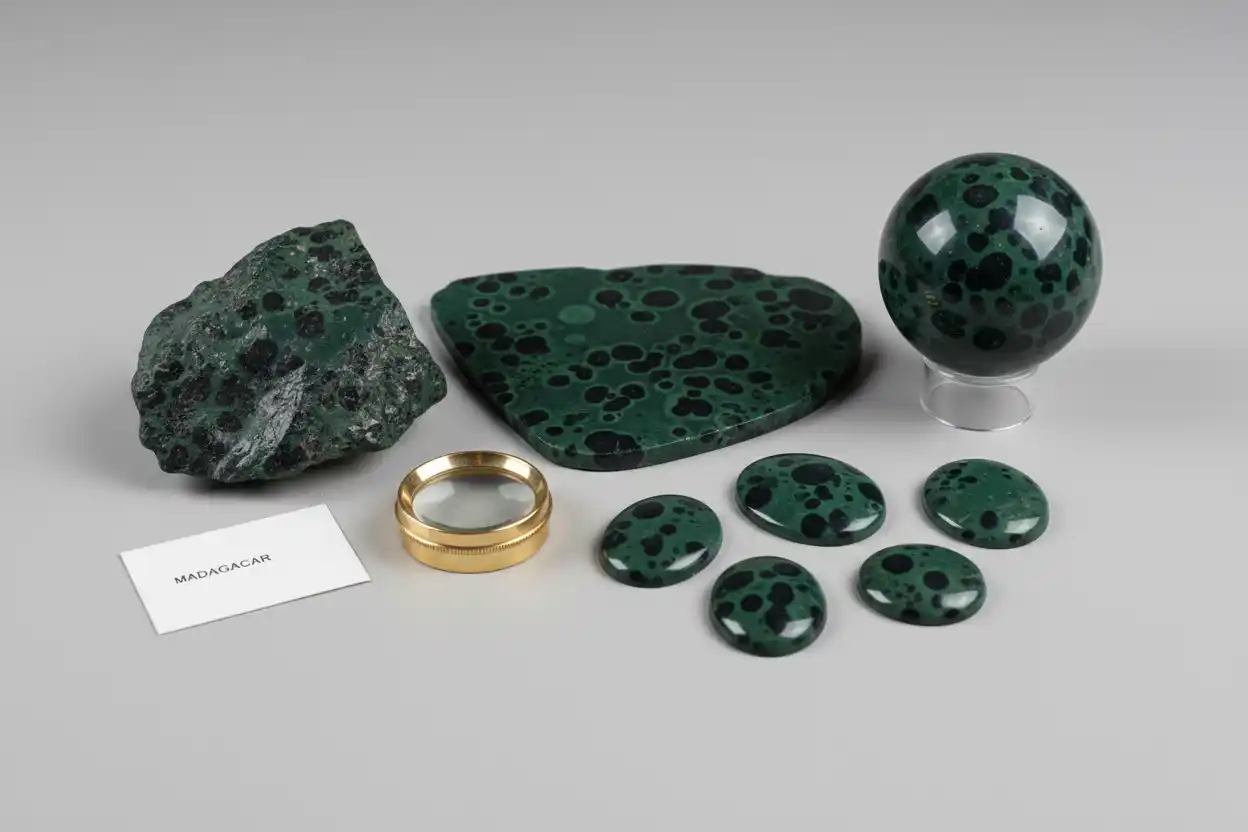
Real Kambaba Jasper is a Madagascan decorative stone recognized by dark green, gray-green and black orbicular or swirling patterns. It is also sold as Crocodile Jasper, Crocodile Stone and Kambaba Stone.
Despite the familiar name, its exact geological classification has been repeatedly misrepresented. Many retailers call it a fossil stromatolite or fossilized algae without providing petrographic evidence. Other analyses and mineral-trade reports describe commercially sold Kambaba material as an orbicular volcanic rock rather than true Jasper or a microbial fossil.
For buyers, the safest approach is to treat Kambaba Jasper as an established trade name for a green-and-black Madagascan lapidary rock. A seller should not charge a fossil premium unless the specific material has credible geological documentation.
The Kambaba Jasper meaning and properties guide covers its trade identity and traditional symbolism. This buying guide focuses on provenance, pattern quality, misleading stromatolite claims, treatment, lookalikes and finished-product construction.
Kambaba Jasper Is a Trade Name
The word Jasper conventionally refers to opaque, impurity-rich microcrystalline silica or a closely related silica-rich rock.
However, many commercial “Jaspers” are rhyolite, radiolarite, feldspar-rich rock, metamorphic material or other decorative stones. The completed general Jasper buying guide explains that broad trade usage.
Kambaba Jasper belongs in this trade-name category. Its commercial identity is based primarily on:
- Madagascan provenance
- Green to gray-green groundmass
- Black or very dark rounded patterns
- Swirling, orbicular or eye-like structures
- Suitability for polishing and carving
A responsible listing can retain the familiar name while stating that the stone may not meet a strict mineralogical definition of Jasper.
The Jasper meaning guide and types of Jasper guide provide the wider family context.
The Stromatolite Claim Requires Caution
Stromatolites are layered sedimentary structures formed through interactions between microbial communities and sediment.
Kambaba Jasper is frequently marketed as a fossil stromatolite, sometimes with claims that its black circles represent ancient algae colonies.
The orbicular appearance alone does not prove a biological origin. Volcanic and metamorphic rocks can also develop rounded, radiating or spherulitic structures.
Public summaries of mineralogical work on Kambaba-like material have described quartz, alkali feldspar, pyroxene and amphibole components consistent with an altered volcanic rock. Meanwhile, confusingly similar Madagascan trade names and different orbicular stones have complicated the available reports.
Therefore, sellers should avoid absolute statements such as:
- “This is definitely fossilized algae”
- “Every black orb is a microbial colony”
- “Kambaba Jasper is one of Earth’s oldest fossils”
- “The stone proves a specific prehistoric age”
Unless a piece carries credible petrographic and locality documentation, describe the pattern rather than inventing its paleontology.
Choose the Product Form First
| Product form | Best source | Main buying concern |
|---|---|---|
| Natural rough | Madagascan material specialist or lapidary supplier | Provenance, pattern depth and fractures |
| Slab | Lapidary supplier | Orb continuity, resin, dye and usable yield |
| Cabochon | Independent cutter | Pattern placement, polish, backing and filler |
| Tumbled stone | Reputable crystal retailer | Generic green stone or dyed Jasper substitution |
| Bead strand | Established bead supplier | Resin, dye, mixed rocks and drill-hole damage |
| Sphere | Experienced lapidary retailer | Pattern coverage, filled fractures and assembly |
| Tower | Stone retailer with exact-item video | Carved point, repaired tip and misleading crystal language |
| Carving | Skilled lapidary seller | Composite construction, coating and weak seams |
| Jewelry | Jeweler with treatment disclosure | Backing, glue and whether the exact stone will ship |
| Locality specimen | Dealer with Madagascan supply records | Unsupported mine or stromatolite claims |
Because pattern controls much of the value, exact-item photographs are essential for polished products.
Where to Buy Genuine Kambaba Jasper
Specialist lapidary suppliers
A reliable lapidary supplier should show rough surfaces, sawn faces, slabs and sample finished stones from the same parcel.
Request dry photographs. Water and oil deepen green tones, increase contrast and conceal scratches.
Ask whether dark orbs continue through the rough. A strong surface pattern may become weaker after cutting.
The supplier should also disclose fractures, soft seams and resin. Multi-mineral rock may polish unevenly where components differ in hardness or texture.
Gem and mineral shows
Shows let you compare Kambaba Jasper with Ocean Jasper, Rhyolite, green Marble, Serpentine and dyed rock.
Use a loupe to inspect pattern boundaries, grain texture, filler and coatings. Natural orbicular structures should enter the rock rather than sit as paint or print on one surface.
Rotate spheres and towers completely. The finest pattern may appear only on the photographed face.
Do not scratch or apply chemicals. The crystal identification guide explains why complex rocks require more than one home test.
Established online sellers
The online gemstone buying guide covers seller identity, protected payment methods and returns.
Ask the seller to state the country of origin, treatment and geological basis for any fossil claim.
Request neutral-light images and a continuous rotation. Digital saturation can transform muted gray-green material into intense emerald green.
A seller who repeats a stromatolite description copied from wholesalers but cannot discuss the material’s rock composition is not offering meaningful provenance.
Independent cutters
A lapidary who selected and cut the rough may understand its fractures, polishing behavior and pattern depth.
Ask to see the original slab or rough. Those photographs help confirm that the orbicular pattern belongs to the stone rather than a coating.
For custom jewelry, request front, back and edge views before setting.
What Genuine Kambaba Jasper Looks Like
Commercial Kambaba Jasper usually has a green, gray-green, blue-green or almost black groundmass.
Its darker patterns can form circles, incomplete orbs, eyes, swirls, rings, irregular spots and connected cloud-like shapes.
Some pieces show broad black areas with smaller green circles. Others have a lighter green body crossed by dark overlapping orbs.
Natural pattern density varies. A mostly green stone with one partial orb can be genuine, though it should not receive the same pattern premium as a balanced multi-orb cabochon.
The pattern should change through the stone. When a slab is turned over, orbs may shift in size and position because they represent cross-sections through three-dimensional structures.
A completely flat printed design or identical pattern across several beads deserves scrutiny.
Kambaba Jasper Versus Ocean Jasper
Ocean Jasper is another Madagascan orbicular trade material, but it occupies a different geological and commercial market.
Ocean Jasper commonly shows broader color diversity, including white, cream, yellow, red, pink, green and brown. It may contain distinct Chalcedony orbs, bands and druzy cavities.
Kambaba Jasper is usually dominated by dark green and black.
The Orbicular Jasper guide explains the general orb-pattern category. Not every orbicular Madagascan stone should be labeled Ocean Jasper, and not every green orbicular stone is Kambaba.
Source records and overall texture matter more than the presence of circles alone.
Kambaba Jasper Versus Rhyolite
Rhyolite is a silica-rich volcanic rock. Some geological descriptions of Kambaba material place it within or near an altered orbicular rhyolitic composition.
Rhyolite can develop spherulites and other rounded patterns during cooling and alteration. Those structures can resemble organic fossils despite forming through inorganic geological processes.
A seller may use “Kambaba Rhyolite” as a cautious descriptive phrase. However, exact rock classification requires petrographic work rather than visual inspection alone.
Kambaba Jasper Versus Nebula Stone
Nebula Stone is another green-and-black orbicular trade material often associated with Mexico.
Commercial descriptions frequently contrast the two by pattern orientation: Kambaba commonly shows dark orbs within a greener background, while Nebula Stone may show green orbs within a darker groundmass.
However, retail batches vary, and naming can become confused before material reaches the final seller.
A buyer should prioritize documented origin rather than trying to identify the trade name from color reversal alone.
Kambaba Jasper Versus Green Marble
Green Marble, Serpentine-bearing rock and other decorative stones can show pale veins or dark spots.
Marble is carbonate-rich and may reveal crystalline texture, while Kambaba material generally has a more silicate-rich polish and orbicular structure.
The seller should not use an acid test on a finished product. Raman spectroscopy, X-ray diffraction or petrographic analysis provides safer classification.
Kambaba Jasper Versus Serpentine
Serpentine occurs in many green shades and is commonly carved.
It may show mottling, black inclusions and veining but usually lacks Kambaba’s characteristic repeated dark orbicular structures.
Serpentine is generally softer and may have a waxier texture. Nevertheless, a polished sphere can remain difficult to classify from a photograph.
Kambaba Jasper Versus K2 Stone
K2 Stone is a pale granite-like rock marked by blue Azurite-related spots.
Both are trade-named patterned rocks, but their color, components and source histories are unrelated.
The comparison illustrates why spot or orb appearance should not be treated as proof of one mineral composition.
Natural Orbs Versus Printed Patterns
Genuine orbicular patterns occupy the rock’s interior. They may change shape across the front, edge and reverse.
A printed or painted pattern can sit over scratches, stop at the girdle or repeat exactly on several pieces.
Under magnification, paint may form a raised boundary or fill shallow surface depressions without continuing inward.
Do not scrape the design. Instead, inspect the edge and request images of unfinished rough.
Dyed Kambaba Jasper
Pale green or gray rock can be dyed to intensify Kambaba-like color.
Artificial color may concentrate in cracks, pits, grain boundaries and drill holes. A chipped edge may expose a lighter interior.
However, natural alteration can also create dark boundaries. Therefore, one colored fracture does not prove dye.
Ask for a written treatment statement and compare several pieces from the parcel. Unnaturally identical saturation may indicate processing.
The fake-crystal buyer’s guide provides broader guidance on dye, paint and manufactured patterns.
Resin and Reconstructed Material
Stone fragments or powder can be mixed with resin and molded into spheres, beads or carvings.
A composite may contain genuine Kambaba material but lacks the structure of one natural rock.
Bubbles, mold seams, repeated orbs and polymer-rich chips support reconstruction.
Resin can also fill fractures within solid natural rock. The seller should distinguish limited filling from a heavily bound composite.
The gemstone treatments guide explains coating, impregnation, filling and reconstruction.
Glass and Ceramic Imitations
Opaque glass or ceramic can reproduce green-and-black patterning.
Glass may show bubbles, flow textures and mold seams. Ceramic can reveal a uniform body beneath a printed or glazed design.
Both materials can be attractive decorative products, but they should not be represented as mined Madagascan stone.
How to Evaluate Rough
Ask for photographs of the natural exterior, a dry sawn face and every visible edge.
The most attractive dark orbs should continue through enough material to justify cutting. One patterned corner in a mostly plain block offers limited yield.
Inspect fractures crossing the desired pattern. A large block may split before producing a sphere or carving.
Ask whether test cabochons polished evenly and whether stabilization was necessary.
How to Evaluate Slabs
Compare both faces. The orbs should move and change naturally through the slab’s thickness.
A quality slab offers enough pattern for intentional cabochons. Dense dark areas can be useful, but an entirely black slab may lose the recognizable Kambaba appearance.
Inspect exposed edges for a straight glued seam or surface-only print.
Backlighting can reveal fractures, but ordinary reflected light is more important for evaluating the normal face-up color.
How to Judge Cabochons
A skilled cutter should frame the most complete orbs and use surrounding swirls to balance the shape.
The dome needs an even polish. Granular or multi-mineral areas may undercut, but broad pits or resin pools reduce quality.
Inspect the back for dye, filler, backing and pattern continuity.
A natural cavity may remain as a design feature, though it should not weaken the girdle.
Buying Beads and Bracelets
A natural strand should show related green-and-black material without repeating the same orb pattern.
Inspect drill holes for concentrated dye, resin and radial fractures. Pattern should continue into holes that cross dark structures.
Ask whether the strand consists entirely of Kambaba Jasper or includes green Serpentine, Rhyolite or other rocks selected for color.
Buying Spheres, Towers and Carvings
Request a complete rotation. One side may show several strong orbs while the opposite face remains nearly solid green or black.
A sphere should have no straight equatorial assembly seam.
Most towers are carved. The point did not grow naturally, even though the rock itself is natural.
Carvings should avoid thin projections crossing fractures. Deep recesses can conceal resin or polishing compound.
Buying Kambaba Jasper Jewelry
Sound polished material is generally suitable for pendants, earrings, bracelets and protected rings.
However, a trade-named rock can contain components with different hardness and fracture behavior.
The gemstone hardness chart offers general scratch-resistance context, while the gemstone toughness-versus-hardness guide explains why fractures and mixed mineral boundaries still matter.
A bezel protects cabochon edges better than widely spaced prongs.
Locality and Provenance
Commercial Kambaba Jasper is associated with Madagascar, particularly the central-western Bongolava region near Tsiroanomandidy.
A precise quarry or district claim needs invoices, exporter records or direct supplier documentation.
Madagascan origin does not prove stromatolite identity. Likewise, an orbicular green stone from another country should not receive the Kambaba name without a credible supply chain.
The ethical gemstone sourcing guide provides practical questions about extraction, cutting labor and traceability.
Price and Value
Kambaba Jasper is generally affordable. Value depends on pattern, natural color, contrast, usable size, structural stability, polish, treatment and provenance.
Balanced orbs and flowing dark structures usually command greater interest than weakly spotted material.
Large spheres and carvings cost more partly because of rough loss, labor and fracture risk.
A fossil or “ancient algae” story should not create a premium without evidence. Instead, pay for the actual pattern, craftsmanship and documented source.
The gemstone pricing guide explains how cutting yield, treatment and documentation influence retail prices.
Questions to Ask the Seller
Ask whether Kambaba Jasper is being used as a trade name and whether the seller has evidence for a volcanic, Jasper or stromatolite classification.
Request Madagascan provenance and the basis for that claim.
Confirm dye, resin, filling, coating, backing, wax, oil and reconstruction.
For rough and slabs, request dry front, reverse and edge photographs. For spheres and carvings, obtain a full rotation.
Ask whether the exact item pictured will ship. Finally, obtain a return policy that allows magnified inspection.
Professional Identification
Petrographic microscopy can reveal whether the material has volcanic, sedimentary or microcrystalline silica textures.
Raman spectroscopy and X-ray diffraction can identify major minerals, while chemical analysis helps distinguish feldspar, quartz, pyroxene and amphibole components.
Testing should sample the green groundmass and dark orbicular structures separately. One reading cannot describe a complex rock.
Demonstrating a true stromatolite requires sedimentological and paleontological evidence, not merely confirmation that the stone contains quartz.
Cleaning and Storage
Clean sound untreated material with lukewarm water, mild soap and a soft cloth.
Avoid prolonged soaking when dye, resin, filler or backing may be present. Do not use steam on heavily fractured or assembled objects.
Store polished pieces away from diamonds, sapphires and other harder stones.
The K crystal directory, K gemstone directory, green gemstones guide and visual gemstone guide provide wider comparisons.
Frequently Asked Questions
1. Is Kambaba Jasper real Jasper?
Kambaba Jasper is an established trade name, but publicly reported analyses often describe the material as a complex volcanic or altered rock rather than strict microcrystalline Jasper.
2. Is Kambaba Jasper a stromatolite?
The claim is widespread but not adequately established for every commercial piece. Orbicular patterns alone do not prove a fossil microbial origin.
3. Where does Kambaba Jasper come from?
Commercial material is associated with Madagascar, especially the Bongolava region near Tsiroanomandidy.
4. Is Crocodile Jasper the same as Kambaba Jasper?
Crocodile Jasper is a common trade-name synonym for Kambaba Jasper.
5. Is Kambaba Jasper the same as Ocean Jasper?
No. Both are Madagascan orbicular trade stones, but their appearance, source identity and geological descriptions differ.
6. Is Kambaba Jasper the same as Nebula Stone?
No. Nebula Stone is associated with a different commercial source and pattern description, although the materials are often confused.
7. Can Kambaba Jasper be dyed?
Yes. Green or black color can be intensified with dye, particularly along fractures and porous areas.
8. Can it contain resin?
Yes. Fractures can be filled, and fragments or powder may be reconstructed with polymer.
9. Do genuine pieces always have perfect circles?
No. Natural structures can be incomplete, distorted, overlapping or visible only as partial arcs.
10. Is Kambaba Jasper suitable for everyday jewelry?
Sound cabochons are generally wearable, though mixed composition, open fractures and filler should be considered.
11. Do ordinary pieces need laboratory reports?
Usually not. Testing is more useful for expensive geological claims, wholesale parcels or disputed fossil and treatment descriptions.
12. What is the biggest warning sign in a listing?
Be cautious when a seller charges a major fossil premium while providing no petrographic evidence, precise provenance or treatment disclosure.
Buy the Pattern Without Buying an Unsupported Fossil Story
Kambaba Jasper can be an attractive natural lapidary rock without being marketed as fossilized algae. Its value rests on the green-and-black pattern, polish, structural quality and Madagascan provenance.
Choose a seller who separates established trade terminology from geological certainty and shows enough of the stone to prove that its orbs continue beyond one display face.
Safety note: Kambaba Jasper is a silica-rich multi-mineral rock. Cutting, drilling, sanding or grinding may produce hazardous mineral dust. Never dry-work unidentified lapidary rock; use wet methods, effective local extraction and suitable eye and respiratory protection.