Oregon Sunstone Meaning, Properties, Color & Value
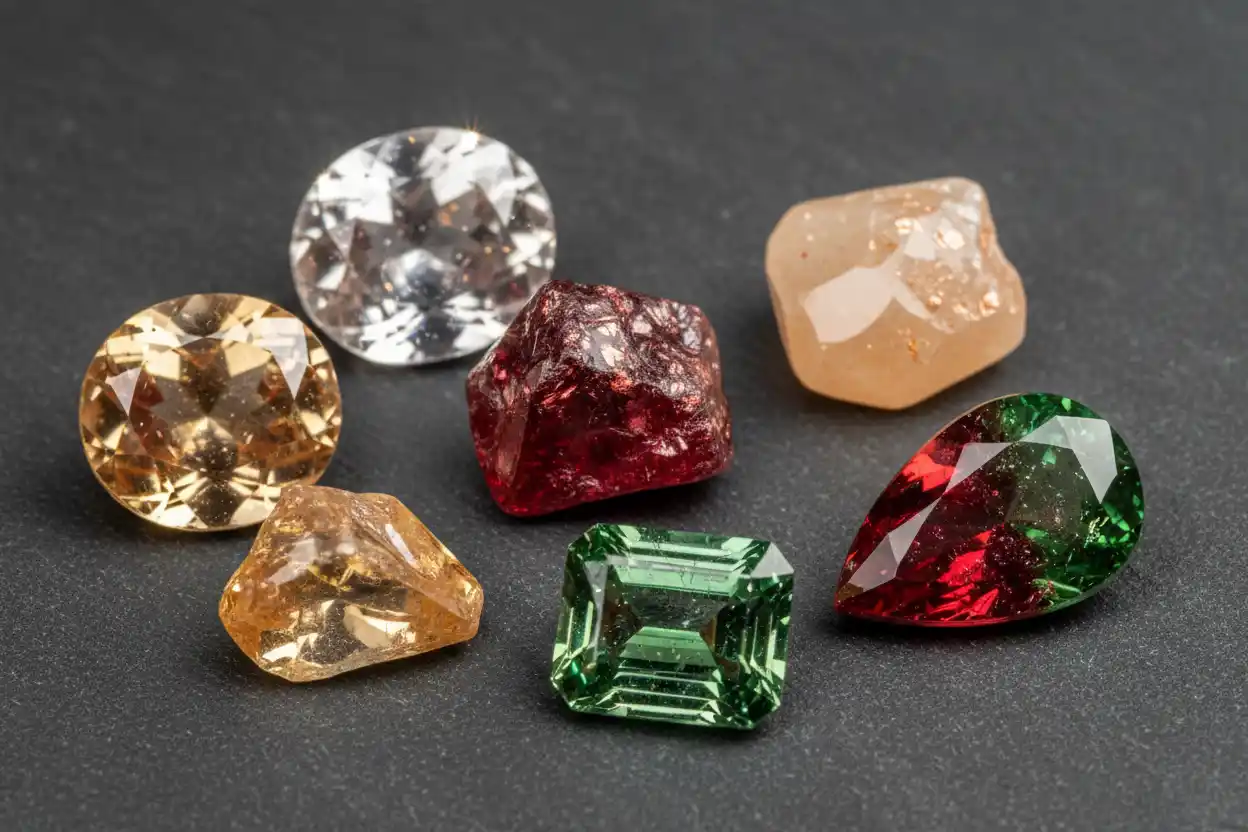
Oregon Sunstone is natural copper-bearing plagioclase feldspar mined from basalt deposits in southeastern Oregon. It can be colorless, pale yellow, champagne, peach, orange, pink, red, green, teal, or red-green bicolor, with some stones displaying reflective copper platelets known as schiller.
Unlike sunstones from many other sources, Oregon material is valued for naturally occurring copper-related color and inclusions. Its identity belongs within the labradorite portion of the plagioclase feldspar series rather than representing a separate mineral species.
Oregon Sunstone at a Glance
| Property | Oregon Sunstone |
|---|---|
| Material type | Natural copper-bearing plagioclase feldspar gemstone |
| Mineral classification | Labradorite-range plagioclase |
| General composition | Solid solution between albite and anorthite, commonly calcium-rich labradorite |
| Common colors | Colorless, yellow, champagne, peach, orange, pink, red, green, teal, and bicolor |
| Optical effects | Aventurescence, copper schiller, color zoning, pleochroism, and occasional directional color contrast |
| Crystal system | Triclinic |
| Typical habit | Blocky feldspar crystals and crystal fragments within basalt |
| Luster | Vitreous |
| Transparency | Transparent to translucent |
| Mohs hardness | Approximately 6–7 |
| Cleavage | Two strong directions meeting near right angles |
| Tenacity | Brittle |
| Specific gravity | Commonly around 2.69–2.72 |
| Common uses | Faceted gems, cabochons, carvings, beads, engagement rings, earrings, pendants, and collector specimens |
| Main care concern | Cleavage chipping, surface abrasion, fractures, undisclosed filling, and unsupported origin claims |
Oregon Sunstone within the Feldspar Family
Oregon Sunstone belongs to the feldspar family, a large group of rock-forming aluminosilicate minerals.
More specifically, it lies within plagioclase, the continuous sodium-calcium series extending from albite to anorthite.
Most studied Oregon gem material falls within labradorite composition. Therefore, it is related to labradorite even when it lacks the broad blue-green labradorescence associated with decorative Canadian or Madagascan labradorite.
The sunstone name describes its color and reflective inclusions rather than a unique mineral structure. Sunstone from other localities may consist of oligoclase, labradorite, or potassium feldspar.
The parent sunstone guide owns the wider family and symbolism. Oregon Sunstone requires separate coverage because copper, American origin, color zoning, mining, and value create a distinct market.
Why Oregon Sunstone Is Different
Aventurescence in many conventional sunstones comes from hematite, goethite, or related reflective inclusions.
Oregon Sunstone is distinguished by native copper particles and platelets. These inclusions can create glittering red, gold, or copper-colored reflections.
Copper also contributes to bodycolor. Its form, concentration, particle size, and distribution influence whether a stone appears pale yellow, peach, red, green, or bicolored.
Some crystals contain almost no visible schiller yet display valuable red, green, or teal bodycolor. Others remain pale or colorless but contain dense reflective copper platelets.
Therefore, Oregon Sunstone should not be judged solely by the amount of glitter. Fine transparent color without schiller can be more valuable than heavily included material.
Geological Formation
Oregon Sunstone occurs as feldspar crystals within basaltic lava flows of Lake County in southeastern Oregon.
The host basalts belong to a volcanic province that erupted during the Miocene. Feldspar crystallized within magma before or during the emplacement of the lava.
Copper was incorporated into the feldspar or precipitated as microscopic particles during cooling and later internal re-equilibration.
Weathering gradually exposed crystals and released them from the basalt. Some occur loose in soil or shallow deposits, while others remain embedded in hard volcanic rock.
Mining ranges from surface collection and shallow excavation to mechanized removal of gem-bearing basalt and weathered material.
The restricted geological setting makes verified Oregon origin meaningful. However, a red or copper-bearing feldspar should still receive testing rather than being assigned an Oregon locality from appearance alone.
Lake County Mining Districts
The principal deposits lie in Lake County near Plush, Rabbit Basin, and the broader Oregon Sunstone Public Collection Area.
Commercially recognized sources include the Ponderosa, Dust Devil, Sunstone Butte, Spectrum or PANA, and Double Eagle operations, among others.
Each deposit can produce colorless, pale, schiller-bearing, red, green, and bicolored material in different proportions.
Mine names can add traceability and collector interest, especially when rough and finished gems remain connected to a documented parcel.
Nevertheless, one mine should not be assigned a universal color. Variation occurs within each basalt flow, crystal, and piece of rough.
Oregon designated sunstone as its official state gemstone in 1987, strengthening its regional identity and public recognition.
Oregon Sunstone Colors
Colorless and pale-yellow stones are the most abundant commercial material. They may contain little visible copper or show a subtle warm glow.
Champagne and peach stones combine yellow, pink, orange, and brown components. These colors often provide an affordable entry point into Oregon-origin material.
Orange and pink can become more saturated as copper-related absorption increases.
Fine red is among the most sought-after colors. The best stones show strong saturation without excessive brown or dark extinction.
Green and teal are less common. They may occur as isolated zones, central cores, or opposing areas within bicolored crystals.
Red-green bicolor stones are especially distinctive. Depending on orientation, one facet may appear red while another looks green or yellow-green.
The dedicated types of sunstone guide owns the broader comparison among Oregon, Indian, Norwegian, Tanzanian, and other material.
Copper Schiller and Aventurescence
Schiller consists of reflective copper platelets oriented along internal crystallographic planes.
When light strikes them at the correct angle, the inclusions flash red, copper, gold, or bronze.
Fine particles create a soft haze or reddish cloud. Larger platelets can produce obvious glitter or broad metallic reflections.
The visual effect is directional. A stone that looks highly aventurescent from one angle may appear transparent from another.
Cutters must orient rough deliberately. A cabochon may emphasize a broad reflective sheet, while a faceted stone can balance bodycolor with smaller flashes.
Too many inclusions can reduce transparency and darken the stone. Therefore, more schiller does not automatically mean higher value.
Pleochroism and Directional Color
Oregon Sunstone can show strong directional color differences. A crystal may appear red in one direction and green or pale yellow in another.
This effect involves the interaction of copper particles, absorption, scattering, and crystal orientation.
Faceting becomes unusually demanding because every pavilion and crown direction affects the visible balance of color.
A cutter may orient a stone for maximum red, preserve a red-green split, or deliberately create contrasting facets.
Poor orientation can produce grayness, uneven extinction, or a face-up color weaker than the rough suggested.
Videos in several lighting directions are therefore more informative than one still photograph.
Oregon Sunstone and Oligoclase Sunstone
Oligoclase can contain hematite or other reflective inclusions and may also be marketed as sunstone.
Classic Norwegian and some Indian sunstones lie within oligoclase composition. Their aventurescence commonly results from iron-rich platelets rather than native copper.
Oregon material is usually more calcium-rich and falls within labradorite.
The two can overlap in orange, peach, or glittering appearance. Gemological measurements and inclusion analysis provide a stronger distinction than color alone.
Origin should not be assigned merely because a stone contains copper-colored glitter. Laboratory testing and reliable mine documentation remain important.
Oregon Sunstone and Labradorite
Oregon Sunstone is a labradorite-range feldspar but normally does not display the broad blue sheet-like labradorescence associated with conventional decorative labradorite.
Instead, its distinctive effects involve copper bodycolor, aventurescence, zoning, and directional color.
Both materials share moderate hardness and feldspar cleavage. Their jewelry-care requirements therefore overlap.
The labradorite-versus-moonstone guide explains related feldspar optics without merging Oregon Sunstone with either conventional labradorite or moonstone.
Identification
Oregon Sunstone has the refractive index, birefringence, density, twinning, and cleavage expected from labradorite-range plagioclase.
Microscopy may reveal copper platelets, reddish particle clouds, color zones, healed fractures, and feldspar twinning.
Native copper inclusions can provide strong evidence, but they do not by themselves establish geographic origin because treated or differently sourced feldspars require consideration.
A laboratory may use refractive-index testing, spectroscopy, chemical analysis, microscopy, and trace-element comparison.
Expensive red, green, teal, or bicolored stones benefit from independent identification and origin assessment.
The general procedures in how to identify crystals provide the correct sequence of visual, physical, and laboratory observations.
Natural Color and Treatment Concerns
Natural Oregon Sunstone is valued as an untreated product whose copper-related color developed geologically.
Routine heating or irradiation is not required to create its recognized red, green, peach, or schiller-bearing appearance.
However, copper diffusion has been used experimentally and commercially to alter feldspar. Treated stones can potentially imitate aspects of naturally copper-bearing material.
Fracture filling is uncommon but possible. A filler may improve apparent clarity or stabilize surface-reaching cracks.
Coatings, backing, oil, resin, and assembled stones also remain possible in jewelry markets.
The presence of treatment does not prove that the core originated in Oregon. Likewise, a seller’s mine story cannot replace gemological evidence.
The processes behind diffusion, filling, and coatings are explained in gemstone treatments.
Cutting Oregon Sunstone
Cutters evaluate color direction, copper-platelet orientation, cleavage, fractures, zoning, and expected weight loss before shaping the rough.
Colorless or lightly included material can suit brilliant rounds, ovals, cushions, and precision fantasy cuts.
Red-green rough often receives a custom cut designed around the zoning. A standardized shape may mix the colors into brown or remove the rarer zone.
Schiller-bearing material can be faceted, cabochon cut, or carved. A cabochon presents broad reflective sheets, while faceting produces sharper flashes.
Concave and fantasy cutting can improve brightness in pale stones. However, complex work adds substantial labor and can make replacement difficult.
Because plagioclase has strong cleavage, polishing pressure and heat must remain controlled.
Durability for Jewelry
Oregon Sunstone has a Mohs hardness around 6–7. It resists some everyday scratches but remains softer than quartz, topaz, sapphire, and diamond.
The gemstone hardness chart provides the direct comparison.
Two cleavage directions create the more serious risk. A sharp blow can chip a girdle or split a stone along an internal plane.
The difference between surface wear and fracture is explained in gemstone toughness versus hardness.
Pendants and earrings receive less impact than rings or bracelets. Nevertheless, a well-set Oregon Sunstone can function in an engagement or everyday ring when the wearer accepts greater maintenance than sapphire or diamond requires.
A low bezel, halo, or protected prong design reduces edge exposure. The dedicated sunstone ring guide owns setting-specific decisions.
Other Jewelry Uses
Earrings allow paired gems to show color and schiller without heavy abrasion. Matching directional effects requires skilled selection, as discussed in the sunstone earrings guide.
Pendants can accommodate larger freeforms and bicolor cuts. Chain and bail design belong on the sunstone necklace guide.
Bracelets require secure settings because the wrist frequently contacts hard surfaces. The sunstone bracelet guide covers links, beads, and tennis-style construction.
Oregon Sunstone can also suit unconventional engagement jewelry. Its practical limitations should be compared with other options in the best gemstones for engagement rings.
Current Oregon Sunstone Asking Prices
Price varies sharply with color, clarity, schiller, size, mine provenance, cutting, and directional appearance.
| Oregon Sunstone product | Broad retail asking range |
|---|---|
| Pale or lightly included rough | About $5–$30 per gram |
| Colorless or pale-yellow faceted stone | About $20–$100 per carat |
| Champagne or peach faceted stone | About $50–$250 per carat |
| Attractive copper-schiller stone | About $75–$400 per carat |
| Fine orange, pink, or red-orange stone | About $150–$800 per carat |
| Strong red, green, teal, or bicolor gem | About $300–$2,000 per carat or more |
| Exceptional large saturated gem | May exceed several thousand dollars per carat |
| Silver jewelry | About $100–$600 |
| Gold or designer jewelry | About $500–$10,000 or more |
These are broad current asking ranges rather than appraisals or guaranteed transaction values.
Detailed size, color, and quality comparisons belong on the sunstone price guide.
What Gives Oregon Sunstone Value?
Color dominates the market. Strong red, green, teal, and distinct red-green bicolor generally command the highest prices.
Saturation should remain attractive under ordinary lighting. A stone that appears brilliant only under one intense spotlight may be less satisfying in daily wear.
Transparency matters for faceted stones, while schiller quality matters for included material.
Copper platelets should support the design rather than obscure the entire interior. Their orientation, brightness, size, and distribution affect value.
Cut quality controls brilliance, extinction, face-up color, zoning, and apparent size.
Large fine gems are substantially scarcer than small pale stones. Price per carat can therefore rise quickly with size.
Mine provenance and independent reports add confidence. However, a famous mine name cannot compensate for poor cutting, major fractures, or weak color.
Buying Oregon Sunstone
Ask for explicit Oregon origin and, when available, the mine or district.
Compare the seller’s statement with laboratory documentation for high-value red, green, teal, or bicolor stones.
Request videos under diffuse daylight, direct light, and movement. Color zoning and schiller can look very different across these conditions.
Inspect the girdle for cleavage chips and surface-reaching fractures. Also check whether dark inclusions or dense copper clouds reduce transparency.
Ask about filling, coating, diffusion, backing, and any other enhancement.
Do not assume that every American sunstone came from Oregon or that every copper-colored feldspar is natural Oregon material.
The dedicated sunstone buying guide owns retailer assessment, reports, treatments, and transaction safeguards.
Oregon Sunstone appears in the crystals beginning with O directory and the gemstones beginning with O directory.
Cleaning and Storage
Clean Oregon Sunstone with lukewarm water, mild soap, and a soft brush. Rinse briefly and dry it with a lint-free cloth.
Avoid steam and ultrasonic cleaners. Cleavage, inclusions, fractures, and possible filling make hand cleaning safer.
Do not use hydrochloric-acid-based products, bleach-containing cleaners, or strong household chemicals. Feldspar can be attacked chemically.
Remove rings before exercise, gardening, construction work, and household cleaning.
Store the gem away from quartz, topaz, sapphire, ruby, and diamond. A separate padded compartment protects facet junctions and polished surfaces.
The complete procedure appears in how to clean sunstone jewelry.
Oregon Sunstone Meaning and Symbolism
Modern symbolism connects Oregon Sunstone with independence, confidence, personal warmth, creativity, and pursuing a path outside conventional gemstone choices.
Its American mining identity inspires associations with locality, traceability, small-scale production, and a stronger connection between source and finished jewelry.
Copper schiller can symbolize visible energy or ideas emerging from within a transparent structure.
Red-green stones offer a natural metaphor for holding contrasting priorities without reducing them to one neutral compromise.
These interpretations remain modern, artistic, spiritual, or personal. Scientific evidence does not show that Oregon Sunstone treats illness, attracts wealth, or guarantees confidence.
Frequently Asked Questions
Is Oregon Sunstone a separate mineral?
No. It is natural copper-bearing plagioclase feldspar, generally within the labradorite compositional range.
What makes Oregon Sunstone different from other sunstone?
Its natural copper-related colors and native copper inclusions distinguish it from many sunstones whose sparkle comes from hematite or other minerals.
What colors occur naturally?
Colorless, yellow, champagne, peach, orange, pink, red, green, teal, and red-green bicolor material all occur.
What causes the glitter?
Flat native-copper platelets reflect light, creating aventurescence commonly called copper schiller.
Can Oregon Sunstone be valuable without schiller?
Yes. Transparent saturated red, green, teal, and bicolored gems can be highly valuable even without obvious glitter.
Where is Oregon Sunstone mined?
The recognized deposits occur in Lake County in southeastern Oregon, including the Plush and Rabbit Basin regions.
Is Oregon Sunstone always untreated?
Natural Oregon material is valued for untreated geological color, but filling, coating, assembly, and copper-treated feldspar must still be considered in the broader market.
How can laboratories confirm Oregon origin?
Laboratories combine mineral identity, inclusions, trace chemistry, spectroscopy, and comparison with documented reference material.
Is Oregon Sunstone suitable for an engagement ring?
It can be used in a protective setting, but its feldspar cleavage and moderate hardness require more care than sapphire or diamond.
Why are red and green stones expensive?
Strong red, green, teal, and bicolor zones are much less common than pale-yellow or colorless material and require careful cutting.
Can Oregon Sunstone go in an ultrasonic cleaner?
No. Warm soapy water is safer because vibration can affect cleavage, fractures, fillings, and the setting.
What should an Oregon Sunstone report say?
It should identify natural plagioclase feldspar or labradorite, disclose detected treatments, and provide an origin opinion when the laboratory offers reliable geographic testing.
Oregon Sunstone’s value comes from the interaction of natural copper, color direction, skilled cutting, and documented American origin. Its broader position among aventurescent feldspars becomes clearer when compared with the full range described in the site’s sunstone-variety guide.