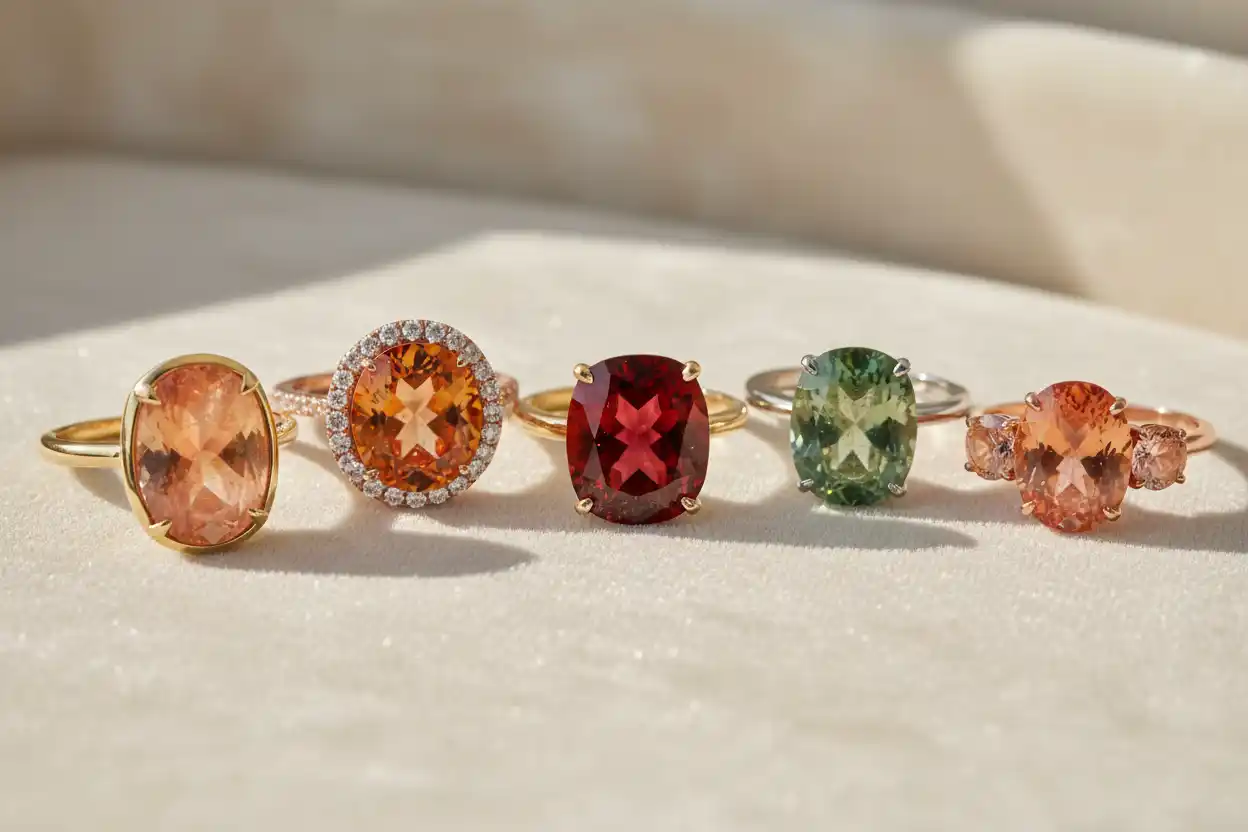
Sunstone Rings: Styles and Buying Tips
Sunstone rings showcase the gem’s warm color and sparkling inclusions in the most visible jewelry format. Peach cabochons, coppery orange stones and transparent red or green Oregon Sunstones can all create distinctive rings.
The hand is also a demanding place for feldspar. Sunstone has moderate hardness and prominent cleavage, so setting protection and wearing habits matter more than they would for Sapphire, Spinel or Diamond.
Sunstone Rings at a Glance
| Feature | What to Consider |
|---|---|
| Gem family | Feldspar |
| Common colors | Peach, orange, gold, red, pink, green, colorless and brown |
| Optical effect | Aventurescence or copper schiller |
| Mohs hardness | Approximately 6–6.5 |
| Cleavage | Two prominent directions |
| Best setting styles | Bezel, protective halo and low substantial prongs |
| Best use | Occasional or careful regular wear |
| Popular cuts | Cabochon, oval, cushion, round and pear |
| Premium material | Transparent Oregon Sunstone |
| Main buying concern | Fractures near the girdle or setting points |
| Main care concern | Impact, scratching and thermal shock |
| Safest cleaning | Lukewarm water, mild soap and a soft brush |
Is Sunstone Suitable for Rings?
Sunstone can be worn in rings, but it is not a carefree daily-wear gem.
Its hardness of approximately 6–6.5 provides moderate scratch resistance. Quartz-rich dust and many common jewelry stones are harder and can abrade polished surfaces.
Cleavage presents a separate risk. A sharp blow from the wrong direction can chip or split the feldspar even when its surface appears relatively hard.
A protective setting, low profile and careful wearer can make a Sunstone ring practical. Someone who works with tools, machinery, stone surfaces or frequent hand washing may prefer earrings or a necklace instead.
The main Sunstone meaning guide covers the mineral and its symbolism. This article focuses on ring design, quality and durability.
Sunstone Solitaire Rings
A solitaire places one gemstone at the center of the ring. It is best suited to a stone with attractive color, balanced cutting and sound structure.
Cabochon solitaires display broad aventurescence and natural patterns. Faceted solitaires emphasize transparency and brilliance.
A high basket creates visual height but increases snagging. The gem may strike doorframes, counters and clothing more frequently.
A lower setting keeps the stone closer to the finger. It may admit slightly less side light, but the durability advantage is often worthwhile.
Bezel-Set Sunstone Rings
A bezel surrounds most or all of the gemstone’s girdle with metal. It is generally the safest setting for a Sunstone ring.
The metal protects the vulnerable edge and creates a smooth profile. A full bezel suits active wearers, while a partial bezel exposes more of the stone.
The jeweler must avoid excessive pressure while closing the bezel. Feldspar can chip along cleavage-related weaknesses.
Bezel settings work especially well with cabochons because the rounded surface and protected edge reduce snagging.
White metal creates a clear outline around orange or red Sunstone. Yellow and rose gold produce a warmer tonal effect.
Prong-Set Sunstone Rings
Prongs expose more of the gemstone and allow light to reach transparent material.
Four-prong designs provide an open appearance but leave more of the girdle unprotected. Six-prong settings offer additional security for round and oval stones.
The prongs should not sit over a visible fracture. Pointed cuts need V-shaped protection at their tips.
A low prong basket performs better for frequent wear than a high projecting setting.
Regular inspection is essential because a bent or worn prong can release the gem before any damage becomes visible.
Halo Sunstone Rings
A halo surrounds the center Sunstone with smaller accent gems.
The design increases apparent size and can protect the center’s outer edge. Bright colorless accents may also strengthen the contrast around pale peach or orange stones.
However, Diamond and Sapphire accents are much harder than Sunstone. Their girdles should not touch the feldspar directly.
A low halo is more practical than a tall double halo. More accent stones also mean more small prongs to inspect and clean.
The complete design should remain balanced. A very large halo can make the natural Sunstone appear secondary.
Three-Stone Rings
A three-stone ring may place Sunstone between colorless or contrasting side gems.
Diamond or white-Sapphire sides create brightness, but they need enough space to avoid abrading the center stone.
A matched trio of Sunstones can display a color progression from peach to orange or from green to red.
Side stones should sit low enough to remain comfortable between adjacent fingers. Wide settings can become irritating even when the top view looks elegant.
Matching is important. One dark or poorly oriented gem can disrupt the composition.
Cluster and Cocktail Rings
Cluster rings use several smaller Sunstones in floral or geometric patterns.
The format can create a larger area of color without requiring one expensive transparent gem. Natural variation may become part of the design.
Cocktail rings use a broad setting, large cabochon or dramatic arrangement. Sunstone’s coppery flashes suit statement jewelry particularly well.
These rings should usually be reserved for occasional wear. Projecting clusters and large domes encounter more impact than compact bezels.
Inspect the underside for strong metal connections and smooth finishing.
Sunstone Engagement Rings
Sunstone can be used in an engagement ring, especially when the couple accepts its care requirements.
Transparent red, green and bicolor Oregon Sunstone offers an unusual alternative to more conventional gems. Peach cabochons can support a softer or artisan style.
For continuous daily wear, the stone is less durable than Sapphire, Spinel or Diamond. It may require repolishing, resetting or replacement over many years.
A low bezel or protective halo is preferable. Thin exposed points and very high prongs increase the chance of damage.
A second ring may be sensible for exercise, travel or manual work. Choosing Sunstone should be an informed style decision rather than an assumption that every gemstone wears like Corundum.
Common Sunstone Versus Oregon Sunstone
Commercial Sunstone often consists of peach, orange or tan feldspar with hematite- or related iron-bearing inclusions.
Oregon Sunstone is copper-bearing labradorite. It may be colorless, yellow, pink, salmon, orange, red, green or multicolored.
Transparent Oregon material is more frequently faceted and can command substantial prices. Common opaque material is usually cut into cabochons and carvings.
Neither is automatically superior for every ring. A beautifully patterned cabochon may suit an artisan bezel better than a transparent faceted stone.
The important distinction is accurate description and pricing.
Choosing Color
Peach and apricot Sunstone produces a warm, understated appearance.
Orange and red material creates stronger visual impact. Deep color should remain lively rather than turning brown or nearly black indoors.
Green and red-green Oregon Sunstone is less common and may show striking zoning. The cutter should position that color pattern attractively within the ring.
Colorless or pale-yellow stones can display vivid copper schiller. Their value may depend more on the inclusion effect than body color.
Compare the gem against the wearer’s skin and under several light sources. Jewelry-store spotlights can exaggerate both color and sparkle.
The orange gemstones guide and red gemstones guide provide broader color comparisons.
Evaluating Aventurescence
Aventurescence should face the viewer when the ring is held in a normal position.
Dense platelets can create a dramatic metallic glow but reduce transparency. Sparse inclusions may create isolated flashes within an otherwise clear stone.
A ring moves through many angles, so directional schiller can remain attractive even when it is not visible continuously.
Rotate the ring under ordinary light. If the effect appears only under one intense spotlight, the gem may look much quieter in daily wear.
The guide to types of Sunstone explains how inclusion type and feldspar composition influence appearance.
Cabochon Versus Faceted Rings
Cabochons are appropriate for opaque, translucent and heavily included Sunstone. Their smooth domes show broad color and reduce fragile facet edges.
A cabochon should have a balanced profile, smooth polish and no deep pits. Flat spots can interfere with the optical effect.
Faceted gems require greater transparency. Ovals, cushions and rounds are common, while pears and trillions need additional corner protection.
A shallow faceted stone may show a window through the center. Excessive depth can make the gem appear smaller and darker than its carat weight suggests.
The best shape follows the rough and intended setting.
Clarity and Structural Safety
Sunstone may contain reflective platelets, mineral crystals, color zones, veils and cleavage fractures.
The inclusions creating aventurescence are desirable. Surface-reaching fractures near prongs or the girdle require caution.
Inspect the gem from the side and beneath the setting. A fracture may be hidden by metal.
Filled cavities, resin or surface coatings should be disclosed. Such treatments may alter repair and cleaning options.
A structurally sound commercial stone is usually more suitable for a ring than a spectacular but heavily fractured specimen.
Sunstone Versus Goldstone
Goldstone is manufactured glass containing metallic crystals.
Its glitter is often dense and uniformly distributed. Natural Sunstone typically shows directional platelets, irregular zoning and feldspar structure.
Goldstone may contain rounded gas bubbles and lacks Sunstone’s cleavage.
Both materials can be attractive, but they should not be priced or described as the same gem.
Sunstone Versus Aventurine
Aventurine is usually Quartz with reflective inclusions.
It is harder than Sunstone and does not share feldspar’s prominent cleavage.
Orange or peach Aventurine can resemble opaque Sunstone, especially in photographs. Inclusion texture, hardness and mineral testing help separate them.
The shared term “aventurescence” describes an optical effect, not a single mineral species.
Sunstone Versus Moonstone and Labradorite
Moonstone displays a floating glow called adularescence.
Labradorite usually shows broad blue, green, gold or multicolor labradorescence.
Sunstone’s effect comes from reflective platelets. Oregon Sunstone has a labradorite composition, but copper creates its characteristic color and schiller.
All three belong to feldspar and share similar general concerns about cleavage and impact.
Natural, Treated and Imitation Material
Natural Sunstone varies widely in quality. Pale feldspar may be altered or misrepresented in the market.
Copper-diffused feldspar has been documented. A report may be appropriate when a strong copper-related color or Oregon origin supports a high price.
Dye, coating, resin filling and manufactured glass can also appear in lower-cost jewelry.
Ask for a written description of identity, origin and known treatment. “Natural stone” does not automatically mean untreated or accurately sourced.
The Sunstone buying guide provides a complete authentication and quality process.
Carat Weight and Visible Size
Carat weight measures mass rather than face-up dimensions.
A deep stone may weigh more while appearing smaller. Compare length, width and depth in millimeters.
Cabochons often look larger than faceted gems of similar weight because their bases and domes distribute material differently.
Large transparent red or green Oregon Sunstones can command significant premiums. Size should not compensate for weak cutting, poor color or unstable fractures.
A halo can increase finger coverage without requiring the largest possible center stone.
Choosing the Metal
Yellow gold enhances peach, orange, red and coppery colors.
Rose gold complements salmon and pink material but can reduce contrast when the stone is pale.
White gold and platinum create a cooler frame that emphasizes red, green and strong schiller.
Sterling silver works for commercial cabochons, although valuable transparent stones deserve sufficiently substantial metal and workmanship.
Alloy sensitivity, maintenance and resizing options should be considered alongside appearance.
Ring Sizing and Comfort
Obtain an accurate finger measurement before purchase.
Wide bands generally fit more tightly than narrow shanks. Finger size also changes with temperature and activity.
Complex halos, engraved shoulders and full eternity designs may have limited resizing options.
A large setting should not rotate constantly or press sharply against adjacent fingers. Sizing beads or a wider shank can improve stability.
Try ordinary hand movements before the return period expires.
Daily Wear
Remove the ring before exercise, gardening, cooking, cleaning and work involving tools.
Do not wear it while lifting weights or gripping metal equipment. Even a protective bezel cannot prevent every impact.
Avoid stacking Sunstone directly against Diamond or Sapphire rings. The harder stones can scratch the feldspar.
A careful wearer may use a low bezel ring regularly. A high or heavily included statement stone is better reserved for occasional use.
The gemstone hardness chart provides context for Sunstone’s position relative to harder jewelry gems.
Comparing Other Sunstone Jewelry
A Sunstone necklace can display a larger gem with less impact exposure.
Sunstone earrings are among the safest options for delicate or highly included stones.
A Sunstone bracelet remains visible to the wearer but experiences frequent contact with desks and surrounding objects.
Rings provide maximum visibility but demand the greatest protection.
Price and Documentation
Color, transparency, aventurescence, size, cutting and geographic origin affect value.
Common peach cabochons are usually affordable. Fine red, green, bicolor and copper-schiller Oregon Sunstones may cost considerably more.
The Sunstone price guide covers market factors without replacing a stone-specific appraisal.
Independent testing may be worthwhile for expensive transparent gems, unusual colors or strong origin claims.
A laboratory report identifies the gemstone and may detect treatment. An appraisal documents the complete ring and estimates replacement value for insurance.
Cleaning and Care
Clean the ring with lukewarm water, mild soap and a soft brush.
Work gently beneath the setting where lotion and soap collect. Rinse briefly and dry thoroughly.
Avoid steam, ultrasonic cleaners and sudden temperature changes. Vibration and heat can extend cleavage fractures.
The dedicated guide to cleaning Sunstone jewelry provides setting-specific care.
For spiritual maintenance, cleansing and charging Sunstone covers gentle methods without replacing physical cleaning.
Storage
Store the ring in a separate lined compartment. Do not drop it into a container with harder gemstones.
Keep it away from Quartz, Spinel, Topaz, Sapphire and Diamond.
Sunstone appears among the crystals beginning with S and gemstones beginning with S directories.
Frequently Asked Questions
1. Is Sunstone durable enough for a ring?
It can be used in rings, but its moderate hardness and prominent cleavage require a protective setting and careful wear.
2. Which setting is safest for Sunstone?
A low full or partial bezel provides the strongest girdle protection. Protective halos and substantial prongs can also work.
3. Can a Sunstone ring be worn every day?
Careful regular wear is possible, but the ring should be removed for exercise, manual work, cleaning and other high-impact activities.
4. Is Sunstone suitable for an engagement ring?
Yes, when the wearer accepts its care needs. It is less durable than Sapphire, Spinel or Diamond and may require maintenance over time.
5. What makes Sunstone sparkle?
Flat reflective inclusions create aventurescence. Oregon Sunstone contains native copper, while many other varieties contain iron-bearing platelets.
6. Is Oregon Sunstone better for rings?
It can offer rare colors, transparency and copper schiller. Common peach Sunstone may still be better suited to an affordable cabochon design.
7. Is a cabochon safer than a faceted Sunstone?
Cabochons have fewer exposed facet edges and often work well in protective bezels. Structural condition and setting remain more important than cut alone.
8. Which metal looks best with Sunstone?
Yellow gold emphasizes warmth, white metal creates contrast and rose gold complements pink or salmon material.
9. How can Sunstone be distinguished from Goldstone?
Sunstone is natural feldspar with directional inclusions. Goldstone is manufactured glass with dense, relatively uniform metallic glitter.
10. Does a Sunstone ring need a laboratory report?
Most commercial rings do not. Testing becomes more useful for expensive Oregon material, rare colors or significant treatment claims.
11. Can Sunstone rings be resized?
Many simple bands can be resized. Complex halos, eternity settings and heavily decorated shoulders may have strict limits.
12. How should a Sunstone ring be cleaned?
Use lukewarm water, mild soap and a soft brush. Avoid steam, ultrasonic equipment, abrasive cleaners and thermal shock.