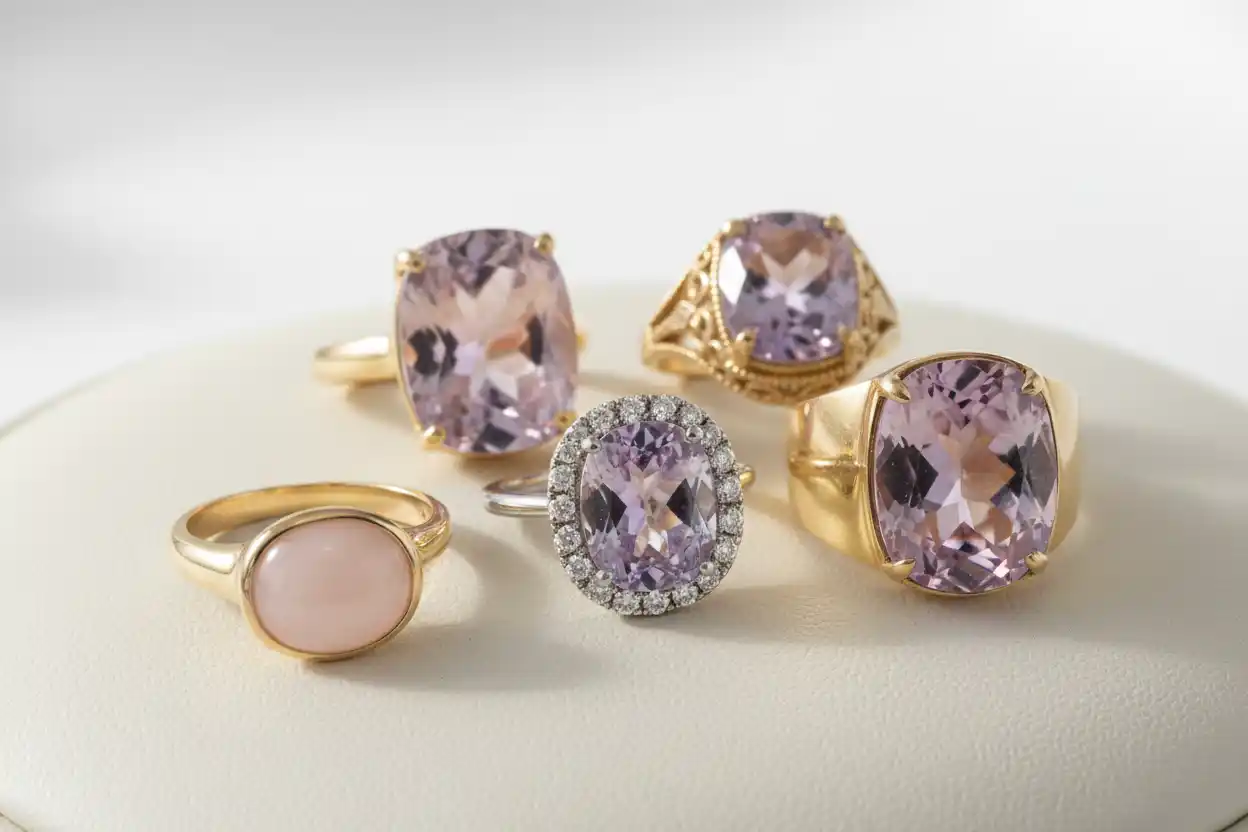
Kunzite Rings: Styles, Durability and Buying Tips
Kunzite rings can show delicate blush pink, lilac, violet-pink, and occasionally vivid purple as the hand moves. Large transparent stones are relatively available, so kunzite can create a substantial ring without the price escalation associated with many rarer pink gems.
However, a ring also places kunzite in its most demanding jewelry environment. The gem has moderate scratch resistance but perfect cleavage in two directions, which means one concentrated blow can split a stone that otherwise looks clean and well polished.
The broader kunzite gemstone guide explains the mineral’s identity, history, formation, and symbolism. This guide focuses on ring-specific construction, durability, settings, color orientation, sizing, buying checks, wear, cleaning, and repair.
Is Kunzite Suitable for a Ring?
Kunzite is the pink-to-violet gem variety of spodumene, a lithium-aluminum silicate. It ranks approximately 6.5–7 on the Mohs scale, so it offers better scratch resistance than pearl, opal, fluorite, or moonstone.
Nevertheless, hardness measures resistance to scratching rather than resistance to splitting. Kunzite’s two strong cleavage directions create its principal vulnerability. Pressure from a prong, a strike against a countertop, or repair heat combined with an existing fracture can cause serious damage.
The gemstone hardness chart provides numerical context. More importantly, the guide to gemstone toughness versus hardness explains why kunzite behaves more delicately than its Mohs number suggests.
A kunzite ring can work well when:
- The stone is free from threatening surface-reaching fractures.
- The mounting protects the girdle and corners.
- The ring sits relatively low on the hand.
- The wearer removes it for impact-prone activities.
- The stone is protected from prolonged intense light and heat.
Consequently, kunzite is better suited to careful regular wear or controlled occasional wear than to an always-on ring.
Kunzite Ring Styles Compared
| Ring style | Protection | Best feature | Main concern |
|---|---|---|---|
| Full bezel | High | Protects most of the girdle | Uneven setting pressure |
| Partial bezel | High to moderate | Balances protection and light entry | Exposed sections remain vulnerable |
| Low halo | Moderate to high | Adds visual spread and lateral protection | Hard accent stones must not contact kunzite |
| Six-prong solitaire | Moderate | Classic open appearance | Exposed girdle between prongs |
| Four-prong solitaire | Low to moderate | Minimal metal around the stone | Fewer protected contact points |
| Three-stone ring | Variable | Symbolic and visually balanced | Adjacent stones may rub or transfer impact |
| Vintage cluster | Variable | Decorative metalwork and smaller stones | Numerous worn prongs and hidden repairs |
| Cocktail ring | Variable | Makes use of large kunzite crystals | Height, leverage, and frequent impact |
| Engagement-style ring | Moderate with the right design | Distinctive pink center stone | Requires disciplined daily care |
| Tension setting | Low for most kunzite | Contemporary appearance | Concentrated pressure on a cleavage-prone gem |
Bezel-Set Kunzite Rings
A well-made bezel is generally the strongest setting choice for kunzite. Metal surrounds most or all of the gemstone’s perimeter, shielding the girdle from direct lateral impacts.
The bezel should fit the exact stone. Kunzite cannot safely be forced into a bearing cut for a slightly different outline. When the metal is pushed unevenly, pressure can concentrate near a cleavage plane or hidden fissure.
Examine the ring under magnification. The bezel should look smooth and continuous, without gaps, crushed corners, glue seepage, or sections that appear hammered heavily against the crown.
A low bezel also reduces snagging. This matters because a caught ring can transmit leverage through the setting even without striking the gemstone directly.
Prong-Set Kunzite Rings
Prongs expose more of the stone and can make pale kunzite appear brighter. They also leave more of the girdle accessible to impact.
Six smaller prongs often provide greater redundancy than four broad prongs on round and oval stones. Pear, marquise, heart, square, and rectangular cuts need guarded points or corners.
Prongs should contact the crown securely without pressing over a fracture. The stone should not rattle when the ring is moved, but tightening should be performed only by a jeweler familiar with spodumene.
A thin, high-set four-prong solitaire may look elegant in photographs while offering little real protection. The side view usually reveals more about wearability than the face-up image.
Halo Kunzite Rings
A halo can make a moderate-size kunzite appear larger and can protect the center stone from some lateral impacts. The protective effect is strongest when the halo sits slightly beyond the kunzite’s outline and the entire ring remains low.
Diamonds, sapphires, spinel, zircon, and moissanite are harder than kunzite. Their exposed girdles should not press against the center gem or a neighboring kunzite surface.
A halo also introduces many small prongs. Those prongs require periodic inspection, particularly when the ring is worn regularly.
Kunzite Solitaire Rings
A solitaire emphasizes kunzite’s color, clarity, pleochroism, and cut. Because the design has no surrounding stones to distract the eye, weak color orientation and windowing become especially visible.
Rounded cushions and ovals are common because they preserve rough and avoid sharp corners. Emerald-style cuts showcase clarity but require corner protection. Pear and heart shapes can produce an expressive design when their points receive adequate metal support.
Large solitaires should sit as low as the pavilion allows. A deeply cut stone may carry substantial weight beneath the finger while showing a more modest face-up size.
Kunzite Engagement Rings
Kunzite can create a distinctive pink or violet engagement ring, but it is not a carefree substitute for sapphire, ruby, spinel, or diamond.
The guide to best gemstones for engagement rings compares stones intended for long-term hand wear. Kunzite’s cleavage and light sensitivity place it below the most durable choices.
A successful kunzite engagement ring should ideally have a low bezel, partial bezel, protective halo, or well-supported six-prong mounting. The shank should be strong enough to resist bending, and a wedding band should not rub against the kunzite or its setting.
Buyers comparing color options can review pink gemstones for engagement rings and purple gemstones for engagement rings.
Morganite is another pastel alternative with greater hardness and better practical toughness. The direct kunzite-versus-morganite comparison explains the material differences, while the morganite ring guide covers that gem’s ring-specific construction and buying considerations.
Vintage and Antique-Style Kunzite Rings
Kunzite works naturally with Art Deco geometry, Edwardian-inspired halos, engraved shoulders, filigree, milgrain, floral clusters, and mid-century cocktail designs.
An antique-style ring may be newly made, while a genuinely older ring may contain worn prongs, replacement stones, repaired shanks, soft solder, glue, or altered settings. Inspect the back and sides rather than relying on decorative surface detail.
Large vintage kunzites may show facet-edge abrasion or small girdle chips. Those signs do not necessarily make the ring unwearable, but they affect value and indicate how carefully the stone must be reset or repaired.
Cocktail and Statement Rings
Large kunzite crystals can yield impressive faceted stones. As a result, cocktail rings often feature kunzites far larger than typical pink sapphires, spinels, or tourmalines at a comparable budget.
Size increases leverage. A large stone set high above the finger is more likely to strike a doorframe, table, handrail, or bag clasp.
Statement rings are therefore best reserved for events, dinners, photography, or other controlled wear. A broad low bezel, substantial halo, split shank, and protected pavilion can improve stability without turning the piece into everyday work jewelry.
Pleochroism and Face-Up Color
Kunzite is strongly pleochroic. Different crystal directions may show pink, violet, pale lilac, or nearly colorless appearances.
The strongest color is generally concentrated down the length of the original crystal. Cutters must orient the rough carefully while also respecting its cleavage planes.
A ring constantly changes orientation as the fingers and wrist move. Therefore, evaluate the stone while rotating it rather than from one face-up photograph.
Look at the ring:
- Straight through the table.
- From each side.
- While rotating it through a full circle.
- Under diffused daylight.
- Under neutral indoor lighting.
- Against skin and a neutral white background.
A natural shift is part of kunzite’s character. However, a large nearly colorless zone, dominant gray area, or poorly placed pale axis can reduce the ring’s visual balance.
Choosing Kunzite Color
Color is usually the most important quality factor. Kunzite commonly appears pale pink, but stronger pink, violet-pink, and purple stones are generally more desirable.
A pale gem may look attractive in a close-up product image yet become nearly colorless on the hand. Medium-light to medium color often provides a better balance between visibility and transparency.
Extremely dark appearance can result from excessive pavilion depth or extinction rather than exceptional saturation. The stone should retain life across most of its face.
Rose gold can reinforce pink tones, while white gold and platinum emphasize lilac and violet. Yellow gold provides warmer contrast and can make pale stones look slightly peachier.
Clarity and Structural Condition
Faceted kunzite is commonly expected to appear relatively clean to the unaided eye. Small enclosed inclusions may be acceptable, but surface-reaching fractures deserve serious attention in a ring.
Inspect for:
- Reflective feathers beneath prongs
- Cracks crossing the girdle
- Chips at corners or points
- Cleavage-like planes near the pavilion
- Cavities concealed by metal
- Fractures filled with oil, resin, wax, or dirt
- Damage from previous tightening
A clear-looking stone can still contain a dangerous fracture hidden beneath a prong. Side and back photographs are therefore essential when buying remotely.
Cut Quality
Kunzite is frequently cut in step, brilliant, or mixed styles. Step cuts highlight clarity and broad color, while brilliant cuts produce more scintillation.
Cutters face three competing pressures: orient the strongest color, avoid cleavage-related damage, and retain valuable weight. Deep stones are therefore common.
Some extra depth can be reasonable. However, a severe window through the center indicates that light is escaping through the pavilion. Large dark areas indicate extinction.
Millimeter dimensions provide a better sense of visible size than carat weight alone.
Carat Weight and Pricing Context
Large kunzite is not exceptionally rare. Therefore, price does not increase by size as sharply as it does for many fine sapphires, rubies, or alexandrites.
Strong color becomes more visible in larger material, but a large pale or badly cut stone may still have modest value.
The Kunzite Buying Guide covers loose-stone quality in detail, while the kunzite price guide owns value ranges and market factors.
In a finished ring, metal, diamonds, design labor, branding, custom setting, and repairability may represent a significant part of the retail price.
Treatments and Color Stability
Kunzite color can be improved through irradiation followed by heat. Both natural and enhanced color may fade under prolonged intense light or heat.
Known treatment should be disclosed, although laboratory testing may not always reconstruct the complete color history. The broader gemstone treatments guide explains the difference between enhancement, filling, coating, imitation, and synthetic origin.
Store kunzite in a closed jewelry box rather than on an exposed stand. The guide to crystals that fade in sunlight provides wider context for light-sensitive gems.
Normal short periods of wear are less concerning than repeated full-day exposure, display beneath strong lamps, or storage on a sunny windowsill.
Metal Choice
Platinum provides strong prong security and good structural support, although it adds cost and weight. White gold offers a cooler appearance but may require rhodium-plating maintenance depending on the alloy.
Yellow gold creates contrast and can support vintage designs. Rose gold harmonizes with pink kunzite but may reduce visual separation when the stone is extremely pale.
Sterling silver can suit occasional-wear rings, yet lightweight silver shanks and prongs may bend more easily than substantial gold or platinum construction.
The ring should have adequate metal beneath and around the stone. Delicate appearance should come from proportion, not from structurally weak prongs or an undersized shank.
Ring Sizing and Comfort
Correct sizing reduces spinning and impact. A top-heavy kunzite ring that rotates constantly exposes the stone to more collisions and reveals its pale pleochroic directions more often.
Wide bands generally fit tighter than narrow ones. Sizing beads, an interior stabilizer, or a broader lower shank can help balance a large center stone.
Ask whether the ring can be resized. Torch heat near kunzite creates substantial risk, and a jeweler may need to remove the gemstone before working on the shank.
Intricate halos, eternity-style accents, engraved shoulders, and antique construction can limit resizing. Resolve the size before purchase rather than assuming every ring can be adjusted later.
Buying Checks
| Buying check | What to look for |
|---|---|
| Face-up color | Visible pink or violet under ordinary lighting |
| Movement | Attractive pleochroic shifts without a dominant colorless axis |
| Clarity | No threatening surface-reaching fracture |
| Cut | Limited windowing, balanced outline, and useful brightness |
| Setting | Protected edges and no concentrated pressure |
| Profile | Low enough for the intended wear pattern |
| Metal | Hallmarked alloy and adequate shank thickness |
| Treatment | Written irradiation, heat, filling, coating, or repair disclosure |
| Size | Exact ring size and realistic alteration options |
| Documentation | Report when identity or value justifies it |
| Return policy | Time to inspect the ring in different lighting |
When buying remotely, follow the safeguards in How to Buy Gemstones Online Without Getting Scammed.
An independent report can establish material identity and some detectable treatments, but it does not grade setting quality or predict future fading. The guide to gemstone certification laboratories explains those limits.
Wearing a Kunzite Ring
Kunzite rings should be removed before exercise, gardening, cleaning, cooking, lifting luggage, construction, mechanical work, swimming, showering, and sleep.
Use the non-dominant hand when practical. Avoid stacking the ring beside diamonds, sapphires, or hard-edged metal settings that can scratch or chip the kunzite.
The broader guide to best gemstones for everyday wear helps place kunzite’s limitations in context.
For a coordinated set, a kunzite bracelet requires similar impact precautions, while kunzite earrings and a kunzite necklace provide safer lower-impact alternatives.
Cleaning and Storage
Use lukewarm water, mild soap, and a soft brush or cloth. Do not use steam or ultrasonic cleaning.
The full procedure appears in How to Clean Kunzite Jewelry Safely.
Rinse over a bowl rather than an open drain, dry the back of the setting thoroughly, and avoid rapid temperature changes.
Store the ring in a separate padded compartment inside a closed box. Harder gemstones can scratch it, while exposed sunlight can weaken its color.
The Gemstones That Start With K directory places kunzite among other K-named gems without changing these ring-specific care requirements.
Repair and Maintenance
Have frequently worn rings inspected for prong wear, metal distortion, stone movement, abrasions, chips, and new fractures.
Tell the jeweler that the center stone is kunzite before repair. Ordinary torch work, steam cleaning, ultrasonic equipment, and forceful tightening can damage it.
A chipped stone may sometimes be recut, but the process can alter the dimensions, pleochroic orientation, face-up color, and setting fit. Replacement may be more practical for a calibrated commercial stone, while a fine large kunzite may justify specialist lapidary work.
Frequently Asked Questions
1. Can a kunzite ring be worn every day?
It can be worn regularly by a careful owner, but it is not a carefree everyday stone. Its two cleavage directions make sharp impacts dangerous even though its hardness is moderate.
2. Is kunzite suitable for an engagement ring?
It can work when the wearer accepts additional maintenance and removal habits. A low bezel or protective halo is preferable to a high exposed solitaire.
3. What is the safest setting for a kunzite ring?
A correctly fitted low bezel generally offers the strongest girdle protection. Partial bezels and low halos can also work well.
4. Are four prongs enough for kunzite?
Four prongs can secure a sound stone, but they expose more of the girdle. Six prongs or additional side protection generally provide greater security.
5. Why does my kunzite ring change from pink to pale?
Kunzite is pleochroic, so different crystal directions show different colors. Hand movement reveals pink, violet, lilac, or nearly colorless components.
6. Can a kunzite ring fade?
Yes. Prolonged intense light and heat can reduce both natural and enhanced color. Store the ring in a closed box.
7. Is a large kunzite more valuable?
Not automatically. Large crystals occur naturally. Color saturation, clarity, cut, orientation, condition, and setting quality matter more than size alone.
8. Can kunzite be resized while still in the ring?
The stone may need to be removed before conventional torch work. Kunzite is vulnerable to heat and sudden temperature changes, so the jeweler must plan the repair around the gem.
9. Is rose gold best for kunzite?
Rose gold complements pink tones, while white metals emphasize violet and lilac. The best choice depends on the stone’s actual hue and the wearer’s metal preference.
10. Can an ultrasonic cleaner break kunzite?
Yes. Vibration can worsen fractures or trigger cleavage-related damage. Gentle hand cleaning is safer.
11. What should I do if the stone becomes loose?
Stop wearing the ring and place it in a padded box. Do not squeeze the prongs yourself; a colored-stone jeweler should inspect the stone before tightening.
12. Does an untreated kunzite ring resist fading?
No. Natural untreated color can also fade under intense light or heat. Treatment status and light stability are separate issues.
A successful kunzite ring uses the gem’s scale and color without pretending that spodumene behaves like sapphire. Protected edges, balanced face-up orientation, sound clarity, controlled height, accurate sizing, and shaded storage matter more than maximum carat weight. When the design respects those limits, kunzite can produce a distinctive ring with unusually soft color and impressive presence.