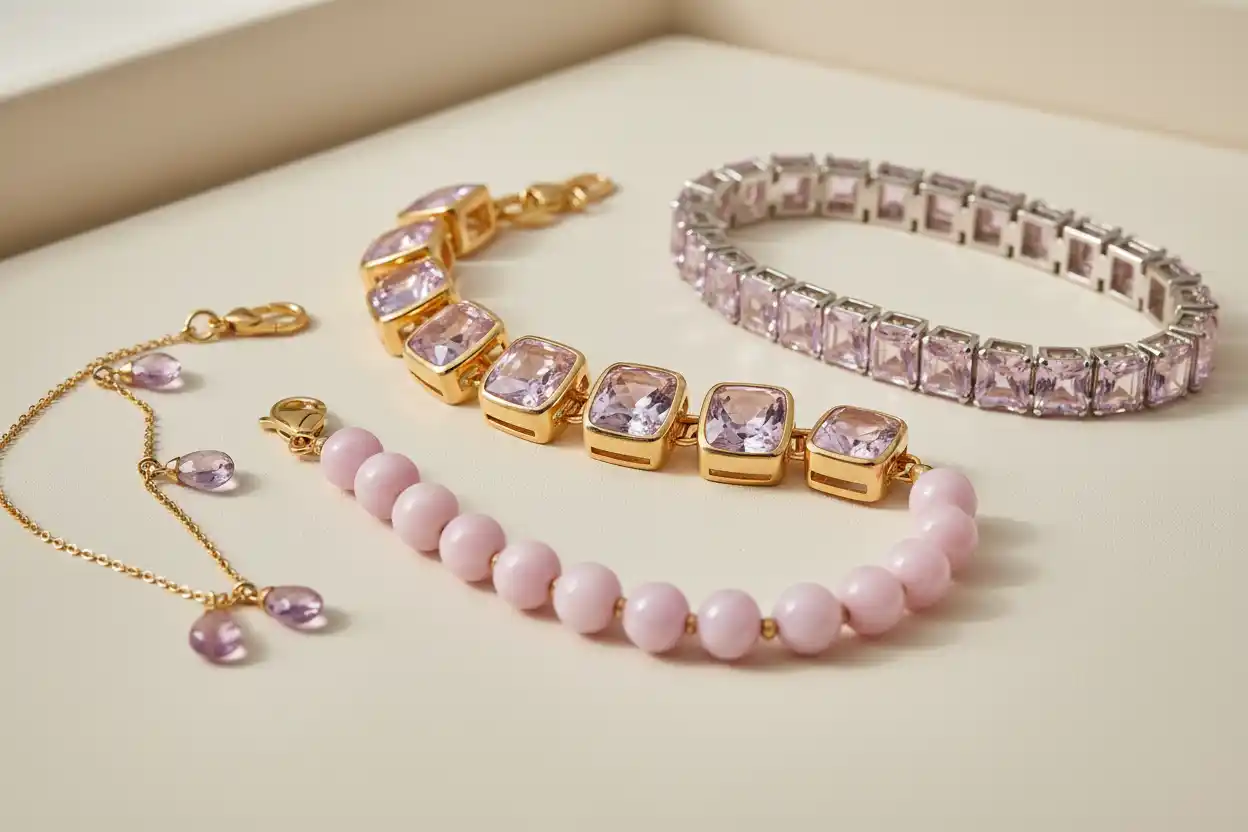
Kunzite Bracelets: Styles, Durability and Buying Tips
Kunzite bracelets can display soft pink, lilac, violet-pink, and occasionally more saturated purple tones across a moving line of gemstones. That movement makes kunzite’s pleochroism especially visible, because each stone may shift in apparent color as the wrist turns.
A bracelet is also one of the most demanding ways to wear kunzite. Wrists repeatedly contact desks, doors, counters, bags, watches, and other jewelry. Kunzite’s Mohs hardness of approximately 6.5–7 provides moderate scratch resistance, but its perfect cleavage in two directions gives it poor resistance to sharp impact and concentrated pressure.
The broader kunzite gemstone guide explains the mineral’s identity, formation, appearance, and symbolism. This article focuses narrowly on bracelet construction, matching, fit, durability, wear, treatment, and purchase decisions.
Is Kunzite Suitable for a Bracelet?
Kunzite can be used in bracelets, but it performs best as carefully worn jewelry rather than an always-on accessory. A protected, well-constructed bracelet may remain beautiful for years, while an exposed high-profile design can chip or split after one badly placed blow.
The distinction between hardness and toughness matters. Kunzite resists some ordinary surface abrasion, yet a knock delivered along a cleavage direction can cause more serious damage than its Mohs number suggests. The gemstone hardness chart provides the numerical comparison, while gemstone toughness versus hardness explains why cleavage can make a moderately hard gemstone structurally vulnerable.
Kunzite bracelets are most practical when they have low settings, rounded stone outlines, enough flexibility to follow the wrist, and metal structures that shield exposed girdles. They are less suitable for someone who keeps bracelets on during sports, gym sessions, manual work, childcare, gardening, or household cleaning.
Main Kunzite Bracelet Styles
| Bracelet style | Appearance | Protection level | Main concern |
|---|---|---|---|
| Bezel-link bracelet | Individual stones surrounded by metal | High | Poorly fitted bezels can apply uneven pressure |
| Halo-link bracelet | Kunzite surrounded by accent stones | Moderate to high | Hard accent stones must not contact kunzite |
| Prong-set tennis bracelet | Continuous line of faceted stones | Moderate | Exposed girdles and many maintenance points |
| Station bracelet | Kunzite elements spaced along a chain | Moderate | Stones may rotate or strike metal links |
| Bead bracelet | Drilled polished or faceted beads | Variable | Drill-hole fractures and cord deterioration |
| Charm bracelet | Small kunzite drops or charms | Low to moderate | Swinging pieces collide with chain and other charms |
| Cuff bracelet | One or more stones in a rigid structure | Variable | Poor fit and leverage against the stone |
| Mixed-gem bracelet | Kunzite with diamonds or colored gems | Variable | Harder stones can scratch or chip kunzite |
| Vintage bracelet | Older articulated or cluster construction | Variable | Worn prongs, previous repairs and uncertain treatment |
Bezel-Link Kunzite Bracelets
A bezel surrounds the stone’s perimeter and can protect the girdle from lateral impact. For kunzite, a low bezel-link design is often safer than an exposed prong-set tennis bracelet.
However, the bezel must fit the stone accurately. Kunzite can split when a setter applies uneven pressure, especially if a hidden fracture or cleavage-related weakness lies near the edge. The metal should follow the outline smoothly without crushed corners, gaps, or areas that appear forced over the crown.
A bracelet also needs enough articulation between links. When the links do not flex freely, the bracelet can behave like a rigid lever and transfer stress into the gemstone settings.
Prong-Set Tennis Bracelets
A kunzite tennis bracelet can create a continuous line of pink or lilac color, but every stone introduces several prongs and exposed girdle sections. That multiplies the number of points requiring inspection.
Rounded ovals and cushions generally present fewer vulnerable corners than princess, baguette, marquise, or pear shapes. Four-prong settings may work for small stones, although protective side rails or partial bezels add security.
Inspect the bracelet from the side. The stones should sit below or within the protective outline of the links rather than projecting far above the wrist. Prongs should contact each crown securely without digging into the stone.
Kunzite Bead Bracelets
Kunzite beads may be round, oval, faceted, chip-shaped, or carved. Their soft pink color can create an understated bracelet, but drilled construction deserves close inspection.
A drill hole removes material and creates a stress concentration. Look for cracks radiating from the opening, chipped rims, rough interiors, and beads drilled too close to one side. Faceted beads with sharp points can also abrade adjacent beads as the bracelet moves.
Elastic offers convenience but deteriorates through stretching, skin oils, heat, and time. Knotted cord or appropriately engineered jewelry wire generally provides greater security for higher-quality beads.
Perfectly uniform bright pink beads offered inexpensively may be glass, dyed quartz, or another imitation. The Kunzite Buying Guide explains how to assess identity, color, cut, clarity, treatment, and seller disclosure.
Pleochroism and Bracelet Matching
Kunzite is strongly pleochroic. Depending on viewing direction, a gem may show pink, violet, pale color, or nearly colorless components.
A cutter normally orients the stone so its strongest color appears through the crown. In a bracelet, however, stones constantly rotate relative to the viewer and light. This makes orientation differences between matched stones more visible than they might be in a stationary display.
A well-matched bracelet should coordinate:
- Face-up hue
- Tone and saturation
- Pleochroic response
- Shape and dimensions
- Cutting depth
- Transparency
- Facet pattern
- Apparent brightness
The stones do not need to look identical at every angle. Natural pleochroism prevents that. Nevertheless, one stone should not become nearly colorless while the others retain strong pink-violet color in the same wrist position.
Choosing Kunzite Color
Color is kunzite’s most important visual quality factor. Pale pink material is common, while more saturated pink, lilac, violet-pink, and purple stones are generally more desirable.
In a bracelet, medium-light color often works better than extremely pale material because each stone is relatively small. A faint kunzite that looks appealing under close-up photography may appear almost colorless from normal viewing distance.
Very dark stones require careful inspection for extinction. Kunzite is often cut deeply to strengthen color, but excessive depth can hide weight below the setting and make the face-up stone look smaller than its carat weight suggests.
The directories of pink gemstones and purple gemstones place kunzite among other stones in the same visual ranges.
Clarity and Fractures
Transparent faceted kunzite is often expected to look relatively clean to the unaided eye. Small enclosed inclusions may have little effect on durability, but reflective feathers and surface-reaching fissures deserve caution.
Pay particular attention to:
- Fractures beneath prongs
- Bright lines crossing a girdle
- Chips around corners
- Cleavage-related planes near drill holes
- Cavities filled with wax, oil, resin, or dirt
- Cracks extending from setting pressure points
A bracelet exposes stones to repeated movement, so an existing fracture can grow over time. When one stone shows a significant open fissure, replacing it before wear may be safer than waiting for breakage.
Cut and Shape
Kunzite appears in ovals, cushions, rounds, emerald-style cuts, pears, trillions, rectangles, beads, and custom designs. Step cuts are common because clean transparent material can support broad facets.
For bracelets, rounded ovals and cushions provide a practical balance of color and durability. Emerald-style cuts can look elegant, although their corners need protection. Pears and marquises should use V-prongs or metal guards around their points.
A wide transparent center may indicate windowing, while large dark zones indicate extinction. Some depth is understandable because cutters must balance pleochroism, cleavage, color, and retained weight.
Sizing and Fit
A kunzite bracelet should sit securely without constricting the wrist. Excessive looseness allows the stones to rotate, strike desks, and slide beneath the hand during daily tasks.
Measure the wrist with a flexible tape and add enough ease for the design. Thin flexible bracelets need less allowance than wide cuffs or large beads.
A tennis-style bracelet should articulate smoothly around the wrist without sharp gaps. The clasp must close positively and should ideally include a secondary safety feature when the stones or metal have meaningful value.
For bead bracelets, avoid a fit so tight that the cord pulls continuously against the drill holes. A little movement is useful, but the bracelet should not slide far enough to collide repeatedly with a watch or tabletop.
Clasps and Safety Features
The clasp can be more vulnerable than the gemstone. Box clasps with figure-eight safeties, lobster clasps with substantial end links, and well-made fold-over systems offer better security than thin spring rings on heavy bracelets.
Inspect solder joints and hinge pins. A sturdy-looking clasp is not useful when it connects to a weak jump ring or lightweight end cap.
For a valuable kunzite bracelet, a secondary safety chain can reduce loss risk. It should remain short enough not to catch on objects or swing against the gemstones.
Metal Choices
White gold, platinum, and silver emphasize kunzite’s cooler lilac and violet tones. Yellow gold creates warm contrast, while rose gold can blend softly with pale pink material.
The metal must be strong enough to protect the stone. Very thin high-karat gold links may bend, while lightweight silver prongs can wear or loosen over time.
Metal sensitivity should be evaluated separately from gemstone quality. The guide to gemstones and metals for sensitive skin explains why posts, clasps, plating, nickel, solder, and alloy composition matter.
Mixed-Gem Kunzite Bracelets
Diamonds, sapphires, spinel, and many other accent stones are harder than kunzite. They can create attractive contrast but should not rub directly against its girdle or polished surface.
A halo around each kunzite can provide protection when the construction keeps the harder accents slightly outside the center stone’s edge. Conversely, loose stacking with diamond bracelets can cause scratches and edge damage.
Morganite offers a warmer peach-pink alternative, although it belongs to the beryl family and behaves differently. The direct kunzite-versus-morganite comparison explains the differences in mineral identity, color, pleochroism, hardness, cleavage, density, and treatment.
Treatment and Light Sensitivity
Kunzite color may be enhanced through irradiation followed by heating. Natural and enhanced color can fade under prolonged intense light or heat.
A seller should disclose known treatment, but a statement that a stone is untreated does not eliminate fading risk. Light stability is an inherent concern for kunzite, not merely a consequence of enhancement.
Avoid leaving a bracelet:
- On a sunny windowsill
- Inside a hot vehicle
- Beneath high-intensity display lighting
- Near a radiator
- In an open jewelry stand exposed to daylight
- Beneath ultraviolet lamps
The broader guide to crystals that fade in sunlight compares kunzite with other light-sensitive materials. Store kunzite in a closed, padded jewelry box when it is not being worn.
The general gemstone treatments guide explains why irradiation, heating, coating, filling, and disclosure should be evaluated separately.
Price and Value Context
The dedicated kunzite price guide owns detailed valuation. In a bracelet, total price depends on more than the combined carat weight.
Important factors include color saturation, matching, clarity, cut, treatment, number of stones, setting labor, metal weight, clasp quality, brand, and repairability.
Large kunzite crystals occur naturally, so size does not produce the same price escalation seen in some rarer gems. However, finding many smaller stones that match in color, orientation, cut, and dimensions can add substantial cost.
Buying Online
Follow the safeguards in How to Buy Gemstones Online Without Getting Scammed.
Request written details covering:
| Buying check | What to confirm |
|---|---|
| Material | Natural kunzite rather than glass, quartz, synthetic product, or another pink gem |
| Treatment | Irradiation, heating, coating, filling, repair, or assembly |
| Matching | Color, cut, dimensions, pleochroic orientation, and clarity |
| Bracelet size | Wearable length, width, stone size, and total weight |
| Construction | Prongs, bezels, drilling, stringing, hinges, and link design |
| Metal | Alloy, fineness, hallmark, plating, and clasp material |
| Condition | Chips, fractures, abrasions, repairs, and loose stones |
| Lighting | Neutral-light video showing wrist movement |
| Returns | Enough time for non-destructive inspection |
| Documentation | Independent report when value or identity justifies it |
AAA, AA, and similar commercial quality labels have no universal kunzite grading standard. Evaluate the actual stones rather than trusting a retailer-created tier.
A laboratory report can help with a high-value or disputed bracelet. The guide to gemstone certification laboratories explains what identification reports can establish.
How to Wear a Kunzite Bracelet
Wear kunzite on controlled social, office, dinner, or formal occasions rather than during impact-prone activity. The non-dominant wrist usually receives fewer knocks.
Remove the bracelet before exercise, cooking, cleaning, swimming, showering, gardening, lifting luggage, or working with tools. Cosmetics and sunscreen should dry before the bracelet is put on.
Do not stack it tightly beside a watch, diamond bracelet, or rigid metal cuff. The general guide to crystal bracelets covers layering and symbolic styling, while best gemstones for everyday wear compares kunzite with more impact-resistant choices.
For a coordinated set, kunzite earrings and a kunzite necklace usually expose the gem to less impact. A kunzite ring requires even greater protection than a bracelet.
Cleaning and Storage
Use lukewarm water, mild soap, and a soft brush or cloth. Do not use steam or ultrasonic cleaning, because heat, vibration, fractures, and cleavage create breakage risks.
The complete process appears in How to Clean Kunzite Jewelry Safely.
Dry the bracelet thoroughly around settings, knots, and drill holes. Store it flat in a closed fabric-lined box, with no harder jewelry resting against the stones.
The Crystals That Start With K directory places kunzite among related alphabetical entries without changing its specific light and impact precautions.
Repair and Maintenance
Inspect a frequently worn bracelet for loose prongs, worn links, stretched cord, bent hinges, damaged clasps, chipped girdles, and movement in the setting.
Tell the jeweler that the stones are kunzite before any repair begins. Torch heat, ultrasonic cleaning, steam, aggressive polishing, and ordinary prong-tightening methods may be inappropriate.
A chipped stone may sometimes be repolished or recut, but the work can alter dimensions, pleochroic orientation, and matching. In a calibrated link bracelet, replacement may be more practical than recutting.
Frequently Asked Questions
1. Can a kunzite bracelet be worn every day?
It is better suited to careful occasional wear. Kunzite has moderate hardness but poor toughness because of perfect cleavage, while bracelets encounter frequent impact.
2. Are kunzite beads durable?
They can be wearable when the beads are sound and well drilled. Cracks around drill holes, bead-to-bead contact, and worn elastic create the main risks.
3. Is a bezel bracelet safer than a prong-set bracelet?
Usually, yes. A correctly fitted bezel protects more of the girdle, although poor setting pressure can still damage kunzite.
4. Why do the stones in my bracelet look like different colors?
Kunzite is pleochroic. Small differences in orientation can make one stone look pink, violet, pale, or nearly colorless while the bracelet moves.
5. Can kunzite fade while being worn?
Repeated intense sunlight and heat can reduce color. Normal brief wear is less concerning, but the bracelet should not be left in prolonged direct sun.
6. Is dark kunzite always more valuable?
More vivid color is generally desirable, but an overly dark or deeply cut stone may show extinction. Color, brightness, clarity, matching, and cut must be considered together.
7. Can kunzite be worn beside a diamond bracelet?
Direct contact is risky. Diamond can scratch kunzite, and exposed settings can chip its edges. Wear the pieces separately or use a protective spacer.
8. How tight should a kunzite bracelet be?
It should remain secure without compressing the wrist or pulling constantly against links and drill holes. Excessive looseness increases impact and rotation.
9. Can a kunzite bracelet be cleaned ultrasonically?
No. Ultrasonic vibration can worsen fractures or trigger cleavage-related breakage. Use lukewarm soapy water.
10. Does natural untreated kunzite still fade?
Yes. Light and heat sensitivity can affect both natural and color-enhanced kunzite.
11. Should an expensive kunzite bracelet have a laboratory report?
A report can be worthwhile when identity, treatment, or value is disputed. It does not grade bracelet construction or guarantee that the stones will not fade.
12. What should I do if one kunzite stone becomes loose?
Stop wearing the bracelet and store it flat in a padded box. A jeweler familiar with cleavage-prone colored stones should inspect the setting before tightening it.
A successful kunzite bracelet places protection and matching ahead of maximum exposed surface. Low settings, rounded stones, controlled articulation, dependable clasps, and limited light exposure preserve the soft color far more effectively than a delicate-looking design that ignores how often the wrist meets hard objects.