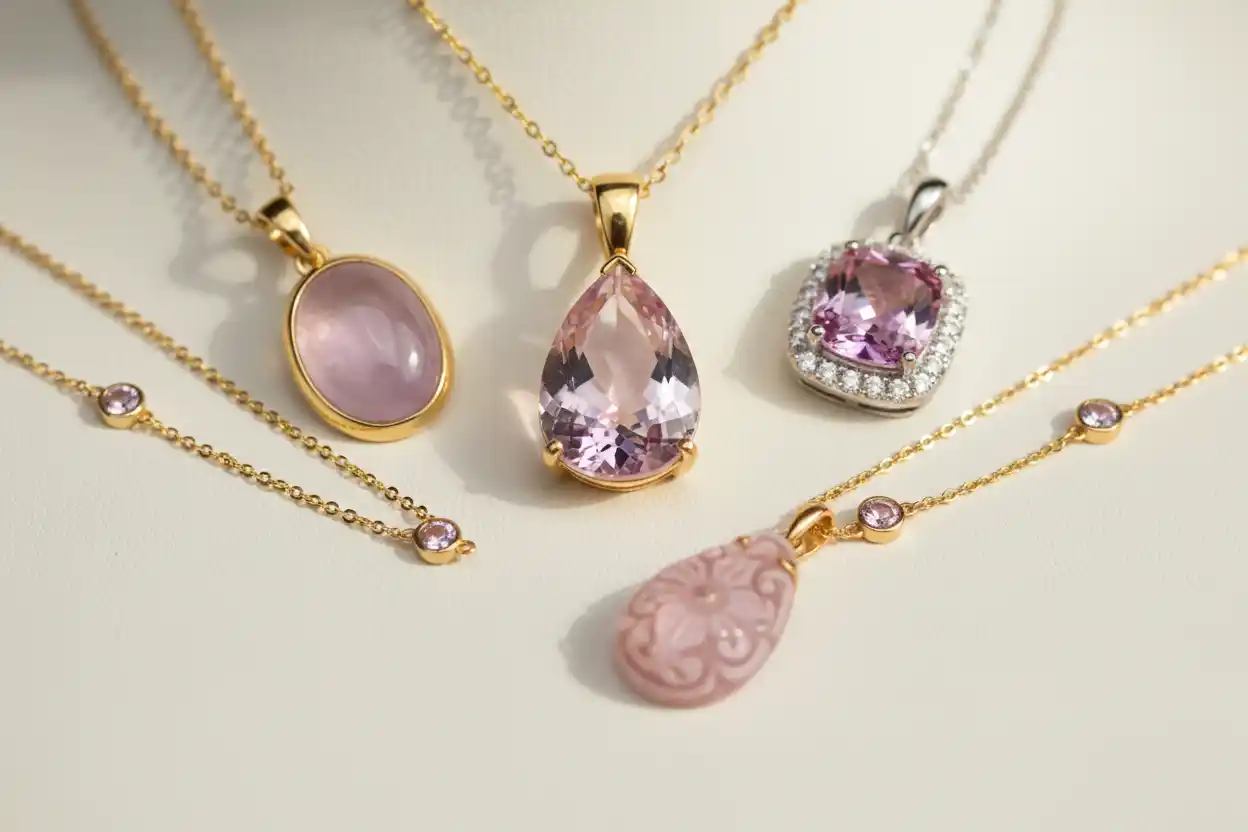
Kunzite Necklaces and Pendants: Styles and Buying Guide
Kunzite is particularly well suited to necklaces and pendants because the chest exposes a gemstone to less impact than the hand or wrist. Its crystals can also produce large, relatively clean faceted stones, making kunzite an accessible choice for dramatic pink or violet pendants.
A pendant is not risk-free. Long necklaces can strike desks, counters, bags, and metal zippers. High settings leave girdles exposed, weak bails can drop heavy stones, and prolonged sunlight can reduce color. The design must therefore protect the kunzite while allowing its pleochroism and transparency to remain visible.
The broader kunzite gemstone guide explains the mineral’s identity, formation, properties, and symbolism. This guide focuses on necklace styles, pendant orientation, chain construction, color, treatments, wearability, buying, and maintenance.
Why Pendants Work Well for Kunzite
Kunzite has perfect cleavage in two directions and poor toughness, despite a Mohs hardness of approximately 6.5–7. Jewelry that receives sharp impact can split it along a cleavage plane.
A pendant usually hangs away from most hard surfaces and avoids the repeated knocks received by a kunzite bracelet or ring. This lower-impact position allows jewelers to use larger stones and more open designs.
The gemstone hardness chart provides the scratch-resistance context. The guide to gemstone toughness versus hardness explains why pendants are preferred even though kunzite is not unusually soft.
Shorter pendants generally remain safer than long swinging necklaces. A large stone that rests near the upper chest is less likely to strike a tabletop than one hanging at waist level.
Main Kunzite Necklace and Pendant Styles
| Style | Visual effect | Practical advantage | Main concern |
|---|---|---|---|
| Solitaire pendant | Focuses attention on one gemstone | Simple and easy to inspect | Exposed girdle or weak bail |
| Bezel-set pendant | Modern protected outline | Strong perimeter protection | Uneven setting pressure |
| Halo pendant | Greater apparent size and sparkle | Halo can shield center stone | Hard accents must not touch kunzite |
| Prong-set drop | Open, bright appearance | Shows more of the gemstone | Exposed edges and corners |
| Station necklace | Small stones spaced along chain | Lightweight contemporary style | Flipping and connector wear |
| Kunzite bead necklace | Broad field of pink or lilac color | Flexible and tactile | Drill holes, cord and bead abrasion |
| Carved pendant | Artistic form and large surface | Uses clean large material | Thin areas and cleavage |
| Vintage pendant | Decorative metalwork | Character and historical styling | Repairs, worn prongs and closed backs |
| Locket or framed plaque | Combines stone with personal design | Strong metal support | Hidden backing, glue or replacement material |
| Multi-stone necklace | Graduated or clustered color | Creates a substantial statement | Matching and many maintenance points |
Solitaire Kunzite Pendants
A solitaire places all attention on one gemstone. Pears, ovals, cushions, rectangles, hearts, and custom fantasy cuts are common because kunzite rough can yield large transparent stones.
A good solitaire should show attractive face-up color, minimal windowing, controlled extinction, and a secure connection between the setting and bail.
Examine the pendant from the side. A very deep stone may contain substantial hidden weight and project far from the chest. That depth can strengthen color, but it also increases leverage and requires a larger, stronger setting.
A six-prong design can provide redundancy for rounded stones. Pears and hearts need protection around their points, while rectangular stones benefit from guarded corners.
Bezel-Set Kunzite Pendants
A bezel surrounds the gemstone’s perimeter and offers strong protection against lateral impact. It can also create a low, smooth pendant that does not snag clothing.
Kunzite must be set carefully because uneven pressure can trigger cleavage. The bezel should fit the stone rather than forcing it into a seat cut for a different outline.
Partial bezels can preserve more light entry while shielding the most vulnerable sides. A protective back rail can support the pavilion without closing the pendant completely.
Halo Kunzite Pendants
A halo can frame pale kunzite with diamonds, sapphires, spinel, zircon, or moissanite. The surrounding contrast makes soft pink-violet color more visible and increases apparent size.
A low halo can protect the center stone when it extends slightly beyond the kunzite’s edge. A tall open halo may remain visually impressive but provide little impact protection.
Hard accent stones should not touch the kunzite. Their girdles and prongs can scratch or chip the softer center if the setting flexes.
Large Kunzite Statement Pendants
Kunzite is available in sizes that would be unusually expensive in many other transparent pink gems. Large stones can create bold pendants without requiring exceptionally rare rough.
However, the chain, bail, setting, and wearer must support the additional weight. A heavy pendant on a fine chain may pull the clasp forward, stretch links, or fail suddenly.
Large stones should hang high enough to avoid desks and counters. They also need a broad bail or articulated connector that allows movement without twisting the setting.
The Kunzite Buying Guide explains why color and cut remain more important than size by itself.
Kunzite Bead Necklaces
Bead necklaces can use round, oval, faceted, graduated, or irregular kunzite. Matching a long strand requires coordination of color, translucency, diameter, polish, and drill quality.
Inspect drill holes for chips and fractures. Kunzite’s cleavage makes drilling demanding, while bead-to-bead movement can enlarge small edge defects.
Knots between beads reduce contact and limit loss if the strand breaks. Synthetic cord or silk may be used depending on weight and desired drape, but every material requires periodic inspection.
Perfectly uniform vivid pink beads at a very low price deserve scrutiny. Glass, dyed quartz, and other pink materials can imitate kunzite.
The general crystal necklaces guide discusses necklace forms and styling, while this page owns kunzite’s specific structural and light-related concerns.
Carved Kunzite Pendants
Clean large crystals allow cutters to produce carved drops, leaves, flowers, abstract forms, and fantasy designs. Carving can also use internal needles or growth features as part of the visual composition.
Kunzite remains difficult to work because its cleavage can cause unpredictable separation during cutting and polishing. A completed carving should retain enough material around holes, loops, points, and narrow bridges.
Examine every projecting edge. Thin petals, openwork, and drilled suspension loops can be more vulnerable than the thick center of the carving.
A metal cap can reinforce the top, but it may also conceal glue, a fracture, or an earlier break.
Pleochroism and Pendant Orientation
Kunzite displays different colors in different crystal directions. Its strongest color is generally visible along the length of the original crystal.
A pendant normally hangs in a predictable vertical orientation. This can help preserve the cutter’s intended face-up color better than a bracelet or loose ring that rotates constantly.
However, pendants can flip. A stone that looks pink from the front may appear pale or nearly colorless when turned sideways. The setting should encourage the pendant to face forward.
When evaluating a necklace:
- View it flat on a neutral surface.
- Hold it upright as it would hang.
- Tilt it from side to side.
- Observe it against skin and fabric.
- Check it under daylight-equivalent and ordinary indoor light.
- Watch whether the pendant flips during movement.
The direct kunzite-versus-morganite guide explains how kunzite’s pleochroism differs from the typically peachier beryl alternative. Buyers comparing similar jewelry can also consider a morganite necklace.
Color and Skin-Level Appearance
Kunzite ranges from very pale pink to lilac, violet-pink, and rare stronger purple. A pendant’s bodycolor can appear different against skin, dark fabric, white clothing, or an open metal back.
Pale kunzite may need sufficient size or a reflective setting to remain visible. Medium pink-violet stones generally show more presence, while extremely dark material may suffer from extinction.
White gold and platinum emphasize cool violet tones. Rose gold supports pink, while yellow gold creates a warmer contrast.
The directories of pink gemstones and purple gemstones compare kunzite with other stones in those color ranges.
Clarity and Condition
Kunzite is often relatively clean. Eye-visible inclusions that reduce transparency can therefore affect value more noticeably.
For a pendant, inspect the area near the bail and setting contacts. A fracture at the top of a heavy stone can be more concerning than a small enclosed inclusion near the center.
Closed-back pendants require particular care. The backing can hide a crack, glue, color foil, assembled material, or replacement stone.
A clean open back allows inspection but should still provide enough metal support to protect the pavilion.
Cut and Face-Up Size
Kunzite may be cut deeply to strengthen color and orient the pleochroism. Consequently, carat weight alone can exaggerate how large the stone will appear from the front.
Compare millimeter dimensions, not merely weight. An elongated pear may appear larger than a deep cushion of equal carat weight.
Step cuts highlight clarity and color zoning, while brilliant cuts add sparkle. Mixed cuts combine broad facets with a livelier pavilion.
A broad central window reduces visual depth. Extensive extinction can make a vivid stone look dark. The best cut balances color, brightness, outline, orientation, and retained weight.
Chain Length and Pendant Placement
Chain length determines both appearance and exposure.
| Necklace position | Typical use | Kunzite consideration |
|---|---|---|
| Choker or short chain | Small pendants near the neck | Low impact, but cosmetics and perfume exposure |
| Princess length | Upper chest | Versatile and relatively protected |
| Matinee length | Mid-chest | Larger movement and possible desk contact |
| Opera length | Lower chest | Higher swing and snagging risk |
| Long rope | Layering or doubled wear | Stone may collide with jewelry or furniture |
Exact placement depends on body proportions, clothing, and pendant size. Request the wearable chain length rather than relying only on style names.
A large kunzite usually performs best at princess or controlled matinee length. Very long chains increase leverage and impact.
Bail and Connector Construction
The bail carries the entire pendant weight. It must be large enough for the chain’s end fitting and strong enough for repeated movement.
Articulated bails allow the pendant to hang naturally. Fixed bails can keep the stone facing forward, but poor alignment may cause constant flipping.
Check solder joints, jump rings, pins, and glue. A narrow metal loop attached to a heavy kunzite can wear through even when the gemstone remains undamaged.
For drilled pendants, inspect the hole for cracks and confirm whether the metal pin passes through the stone or relies only on adhesive.
Choosing a Chain
A chain should match the pendant’s weight and style. Delicate cable, box, wheat, rope, and curb chains vary considerably in strength even when they look similar in photographs.
White gold or platinum creates a cool presentation. Yellow and rose gold alter the apparent warmth of the stone. Sterling silver can be suitable for moderate pendants, although thin silver links and plated components require closer inspection.
A clasp should close positively and remain large enough for the wearer to operate comfortably. Valuable pendants benefit from sturdy lobster or box-style closures rather than the smallest available spring ring.
Metal sensitivity depends on the chain, clasp, solder, and plating. The guide to gemstones and metals for sensitive skin addresses those issues separately.
Treatments and Color Stability
Kunzite may receive irradiation followed by heating to improve color. Both natural and enhanced color can fade under prolonged intense light or heat.
An untreated claim therefore does not make a necklace suitable for constant sunny display. Store it in a closed box, away from windows and high-intensity lamps.
The guide to crystals that fade in sunlight provides broader context. The gemstone treatments guide explains why treatment disclosure, color stability, and natural origin are separate questions.
Avoid leaving kunzite necklaces in hot vehicles, direct sun, tanning environments, or heated display cabinets.
Price and Value
The dedicated kunzite price guide owns current value factors.
In a necklace, the finished price may reflect:
- Kunzite color and clarity
- Cut and face-up size
- Treatment
- Metal weight
- Accent stones
- Bail and chain construction
- Carving labor
- Brand
- Matching in multi-stone designs
- Repairability
- Independent documentation
Large size alone does not establish exceptional value because kunzite occurs in substantial crystals. Strong vivid color and skillful orientation are generally more important.
Buying Online
Follow the safeguards in How to Buy Gemstones Online Without Getting Scammed.
Request:
| Buying check | What to confirm |
|---|---|
| Material | Natural kunzite or clearly disclosed alternative |
| Treatment | Irradiation, heat, coating, filling, glue, repair, or assembly |
| Stone data | Carat weight and millimeter dimensions |
| Pendant data | Total length, width, depth, and weight |
| Chain | Length, gauge, alloy, hallmark, clasp, and removability |
| Bail | Opening size, attachment method, articulation, and condition |
| Color | Neutral-light video showing front, side, and movement |
| Condition | Fractures, chips, abrasions, repairs, and loose settings |
| Returns | Time to inspect the pendant without destructive testing |
| Documentation | Independent report when price or identity justifies it |
The gemstone certification guide explains how identification reports differ from appraisals and seller cards.
Wearing a Kunzite Necklace
Put the necklace on after perfume, hairspray, sunscreen, and cosmetics have dried. Remove it before exercise, swimming, showering, sleeping, cooking, or carrying objects that may strike the pendant.
Shorter pendants can be worn more regularly than long statement pieces. Even so, avoid leaning a large stone directly against a desk.
Do not layer kunzite against diamond necklaces or hard-edged chains. Repeated rubbing can scratch its surface.
A matching pair of kunzite earrings can create a coordinated set without adding hand-level impact. A kunzite ring should be reserved for more controlled wear.
The guide to best gemstones for everyday wear compares kunzite with tougher alternatives when daily, unrestricted use is the priority.
Cleaning and Storage
Use lukewarm water, mild soap, and a soft brush or cloth. Avoid steam and ultrasonic equipment.
The complete procedure appears in How to Clean Kunzite Jewelry Safely.
Support the pendant while cleaning so its weight does not pull against the bail. Rinse it in a bowl rather than directly over an open drain.
Dry the chain, clasp, back, and setting thoroughly. Store the necklace flat or in a broad curve inside a closed fabric-lined box, with the pendant in its own compartment.
The Crystals That Start With K directory places kunzite within the wider K directory while retaining its distinct cleavage and light-sensitivity requirements.
Repair and Maintenance
Inspect the bail, jump rings, chain links, clasp, prongs, bezel, and stone condition periodically. A heavy pendant creates constant wear at the connection point.
Tell the jeweler that the gemstone is kunzite before repair. Torch heat, steam, ultrasonic cleaning, sudden temperature changes, and concentrated setting pressure can cause damage.
When a large pendant chips, recutting may preserve the material, but it can change the outline, color orientation, and fit within the original setting. A custom repair may therefore require both lapidary and jewelry work.
Frequently Asked Questions
1. Is a kunzite pendant durable enough for regular wear?
It can be worn regularly with care because pendants receive less impact than rings and bracelets. Shorter, low-profile designs are generally safer.
2. What is the safest setting for a kunzite pendant?
A carefully fitted bezel or partial bezel usually provides strong edge protection. Low halos and secure six-prong designs can also work.
3. Why does my kunzite pendant look pale from the side?
Kunzite is pleochroic, so different directions can show pink, violet, pale, or nearly colorless appearances.
4. Is a large kunzite pendant valuable?
Large stones are not unusual. Vivid color, clarity, cut, orientation, treatment, and workmanship usually matter more than size alone.
5. Can kunzite necklaces fade in daylight?
Normal brief wear is less concerning, but prolonged intense light and heat can fade natural or enhanced color. Store the necklace in a closed box.
6. What chain length is best for kunzite?
Princess length is versatile and keeps most pendants relatively protected. Very long chains increase swinging and impact risk.
7. Can kunzite be drilled for a pendant?
Yes, but drilling introduces stress around the hole. The area should be inspected for chips, fractures, and overreliance on glue.
8. Is a halo safer than an open solitaire?
A low halo can shield the center stone, provided the harder accent stones do not contact the kunzite.
9. Can I wear a kunzite necklace in direct sun?
Brief ordinary exposure is generally less problematic than prolonged display. Avoid extended direct sun, hot cars, and intense artificial lighting.
10. Can a kunzite necklace be cleaned ultrasonically?
No. Ultrasonic vibration can exploit fractures and cleavage. Warm soapy water is safer.
11. Does an expensive kunzite pendant need a laboratory report?
A report may be appropriate when identity, treatment, or value is disputed. It does not evaluate chain strength or guarantee color stability.
12. What should I do if the pendant begins flipping constantly?
Check whether the bail is aligned, the chain is too light, or the setting is unbalanced. A jeweler may be able to adjust the connector without applying pressure to the stone.
Kunzite’s large clean crystals and soft color make it particularly effective in pendants, but scale should never outrun construction. A balanced necklace uses a secure bail, adequate chain, protected girdle, stable face-forward orientation, and shaded storage. Those details allow the gemstone to display its pleochroism without exposing its cleavage to unnecessary stress.