Obsidian Meaning: Properties, Healing Traditions, Uses & Care
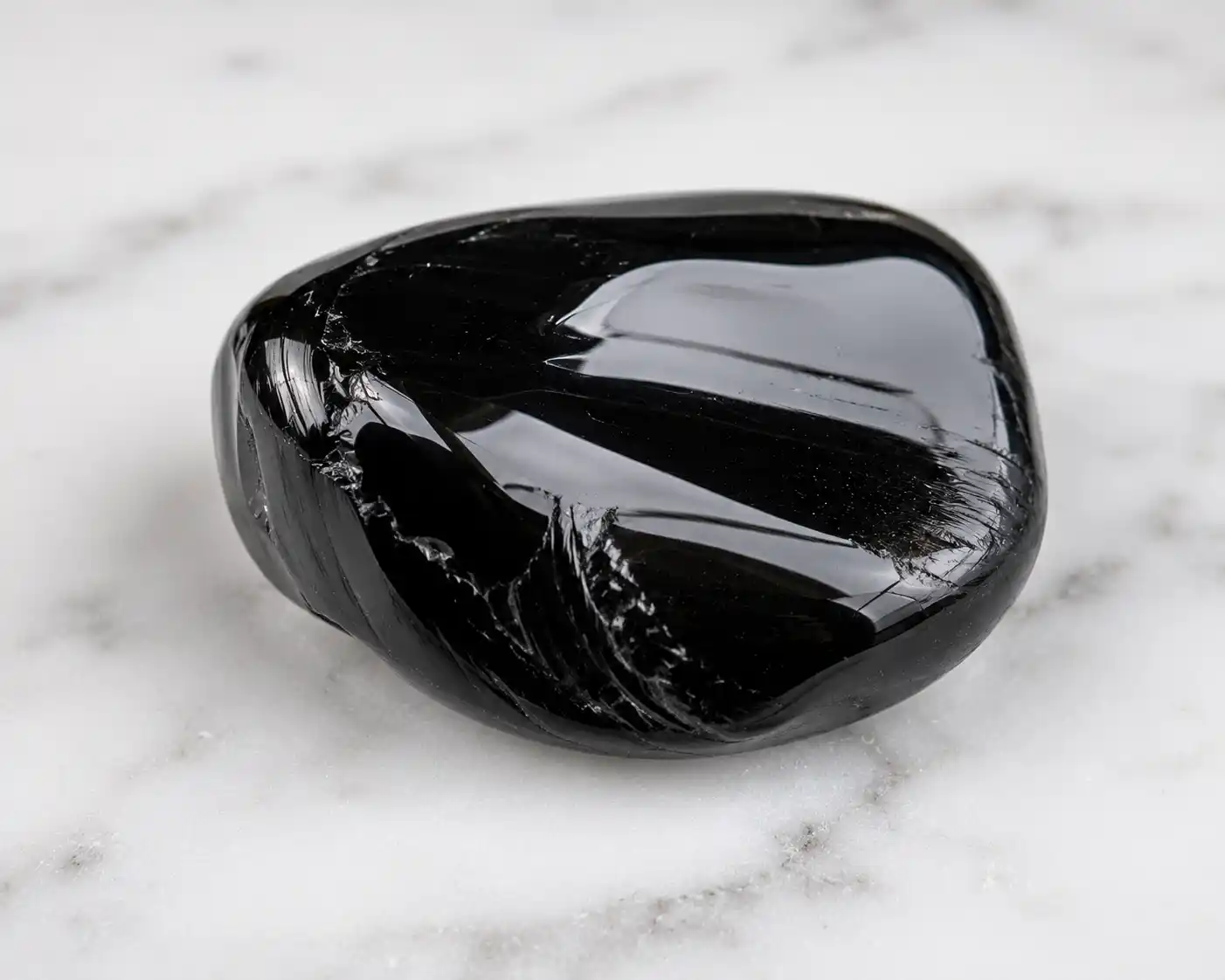
Obsidian is natural volcanic glass formed when silica-rich lava cools before extensive crystals can develop. Most people recognize it as glossy black material, but natural obsidian can also show reddish-brown patches, pale snowflake-like structures, silver or golden sheen, and vivid rainbow effects. Obsidian meaning developed around this unusual combination of darkness, reflection and exceptionally sharp fracture, producing symbolic associations with truth, grounding, protection, boundaries and recognizing difficult patterns.
The physical material and obsidian meaning should be understood separately. Geology explains why obsidian forms, why it behaves like glass and why broken pieces can develop extremely sharp edges. Cultural history and contemporary spirituality explain why people use the material as a symbol of self-examination, release and protection.
That distinction makes obsidian meaning more useful rather than less meaningful. A polished stone can serve as a deliberate reminder to examine a decision or reinforce a boundary without being treated as a supernatural shield, medical treatment or source of hidden information.
Obsidian at a Glance
| Property | Obsidian |
|---|---|
| Material type | Natural volcanic glass |
| Geological classification | Glassy igneous rock |
| Typical composition | Silica-rich volcanic glass with varying minor elements |
| Structure | Amorphous rather than crystalline |
| Common colors | Black, dark brown, reddish brown, gray and muted greenish tones |
| Patterned varieties | Snowflake and mahogany obsidian |
| Optical varieties | Rainbow, golden-sheen and silver-sheen obsidian |
| Luster | Vitreous |
| Transparency | Transparent at thin edges to opaque |
| Mohs hardness | About 5–5.5 |
| Cleavage | None |
| Fracture | Conchoidal |
| Typical uses | Cabochons, beads, carvings, mirrors, decorative objects and historical tools |
| Main durability concern | Chipping, scratching and extremely sharp broken edges |
| Common symbolic themes | Truth, grounding, boundaries, protection, reflection and release |
What Is Obsidian?
Obsidian is volcanic glass rather than a conventional mineral crystal. It usually develops from silica-rich volcanic material, commonly associated with rhyolitic or related compositions. When the molten material cools rapidly enough, atoms do not have sufficient time to organize into an extensive repeating crystal lattice.
The result is an amorphous glass.
For this reason, calling obsidian a crystal is convenient in general crystal-shop language but not mineralogically precise. Its natural origin is not in doubt simply because it lacks crystalline structure.
Understanding this difference gives obsidian meaning an interesting physical foundation. The material represents a moment when molten rock changed state rapidly and became glass before ordinary crystallization could dominate. That dramatic formation history makes transformation an intuitive metaphor, even though geology itself does not prove spiritual transformation.
The broader types of obsidian guide separates the major colors, patterns and optical effects without treating them as entirely different mineral species.
How Obsidian Forms
Obsidian develops where volcanic melt cools under conditions that suppress extensive crystal growth. High silica content makes many obsidian-forming magmas relatively viscous, limiting the movement required for atoms to organize efficiently.
Glassy zones can form near lava-flow margins, volcanic domes and other rapidly cooled portions of volcanic systems. Tiny crystals, bubbles and flow structures may still be present, so natural obsidian does not need to be perfectly featureless.
Over geological time, volcanic glass can slowly change. Water can enter the glass, while atoms may reorganize into microscopic crystalline structures through devitrification.
Those processes are scientifically important and should remain separate from obsidian meaning. Obsidian does not physically absorb emotional negativity because volcanic glass can undergo environmental hydration. The two uses of the word “absorb” describe completely different concepts.
Why Obsidian Is Usually Black
Most familiar obsidian looks deep black because iron-bearing components, microscopic particles and the thickness of the glass influence how light is absorbed and transmitted.
A thin edge may reveal smoky brown, gray or muted greenish translucency even when a thick polished piece looks completely opaque. Black color therefore does not mean the material is composed mainly of carbon.
The dark reflective surface strongly influenced modern obsidian meaning. Black has become associated symbolically with protection, depth, seriousness and introspection, while the reflective polish encourages metaphors about looking inward.
The dedicated black obsidian meaning guide explores the uniform dark variety in more depth. Not every black polished stone is obsidian, however, and color alone should never establish identity.
Obsidian Meaning and Symbolism
The broadest obsidian meaning centers on truth, grounding, boundaries, protection and release. Its physical appearance helps explain why these themes developed.
A polished black surface can act like a dark mirror. Its fracture creates decisive, razor-fine edges. Its volcanic origin connects it visually with heat, cooling and dramatic geological change.
Modern spiritual traditions often translate those features into symbolic language: seeing what has been avoided, separating useful information from confusion, ending an unhelpful pattern or creating stronger boundaries.
A grounded approach to obsidian meaning treats these ideas as reflective prompts.
Instead of asking the stone to reveal a hidden truth, ask which facts are already available and which assumptions need verification. Instead of expecting obsidian to remove an unhealthy influence, identify what behavior, boundary or environmental change would materially improve the situation.
The stone can mark the intention. Human action creates the change.
Obsidian Meaning for Grounding
Grounding is one of the most common themes associated with obsidian meaning. Dark color, physical weight and volcanic origin contribute to imagery involving stability and connection with the Earth.
Obsidian appears frequently among crystals for grounding, but grounding does not require a gemstone to work.
In practical terms, grounding means bringing attention back to the immediate environment and the next manageable action. Someone might notice the surface under their feet, identify visible objects in the room, slow their breathing or complete one concrete task.
Obsidian meaning can support this process by becoming a consistent visual cue.
If a person sees the stone on a desk during an overwhelming moment, it may prompt the question: What actually needs my attention right now?
The benefit comes from redirecting attention and behavior, not from volcanic glass altering the nervous system.
Obsidian Meaning for Protection
Protection is another major part of obsidian meaning. The stone appears widely in historical symbolism and contemporary crystal protection traditions.
A useful modern interpretation focuses on boundaries and risk awareness rather than an invisible shield.
Obsidian cannot prevent burglary, physical violence, infection, cybercrime, financial fraud, accidents or other real hazards. Protection requires appropriate actions such as securing property, using safety equipment, changing compromised passwords, documenting misconduct or seeking professional assistance.
Within that framework, obsidian meaning can represent the decision to notice warning signs instead of dismissing them.
The symbolism becomes especially practical when the stone is associated with a question such as: What risk am I actually trying to reduce?
That question directs attention toward evidence rather than fear.
Obsidian Meaning and “Negative Energy”
People often describe obsidian meaning in terms of absorbing or blocking negative energy. The phrase can refer to many different experiences: interpersonal tension, exhaustion, fear, an unpleasant environment, social pressure or memories connected with a place.
There is no established physical substance called negative energy that obsidian removes from a room or body.
A symbolic interpretation can still be useful. Someone who places obsidian near a workspace might use it as a reminder not to engage repeatedly with unnecessary conflict. Another person may associate it with creating distance from an unhealthy dynamic.
Obsidian meaning works best here when the question shifts from “How much negativity has this stone absorbed?” to “What part of this situation can I change?”
The stone does not become dangerous because it has not undergone energetic cleansing. Physical cleaning and spiritual cleansing are different ideas.
Obsidian Meaning for Emotional Honesty
The reflective quality of polished obsidian has made emotional honesty an important part of obsidian meaning.
Modern traditions sometimes say the stone reveals hidden emotions. A more careful interpretation is that deliberately stopping to reflect can make previously ignored reactions easier to notice.
For example, someone might separate an experience into four parts: what happened, what they thought about it, what they felt and what action they now want to take.
That distinction matters because emotions are real experiences without always being accurate evidence about another person’s motives.
Fear can exaggerate risk. Anger can simplify a complicated situation. Shame can turn one mistake into a global judgment about identity.
Obsidian meaning can represent willingness to examine those reactions without treating every thought as fact.
Obsidian Meaning and Shadow Work
Obsidian is often associated with shadow work, a contemporary psychological and spiritual framework for examining traits, reactions or desires a person tends to avoid.
The connection fits obsidian meaning because the dark reflective surface has become a metaphor for looking at uncomfortable material.
A useful exercise remains specific. Choose one recurring response and ask what situations tend to trigger it, what the response attempts to protect and whether the behavior still produces a useful outcome.
The goal should not be to force emotional pain or search endlessly for a dramatic hidden cause.
Obsidian cannot reliably recover suppressed memories or prove that an interpretation of the past is correct.
Severe trauma symptoms, dissociation, self-harm thoughts or overwhelming memories require qualified mental-health support. Intense distress is not evidence that obsidian meaning is “working more deeply.”
Obsidian Meaning for Emotional Healing
Obsidian meaning is frequently connected with emotional release, grief and moving beyond old patterns. The wider healing crystals framework can include stones as symbolic attention cues while keeping medical claims separate from personal practice.
A gentle reflective exercise might ask three questions: What still hurts? What part of the situation cannot be changed? What support or action would be useful today?
That approach avoids turning emotional healing into a demand to uncover everything at once.
Obsidian cannot remove grief, cure trauma, repair abuse or make another person accept responsibility. Recovery often involves safety, time, supportive relationships, professional care when needed and repeated practical decisions.
Obsidian meaning can accompany that process without being presented as its cause.
Obsidian Meaning for Anxiety and Stress
Some modern traditions recommend obsidian during anxiety or stress because of its grounding symbolism.
No mineral-specific anti-anxiety effect has been established. However, holding a familiar smooth object while deliberately slowing attention may feel calming for some people.
A simple grounded practice is to state the concern in one sentence and then classify it: Does this situation require action, information, scheduling, rest or outside support?
Obsidian meaning can make that routine easier to remember.
Persistent panic, significant avoidance, sleep disruption or other ongoing symptoms deserve appropriate professional assessment. If focusing on a dark reflective stone makes a person feel more distressed, the exercise can simply stop.
Discomfort should never be interpreted as proof that someone must continue because the stone is releasing hidden negativity.
Obsidian Meaning for Boundaries
Boundaries are one of the most practical interpretations of obsidian meaning.
A boundary is not an instruction that controls someone else. It describes what a person will do when a defined limit is crossed.
“I will end the conversation if insults begin” is a boundary. “This person must become respectful because I carry obsidian” is not.
The stone’s sharp fracture offers a strong metaphor for clarity, but real boundaries depend on communication and consistent follow-through.
Obsidian meaning can therefore represent recognizing where responsibility ends. Someone may decide not to lend additional money, limit communication outside agreed hours or stop participating in conversations that repeatedly become abusive.
The stone cannot force anyone to respect those limits. Distance, documentation, support and enforceable decisions create the actual protection.
Obsidian Meaning for Confidence and Decision-Making
Because fractured obsidian can form an extremely precise edge, contemporary obsidian meaning sometimes includes decisiveness and confidence.
A useful decision ritual starts with evidence rather than intuition alone. Define the decision, list realistic options, identify the most important unknowns and determine whether one option is reversible.
Confidence does not require pretending uncertainty has disappeared.
Obsidian cannot identify the correct career, relationship, investment or treatment through hidden knowledge. Instead, obsidian meaning can represent the willingness to make a proportionate decision after examining available evidence.
This interpretation keeps the symbolism connected with agency rather than prediction.
Obsidian Meaning for Manifestation
Obsidian sometimes appears among crystals for manifestation because its symbolism emphasizes removing distractions and facing obstacles honestly.
The stone cannot attract money, guarantee a job offer, force reconciliation or make a desired event happen.
A grounded version of obsidian meaning turns an intention into measurable behavior. Write the desired outcome, identify what evidence would show progress and list actions within personal control.
The stone can sit beside that plan as a reminder to complete the scheduled action.
The ritual becomes effective to the extent that it supports attention, consistency and realistic reassessment.
Obsidian Meaning in Meditation
Polished obsidian is visually suited to meditation because its dark surface can provide a simple point of attention. It therefore appears in many crystal meditation practices.
Place an intact polished piece on a stable surface and observe its color, reflection and small internal features. Notice what changes when the light or viewing angle changes without treating every reflection as a message.
When attention wanders, return to ordinary breathing.
A session can finish with one observation and one practical next step. This keeps obsidian meaning connected with everyday life.
People who experience panic, dissociation or significant distress during meditation should stop rather than assuming discomfort is spiritually necessary.
Obsidian Mirrors and Scrying Traditions
Highly polished obsidian can produce a dark reflective surface, and obsidian mirrors have significant historical and cultural contexts.
Contemporary practitioners sometimes use them for scrying, meditation or symbolic self-reflection.
Obsidian meaning in this setting often involves seeing beneath appearances or revealing hidden truth. A dark reflection, however, cannot reliably predict the future, identify supernatural entities or provide inaccessible factual information.
Human perception naturally searches for patterns, particularly in ambiguous visual fields. Expectations can influence what a viewer believes they see.
A grounded mirror practice uses the object as a focus for reflection rather than evidence of prophecy.
Historically important obsidian objects should also be understood within their specific cultures instead of reducing every archaeological artifact to modern crystal terminology.
Obsidian and the Root Chakra
Black and reddish-brown obsidian varieties are commonly associated with the root chakra in contemporary spiritual systems.
Within that framework, the root chakra represents stability, safety, routine, shelter and belonging. The broader root chakra crystals tradition includes obsidian alongside several physically unrelated stones that share similar symbolism.
A grounded root-focused interpretation of obsidian meaning can review practical foundations: Is sleep adequate? Are meals regular? Is the immediate environment reasonably safe? Are finances being monitored? Is a recurring problem being avoided?
Chakras are spiritual concepts rather than measurable anatomical structures. Obsidian does not treat spinal conditions, digestive disorders, circulation problems or adrenal disease.
Major Obsidian Varieties and Their Symbolism
Different varieties have developed distinct symbolic profiles, although their meanings are cultural rather than measurable energetic categories.
Black obsidian is most strongly associated with protection, directness, boundaries and honest self-examination.
Snowflake obsidian contains pale spherulitic structures within darker volcanic glass. Its contrast has encouraged symbolism involving balance, patience and finding order during change.
Mahogany obsidian combines black with reddish-brown areas and is commonly associated with endurance, steady action and grounded transformation.
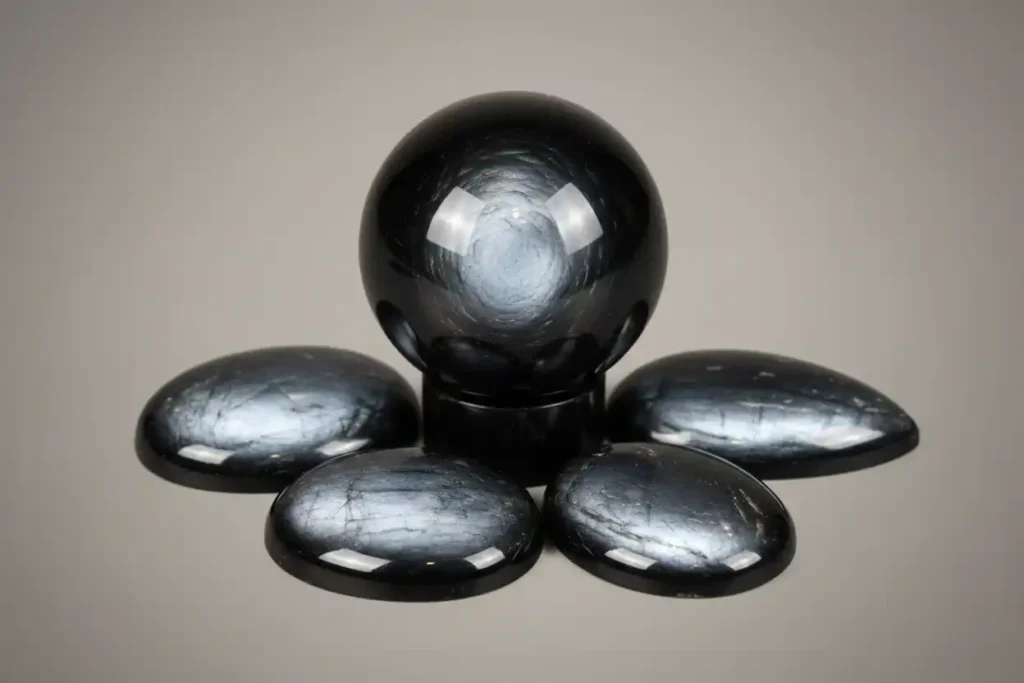
Rainbow obsidian can reveal green, purple, blue, gold or other colors under suitable directional light. Modern symbolism often connects it with emotional complexity, resilience and discovering constructive perspectives after difficulty.
Golden obsidian is generally linked symbolically with confidence, direction and personal responsibility, while silver sheen obsidian is commonly associated with reflection and seeing a situation from another angle.
These differences can personalize obsidian meaning, but no variety has scientifically demonstrated stronger healing or protective energy.
Snowflake Obsidian Is Partly Devitrified Glass
Snowflake obsidian deserves a mineralogical distinction because its pale spots are not literal snow, painted markings or trapped ash.
They are spherulitic structures that develop when parts of the volcanic glass begin to crystallize. Cristobalite is commonly an important component of these pale areas.
This makes snowflake obsidian a useful example of how geological facts and obsidian meaning can coexist without being confused.
The real physical pattern records partial crystallization. The symbolic interpretation of balancing light and dark is a human response to that pattern.
Both can be interesting without one proving the other.
Rainbow, Golden and Silver Sheen
Some of the most visually dramatic forms of obsidian appear almost black until they are moved under directional light.
Rainbow material reveals bands or layers of color, while golden and silver-sheen forms produce broader metallic-looking reflection. Microscopic internal structures, bubbles and inclusions interact with light to create these effects.
Correct cutting orientation is crucial. A piece of rough may contain impressive sheen that disappears if the strongest internal layer is not positioned correctly.
These optical effects often reinforce obsidian meaning because something apparently hidden becomes visible when perspective changes.
That metaphor can be personally useful, but the colors themselves arise from physical interactions with light rather than spiritual frequencies.
Obsidian vs Onyx
Obsidian and onyx are frequently confused because both can appear glossy black when polished.
They are completely different materials.
Obsidian is natural volcanic glass with an amorphous structure and conchoidal fracture. Onyx is chalcedony, a microcrystalline form of quartz.
Onyx is also harder and generally more scratch resistant.
The dedicated onyx vs obsidian comparison covers identification in detail. A black polished surface alone is not enough to identify either stone.
The symbolic overlap is also substantial because both frequently receive grounding or protection associations. Similar obsidian meaning and onyx symbolism do not indicate a geological relationship.
Obsidian vs Black Tourmaline
Black tourmaline is another dark material commonly associated with protection traditions, but it is a crystalline mineral rather than volcanic glass.
Tourmaline often develops prismatic crystal forms and lengthwise striations. Obsidian instead shows glassy surfaces, flow structures and conchoidal fracture.
The black tourmaline vs obsidian comparison also includes onyx, helping separate three materials that are frequently grouped together because of color and symbolism.
Protection associations belong to cultural practice. Their physical compositions and structures remain unrelated.
Obsidian vs Tektite
Obsidian forms during volcanic activity. Tektites form through large impact events that melt terrestrial material and scatter natural glass.
The tektite meaning guide explains the separate geological origin.
This distinction is especially important when bright green glass is sold as “green obsidian.” Moldavite, for example, is a tektite rather than volcanic obsidian.
Natural origin does not make every glassy material obsidian.
Is Bright Green or Blue Obsidian Natural?
Natural obsidian can show muted greenish, grayish or brownish tones, particularly around thin edges.
However, highly transparent emerald-green, cobalt-blue and other neon-colored products marketed as obsidian are frequently manufactured glass.
Bubbles alone cannot prove that a specimen is artificial because natural volcanic glass can contain gas bubbles. Likewise, perfectly clear appearance alone is not a sufficient test.
Material identification should consider the complete combination of appearance, structure, provenance and, when needed, gemological testing.
Obsidian meaning cannot authenticate a stone. A sensation, spiritual response or seller’s energetic claim does not establish natural volcanic origin.
Obsidian in Archaeology and Human History
Obsidian was valued long before modern crystal traditions developed.
Its conchoidal fracture allowed skilled craftspeople to produce exceptionally sharp edges. Archaeological sites contain obsidian projectile points, blades, scrapers, ornaments and ritual objects from numerous cultures.
Obsidian sources can also have distinctive trace-element chemistry. Scientists can compare artifacts with geological deposits to investigate ancient movement, exchange and trade networks.
That history gives obsidian significance beyond contemporary obsidian meaning.
A stone from an archaeological context is not simply an old “protection crystal.” Its meaning depends on the society that produced, used and exchanged it.
Collectors should respect archaeological laws and avoid purchasing undocumented artifacts that may have been illegally removed from protected sites.
Obsidian Hardness and Durability
Obsidian commonly measures around 5–5.5 on the Mohs scale. The gemstone hardness chart shows that it scratches more easily than quartz, topaz, sapphire and many commonly worn gemstones.
The material has no mineral cleavage because it lacks a crystalline lattice, but that does not make it tough.
Obsidian is brittle.
A hard impact can create a shell-like conchoidal chip with an edge sharp enough to cut skin. This difference between scratch resistance and resistance to breakage is important when choosing jewelry.
Obsidian meaning has no effect on physical durability. A stone symbolically associated with protection can still require careful protection from impact.
Obsidian Jewelry
Obsidian is commonly fashioned into cabochons, beads, pendants, earrings, bracelets, rings and carvings.
Pendants and earrings generally reduce impact exposure. Rings and bracelets encounter desks, door frames and other hard surfaces more frequently, making edge protection especially important.
A low bezel can protect the perimeter of a cabochon better than an exposed setting.
Bead holes should also be inspected. A chip around a drilled opening may create a sharp surface that damages stringing material or scratches skin.
Rainbow and sheen varieties require another quality check: the optical effect should face the viewer in normal wear rather than appearing only at an awkward angle.
The attraction to obsidian meaning may influence why someone chooses the jewelry, but workmanship determines how safely and comfortably it performs.
How to Judge Obsidian Quality
There is no single quality scale for every obsidian variety.
For ordinary black obsidian, smooth polish, attractive color, minimal damaging fractures and good workmanship matter. Because common black material is relatively abundant, exceptional carving or provenance may contribute more to price than raw stone scarcity.
Snowflake material is judged partly by the distribution and contrast of its pale patterns.
Mahogany obsidian benefits from strong, attractive contrast between black and reddish-brown areas.
Rainbow, golden and silver-sheen pieces depend heavily on brightness, coverage, orientation and how easily the optical effect appears.
The where to buy obsidian guide covers seller claims, authenticity and purchase decisions in greater depth, while buyers focusing on the uniform dark variety can use the black obsidian buying guide.
Obsidian meaning should not be treated as a quality grade. Claims about unusually powerful energy do not establish rarity or monetary value.
Treatments, Manufactured Glass and Imitations
Obsidian may be polished, carved, coated, backed, filled or incorporated into composite objects.
Manufactured glass can imitate ordinary black obsidian as well as more unusual colors and sheen effects. Industrial glass and slag are sometimes given dramatic trade names containing the word “obsidian” even when they are not natural volcanic glass.
Low price does not automatically indicate a fake because ordinary natural obsidian can be inexpensive.
Likewise, high price does not prove authenticity.
A strong seller should describe the material accurately, distinguish trade names from geological terms and disclose treatments when known.
How to Identify Real Obsidian
Natural obsidian commonly shows a glassy luster and conchoidal fracture. Thin edges may transmit brown, smoky or muted greenish light. Flow structures, tiny bubbles or microscopic inclusions may occur.
None of these observations is conclusive on its own.
Manufactured glass can reproduce many glass-like features because both materials are glass.
Avoid destructive home tests involving deliberate scratching, flame or breaking. A genuine obsidian object can be damaged, and creating a fresh fracture may produce a hazardous cutting edge.
For higher-value material, professional examination can evaluate physical properties more safely.
The crystals that start with O and gemstones that start with O directories also help place obsidian among similarly named materials without implying that all are mineral crystals.
Obsidian Physical Safety
Obsidian’s most important practical hazard is sharp fracture.
A polished stone may feel completely smooth until it falls and develops a thin chip. That edge can be sharper than its appearance suggests.
Do not carry loose raw shards in a pocket, place sharp fragments beneath bedding or give chipped pieces to children.
A damaged piece used for meditation should be removed until it can be safely repolished or stored.
Cutting, drilling and grinding also create fine glass-rich dust and fragments, so lapidary work requires appropriate professional controls.
Obsidian should never be used for blood rituals, skin cutting or home medical procedures.
These precautions arise from real material properties and should take priority over any interpretation of obsidian meaning.
Can Obsidian Go in Water?
An intact polished obsidian stone generally tolerates brief contact with clean water better than many soft or porous minerals.
That does not mean prolonged soaking is always necessary or appropriate.
Jewelry may contain adhesives, coatings, metals or mixed materials with different care requirements. Chipped surfaces also deserve caution.
Do not prepare drinking-water crystal elixirs with obsidian. There is no need to place a stone inside water intended for consumption to use obsidian meaning symbolically.
Keeping an intact polished stone beside a glass achieves the same ritual association without introducing unnecessary contamination or breakage risks.
How to Clean and Store Obsidian
For ordinary physical cleaning, remove loose grit first. Then use lukewarm water, mild soap and a soft cloth.
Avoid abrasive powders, toothpaste and aggressive scrubbing because volcanic glass can scratch.
Steam, sudden temperature changes and high heat are unnecessary risks. A damaged piece should be examined carefully before further handling because new chips may be extremely sharp.
Store obsidian separately from harder gemstones and metal edges. A padded compartment also helps contain fragments if accidental breakage occurs.
Spiritual cleansing is optional and belief-based. Physical cleaning removes dirt and skin oils; it does not alter a scientifically measurable protective energy.
How Obsidian Meaning Fits With the Real Material
Obsidian meaning becomes most coherent when the symbolism grows from genuine characteristics without being mistaken for them.
Its volcanic formation can represent change. Its reflective surface can symbolize self-examination. Its dark appearance can represent boundaries or seriousness. Its sharp fracture can become a metaphor for clarity and decisive separation.
Those connections are interpretations.
The volcanic glass itself does not know which relationship should end, which decision is correct or which hidden truth exists.
At Gems Lore, obsidian meaning is most useful when it encourages grounded observation instead of certainty without evidence. A stone can mark a boundary, accompany journaling or provide a focus during meditation, while decisions still depend on facts, communication, safety and personal responsibility.
Obsidian does not need supernatural powers to be extraordinary. Its transition from lava to glass, ancient technological importance, chemical usefulness in archaeological sourcing and ability to produce remarkably fine fracture edges already make it one of the most distinctive natural materials used as a gemstone.
Frequently Asked Questions
What is the main obsidian meaning?
The main obsidian meaning centers on protection, grounding, truth, personal boundaries, self-examination and releasing unhelpful patterns. These interpretations come from cultural and contemporary spiritual traditions rather than scientifically established energetic effects.
Is obsidian really a crystal?
Not mineralogically. Obsidian is natural volcanic glass with an amorphous structure rather than an extensive repeating crystal lattice. The word crystal is often used more broadly in metaphysical retail settings.
Does obsidian have healing properties?
Obsidian healing properties are spiritual or symbolic traditions rather than medically proven effects. The material has not been shown to cure illness, treat trauma, remove anxiety or alter body chemistry.
Does obsidian absorb negative energy?
There is no demonstrated physical mechanism by which obsidian absorbs a substance called negative energy. Obsidian meaning can instead represent setting boundaries or changing how someone responds to stressful situations.
Is obsidian good for grounding?
Obsidian is widely used symbolically for grounding. The stone can serve as a reminder to focus on sensory information and the immediate situation, but the grounding effect comes from attention and behavior rather than mineral-specific energy.
Can obsidian help with anxiety?
No established evidence shows that obsidian treats anxiety. Holding a smooth object during a structured calming routine may feel helpful to some people, but persistent or severe symptoms deserve appropriate professional care.
What chakra is obsidian associated with?
Black and reddish-brown obsidian are commonly linked with the root chakra in modern spiritual traditions. Chakras are symbolic spiritual concepts rather than scientifically established anatomical structures.
Can obsidian attract money?
Obsidian cannot generate money or guarantee financial success. Within manifestation practices, obsidian meaning can be used as a reminder to review finances, complete planned work or take another measurable step toward a goal.
Can obsidian reveal hidden truths?
Obsidian cannot obtain supernatural information. Its reflective symbolism can encourage someone to question assumptions and examine evidence, but intuition or scrying should not be treated as factual proof.
What is the difference between black obsidian and snowflake obsidian?
Black obsidian is predominantly dark volcanic glass. Snowflake obsidian contains pale spherulitic structures created as portions of the glass begin to crystallize. Their symbolic associations also differ, but neither variety has scientifically demonstrated stronger energy.
Is rainbow obsidian natural?
Genuine rainbow obsidian is natural volcanic glass whose internal structures produce colored bands under suitable lighting. Coated and manufactured imitations also exist, so appearance alone is not always conclusive.
Is obsidian the same as onyx?
No. Obsidian is volcanic glass, while onyx is chalcedony, a microcrystalline quartz material. Onyx is generally harder and more scratch resistant.
Is obsidian safe to touch?
Smooth, intact polished obsidian is generally suitable for ordinary handling. Raw or chipped material can form extremely sharp edges and requires much more caution.
Can obsidian go in drinking water?
Do not prepare crystal drinking elixirs with obsidian. Keeping the stone outside the drinking vessel avoids unnecessary contamination and breakage concerns while preserving any symbolic ritual.
How should obsidian be cleaned?
Clean intact polished obsidian briefly with lukewarm water, mild soap and a soft cloth. Avoid abrasive products, high heat and sudden temperature changes, and inspect damaged pieces for sharp chips before handling them again.
Obsidian records a rapid geological transition from molten material to natural glass. Its dark reflection, volcanic origin and sharp fracture later inspired a rich symbolic vocabulary involving truth, boundaries, grounding and transformation. The strongest interpretation of obsidian meaning respects both parts of that story: geology explains the material, while symbolism gives people a framework for reflection.
Obsidian meaning does not require the stone to absorb negativity, predict outcomes or treat illness. It can be meaningful precisely because it provides a physical reminder to examine what is happening, distinguish evidence from assumption, establish realistic boundaries and choose the next action deliberately.
Obsidian meaning, grounding, protection, chakra, manifestation, emotional-healing and negative-energy associations belong to cultural, spiritual or personal traditions rather than scientifically established effects. Obsidian should not replace medical or mental-health care, emergency assistance, financial safeguards or physical-safety measures. Raw or chipped obsidian can form extremely sharp edges and should be handled and stored carefully.