Opal Color Meaning, Play-of-Color & Symbolism
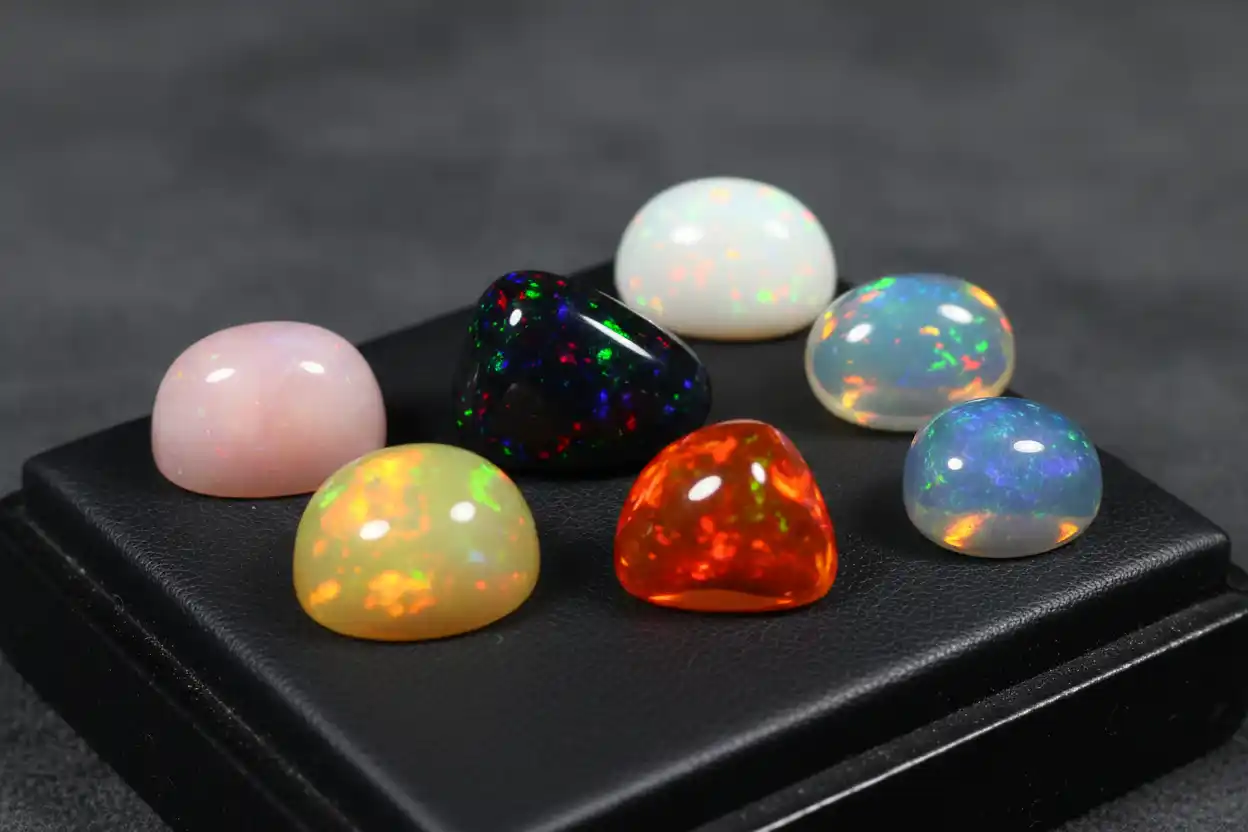
Opal can display two different kinds of color: the stone’s underlying bodycolor and the shifting spectral flashes known as play-of-color. A white opal may reveal green and red flashes, while a transparent orange fire opal may have strong bodycolor without displaying any rainbow effect.
Those differences matter in gem identification, valuation, and symbolism. Bodycolor helps classify the opal, whereas the brightness, range, pattern, and visibility of play-of-color strongly influence the appearance of precious opal.
Opal Colors at a Glance
| Opal appearance | Gemological description | Common modern symbolism |
|---|---|---|
| White or light | White, cream, or pale-gray bodycolor; may show play-of-color | Clarity, renewal, openness, and reflection |
| Black or dark | Dark gray, blue-gray, brown, or black bodycolor beneath spectral color | Depth, independence, resilience, and mystery |
| Crystal or water | Transparent to semitransparent body with visible internal color | Perspective, honesty, fluidity, and adaptability |
| Orange or red fire opal | Yellow, orange, or red transparent-to-translucent bodycolor | Vitality, creativity, confidence, and expression |
| Pink | Pink common opal, sometimes with white, brown, or dendritic features | Affection, gentleness, connection, and emotional openness |
| Blue | Blue common opal or transparent-to-opaque blue material | Communication, calm observation, and spaciousness |
| Yellow or golden | Pale lemon to honey-yellow common or precious opal | Optimism, curiosity, confidence, and warmth |
| Green | Pale mint to deep green common opal | Growth, renewal, patience, and connection with nature |
| Multicolored play-of-color | Two or more spectral colors moving across the gem | Complexity, imagination, integration, and change |
These associations belong to modern color symbolism and personal interpretation. They do not describe scientifically demonstrated physical or emotional effects.
Bodycolor and Play-of-Color Are Different
The bodycolor is the stable background color visible when the opal is viewed without focusing on its spectral flashes. It may be white, black, gray, brown, yellow, orange, red, blue, green, pink, or nearly colorless.
Play-of-color is the shifting display of spectral color produced when ordered microscopic silica structures interact with light. It changes as the stone, light source, or viewer moves.
A black opal does not necessarily display black flashes. Instead, its dark background makes red, green, blue, orange, and violet play-of-color appear more strongly contrasted.
Likewise, a white opal may show the entire spectrum over a pale body. The difference lies primarily in the background against which the flashes appear.
The foundational chemistry, formation, and general history of the material belong on the main opal guide. This page instead explains how visible color affects classification, symbolism, and buying decisions.
What Produces Opal’s Spectral Colors?
Precious opal contains microscopic silica spheres arranged with enough regularity to interact with visible light. Light passing through this structure diffracts into spectral colors.
Sphere size and spacing affect which wavelengths become visible. Smaller structures commonly produce violet, blue, and green, while larger structures are required for orange and red.
The degree of order also matters. When the spheres vary too greatly in size or occur without regular packing, the material may show a soft glow or bodycolor but no true play-of-color.
That distinction separates precious opal from common opal. Common opal can still be blue, pink, yellow, green, white, or orange, but it lacks the organized spectral flashes of precious material.
The detailed variety framework appears in the guide to types of opal, which distinguishes body types, structures, origins, and commercial categories.
White and Light Opal Meaning
White opal has a white, cream, or pale-gray background. The body may be translucent, semitranslucent, or opaque, with spectral color appearing over or within it.
The pale background softens contrast, so play-of-color may appear more delicate than it does in black opal. Fine light opal can nevertheless show vivid red, green, blue, and orange across much of its face.
Modern symbolism associates white opal with reflection, fresh perspective, openness, and starting again without denying earlier experience.
Its appearance can also represent subtlety. A quiet-looking stone may reveal much more color when its viewing angle changes.
The dedicated white opal guide owns its localities, identification, buying concerns, durability, and specific symbolism.
Black and Dark Opal Meaning
Black opal has a dark bodycolor ranging from medium gray and blue-gray to brown-black or nearly black. The term describes the background, not the color of the flashes.
A dark base increases contrast, making spectral colors appear especially vivid. Red and orange can look dramatic, while blue and green may appear electric against charcoal or black.
Modern symbolic interpretations connect black opal with depth, privacy, independence, transformation, and retaining a strong internal identity.
However, not every dark opal is equally rare or valuable. Body tone, brightness, pattern, visible color range, treatment, origin, condition, and cut all matter.
Detailed evaluation belongs on the black opal guide, while current market analysis remains on the separate opal pricing pages.
Crystal and Water Opal Meaning
Crystal opal is transparent to semitransparent precious opal with visible play-of-color. The word crystal refers to transparency rather than a crystalline structure; opal remains an amorphous mineraloid.
Because light enters the transparent body, spectral colors can appear suspended at different depths. Dark backing or a dark surface beneath a loose stone may strengthen the visible effect.
Water opal is also transparent or semitransparent but may show weak, localized, or no play-of-color. The trade boundaries between crystal and water opal are not always applied consistently.
Modern symbolism links transparent opal with perspective, honesty, flexibility, and seeing several layers of a situation at once.
Hyalite is a transparent-to-translucent common opal that may show distinctive fluorescence, but it does not automatically qualify as crystal precious opal.
Orange and Red Fire Opal Meaning
Fire opal is defined primarily by yellow, orange, or red bodycolor rather than by play-of-color. Some pieces show spectral flashes, while others are valued entirely for their transparent warm color.
The richest red and orange bodycolors create associations with heat, movement, vitality, confidence, creative work, and visible self-expression.
Modern symbolism often frames orange fire opal as energetic without making it aggressive. Redder material may represent determination, courage, and purposeful action.
The word fire can be misleading when buyers assume that every fire opal must display rainbow flashes. In gemological usage, it usually describes the bodycolor.
The full geological and gem-market identity belongs on the fire opal guide.
Pink Opal Meaning
Pink opal is generally common opal whose bodycolor ranges from pale blush and peach-pink to deeper rose. White areas, brown matrix, dendrites, or subtle veining may occur.
Most pink opal does not show play-of-color. Its appeal comes from even bodycolor, soft translucency, natural patterning, polish, and suitability for cabochons or beads.
Modern symbolic interpretations connect pink opal with affection, gentleness, emotional honesty, supportive relationships, and communicating without unnecessary defensiveness.
These themes come from contemporary color symbolism rather than one universal ancient tradition.
Identification, treatments, common imitations, and buying factors are covered in the dedicated pink opal guide.
Blue Opal Meaning
Blue opal can range from pale sky blue and green-blue to smoky turquoise or deep blue-gray. Most commercial blue opal is common opal rather than precious opal.
Its color may arise from microscopic inclusions, light scattering, mineral impurities, or the interaction of several structural factors. The precise cause can vary by deposit.
Blue opal is commonly associated with thoughtful communication, calm observation, listening, spaciousness, and expressing an idea with greater precision.
Owyhee material from Oregon is known for soft-to-saturated blue bodycolor, although it represents only one blue-opal source. Its locality-specific properties belong on the Owyhee opal guide.
Yellow and Golden Opal Meaning
Yellow opal ranges from pale lemon and cream-yellow to honey, mustard, and golden brown. It may be transparent, translucent, or opaque.
Some yellow opal displays play-of-color, but much of it is common opal valued for bodycolor and polish.
Modern symbolism associates yellow opal with optimism, curiosity, intellectual confidence, warmth, and recognizing opportunities without ignoring risk.
Color grading is not standardized across every seller. Pale orange fire opal, honey opal, yellow common opal, and yellow chalcedony can overlap visually in online listings.
The dedicated yellow opal guide owns identification and color-specific buying intent.
Green Opal Meaning
Green opal ranges from pale mint and yellow-green to olive, moss green, and deep forest tones. It is usually common opal and may contain matrix, dendrites, or cloudy variations.
Nickel-bearing phases, iron-bearing minerals, inclusions, and light-scattering structures can contribute to green coloration, depending on the deposit.
Modern interpretations connect green opal with renewal, practical growth, patience, rest, and rebuilding after change.
Green opal should not be identified solely from color. Chrysoprase, serpentine, prehnite, dyed chalcedony, glass, and other materials can look similar.
A laboratory can distinguish these materials through refractive index, spectroscopy, microscopy, density, and structural analysis.
Multicolored and Rainbow Opal Meaning
A precious opal may display one dominant spectral hue or several colors across its face. Full-spectrum material can reveal red, orange, yellow, green, blue, and violet as the viewing angle changes.
Modern symbolism associates multicolored opal with imagination, complexity, integration, and accepting that one experience can contain several apparently opposing elements.
“Rainbow opal” is not one standardized geological variety. Sellers may use the phrase for any opal showing several colors, and it should not replace a more precise description of body type, origin, treatment, and structure.
The Ethiopian market supplies many transparent, white, yellowish, and smoky opals with broad play-of-color. Their hydrophane behavior and source-specific considerations belong on the Ethiopian opal guide.
Boulder Opal Color
Boulder opal consists of seams, patches, or veins of opal that remain attached to their natural host rock after cutting.
Brown ironstone commonly creates a dark supporting background, strengthening blue, green, orange, and red play-of-color. The host may also form part of the visible pattern.
Because the backing is natural, boulder opal should not be confused automatically with an assembled doublet. Nevertheless, buyers should inspect the relationship between opal and matrix carefully.
Its detailed construction, geology, and buying factors belong on the boulder opal guide.
Does Color Affect Opal Value?
Color influences value, but no single hue determines price independently.
Brightness usually matters more than merely having many colors. A vivid green-and-blue opal can be more attractive than a weak full-spectrum stone.
Red play-of-color is traditionally prized because the required optical structures are less common. Orange generally follows, then green and blue, although personal taste and market fashion can shift preferences.
Bodycolor also affects contrast. Dark opal often makes play-of-color look stronger, while transparent crystal opal can create exceptional depth.
Pattern, coverage, directional visibility, transparency, cut, thickness, crazing, treatment, origin, and condition all remain important. Detailed figures and market comparisons belong on the dedicated opal price guide.
Anyone preparing to purchase a significant stone should use the separate opal buying guide rather than relying on color symbolism alone.
Natural Color, Treatment, and Assembly
Opal may be smoked, dyed, impregnated, sugar-and-acid treated, coated, filled, backed, or assembled into doublets and triplets.
Smoking and dark treatments can increase contrast by changing the body appearance. Dye may create stronger black, blue, red, orange, green, or purple tones.
A doublet usually combines a thin opal layer with a dark backing. A triplet adds a transparent cap. These constructions can produce attractive and practical jewelry when disclosed accurately.
Laboratory-grown opal and glass imitations may reproduce bodycolor and play-of-color-like effects. Their appearance does not establish natural origin.
Treatment-specific indicators are covered in treated opal identification, while assembled stones and common simulants belong on the real-versus-fake opal guide.
Choosing an Opal Color for Jewelry
Color choice should begin with visual preference rather than a symbolic rule. Some people prefer the contrast of black opal, while others value the softer appearance of white, pink, yellow, or blue material.
The setting metal changes perception. Yellow gold strengthens warm fire-opal tones, while white metals can sharpen blue, green, and violet flashes.
Jewelry format also affects visibility. A ring allows the wearer to rotate the stone constantly, but it exposes opal to more impact, water, cosmetics, and temperature changes.
Anyone choosing that format should consider the structural and setting factors in the opal ring guide.
Opal is also one of October’s traditional birthstones. Its broader seasonal and historical role appears in the October birthstone guide.
Color Symbolism and Healing Claims
The symbolism assigned to opal colors is influenced by general color psychology, historical jewelry traditions, modern crystal culture, and the individual stone’s appearance.
White is frequently linked with renewal, black with depth, orange with expression, pink with affection, blue with communication, yellow with optimism, and green with growth.
Multicolored opal can represent flexibility or integration because its appearance changes without the material losing its identity.
These symbolic readings may support reflection, storytelling, or personal ritual. They should not be presented as medical treatment or guaranteed psychological outcomes.
Claims about emotional, spiritual, or metaphysical use belong on the separate opal healing-properties guide, where belief-based language can remain clearly separated from gemological fact.
Color Preservation and Care
Opal color can appear different under daylight, warm indoor lighting, direct spotlights, and dark backgrounds. This is normal and does not necessarily indicate treatment.
Surface residue can reduce brightness. Clean suitable opal jewelry gently rather than using abrasive polish to restore its appearance.
Hydrophane opal may temporarily change transparency or body appearance after absorbing water. Oils and colored liquids can create longer-lasting problems.
Doublets, triplets, backed stones, fracture-filled opals, and glued settings need stricter moisture precautions than solid untreated material.
The complete process is covered in how to clean opal jewelry.
Opal and its principal color varieties are indexed through the crystals beginning with O directory and the gemstones beginning with O directory.
Frequently Asked Questions
What is the difference between opal bodycolor and play-of-color?
Bodycolor is the stable background color of the opal. Play-of-color is the moving spectral display produced when ordered silica structures diffract light.
Does black opal display black flashes?
Not necessarily. Black refers to the dark bodycolor beneath the play-of-color, which may be red, orange, green, blue, or violet.
Why is red play-of-color less common?
Red requires larger, regularly arranged silica structures than blue or green. Suitable ordered structures occur less frequently.
Can fire opal have no rainbow color?
Yes. Fire opal is classified primarily by its yellow, orange, or red bodycolor and may show strong, weak, or no play-of-color.
Is white opal automatically less valuable than black opal?
No. Black opal often commands a premium, but exceptional white opal with bright, broad, well-patterned color can still be highly valuable.
Is blue opal naturally blue?
Natural blue opal exists. However, dye, glass, resin, and other blue minerals can imitate it, so identification matters.
Does pink opal usually show play-of-color?
Most pink opal is common opal and does not display spectral play-of-color. It is valued for its bodycolor, texture, and polish.
Can an opal’s color prove where it came from?
No. Some localities have characteristic appearances, but color alone cannot establish Australian, Ethiopian, Mexican, Peruvian, or Oregon origin.
Can opal color be artificially changed?
Yes. Smoking, dyeing, impregnation, coating, backing, and assembly can alter or strengthen an opal’s apparent color.
Why does the same opal look different indoors?
Light spectrum, direction, background, viewing angle, and surface residue all influence which colors are visible.
Which opal color is best for everyday jewelry?
Durability depends more on the stone’s structure, treatment, condition, and setting than on color. A stable protected opal is more practical than a cracked stone of any hue.
What does a multicolored opal symbolize?
Modern interpretations often connect it with creativity, adaptability, integration, and accepting several sides of one experience.
Opal color becomes easier to interpret once bodycolor, transparency, pattern, and play-of-color are considered separately. Those features can then be matched to the correct commercial and geological category in the site’s complete opal-variety framework.