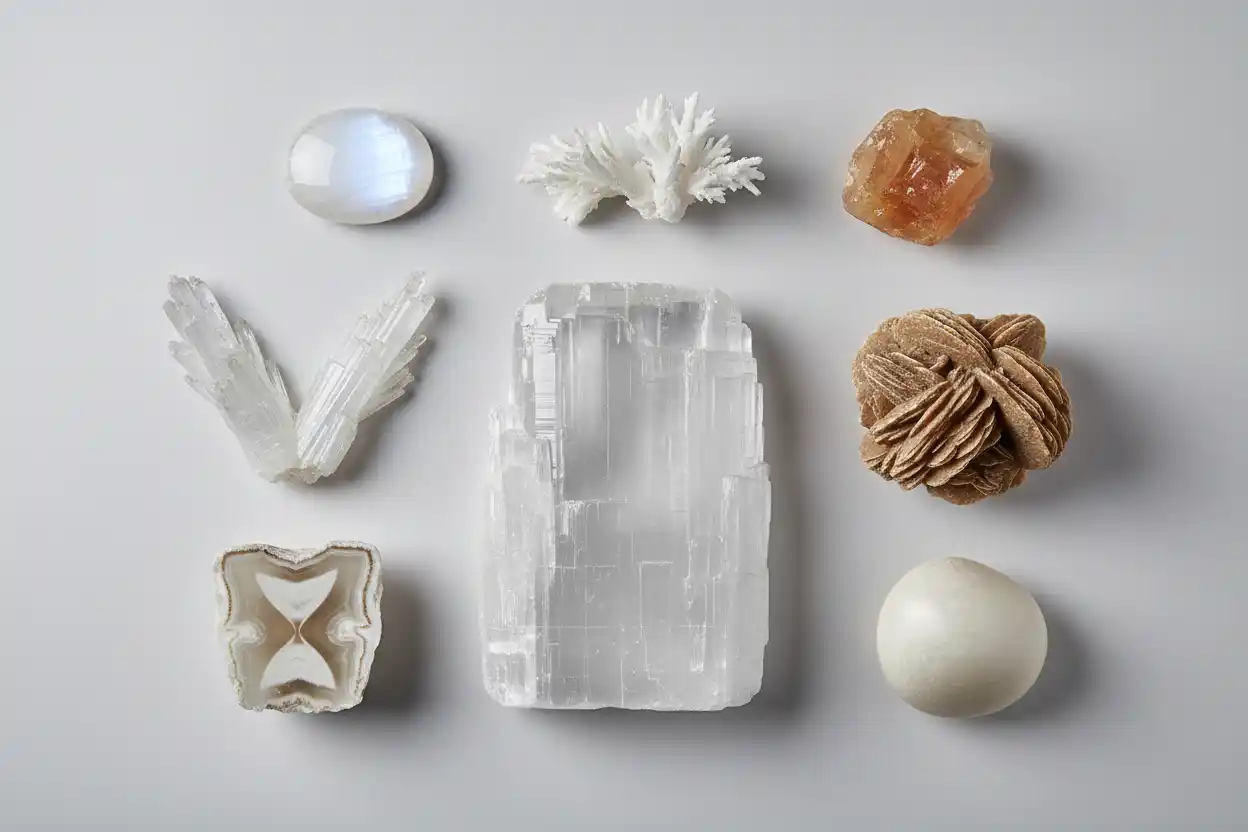
Types of Selenite: Colors and Varieties Explained
Selenite is the transparent to translucent, visibly crystalline form of gypsum. However, crystal shops often use “selenite” as an umbrella name for several gypsum materials, including fibrous satin spar, sand-filled desert roses, gypsum flowers, and carved white gypsum.
All of these materials share the calcium sulfate dihydrate composition described in the main selenite meaning and properties guide, but their crystal habits, texture, transparency, formation, durability, and market use differ. Understanding those boundaries prevents a satin-spar wand or desert rose from being misrepresented as a large transparent selenite crystal.
Selenite at a Glance
| Property | Selenite and Related Gypsum Varieties |
|---|---|
| Composition | Calcium sulfate dihydrate, CaSO₄·2H₂O |
| Mineral group | Sulfates |
| Main colors | Colorless, white, cream, gray, yellow, orange, red-brown, pink, greenish, and rarely bluish |
| Crystal system | Monoclinic |
| Typical habit | Tabular crystals, elongated blades, prismatic crystals, twins, rosettes, fibrous veins, curved petals, and massive fine-grained material |
| Luster | Vitreous to pearly in selenite; silky in satin spar; dull to waxy in massive gypsum |
| Transparency | Transparent to opaque |
| Mohs hardness | 2 |
| Cleavage | Perfect in one direction, with additional weaker cleavage directions |
| Tenacity | Brittle; thin crystals may be flexible but are not elastic |
| Common uses | Mineral specimens, carvings, lamps, bowls, decorative slabs, wands, beads, teaching samples, plaster, cement, and drywall production |
| Main care concern | Water solubility, easy scratching, cleavage, surface abrasion, heat, and misleading trade terminology |
Selenite Is a Type of Gypsum
Gypsum is the mineral species. Selenite is one of its crystalline appearances.
The wider gypsum guide owns the family-level mineralogy, industrial applications, and relationship with anhydrite. This article remains focused on the varieties commonly sold as selenite or closely associated gypsum.
Strictly speaking, transparent or translucent crystals with recognizable faces qualify as selenite. Fibrous satin spar and fine-grained alabaster are gypsum, but they are not selenite in the narrow mineralogical sense.
Retail usage is looser. A white fibrous tower may be labeled selenite because consumers recognize that name more readily than satin spar. A useful description should preserve both the familiar trade name and the accurate mineral term.
Clear Selenite
Clear selenite is the classic transparent gypsum variety.
Fine crystals may appear water-clear, colorless, or only faintly gray or yellow. Flat cleavage surfaces can produce a glassy or pearly reflection.
Large crystals often contain cleavage lines, cloudy zones, internal fractures, fluid inclusions, clay, or smaller intergrown crystals. Completely flawless pieces are less common than polished product photographs imply.
Because gypsum has perfect cleavage, transparent plates can split into thin sheets. Those sheets are easily scratched with a fingernail and may break across flat internal planes.
Clear selenite can resemble clear quartz, calcite, halite, glass, or colorless barite. The dedicated clear quartz versus selenite guide explains why hardness, cleavage, water response, and crystal form provide better evidence than transparency.
Tabular Selenite
Tabular selenite forms flat, plate-like crystals with broad faces.
Individual plates may be thin and transparent or develop into thick blocks. Parallel growth can create book-like stacks, stepped surfaces, and overlapping blades.
Collectors value intact corners, strong luster, clarity, undamaged edges, and documented locality. A complete natural crystal generally has more specimen significance than an equivalent fragment created by cleavage.
Tabular material may grow inside clay, shale, evaporite beds, mine cavities, and sedimentary fractures.
Bladed and Prismatic Selenite
Some selenite forms elongated blades or narrow prismatic crystals rather than broad flat plates.
Blades may occur singly, in parallel groups, or as radiating sprays. Their surfaces can be transparent, pearly, frosted, or clay-coated.
Long crystals remain fragile because cleavage runs through the structure. Even a thick-looking blade can split if pressure is applied to one end.
Prismatic selenite is sometimes polished into windows, slabs, or decorative pieces. Polishing removes natural surfaces, so collector listings should distinguish worked material from complete crystals.
Fishtail and Swallowtail Twins
Gypsum commonly forms contact or penetration twins.
Fishtail twins resemble a forked fish tail, bird tail, arrowhead, or open V. The two crystal individuals meet according to a consistent crystallographic relationship.
Swallowtail is another trade description for similar V-shaped gypsum twins. Terminology varies among collectors, and the same specimen may receive both names.
Fine twins have balanced symmetry, intact points, clear boundaries between the individuals, and minimal repair. Small edge chips are common because the projecting arms break easily.
Twinned material is especially useful for showing that crystal shape reflects atomic structure rather than random external growth.
Hourglass Selenite
Hourglass selenite contains darker sand, clay, or iron-rich material arranged in an hourglass-shaped zone inside a transparent gypsum crystal.
The best-known examples come from the Great Salt Plains of Oklahoma, where crystals grow within saline mud. As the crystals develop, they incorporate surrounding sediment selectively into particular growth sectors.
The hourglass is therefore an internal inclusion pattern rather than a painted or carved design.
Colors range from tan and reddish brown to gray and nearly black, depending on the host sediment. Collecting at protected localities is governed by seasonal and site-specific rules, so lawful provenance matters.
Gypsum Flowers
Gypsum flowers are curved, branching, rosette-like, or twisting crystal aggregates that form in caves, mines, fractures, and dry evaporitic environments.
Unlike the compact petals of a typical desert rose, gypsum flowers may grow into delicate branching sprays or curling blades. Capillary action and evaporation can feed mineral-rich water toward the growing tips.
Fine examples are extremely fragile. Thin petals can break from vibration, compressed packing material, or careless dusting.
Because many gypsum flowers develop in caves and abandoned mines, collecting can involve legal, conservation, and physical-safety restrictions. Cave formations should never be removed without explicit authorization.
Desert Rose Gypsum
Desert rose consists of radiating gypsum crystals that trap abundant sand as they grow.
The crystals form petal-like blades around a central point, creating rosettes, clusters, and flower-shaped concretions. Tan, beige, cream, rust, gray, and pale pink are common because the included sand controls much of the visible color.
Desert roses commonly develop in arid basins where mineral-rich groundwater rises and evaporates near the surface. Repeated wetting and drying supports crystal growth inside loose sediment.
Not every desert rose is gypsum. Barite can also form sand roses, and the two minerals differ substantially in weight, hardness, and density.
A gypsum rose feels relatively light and scratches easily. A barite rose is much heavier for the same size.
Satin Spar Gypsum
Satin spar is the fibrous gypsum most commonly sold as “selenite” in crystal shops.
Its tightly packed parallel fibers create a silky luster and an optical effect that carries light from one side to the other. Polished pieces may appear to glow, especially when placed over print or a light source.
Satin spar is typically white, cream, gray, pale peach, or faintly pink. It forms in veins and seams within sedimentary rocks.
Wands, towers, bowls, charging plates, lamps, and massage shapes are usually satin spar rather than true clear selenite. The dedicated selenite versus satin spar guide owns the full comparison.
The material’s fibers can separate, splinter, or fray. A polished satin-spar tower should therefore be handled more like a soft fibrous carving than a durable quartz point.
Cat’s-Eye and Fiber-Optic Satin Spar
When satin spar is cut across its aligned fibers, it can display a bright moving band resembling a cat’s eye.
The phenomenon comes from reflection and light transmission along the parallel gypsum fibers. It is especially visible in polished spheres, cabochons, and rounded wands.
The eye may be broad rather than sharply defined because gypsum fibers are coarse compared with the fine inclusions responsible for chatoyancy in many gemstones.
This material is sometimes marketed as cat’s-eye selenite. A more precise description is chatoyant satin-spar gypsum.
Alabaster Gypsum
Alabaster is fine-grained, massive gypsum capable of taking a smooth, soft polish.
It may appear white, cream, gray, yellow, orange, pink, or brown, commonly with clouds, veins, and translucent edges. Sculptors have used it for vessels, relief carvings, lamps, statues, and architectural decoration.
Not every stone called alabaster is gypsum. Calcite alabaster also exists, particularly in archaeological and decorative contexts.
Gypsum alabaster is softer and does not react with weak acid in the same way as calcite. Laboratory or conservation testing may be needed for valuable historic objects.
Alabaster belongs to the gypsum family but is not true crystalline selenite.
Rock Gypsum
Rock gypsum is a massive sedimentary rock composed largely of fine- to coarse-grained gypsum.
It commonly forms thick evaporite beds and may contain clay, anhydrite, carbonate minerals, halite, sulfur compounds, or organic material.
Industrial mines extract rock gypsum for wallboard, plaster, cement, soil conditioning, and other applications. Decorative selenite specimens can occur within or near the same deposits, although industrial ore is judged by chemistry and processing quality rather than crystal aesthetics.
Colorless and White Selenite
Pure gypsum is colorless or white.
Cloudiness can come from microscopic fluid inclusions, fractures, clay, fine crystal boundaries, and internal scattering.
White material dominates commercial satin spar, alabaster, carvings, and lamps. However, a white color does not determine whether a piece is transparent selenite, fibrous satin spar, or massive gypsum.
Texture and crystal structure provide the more meaningful classification.
Orange, Peach, and Red Selenite
Orange, peach, rust, and reddish gypsum receive color from iron oxides, clay, sand, or other mineral inclusions.
Color may occur evenly through massive material, concentrate along cleavage surfaces, or appear as a surface coating.
Some orange satin spar is sold as peach selenite. It can be natural, but strong uniform color should be inspected for dye or artificial staining.
Red selenite crystals from iron-rich sedimentary environments can be natural and collectible, especially when the color lies inside the crystal rather than only on its surface.
Yellow and Golden Gypsum
Yellow gypsum ranges from pale cream and straw to honey and golden brown.
Iron-bearing inclusions, sulfur-related material, clay, and organic matter may contribute. Golden color can also result from lighting passing through cream satin-spar fibers.
“Golden selenite” is a trade description rather than a formal mineral variety. A seller should clarify whether the material is transparent crystalline gypsum, fibrous satin spar, alabaster, or dyed stone.
Gray, Brown, and Black-Included Selenite
Gray and brown colors often come from clay, mud, sand, organic material, iron oxides, or sulfide inclusions.
Hourglass crystals provide one obvious example of dark included selenite. Other specimens contain cloudy black zones, sediment bands, dendritic markings, or dark crystals suspended within clear gypsum.
The host inclusion may increase collector interest, but dense mud commonly reduces transparency and makes cleavage damage harder to see.
Green and Blue Gypsum
Natural pale green or bluish gypsum exists but remains uncommon.
Greenish tones can come from copper minerals, clay, organic inclusions, or associated host rock. Blue-gray coloration may result from inclusions and light scattering.
Bright turquoise, cobalt, emerald, or neon-colored “selenite” is frequently dyed satin spar or an unrelated manufactured material.
Dye tends to concentrate along fibers, cracks, pores, and damaged edges. The principles in the gemstone treatments guide help distinguish a familiar trade color from a mineral variety.
Fluorescent and Phosphorescent Gypsum
Some gypsum fluoresces under ultraviolet light.
Possible responses include white, blue, green, yellow, orange, and cream, depending on impurities, organic material, and locality. A few specimens continue glowing briefly after the ultraviolet source is removed.
Fluorescence is not universal and does not prove that a piece is selenite. Calcite, barite, fluorite, glass, and many other materials can also glow.
Selenite Formation
Gypsum commonly forms when sulfate-rich water evaporates.
Marine lagoons, saline lakes, sabkhas, desert basins, and restricted sedimentary environments can precipitate extensive gypsum beds. Groundwater may later dissolve and redeposit the mineral inside fractures and cavities.
Gypsum also forms through oxidation of sulfide minerals, hydration of anhydrite, volcanic fumarolic activity, cave processes, and reactions involving sulfuric-acid-rich water.
Crystal habit depends on space, water chemistry, sediment, evaporation rate, temperature, and impurities. Open cavities favor transparent crystals, fibrous seams create satin spar, and sand-rich near-surface conditions form desert roses.
Important Localities
Mexico has produced enormous transparent gypsum crystals, including famous mine-cavity specimens. Spain, Morocco, Tunisia, Algeria, Australia, Canada, Chile, Russia, Italy, and the United States also supply collector material.
Oklahoma is famous for hourglass crystals. Morocco, Mexico, Tunisia, and several desert regions supply gypsum roses.
Commercial satin spar commonly enters the market from Morocco and other evaporite-producing countries. However, shape and color alone rarely prove origin.
Protected caves, active mines, and important scientific localities require permission. A seller claiming a famous source should provide credible provenance.
Inclusions and Internal Features
Selenite can contain clay, sand, iron oxides, organic matter, halite, sulfur, calcite, barite, fluid inclusions, and other gypsum crystals.
Cleavage lines can resemble fractures but represent structural weakness just as seriously. A transparent crystal may split along one of these planes during shipping.
Water can travel into cracks and dissolve their edges, leaving cloudy or frosted surfaces. Repeated handling also deposits skin oils that reduce luster.
How Selenite Is Identified
Gypsum has Mohs hardness 2 and can be scratched with a fingernail. The gemstone hardness chart places it among the softest materials commonly sold in crystal shops.
It has perfect cleavage and commonly forms thin plates, fibrous masses, or bladed crystals. The gemstone cleavage guide explains why flat breakage surfaces differ from natural crystal faces.
Selenite is much softer than quartz and feels lighter than barite. Halite has cubic cleavage and readily dissolves with a salty residue, although tasting mineral specimens is unsafe and unnecessary.
The crystal identification guide provides a non-destructive evidence-based approach.
Treatments and Imitations
Dyeing is common in satin spar. Bright pink, blue, green, purple, and rainbow-colored pieces may have color concentrated along the fibers.
Clear resin, glue, or stabilizer may repair broken blades or reinforce carvings. Polished points are sometimes manufactured from satin spar rather than representing natural crystal terminations.
Glass, calcite, barite, halite, plastic, and synthetic fiber-optic material can imitate particular selenite appearances.
The dedicated selenite buying guide retains the complete authenticity and seller checklist.
Cutting and Carving Behavior
Gypsum cuts easily but damages just as easily.
Low hardness allows rapid shaping, yet perfect cleavage can split a carving unexpectedly. Fibrous satin spar may peel or fray, while transparent selenite plates break along flat planes.
Water-based cutting and polishing must be controlled because gypsum dissolves slightly. Prolonged wet grinding rounds details and leaves a cloudy surface.
Most faceted selenite is produced for collections rather than wearable jewelry. Facet edges abrade quickly, and setting pressure can cleave the stone.
Durability and Jewelry Suitability
Selenite is unsuitable for unrestricted daily-wear jewelry.
Hardness 2 means metal, dust, fingernails, and ordinary household contact can scratch it. Perfect cleavage increases the chance of splitting.
The difference between surface hardness and breakage resistance is explained in gemstone toughness versus hardness.
Protected pendants, occasional earrings, display cabochons, and removable decorative components are more realistic than rings or bracelets.
Polished towers and plates should also be treated carefully. They can scratch one another when stacked.
Selenite Prices in 2026
Ordinary satin spar is inexpensive because substantial quantities reach the decorative market.
Small wands, sticks, and tumbled pieces commonly cost $2–$15. Medium towers, palm stones, spheres, bowls, and charging plates frequently range from $10–$60.
Large satin-spar lamps, carvings, and polished slabs commonly cost $50–$250, depending on size, finish, shipping weight, and workmanship.
Small desert roses generally sell for $3–$20. Larger balanced clusters commonly range from $20–$100, while unusually large, intact, well-formed display specimens can reach $100–$300 or more.
Transparent natural selenite crystals commonly range from $10 to several hundred dollars. Exceptional clarity, size, twinning, locality, undamaged condition, and historic provenance can produce much higher collector prices.
Industrial gypsum value should not be compared with specimen prices. Bulk wallboard or agricultural material sells as a commodity, while one intact crystal is priced for aesthetics and rarity.
Buying Guidance
Determine whether the piece is true crystalline selenite, satin spar, desert rose, alabaster, or another gypsum form.
Photographs should show edges, bases, repairs, cleavage, and surface texture. A polished point is not automatically a natural termination.
For clear crystals, inspect internal cleavage and any reconstructed corners. For satin spar, examine fiber splitting, chalky surfaces, dye, and resin.
Locality claims matter mainly for collectors. A generic white wand does not become rare because a seller attaches the name of a famous mine.
General remote-purchase safeguards appear in how to buy gemstones online.
Water, Sunlight, and Cleaning
Gypsum is water soluble enough that prolonged soaking damages polish and sharp edges.
The dedicated selenite water and sunlight guide owns the full exposure question, while which crystals can go in water provides broader comparisons.
Dust the piece with a soft dry brush or air blower. For a localized mark, use a barely damp cloth and dry the area immediately.
Do not use an ultrasonic cleaner. Vibration, water, and heat can damage cleavage planes, repairs, and fibrous material. Equipment-specific guidance appears in gemstones in ultrasonic cleaners.
Strong prolonged sun and heat can dry, discolor, or thermally stress some included or repaired material. Conservative display guidance appears in crystals that fade in sunlight.
Non-contact spiritual-care methods are covered in how to cleanse and charge selenite.
Meaning and Symbolism
Modern crystal traditions commonly associate selenite with clarity, calm, reflection, spiritual cleansing, and creating a sense of order.
Transparent crystals may symbolize openness, while satin spar’s light-carrying fibers inspire associations with connection and direction. Desert roses are often linked with endurance or finding structure in difficult environments.
These meanings belong to personal, cultural, and spiritual practice. They are not scientifically demonstrated effects of calcium sulfate dihydrate.
Selenite and related gypsum materials are organized with other S entries in the crystals that start with S directory and the gemstones that start with S guide.
Frequently Asked Questions
1. What are the main types of selenite?
The main crystalline and trade categories include clear selenite, tabular crystals, blades, fishtail twins, hourglass crystals, gypsum flowers, satin spar, desert roses, and alabaster.
2. Is satin spar the same as selenite?
Both are gypsum, but satin spar is fibrous and silky, whereas selenite is transparent to translucent and visibly crystalline.
3. Are crystal-shop selenite wands real?
They are usually real gypsum, but most are satin spar rather than true transparent selenite.
4. Is desert rose a form of selenite?
A gypsum desert rose is made from bladed gypsum crystals containing sand. Barite can also form desert roses, so the name does not always indicate gypsum.
5. What is hourglass selenite?
It is a transparent gypsum crystal containing sand or clay arranged in an hourglass-shaped internal growth zone.
6. What creates orange or peach selenite?
Iron oxides, clay, sand, and other mineral inclusions commonly create orange, peach, rust, and red-brown colors.
7. Does genuine blue or green selenite exist?
Pale natural blue-gray or greenish gypsum exists, but bright saturated colors are commonly dyed or misidentified material.
8. Can selenite be faceted?
Yes, but faceted stones are collector pieces because hardness 2 and perfect cleavage make them unsuitable for normal jewelry wear.
9. Does selenite contain selenium?
No. The name refers historically to the moon and does not indicate meaningful selenium content.
10. Can selenite go in water?
Brief accidental contact may not destroy a piece immediately, but soaking dissolves and dulls gypsum. Dry or minimally damp cleaning is safer.
11. Is alabaster a type of selenite?
Gypsum alabaster is a fine-grained massive form of gypsum, not transparent crystalline selenite. Some alabaster is calcite rather than gypsum.
12. Which selenite type is most valuable?
Large transparent undamaged crystals, symmetrical twins, important locality specimens, exceptional gypsum flowers, and rare documented formations generally command the highest collector prices.
Selenite types reveal how one soft evaporite mineral responds to very different growth environments. Open cavities produce transparent plates and blades, sediment creates hourglass inclusions, desert basins form sand roses, veins create fibrous satin spar, and fine-grained deposits become alabaster. Accurate naming protects those geological distinctions without reducing every white gypsum carving to the same trade label.
Safety disclaimer: Do not use raw selenite or gypsum specimens to prepare drinking water. The mineral can dissolve, and natural or treated pieces may release clay, dye, metal-bearing inclusions, polishing residue, or other contaminants. Gypsum dust can also irritate the eyes and respiratory tract.