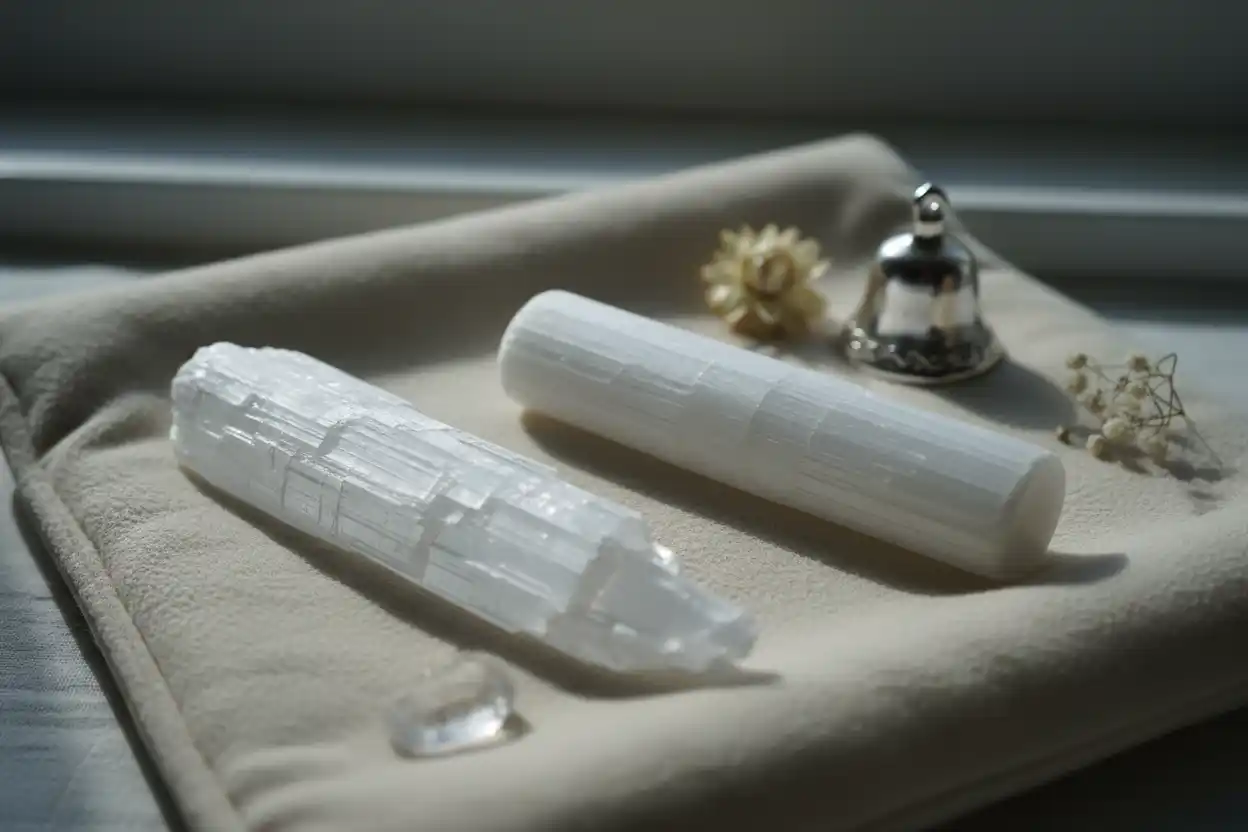
How to Cleanse and Charge Selenite
The safest ways to cleanse and charge Selenite are sound, intention, visualization, a written dedication, gentle breath at a distance, and indirect indoor moonlight. These dry, low-contact methods protect Gypsum’s extremely soft surface and perfect cleavage.
Selenite should not be rinsed, soaked, placed in saltwater, buried in salt or soil, exposed to steam, or rubbed against other crystals. Most commercial wands and towers called Selenite are actually satin spar Gypsum, whose fibrous surfaces can fray and trap residue even more easily than transparent Selenite crystals.
What Cleansing and Charging Mean
Cleansing is a personal or spiritual ritual used to mark a fresh beginning, release earlier associations, or prepare an object for meditation.
Charging means dedicating it to an intention, routine, value, memory, or symbolic role.
Neither process is required to preserve Gypsum. No established scientific evidence shows that cleansing changes Selenite’s chemistry, water content, optical properties, health effects, or measurable energy.
The material’s geology, varieties, symbolism, and uses belong to the broader Selenite guide.
Belief-based wellness claims belong separately to Selenite Healing Properties.
Selenite Is a Variety of Gypsum
Selenite traditionally refers to transparent or translucent crystalline Gypsum.
Gypsum is calcium sulfate dihydrate, meaning water forms part of its crystal structure.
| Property | Ritual implication |
|---|---|
| Mineral species | Gypsum |
| Composition | Calcium sulfate dihydrate |
| Mohs hardness | Approximately 1.5 to 2 |
| Tenacity | Flexible in thin sheets but inelastic; otherwise easily damaged |
| Cleavage | Perfect in one direction and distinct in others |
| Typical forms | Transparent blades, tabs, twins, fibers, rosettes, and masses |
| Safest ritual methods | Sound, intention, visualization, writing, and indoor moonlight |
| Water exposure | Avoid |
| Main risks | Scratches, cleavage, dissolution, fibrous damage, pressure, and residue |
The broader mineral profile belongs to the Gypsum guide.
The gemstone hardness chart explains why a fingernail can scratch Gypsum.
Its cleavage and fibrous forms add risks beyond ordinary surface marks. Those distinctions appear in Gemstone Toughness vs Hardness and Gemstone Cleavage Explained.
Selenite, Satin Spar, and Desert Rose
Retailers often call every pale Gypsum object Selenite, but the varieties have different habits.
True Selenite usually forms transparent or translucent crystals and blades.
Satin spar consists of parallel fibrous Gypsum with a silky, chatoyant appearance. Most white wands, sticks, towers, and charging plates sold as Selenite are satin spar.
Desert rose consists of rosette-shaped Gypsum crystals containing or coated with sand.
The complete distinction belongs to Selenite vs Satin Spar, while the broader variety framework appears in Types of Selenite.
Every variety is soft and moisture sensitive, but satin spar’s fibers and desert rose’s sand make direct wiping and soaking particularly unsuitable.
Selenite Does Not Contain Selenium
The similarity between the words Selenite and selenium causes frequent confusion.
Selenite Gypsum is calcium sulfate dihydrate and does not receive its name from containing the element selenium.
The traditional name relates to the Moon.
This distinction matters because handling guidance should be based on Gypsum’s softness and solubility rather than imagined selenium content.
Do not grind, lick, dissolve, or ingest a specimen merely because intact Gypsum is widely used industrially.
Commercial objects may contain sand, dye, glue, coatings, dirt, and associated minerals.
Inspect the Piece Before Beginning
Examine the object under soft, indirect light.
Look for split fibers, fresh cleavage surfaces, chipped corners, cloudy glue, loose flakes, powder, scratched polish, cracks, and repairs.
Transparent Selenite may show natural cleavage reflections, growth lines, inclusions, or twinning.
Satin spar may display silky bands and fine parallel fibers. These features are not dirt.
Do not press on a split fiber or bend a thin crystal to test flexibility.
When the piece sheds powder or fibers, leave it in a stable display position and use a completely non-contact ritual.
Physical Cleaning Is Separate
Symbolic cleansing does not remove dust or fingerprints.
Use a clean, exceptionally soft, dry brush to remove loose dust from a stable crystal.
A smooth face may receive the lightest pass with a dry microfiber cloth, but rubbing can scratch or dull Gypsum.
Do not use water, alcohol, sanitizer, vinegar, essential oil, steam, compressed air, or ultrasonic equipment.
The equipment-specific restriction belongs to Which Gemstones Can Go in an Ultrasonic Cleaner?.
When dirt is embedded in fibers, a rosette, or a repaired specimen, leaving it in place may be safer than aggressive cleaning.
Method 1: Cleanse Selenite with Sound
Place the Selenite on a thick folded cloth or leave it inside a stable display box.
Ring a small bell, chime, tuning fork, or singing bowl nearby. You may also hum, chant, clap gently, or play quiet music.
Do not place the stone inside a metal bowl or directly against a vibrating surface.
Hard contact can scratch, cleave, or split the Gypsum.
Several gentle tones are sufficient.
Sound is suitable for transparent blades, satin spar, desert roses, charging plates, towers, carvings, and repaired objects.
Method 2: Use Intention
Leave the Selenite supported on a padded surface.
Choose one concise purpose. It might remind you to simplify a workspace, create a consistent evening routine, approach a conversation calmly, or pause before adding another commitment.
State the intention silently or aloud.
The stone does not need to be held or passed over the body for the ritual to feel deliberate.
A low-contact method is especially appropriate for thin blades and fibrous satin spar.
Method 3: Use Visualization
Place the Selenite where it cannot roll, tip, or fall.
Imagine previous associations fading while the pale object becomes connected with the chosen purpose.
Some practitioners visualize white, silver, gold, or neutral light.
The imagery is symbolic and does not change Gypsum’s crystal water, transparency, or hardness.
Continue for several slow breaths or a few minutes.
Visualization is the safest method for cracked, fibrous, repaired, powdery, or valuable specimens.
Method 4: Use a Written Dedication
Write one clear statement and place it beside the Selenite.
A practical statement might focus on clearing a workspace, reducing unnecessary commitments, protecting time for rest, or beginning a calmer routine.
Keep pens, staples, clips, and rough paper edges away from the mineral.
Do not lift a large plate or tower merely to place paper beneath it. Position the note beside the existing support.
A written dedication keeps the object dry and undisturbed.
Method 5: Use Gentle Breath at a Distance
Breath contains moisture, so do not exhale directly onto the surface.
Instead, leave the Selenite on its support and perform several slow breaths while directing attention toward the intention.
When a breath gesture is personally meaningful, exhale toward the space above or beside the object rather than onto its fibers or cleavage faces.
State the dedication afterward.
This approach preserves the ritual without adding condensation.
Method 6: Use Indirect Moonlight Indoors
Place Selenite indoors near a window on a padded, dry tray.
An hour or an evening is sufficient. Overnight indoor placement may also be used when the location remains dry and stable.
Do not place Selenite outdoors. Dew, fog, rain, frost, soil, grit, animals, and temperature changes create unnecessary risks.
The Moon association belongs to the mineral’s name and cultural symbolism, not a measurable physical charging process.
The broader light framework appears in Which Crystals Can and Can’t Go in the Sun.
Method 7: Create a Dry Display Ritual
Arrange the Selenite near a journal, photograph, dry textile, or another symbolic object.
Use separate padded supports.
Do not add water bowls, fresh flowers, wet soil, salt, essential oils, candles, or incense ash.
A transparent display cover can reduce dust, provided it does not trap condensation or touch the mineral.
This method works especially well for a large satin spar tower or charging plate that should not be moved frequently.
Method 8: Place Other Crystals Nearby—Not on Top
Selenite is often marketed as a surface that cleanses or charges other crystals.
No scientific evidence demonstrates that Gypsum removes measurable energy from another mineral.
Furthermore, direct contact can physically damage both objects. Harder stones scratch Selenite, while heavy crystals can split a plate or crush fibers.
Place the second crystal on its own cloth beside the Selenite rather than stacking it directly.
The identification distinction from a common companion mineral belongs to Clear Quartz vs Selenite.
The general ritual framework appears in How to Cleanse Crystals.
Never Cleanse Selenite in Water
Gypsum is soluble enough that water exposure can dull, roughen, groove, weaken, or partially dissolve a polished surface.
Running water also increases the risk of dropping the slippery mineral against a sink.
Fibrous satin spar can trap moisture between fibers, while desert rose specimens may release sand or lose fragile edges.
The complete environmental explanation belongs to Is Selenite Safe in Water and Sunlight?.
The broader comparison appears in Which Crystals Can and Can’t Go in Water.
When Selenite becomes wet accidentally, blot nearby stable surfaces without rubbing and allow it to dry naturally at room temperature.
Never Use Salt or Saltwater
Salt grains can scratch Gypsum and lodge inside cleavage openings, fibers, carvings, and rosettes.
Some salts absorb moisture from the air, creating a locally damp environment.
Saltwater combines abrasion, moisture, and dissolved ions.
Do not place Selenite in sea salt, Himalayan salt, table salt, or cleansing granules.
When salt has symbolic importance, keep it sealed in a separate container several centimeters away.
Avoid Soil Burial
Soil contains Quartz grains that are far harder than Gypsum.
It also introduces moisture, microorganisms, organic acids, fertilizers, and staining material.
These substances can scratch, dissolve, discolor, or become trapped inside the specimen.
A nature-based alternative places Selenite near a plant while keeping it dry and physically separated from soil and watering areas.
Avoid Smoke Residue and Heat
A brief cool-smoke ritual may be used cautiously, but smoke can leave soot, resin, and oil on pale surfaces and fibers.
Removing those deposits without water or rubbing can be difficult.
Keep Selenite away from candles, incense coals, hot ash, radiators, fireplaces, and heated ritual bowls.
At elevated temperatures, Gypsum loses structural water and changes mineralogically. Household heat is therefore unsuitable for cleansing or charging.
Selenite, Angelite, and Celestite
Selenite, Angelite, and Celestite are different sulfate minerals that often appear together in modern crystal discussions.
Selenite is Gypsum, a hydrated calcium sulfate.
Angelite is pale-blue Anhydrite, a calcium sulfate without the same structural water. Its material profile belongs to the Angelite guide, while its ritual care appears in How to Cleanse and Charge Angelite.
Celestite is strontium sulfate. Its material profile belongs to the Celestite guide, and its ritual method appears in How to Cleanse and Charge Celestite.
All benefit from dry, low-contact rituals, though their chemistry differs.
Buying and Authentication Context
The Where to Buy Real Selenite guide covers Gypsum identity, satin spar labeling, crystal form, scratches, dye, repairs, coatings, and seller claims.
The most common retail mistake is not necessarily a fake—it is calling satin spar “Selenite” without explaining the variety.
The complete variety and identification distinction belongs to Selenite vs Satin Spar.
A cleansing ritual cannot determine whether a white wand is Gypsum, Calcite, glass, plastic, or another material.
Safe Ritual Handling
Do not lick, grind, burn, drill without controls, or place Selenite in drinking water.
Powder can irritate through mechanical exposure, while commercial objects may contain dye, glue, coating, sand, or contamination.
Ordinary intact display differs from generating dust or ingesting mineral material.
The broader handling framework belongs to the Toxic Crystals safety list.
Frequently Asked Questions
1. What is the safest way to cleanse Selenite?
Use sound, intention, visualization, writing, indirect indoor moonlight, or another dry non-contact ritual.
2. Can Selenite be cleansed in water?
No. Water can dull, groove, weaken, or partially dissolve Gypsum.
3. Can Selenite be left in moonlight overnight?
Yes, when kept indoors on a dry padded surface.
4. Can Selenite be charged in sunlight?
Ordinary indirect light is not the main concern, but heat, outdoor moisture, and weather should be avoided.
5. Can Selenite be cleansed with salt?
No. Salt can scratch Gypsum, lodge in fibers, and attract moisture.
6. Can Selenite be cleansed with smoke?
A brief cool-smoke ritual is possible, but soot and oil are difficult to remove safely.
7. Does Selenite cleanse other crystals?
This is a spiritual belief rather than a scientifically established effect. Keep stones physically separated to avoid scratches and breakage.
8. Is satin spar the same as Selenite?
Both are Gypsum varieties, but satin spar is fibrous while true Selenite is typically transparent or translucent crystalline material.
9. Does Selenite contain selenium?
No. Selenite Gypsum is calcium sulfate dihydrate.
10. Can Selenite touch Clear Quartz?
Use a cloth barrier. Quartz is much harder and scratches Selenite easily.
11. How long should Selenite charge?
A few minutes or an evening is sufficient. There is no scientifically required duration.
12. Does cleansing change Selenite scientifically?
No established evidence shows that cleansing changes its chemistry, water content, health effects, or measurable physical energy.
Conclusion
Selenite’s pale appearance and Moon-associated name make it popular for ritual use, but its physical reality is extremely soft, cleavable Gypsum. Sound, intention, visualization, writing, and protected moonlight preserve the mineral without exposing it to water, salt, or abrasive contact. A responsible ritual leaves every blade, fiber, and cleavage face dry and physically unchanged.
Crystal cleansing and charging are spiritual or personal practices, not scientifically established methods for changing health, energy, or the physical properties of Selenite.