Snowflake Obsidian: Meaning, Healing Properties & Uses
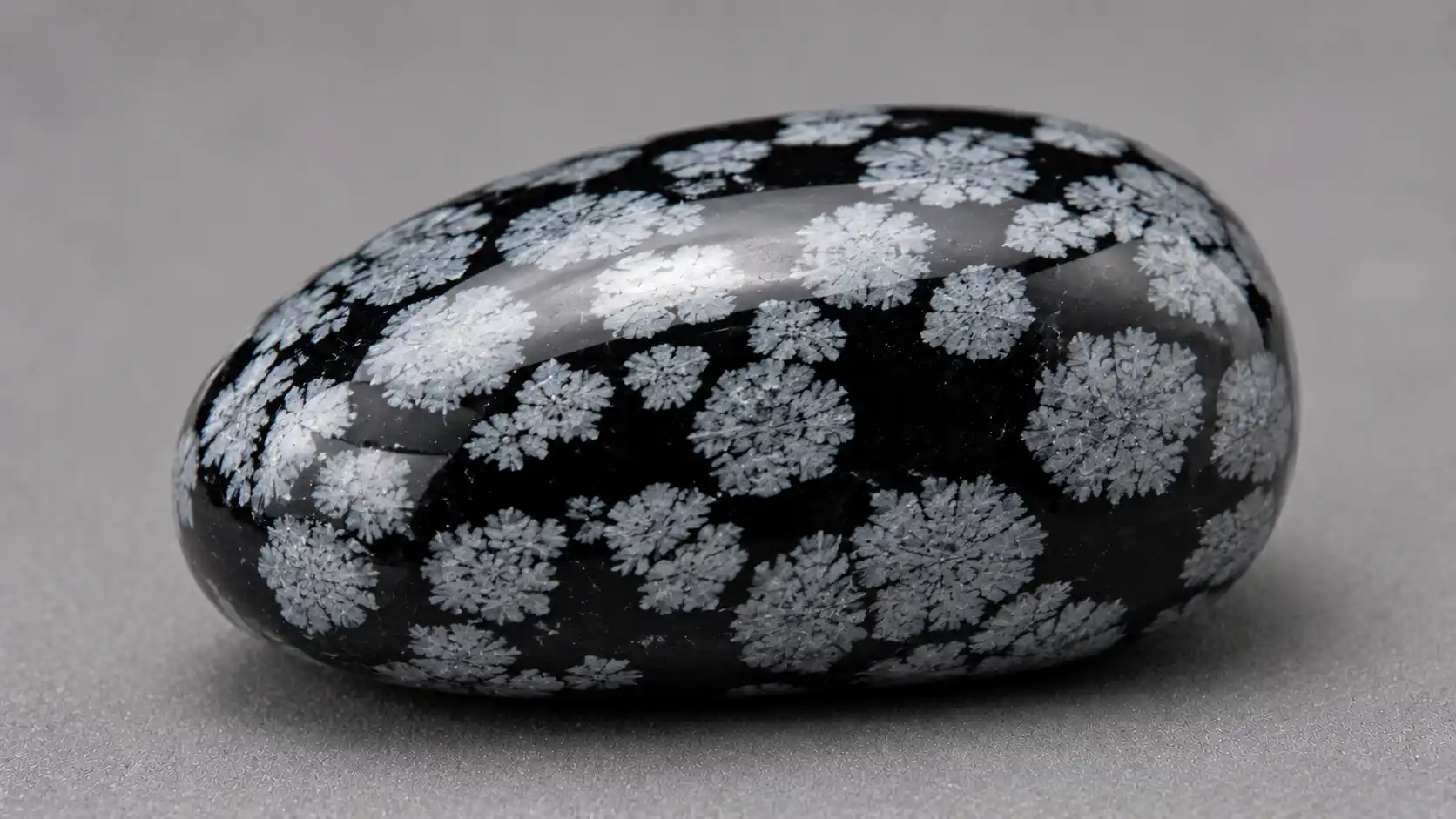
Snowflake Obsidian is black to dark gray volcanic glass patterned with pale gray or white circular forms that resemble snowflakes, flowers or stars. Those markings develop when portions of the glass begin to crystallize, creating silica-rich spherulites within the otherwise glassy material.
Unlike Quartz, Sodalite or most familiar gemstones, Snowflake Obsidian is not a single crystalline mineral. It is a patterned natural glass and igneous rock whose contrasting texture records the gradual transformation of unstable volcanic glass.
Snowflake Obsidian at a Glance
| Property | Snowflake Obsidian |
|---|---|
| Material type | Natural volcanic glass and igneous rock |
| Mineral classification | Mineraloid rather than a true mineral |
| Typical composition | Silica-rich, commonly rhyolitic volcanic glass |
| Pattern | White or gray cristobalite-rich spherulites |
| Color | Black, dark gray or brownish black |
| Luster | Vitreous when freshly broken or highly polished |
| Transparency | Opaque, occasionally translucent at thin edges |
| Mohs hardness | Approximately 5–5.5 |
| Cleavage | None |
| Fracture | Conchoidal, locally interrupted by crystallized areas |
| Common cuts | Cabochons, beads, carvings and tumbled stones |
| Main care concern | Chipping, scratching and very sharp broken edges |
What Is Snowflake Obsidian?
Snowflake Obsidian is a variety of Obsidian, the natural glass formed when silica-rich molten rock cools before atoms can organize into a fully crystalline structure.
Fresh Obsidian may appear uniform and glassy. Over time, however, parts of the glass can begin to devitrify, meaning that they transform into microscopic or fine-grained crystalline material.
In Snowflake Obsidian, this process starts at scattered points and grows outward in radiating forms. The resulting spherulites are commonly rich in cristobalite, a silica mineral related chemically to Quartz but with a different crystal structure.
When the rock is cut and polished, cross-sections through the spherulites create the familiar pale snowflake pattern.
Is Snowflake Obsidian a Crystal?
In commercial crystal language, Snowflake Obsidian is often called a crystal. Mineralogically, that label is imprecise because the black matrix is amorphous volcanic glass rather than a material with a regular crystal lattice.
The pale snowflakes contain crystalline silica phases, but the stone as a whole remains a partially crystallized volcanic glass. “Mineraloid,” “natural glass” or “igneous rock” provides a more accurate description.
This distinction matters for identification and care. Obsidian behaves like glass: it breaks with curved conchoidal surfaces, develops exceptionally sharp edges and chips more readily than its polished appearance may suggest.
The complete guide to types of Obsidian places Snowflake Obsidian beside black, mahogany, rainbow and sheen varieties without presenting them as separate mineral species.
How Snowflake Obsidian Forms
Obsidian usually forms from highly viscous, silica-rich lava associated with rhyolitic volcanic activity. Rapid cooling prevents extensive crystal growth, leaving a solid glass.
The glass is metastable, which means it can gradually reorganize into more stable crystalline phases. Devitrification may begin around tiny structural irregularities, mineral particles or nucleation points inside the glass.
Silica crystals then grow radially, creating spherulites. When numerous radiating fibers intersect in a rounded cluster, the cut surface resembles a snowflake.
The process must remain incomplete for the material to retain its characteristic appearance. If crystallization progresses too far, the rock loses much of its smooth glassy texture and no longer resembles typical Obsidian.
The parent magma often has a composition similar to Rhyolite, although Obsidian’s exact chemistry varies between volcanic sources.
Appearance and Pattern Quality
Snowflake patterns range from tiny pinpoints to large rounded rosettes. Some pieces contain evenly distributed markings, while others show dense patches separated by broad areas of black glass.
The snowflakes may appear bright white, pale gray, cream or slightly brown. Their edges can be sharply defined or soft and feathery, depending on crystal size, polishing and the angle at which each spherulite was cut.
Highly valued lapidary material usually has a balanced pattern with enough contrast to remain visible from a normal viewing distance. However, collectors may prefer unusual natural arrangements, partial spherulites or areas that show the transition between glass and crystal.
Perfectly identical snowflakes repeated across a manufactured object can be a warning sign. Natural patterns vary in size, spacing and shape.
Snowflake Obsidian Meaning and Symbolism
Contemporary crystal traditions associate Snowflake Obsidian with balance, self-examination and gradual transformation. Its black-and-white pattern encourages symbolic interpretations involving light and shadow, certainty and ambiguity, or acceptance and change.
Some practitioners view the pale spherulites as reminders that structure can emerge from periods of disorder. Others use the stone to represent observing difficult patterns without becoming defined by them.
Its appearance also supports a theme of integration. Instead of presenting darkness and light as opposing forces, Snowflake Obsidian visibly contains both within one material.
These meanings are cultural and spiritual interpretations. The pattern is produced by geological crystallization rather than a scientifically measurable emotional influence.
Healing Properties in Crystal Traditions
Snowflake Obsidian is commonly described in crystal practice as a grounding and centering stone. Practitioners may hold it during meditation when they want to approach uncomfortable emotions with greater steadiness.
The stone is also associated with recognizing recurring habits. A person might use it as a reflective prompt while journaling about reactions, relationships or choices that repeatedly lead to the same outcome.
Some traditions connect Snowflake Obsidian with emotional resilience and the ability to accept gradual progress. The slow crystallization recorded in its pattern provides a natural metaphor for change that occurs in stages rather than all at once.
The broader Obsidian healing properties guide covers general protection, grounding and shadow-work traditions. Snowflake Obsidian adds its distinctive symbolism of pattern recognition and balance.
Chakra Associations
Snowflake Obsidian is frequently linked with the Root Chakra because of its dark color and grounding symbolism. Practitioners may place a tumbled stone near the feet or hold it while focusing on physical surroundings and slow breathing.
It also appears in lists of Root Chakra crystals used to symbolize stability, boundaries and a sense of connection with everyday life.
Some users interpret the white pattern as adding clarity to the darker grounding qualities associated with Obsidian. This creates a symbolic balance between honest self-reflection and emotional steadiness.
Chakra systems belong to spiritual traditions and are not anatomical structures recognized by medical science.
Meditation and Journaling
A polished palm stone can serve as a practical focus during meditation. Its patterned surface gives the eyes a specific point to follow, while its smooth shape provides a tactile anchor.
For journaling, a user may choose one visible snowflake and trace its branches before writing about a situation that has developed from a small beginning. The stone does not supply an answer, but it can establish a deliberate pause before reflection.
Snowflake Obsidian may also be placed near a notebook, therapy journal or planning area as a symbolic reminder to observe patterns honestly. Such use should complement, not replace, professional emotional support when needed.
Common Uses
Lapidaries cut Snowflake Obsidian into cabochons because a broad polished surface displays the contrast between black glass and pale spherulites. Oval, round, shield and freeform shapes are common.
Beads, pendants and earrings also show the pattern effectively. Carvers use the material for small animals, spheres, pyramids, palm stones and decorative objects.
Tumbled stones are widely available, although their quality varies. A good polish should appear smooth and reflective without extensive bruising around edges.
Historically, Obsidian served as a cutting and tool material because conchoidal fracture can produce extraordinarily sharp edges. Snowflake material contains crystallized areas that may interrupt predictable flaking, so uniform black Obsidian was generally more suitable for carefully shaped blades.
Small rounded Obsidian nodules have their own identity as Apache Tears and should not be treated as another name for Snowflake Obsidian.
Jewelry Suitability
Snowflake Obsidian is attractive in earrings, pendants, brooches and protected beads. These formats reduce the frequency of hard impacts.
Rings and bracelets present greater risk because Obsidian has only moderate scratch resistance and relatively low toughness. A direct blow can chip the edge of a cabochon or create a sharp fracture.
A bezel setting provides more protection than exposed prongs. Smooth, rounded cabochons are safer than carvings with thin points or sharply projecting corners.
Drilled beads should be inspected for cracks around the holes. Repeated string movement can enlarge small fractures, particularly when heavy beads strike one another.
Blackened silver, polished sterling silver and white metals emphasize the pale pattern. Yellow or rose gold creates warmer contrast, especially when the snowflakes have cream or beige tones.
How to Identify Snowflake Obsidian
The defining feature is a natural black or dark gray glass matrix containing white-to-gray rounded spherulites. Patterns should vary rather than repeat mechanically.
Fresh or chipped surfaces may show glassy luster and conchoidal fracture. Thin edges can be slightly translucent under strong light, although most polished pieces appear opaque.
Natural Obsidian is lighter than many dense black minerals. It also lacks the crystal faces, cleavage and metallic luster expected from crystalline lookalikes.
The snowflakes are not painted surface decorations. On a cut stone, patterns continue beneath the polished face and may appear on several sides.
The general guide to crystal identification explains how hardness, fracture, luster, texture and density can be combined without damaging the specimen.
Lookalikes
Black-and-white Jasper, Granite, Porphyry and manufactured glass can resemble Snowflake Obsidian from a distance. Their textures differ under magnification.
Jasper is microcrystalline Quartz and commonly shows a waxier luster and more diffuse pattern. Granite consists of visibly interlocking mineral grains rather than a glassy black ground.
Synthetic glass may contain white chips, swirls or printed patterns. Mold seams, identical motifs, rounded bubbles and an unnaturally uniform surface can indicate manufacture.
Onyx and Obsidian are frequently confused because both can look black when polished. Onyx is a banded form of Chalcedony, whereas Obsidian is volcanic glass.
Other Obsidian Varieties
Black Obsidian generally lacks the obvious pale spherulites that define the snowflake variety.
Mahogany Obsidian contains red-brown and black areas commonly related to iron-rich material and flow structures.
Rainbow Obsidian displays colored iridescent bands when cut at the correct angle. Golden Obsidian and Silver Sheen Obsidian produce reflective effects from oriented microscopic inclusions or bubbles.
Snowflake Obsidian does not show a movable metallic sheen. Its pattern remains visible as pale, fixed crystallized areas.
Buying Considerations
Examine the polish under direct light. Dull spots, bruised edges and shallow pits reduce the clean contrast of the pattern.
A well-cut cabochon should display an intentional arrangement of snowflakes rather than placing all visual interest at the edge or beneath a setting. Pattern preference remains personal: some buyers favor many small flakes, while others prefer a few large rosettes.
Check carvings for thin projections and internal fractures. Obsidian can break sharply, so decorative pieces need stable bases and rounded vulnerable areas.
Ask whether the object is natural Snowflake Obsidian or manufactured glass. A responsible seller should describe it as volcanic glass and avoid claiming that it is a rare crystalline mineral.
Care and Cleaning
Clean Snowflake Obsidian with lukewarm water, mild soap and a soft cloth or brush. Rinse briefly and dry thoroughly.
Avoid steam, sudden temperature changes and ultrasonic cleaning. Existing chips or internal stress can expand when the stone experiences vibration or thermal shock.
Store pieces separately from harder gemstones. Quartz, Topaz, Corundum and Diamond can scratch polished Obsidian.
Never handle a freshly broken edge with bare fingers. Conchoidal fracture can create edges sharp enough to cut skin even when the fragment appears small.
For spiritual cleansing, dry methods are the safest default. Sound, visualization or brief moonlight avoids unnecessary impact and temperature change. The general guide to cleansing crystals describes several nonabrasive methods.
Pairing Snowflake Obsidian With Other Stones
In spiritual practice, users often pair Snowflake Obsidian with Clear Quartz, Hematite or other grounding materials. The combination is symbolic rather than chemically interactive.
From a physical-care perspective, avoid storing it loose beside harder crystals because they can scratch the glass. “Compatible energy” does not mean compatible hardness.
The guide to crystal pairings separates symbolic combinations from practical storage and handling concerns.
Directory Placement
Snowflake Obsidian appears among the crystals beginning with S and gemstones beginning with S. Although it is commonly used as a gem material, its geological classification remains volcanic glass rather than a crystalline gemstone mineral.
Final Perspective
Snowflake Obsidian captures a transition that most polished stones conceal. Its pale patterns show where volcanic glass began reorganizing into crystals, leaving a visible record of change inside a dark glassy ground.
That geological identity also explains its symbolism. The material does not erase contrast; it holds contrasting structures together. With protected wear, careful storage and realistic expectations, a well-patterned piece can remain both a useful lapidary material and a compelling object of reflection.
Frequently Asked Questions
1. What creates the white snowflakes in Snowflake Obsidian?
They are spherulitic areas formed as parts of the volcanic glass crystallized. The pale structures are commonly rich in cristobalite and related silica phases.
2. Is Snowflake Obsidian a mineral?
No. It is partially crystallized volcanic glass and is classified as a mineraloid or igneous rock rather than a single mineral species.
3. Is Snowflake Obsidian naturally occurring?
Yes. Natural devitrification creates the pattern inside Obsidian. Manufactured black-and-white glass imitations also exist, so identification still matters.
4. Is every snowflake pattern unique?
Natural spherulites vary in size, shape, spacing and orientation, so no two cut surfaces are exactly identical.
5. What does Snowflake Obsidian symbolize?
Modern crystal traditions associate it with balance, pattern recognition, grounding, self-examination and gradual personal change.
6. Is Snowflake Obsidian good for rings?
It can be used in a protective bezel, but its moderate hardness and low toughness make rings riskier than pendants or earrings.
7. Can Snowflake Obsidian go in water?
Brief cleaning with lukewarm soapy water is usually acceptable. Avoid prolonged soaking, boiling water, temperature shock and soaking jewelry containing glue or vulnerable metals.
8. Can Snowflake Obsidian scratch?
Yes. At approximately 5–5.5 on the Mohs scale, it can be scratched by Quartz-rich dust and many common gemstones.
9. How is Snowflake Obsidian different from black Obsidian?
Snowflake Obsidian contains obvious pale spherulites formed through partial crystallization. Black Obsidian usually has a more uniform dark glassy appearance.
10. Is Snowflake Obsidian the same as Onyx?
No. Snowflake Obsidian is volcanic glass, while Onyx is banded Chalcedony composed of microcrystalline Quartz.
11. Where is Snowflake Obsidian found?
It occurs in young volcanic regions where suitable Obsidian formed and partly devitrified. Well-known material comes from parts of the western United States and other volcanic provinces worldwide.
12. Are broken Snowflake Obsidian edges dangerous?
They can be. Like other Obsidian, it may fracture into extremely sharp edges. Handle chips carefully and dispose of fragments in a rigid container.
Snowflake Obsidian’s grounding, emotional-healing and chakra associations are spiritual interpretations rather than scientifically established medical effects. Broken Obsidian can produce exceptionally sharp edges; handle damaged pieces carefully and do not use them in place of professional healthcare.