Rhyolite Meaning, Formation, Identification & Uses
Rhyolite is a silica-rich volcanic rock that forms when felsic magma erupts or intrudes close to Earth’s surface and cools rapidly. It is broadly the volcanic equivalent of granite, sharing quartz- and feldspar-rich chemistry while developing a much finer, glassier, or more strongly flow-textured structure.
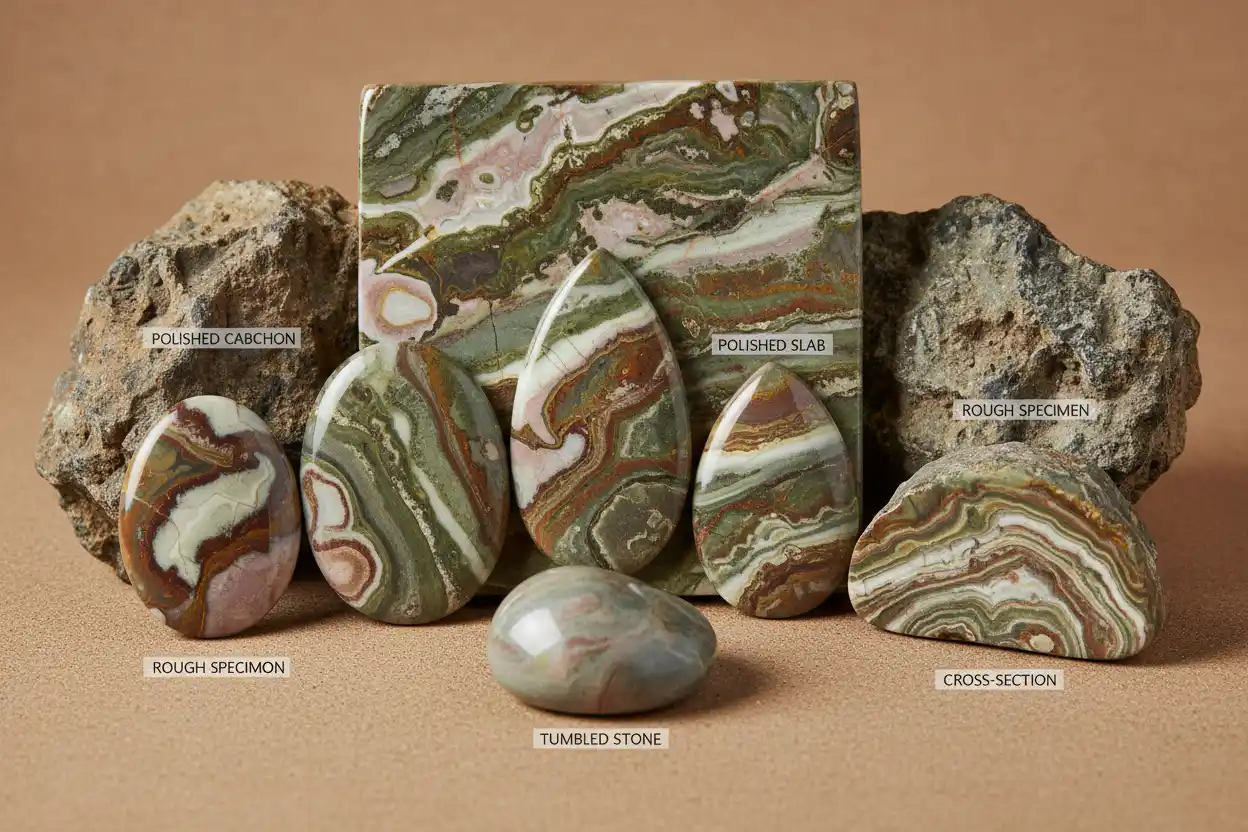
Most Rhyolite is pale gray, pink, cream, tan, reddish brown, greenish, or black-speckled. Lapidary material may display bands, spots, orbicular structures, breccia, spherulites, cavities, quartz crystals, and several generations of volcanic alteration.
Rhyolite at a Glance
| Property | Rhyolite |
|---|---|
| Material type | Felsic volcanic or shallow-intrusive igneous rock |
| Typical composition | Quartz, alkali feldspar, plagioclase, silica-rich groundmass, and minor mica, amphibole, pyroxene, or iron-titanium oxides |
| Chemical character | High silica, commonly approximately 69% SiO₂ or more in standard volcanic-rock classifications |
| Common colors | White, cream, pale gray, pink, red, tan, brown, green, yellow, purple-gray, and black-speckled |
| Crystal system | No single system applies to the complete rock |
| Typical texture | Aphanitic, porphyritic, glassy, flow-banded, spherulitic, vesicular, brecciated, lithophysal, or pyroclastic |
| Luster | Dull to vitreous or waxy after polishing |
| Transparency | Usually opaque, with translucent glassy, quartz, or chalcedony-rich areas |
| Mohs hardness | Variable, commonly approximately 5.5–7 according to mineral and glass content |
| Cleavage | Variable; feldspar grains have cleavage, quartz and volcanic glass do not |
| Tenacity | Brittle |
| Common uses | Cabochons, beads, spheres, carvings, slabs, architectural stone, aggregate, scientific specimens, and decorative objects |
| Main care concern | Variable mineral composition, fractures, soft alteration zones, misleading Jasper names, resin, and respirable silica dust |
Rhyolite Is a Rock, Not a Mineral Species
Rhyolite consists of several minerals and, in some examples, natural volcanic glass.
Therefore, it does not have one fixed formula, one universal hardness, or one crystal system.
Quartz and feldspar commonly dominate the crystalline portions. Biotite, hornblende, pyroxene, magnetite, ilmenite, zircon, clay minerals, and additional phases may occur.
The parent classification in types of gemstones explains why multi-mineral rocks can serve as ornamental gems without becoming mineral species.
The individual mineral components are covered more broadly in the Quartz guide and Feldspar guide.
Why Rhyolite Is Compared with Granite
Granite and Rhyolite occupy broadly similar silica-rich chemical ranges.
Granite crystallizes slowly underground, allowing quartz, alkali feldspar, plagioclase, mica, and other minerals to develop visible coarse grains.
Rhyolite cools much more rapidly at or near the surface.
As a result, most of its groundmass is too fine grained for individual minerals to be distinguished without magnification.
Porphyritic Rhyolite records two cooling stages. Large quartz or feldspar crystals began growing slowly underground before the remaining magma erupted and cooled rapidly around them.
Accordingly, Rhyolite can contain visible crystals without becoming granite.
A rock should be classified by both composition and texture rather than color alone.
How Rhyolitic Magma Forms
Rhyolitic magma can form through several processes.
Basaltic or intermediate magma may crystallize progressively, leaving the remaining melt increasingly enriched in silica, potassium, sodium, water, and incompatible elements.
Heat from mantle-derived magma can also partially melt silica-rich continental crust.
Many large volcanic systems combine crustal melting, fractional crystallization, magma mixing, and repeated reheating.
The resulting magma is highly viscous because silica tetrahedra form interconnected structures within the melt.
Gas escapes less easily from viscous magma, which can increase pressure and contribute to explosive eruptions.
However, Rhyolite does not form only through catastrophic explosions.
Gas-poor rhyolitic magma can produce thick lava flows, coulees, plugs, and domes.
Eruptive Forms
Rhyolite can occur as lava flows, domes, volcanic plugs, shallow intrusions, ash-flow deposits, pumice, welded tuff, and glassy obsidian.
A lava dome forms when viscous magma accumulates near a vent instead of flowing far.
Explosive fragmentation creates ash, pumice, and larger volcanic blocks.
Hot ash flows can compact and weld into ignimbrite or welded tuff.
When lava cools extremely rapidly with minimal crystallization, it can form Obsidian.
Gas-rich magma can expand into pumice, while hydrated volcanic glass can alter gradually into perlite.
These products share rhyolitic chemistry but differ in texture, porosity, and cooling history.
The broader volcanic-glass variety framework appears in types of Obsidian.
Aphanitic and Porphyritic Rhyolite
Aphanitic Rhyolite has a groundmass whose grains are too small to identify with the unaided eye.
Its surface may look uniform, waxy, dull, or finely speckled.
Porphyritic Rhyolite contains larger crystals called phenocrysts inside that fine groundmass.
Quartz phenocrysts may appear clear, smoky, gray, or blue-gray.
Feldspar commonly appears white, cream, pink, or salmon.
Dark biotite, amphibole, pyroxene, or iron-titanium oxides create black and brown specks.
The combination can resemble granite at first glance, but the fine matrix between the large crystals reveals the volcanic texture.
Flow Banding
Viscous rhyolitic lava can stretch into layers while moving.
Differences in crystal content, bubble abundance, oxidation, glass composition, and color create visible bands.
These bands may be straight, wavy, folded, swirled, or sharply contorted.
A polished slab can resemble wood grain, landscapes, clouds, or flowing paint.
Flow banding should not be confused automatically with sedimentary bedding.
Volcanic bands commonly wrap around phenocrysts, stretch through glassy zones, and reflect the movement of partly crystallized lava.
Later deformation and hydrothermal alteration can make the original flow structure more complicated.
Spherulites and Lithophysae
Volcanic glass is unstable over geological time and may begin to crystallize.
Spherulites are rounded radiating growths commonly composed of quartz and feldspar.
They can appear as white, cream, gray, pink, or brown circles within darker Rhyolite.
Lithophysae are hollow or partly mineral-filled structures that form during cooling and devitrification of silica-rich lava.
Open cavities may later contain Quartz, Chalcedony, Agate, Opal, Calcite, or other minerals.
Orbicular and flower-like lapidary patterns can develop when a slab intersects these structures.
However, not every round spot is a true spherulite. Vesicles, mineral nodules, altered feldspar, and breccia fragments can create similar appearances.
Vesicles and Vugs
Gas bubbles trapped during cooling create vesicles.
Small vesicles can make the rock porous, while large cavities create a rough open texture.
Mineral-bearing fluids may later fill these spaces.
Quartz crystals can line a cavity, while Chalcedony or Agate fills it partly or completely.
A polished Rhyolite containing mineral-filled bubbles may be marketed as orbicular Jasper, Rainforest Jasper, or another scenic trade material.
The appropriate name depends on mineral composition, locality, texture, and accepted lapidary usage.
Rhyolite Colors
Relatively unaltered felsic material is commonly pale gray, cream, tan, or pink.
Pink and red colors often come from alkali feldspar and iron oxidation.
Green can result from chlorite, celadonite, epidote-related phases, clay alteration, or additional secondary minerals.
Black spots commonly represent biotite, amphibole, pyroxene, magnetite, or volcanic glass.
Yellow, orange, and brown areas frequently reflect iron-weathering products.
White zones may contain feldspar, silica, altered volcanic ash, or cavity-filling Quartz.
A multicolored specimen can record original magma chemistry, cooling texture, hydrothermal alteration, weathering, and later fracture filling.
Rhyolite and Que Sera Stone
Que Sera Stone is an unstandardized trade name commonly applied to mottled blue-quartz-bearing volcanic or shallow-intrusive rock.
Many pieces resemble porphyritic Rhyolite containing blue-gray quartz and pink or cream feldspar.
However, Que Sera does not guarantee one mineral composition or locality.
A correctly identified blue-quartz Rhyolite can be sold under its geological name without repeating the extensive unverified mineral list associated with the Que Sera trade.
Conversely, a mixed stone should not be called Rhyolite solely because it has blue and pink spots.
Petrographic texture and mineral proportions remain decisive.
Rhyolite and Rainforest Jasper
Rainforest Jasper is a common lapidary name for green, cream, brown, red, and orbicular Rhyolite.
It often contains spherulites, vesicles, mineral-filled cavities, and altered volcanic textures.
Despite the Jasper name, classic Rainforest Jasper is generally Rhyolite rather than homogeneous microcrystalline silica.
The green colors may reflect chlorite, clay, epidote-related minerals, or other alteration phases.
The parent Jasper guide explains why many trade-name jaspers are rocks with more complex compositions than strict silica Jasper.
A Rainforest Jasper label should describe appearance and trade use rather than replace the rock’s volcanic origin.
Rhyolite and Picture Jasper
Picture Jasper is a visual category for scenic silica-rich stones whose patterns resemble landscapes.
Flow-banded Rhyolite can produce similar scenes.
Nevertheless, Picture Jasper commonly emphasizes silica-rich sedimentary, hydrothermal, or altered materials, while Rhyolite is defined by felsic volcanic origin.
A stone’s perceived landscape does not establish its geology.
The pattern may be attractive under either name, but mineral composition and texture determine durability and accurate classification.
Rhyolite and Unakite
Unakite is an altered granitic rock composed principally of pink feldspar, green epidote, and Quartz.
Both Rhyolite and Unakite can display green, pink, cream, and black mottling.
Unakite has a coarse interlocking texture inherited from granite, whereas Rhyolite usually has a fine volcanic groundmass.
Large visible feldspar grains within Rhyolite sit as phenocrysts inside a finer matrix rather than forming an entirely coarse-grained rock.
Rhyolite and Quartzite
Quartzite is a metamorphic rock formed mainly from recrystallized quartz-rich sandstone.
Rhyolite is an igneous volcanic rock.
Quartzite commonly has an interlocking granular texture and is dominated by Quartz.
Rhyolite contains a fine or glassy groundmass with feldspar, quartz, and other volcanic phases.
Both can be hard, pale, and suitable for cabochons, but their textures and formation histories differ.
Important Rhyolite Regions
Rhyolite occurs in silica-rich volcanic provinces around the world.
Yellowstone in the United States contains extensive caldera-forming deposits, domes, flows, and Obsidian derived from rhyolitic magma.
The Taupō Volcanic Zone in New Zealand has produced large rhyolitic eruptions and ignimbrites.
Iceland includes rhyolitic centers alongside its more familiar basaltic volcanism.
The Andes, Japan, Italy, Indonesia, Mexico, Turkey, Australia, and East Africa also contain rhyolite domes, ash deposits, and lava flows.
Brazil, Australia, India, Mexico, the United States, and Madagascar supply patterned lapidary rocks sold under Rhyolite or Jasper-inspired names.
A retail country label should not be converted into a specific volcano or formation without geological documentation.
How to Identify Rhyolite
Begin with texture.
A fine-grained or glassy matrix containing visible quartz or feldspar phenocrysts supports a porphyritic Rhyolite interpretation.
Flow bands, spherulites, vesicles, lithophysae, and volcanic breccia provide additional clues.
Magnification may reveal tiny feldspar laths, quartz grains, oxide particles, altered glass, clay, resin, and polishing marks.
Hardness varies by phase. Quartz-rich zones resist scratching, while weathered feldspar or clay-rich areas may abrade more easily.
Petrographic microscopy is the strongest routine method for identifying rock texture and mineral proportions.
Raman spectroscopy can identify exposed minerals but cannot classify the entire rock from one small spot.
X-ray diffraction and chemical analysis provide supporting data.
The multi-method process appears in how to identify crystals.
Common Mislabeling and Imitations
Any multicolored volcanic-looking rock can be sold as Rhyolite without proof.
Dyed quartzite, Jasper, granite, ceramic, resin, concrete, and manufactured aggregate can imitate patterned lapidary material.
Commercial names such as Rainforest Jasper, Bird’s Eye Rhyolite, Leopard Rhyolite, Galaxy Rhyolite, and Ocean Rhyolite are not standardized globally.
Some products are natural but assigned an unsupported variety or mine name.
Repeated identical orbs, mold seams, round bubbles in resin, low weight, and color concentrated in cracks provide warning signs.
The general indicators of composites and artificial coloring appear in how to spot fake crystals.
Treatments
Solid Rhyolite usually requires only cutting and polishing.
Porous or fractured material may receive resin stabilization.
Clear filler can strengthen breccia boundaries and level open cavities.
Dye can intensify green, blue, red, black, or purple areas.
Wax and oil deepen contrast temporarily.
Coatings create a stronger gloss but can scratch or yellow.
Composite carvings may contain Rhyolite fragments mixed with resin.
Treatment is especially relevant in orbicular and heavily altered material because different zones absorb liquids unevenly.
The wider enhancement framework appears in gemstone treatments explained.
Lapidary Use
Rhyolite is cut into cabochons, spheres, towers, palm stones, beads, carvings, bookends, slabs, and decorative panels.
Faceting is generally inappropriate because the rock is opaque and multi-mineral.
A cutter studies the rough for orbicular patterns, flow bands, color contrasts, and fractures.
Freeform cabochons preserve scenic areas more efficiently than calibrated ovals.
Mixed hardness can cause undercutting when softer altered zones sit beside Quartz.
Open cavities may need stabilization or careful cleaning after polishing.
The material’s carving use fits within the broader guidance for gemstones and rocks used for carving.
Durability and Jewelry Suitability
Rhyolite’s hardness varies according to its mineral and glass content.
Quartz-rich sections can approach Mohs 7, while feldspar, volcanic glass, clay-rich alteration, and porous zones are softer.
Its variable surface durability should be interpreted through the gemstone hardness chart.
The rock remains brittle.
Flow bands, vesicles, breccia boundaries, and mineral-filled fractures can split after impact.
The distinction between hardness and toughness appears in gemstone toughness versus hardness.
Stable cabochons work well in pendants, earrings, bolo ties, bracelets, and occasional-wear rings.
A bezel supports the edge and helps protect mixed-mineral areas.
Bead holes should be inspected for fractures and soft altered rims.
Current Rhyolite Asking Prices
Rhyolite is widely available and usually priced as an ornamental rock rather than a rare gemstone.
| Rhyolite product | Broad July 2026 retail asking range |
|---|---|
| Small tumbled stone | About $2–$8 |
| Palm stone | About $8–$30 |
| Standard cabochon | About $5–$30 |
| Scenic, orbicular, or designer cabochon | About $20–$100 |
| Bead strand | About $8–$45 |
| Small sphere or tower | About $15–$60 |
| Large sphere, carving, or freeform | About $60–$300 |
| Small mineral or volcanic specimen | About $10–$100 |
| Exceptional patterned slab or lapidary artwork | About $100–$750 or more |
| Architectural or landscape stone | Priced by weight, slab dimensions, fabrication, and transport |
These figures represent broad asking prices rather than appraisals or resale guarantees.
A commercial name such as Rainforest Jasper can increase retail demand, but it does not make common Rhyolite geologically rare.
What Gives Rhyolite Value?
Pattern drives much of the lapidary market.
Orbicular structures, contrasting flow bands, scenic layers, blue quartz phenocrysts, and mineral-filled cavities can create premiums.
Color should remain attractive under neutral light.
Dense stable material produces a smoother polish than porous or clay-rich rock.
Cutting orientation determines whether a striking pattern becomes centered within the cabochon.
Structural integrity matters more than size. A large slab crossed by open fractures may be less useful than a compact smaller piece.
Verified locality, unusual mineral associations, scientific significance, treatment disclosure, and craftsmanship complete the valuation.
Buying Rhyolite
Ask whether Rhyolite is the geological identification or merely a retail trade name.
Request front, back, edge, and magnified photographs.
Inspect the fine matrix and visible phenocrysts rather than relying on color.
Ask whether the product is also being marketed as Rainforest Jasper, Que Sera Stone, or another named lapidary variety.
Check for resin, dye, coating, backing, open cavities, and soft weathered zones.
A seller should not guarantee one universal mineral composition for every Rhyolite object.
Rhyolite appears in the crystals beginning with R directory and gemstones beginning with R directory, although it remains a volcanic rock rather than a mineral crystal.
Cleaning and Storage
Clean stable polished Rhyolite with lukewarm water, mild soap, and a soft cloth or brush.
Rinse briefly and dry it completely.
Avoid prolonged soaking when the piece contains clay-rich zones, vesicles, dye, resin, glue, backing, or open fractures.
The broader limits appear in which crystals can and cannot go in water.
Ultrasonic and steam cleaning are unnecessary for mixed or treated rock.
Avoid acids, bleach, abrasive powders, and harsh solvent cleaners.
Store jewelry separately from harder stones.
Natural rough and polished carvings may require different cleaning approaches, as explained in raw versus polished crystals.
Rhyolite Meaning and Symbolism
Modern crystal traditions associate Rhyolite with adaptability, creativity, gradual change, and combining several experiences into a workable whole.
Its porphyritic texture provides a visible metaphor for early developments remaining present after circumstances change around them.
Flow banding inspires themes of movement, flexibility, and allowing a plan to adjust without losing direction.
Spherulites and mineral-filled cavities can symbolize growth continuing inside spaces created by disruption.
Rhyolite’s wide range of commercial names does not represent one universal historic spiritual tradition.
These interpretations remain personal, artistic, cultural, or spiritual. Scientific evidence does not show that Rhyolite treats illness, increases creativity, releases trauma, or guarantees personal change.
Frequently Asked Questions
Is Rhyolite a mineral?
No. Rhyolite is a silica-rich volcanic rock composed of several minerals and sometimes volcanic glass.
Is Rhyolite the volcanic equivalent of granite?
Yes. They occupy broadly similar felsic chemical ranges, but granite is coarse grained and intrusive while Rhyolite is fine grained or glassy and volcanic.
Why is Rhyolite often fine grained?
Its magma cools rapidly at or near Earth’s surface, limiting the time available for large crystals to grow.
Can Rhyolite contain large crystals?
Yes. Porphyritic Rhyolite contains quartz or feldspar phenocrysts that began growing before eruption.
Is Obsidian a type of Rhyolite?
Obsidian can have rhyolitic composition, but it is classified by its natural-glass texture rather than called ordinary crystalline Rhyolite.
Is Rainforest Jasper actually Rhyolite?
Classic Rainforest Jasper is generally orbicular or spherulitic Rhyolite rather than strict microcrystalline Jasper.
Is Que Sera Stone Rhyolite?
Some material appears to be blue-quartz porphyritic Rhyolite, but the Que Sera trade name is unstandardized.
How does Rhyolite differ from Unakite?
Rhyolite has a fine volcanic matrix, while Unakite is a coarse altered granitic rock containing epidote, feldspar, and Quartz.
How hard is Rhyolite?
Its hardness varies, commonly from approximately 5.5 to 7 according to quartz, feldspar, glass, and alteration content.
Is Rhyolite commonly treated?
Many pieces are only polished, but resin stabilization, filling, dye, wax, oil, coating, and composite construction can occur.
Can Rhyolite go in water?
Brief washing is usually suitable for dense untreated material. Avoid soaking porous, dyed, filled, glued, or clay-rich pieces.
What makes Rhyolite valuable?
Pattern, color, orbicular or flow structures, mineral associations, stability, polish, cutting orientation, locality, treatment disclosure, and craftsmanship determine value.
Rhyolite is best understood as a broad volcanic-rock category rather than one green or orbicular crystal variety. Its textures preserve the cooling, movement, gas release, crystallization, and alteration history of silica-rich magma.
Cutting, drilling, crushing, sanding, or polishing Rhyolite can release respirable crystalline-silica and mixed-mineral dust. Use wet methods, effective local exhaust, eye protection, protective clothing, and suitable respiratory controls. Never dry-grind Rhyolite in an occupied indoor area.