Types of Obsidian: Colors and Varieties Explained
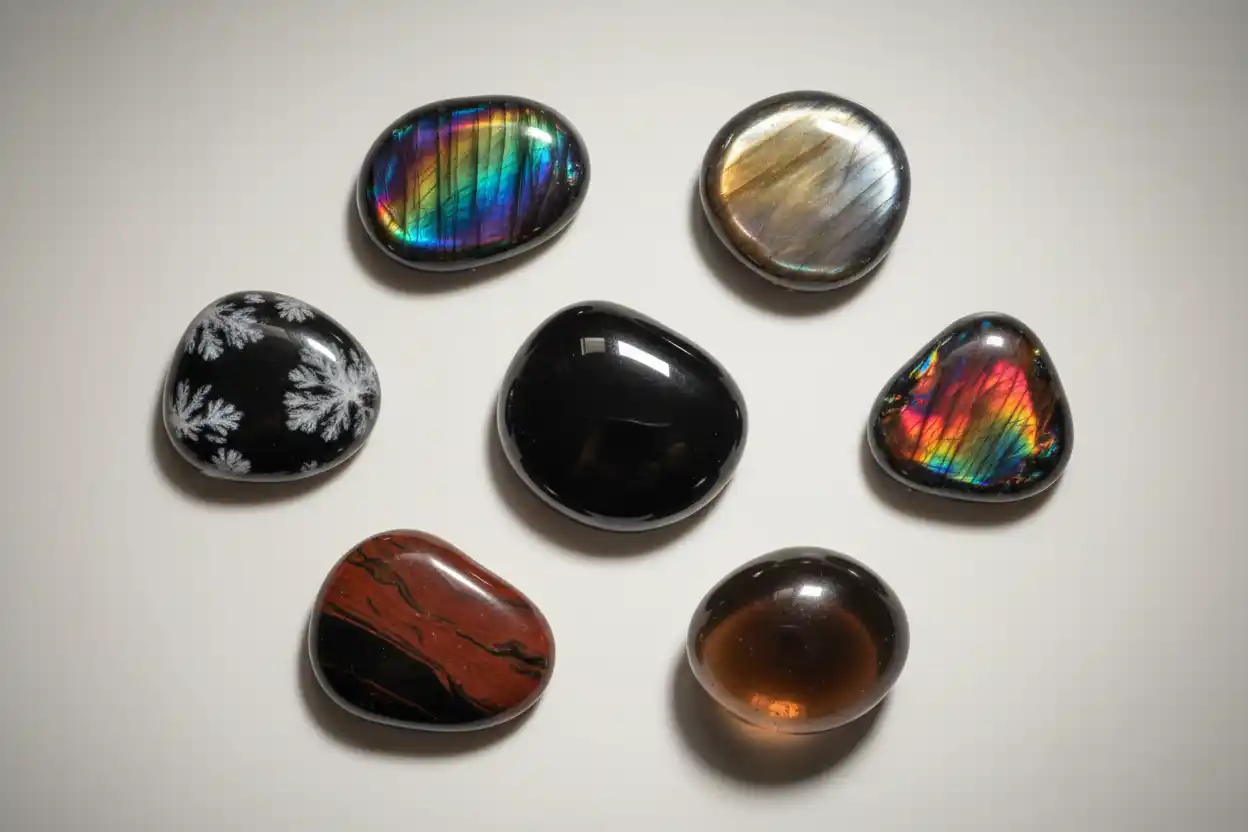
Obsidian is natural volcanic glass created when silica-rich lava cools too quickly for ordinary mineral crystals to develop. Although most obsidian looks black, differences in bubbles, microscopic crystallites, oxidation, flow banding, weathering, and thin-film interference can produce brown, red, gray, golden, silver, rainbow, iridescent, spotted, and translucent varieties.
These types remain volcanic glass rather than separate mineral species. The main obsidian meaning and properties guide covers the material as a whole, while this article separates the principal colors, textures, optical effects, and trade varieties.
Obsidian at a Glance
| Property | Obsidian |
|---|---|
| Composition | Silica-rich volcanic glass with aluminum, sodium, potassium, iron, magnesium, calcium, water, and minor components |
| Material group | Natural volcanic glass; igneous rock rather than a crystalline mineral |
| Main colors | Black, brown, mahogany red, gray, greenish, golden, silver, rainbow, blue- or violet-flashing, and nearly colorless at thin edges |
| Structure | Amorphous glass with variable microscopic crystallites, bubbles, flow bands, and inclusions |
| Typical habit | Massive lava-flow material, rounded nodules, flow-banded blocks, vesicular pieces, and glassy fragments |
| Luster | Vitreous |
| Transparency | Transparent at thin edges to translucent or opaque |
| Mohs hardness | Approximately 5–5.5 |
| Cleavage | None |
| Tenacity | Brittle, with sharp conchoidal fracture |
| Common uses | Cabochons, beads, carvings, mirrors, blades, arrowheads, jewelry, ornamental objects, and archaeological tools |
| Main care concern | Scratching, sharp chips, hidden fractures, edge damage, and confusion with manufactured glass or treated material |
How Obsidian Forms
Obsidian commonly forms from rhyolitic or dacitic magma with a high silica content. Silica makes magma viscous, so atoms cannot move easily enough to arrange themselves into large crystals when the lava cools rapidly.
Instead, the melt solidifies as glass. Tiny crystallites may still develop, but they remain microscopic or form localized structures such as the pale spots in snowflake obsidian.
Obsidian often occurs near the margins of thick lava flows, domes, and explosive volcanic deposits. The outer sections cool faster than the hotter interior, producing glassy zones beside more crystalline volcanic rock.
Because volcanic glass is not stable over unlimited geological time, water slowly enters its structure and encourages devitrification. Consequently, most major obsidian deposits are geologically young compared with ancient granites and metamorphic rocks.
Black Obsidian
Black obsidian is the most familiar variety. In thick pieces it may appear completely opaque, although thin edges commonly transmit brown, gray, greenish, or smoky light.
Iron-bearing components and microscopic particles absorb and scatter light, creating the dark appearance. The glass itself is not necessarily uniformly jet black at microscopic scale.
Fine black obsidian has a smooth vitreous polish, even color, and minimal fractures, pits, or gray weathering. However, natural flow lines and tiny bubbles may remain visible under magnification.
Ordinary black material occurs in many volcanic regions and remains affordable. Its value comes primarily from cutting, carving, archaeological importance, locality, or unusually clean texture rather than raw rarity.
The dedicated black obsidian buying guide owns detailed authenticity and seller checks.
Mahogany Obsidian
Mahogany obsidian displays reddish brown, rust, mahogany, or orange-brown patches within black volcanic glass.
Iron oxidation produces the warm areas. Patterns may form broad clouds, narrow bands, speckles, swirls, or broken angular patches.
Mexican material dominates much of the commercial market, although similar iron-rich obsidian occurs elsewhere. Fine rough should show strong contrast and enough structural integrity for cabochons, beads, spheres, and carvings.
A cutter studies both faces of a slab before shaping it because the most attractive red-black pattern may disappear if too much material is removed.
The dedicated mahogany obsidian buying guide retains its transaction-focused content.
Snowflake Obsidian
Snowflake obsidian contains pale gray or white rounded structures scattered through black or dark brown glass.
These “snowflakes” are spherulites made mainly from radiating cristobalite crystallites, commonly with feldspar or related microscopic phases. They form as the volcanic glass begins to devitrify.
The spots may appear sharp and flower-like, diffuse and clouded, or densely crowded. Balanced spacing and clear contrast generally create the strongest commercial appearance.
Snowflake obsidian is not glass containing literal snow, calcite spots, or painted markings. Its pattern records partial crystallization inside the original volcanic glass.
Because cristobalite-rich areas can respond differently during polishing, some stones show slight undercutting or uneven gloss. The snowflake obsidian buying guide covers quality and imitation concerns.
Golden-Sheen Obsidian
Golden obsidian shows a gold, bronze, copper-gold, or warm metallic sheen when light strikes it at the correct angle.
Extremely small elongated gas bubbles and flow-aligned structures reflect and scatter light within the glass. The effect sits below the polished surface rather than functioning as metallic paint.
Fine golden sheen should move smoothly across the face as the stone rotates. Weak material may show only a small dull patch, while poorly oriented cabochons can hide the effect almost completely.
Mexican deposits supply much of the commercial material. Large uniform golden-sheen slabs are often carved into masks, spheres, mirrors, and decorative objects.
Photographs should show the stone both with and without the sheen. A permanently gold-looking surface may indicate coating, metallic glass, or misleading lighting.
Silver-Sheen Obsidian
Silver sheen obsidian contains a white, gray, silver, or smoky metallic-looking reflection.
Its optical effect also comes from minute flow-aligned bubbles and internal structures. The cooler color distinguishes it from golden-sheen material, although some stones display both.
Silver sheen may form broad sheets, narrow bands, curved waves, eyes, or cloud-like areas. A dark body gives the strongest contrast.
High-quality cabochons place the reflective layer near the top and keep it visible across a useful viewing range. Deep grinding can remove the strongest layer, making cutting orientation critical.
Rainbow Obsidian
Rainbow obsidian displays curved bands or sheets of green, purple, blue, gold, pink, red, and silver.
The colors result from interference involving microscopic layers, bubbles, magnetite-related particles, or other aligned structures within the glass. They become visible only when the stone and light source reach a favorable angle.
Many rough pieces look almost completely black until a cutter exposes and orients the color layers. Lapidaries commonly shape high domes, hearts, eyes, or freeforms to center the best band.
Fine rainbow material shows saturated colors, broad coverage, sharp separation, and minimal fractures. Weakly colored commercial pieces may display only muted green or purple at one narrow angle.
The rainbow obsidian buying guide should retain detailed grading and seller guidance.
Fire Obsidian
Fire obsidian is a rare iridescent variety best known from central Oregon, particularly the Glass Buttes region.
It can display intense red, orange, gold, green, blue, violet, and magenta layers. The effect arises from extremely thin internal structures and aligned mineral nanoparticles within flow bands.
Unlike ordinary rainbow obsidian, fine fire obsidian may produce exceptionally bright, narrow spectral bands resembling metallic flame or oil-film color. However, much rough reveals no obvious effect before careful preparation.
Cutting requires exceptional precision. A lapidary may remove fractions of a millimeter at a time because passing through the active layer destroys or changes the color.
For that reason, artistry and orientation often contribute more value than weight. A small high-quality fire-obsidian cabochon can cost far more than a much larger ordinary black carving.
Apache Tears and Marekanite
Apache tears are small rounded or irregular nodules of translucent black to smoky brown obsidian.
They commonly occur within pale volcanic ash or perlite, where discrete masses of glass remained less hydrated than the surrounding material. The mineralogical term marekanite is also used for rounded obsidian nodules of this general kind.
When held to strong light, many pieces reveal brown, gray, or greenish transparency. Thick specimens can still look completely black under normal room lighting.
The name carries historical and cultural narratives in the southwestern United States. Sellers should present those stories respectfully rather than treating them as scientifically verified healing claims.
Apache tears are usually tumbled or kept as natural nodules instead of cut into large faceted stones.
Gray and Smoky Obsidian
Gray obsidian contains enough microscopic bubbles, crystallites, weathering, or compositional variation to soften its black color.
It may appear smoke gray, blue-gray, brown-gray, or nearly silver. Some pieces show subtle sheen, while others remain uniformly dull when polished.
Translucent gray material can be attractive in thin cabochons and carvings. However, pale gray artificial glass can imitate it, so bubbles, flow structures, and provenance should be considered together.
Brown and Reddish Obsidian
Obsidian can occur in brown, reddish brown, dark red, and orange-brown forms even without the sharply contrasting patches expected in mahogany material.
Iron oxidation and the thickness of the glass influence the visible color. A thin brown section may look black when viewed through greater depth.
Uniform brown obsidian is less widely marketed than mahogany or black varieties but can still produce attractive beads and archaeological blades.
Green Obsidian
Natural green obsidian exists, although most material is muted olive, gray-green, brown-green, or nearly black rather than bright emerald.
Trace chemistry, iron oxidation states, microscopic particles, and thickness influence its color. Strong transparent bottle-green material deserves careful scrutiny because manufactured glass is common.
Bright neon green “obsidian,” especially when perfectly transparent and bubble-rich, is frequently artificial slag, bottle glass, or decorative glass rather than volcanic material.
A reliable seller should provide locality and testing information instead of relying on color alone.
Blue and Violet Obsidian
Natural obsidian may show blue, violet, or indigo reflections through sheen and interference effects.
Uniform transparent cobalt-blue obsidian is exceptionally unusual. Most vivid blue items sold under the name are manufactured glass.
Blue-flash natural material should reveal the effect as the viewing angle changes rather than maintaining an evenly saturated body color from every direction.
Bubble Obsidian
Bubble obsidian contains rounded or elongated cavities and bubble-rich zones preserved during rapid cooling.
Some specimens show large visible vesicles, while others contain packed microscopic bubbles. Flow can stretch the cavities into parallel tubes or layered patterns.
Recent gemological study of Armenian material documented translucent bubble-rich obsidian with unusual optical textures. Such material is principally a specimen or specialty lapidary variety rather than a standardized commercial category.
Flow-Banded Obsidian
Flow-banded obsidian preserves lines, waves, folds, and streaks created while the viscous lava moved.
Bands may differ in bubble content, oxidation, microscopic crystallites, or composition. They can appear black and gray, brown and red, or almost invisible until the glass receives a high polish.
In sheen and fire varieties, flow bands often control the orientation of the optical effect. Consequently, the cutter follows the internal structure rather than applying one standard cabochon angle.
Spherulitic and Devitrified Obsidian
Snowflake obsidian represents the most familiar spherulitic form, but partial devitrification can produce many other textures.
Small radiating crystal clusters may create gray spots, concentric growths, cloudy zones, or densely crystalline areas. As devitrification progresses, the material becomes less glassy and may grade into perlite or fine volcanic rock.
Heavily altered material often polishes unevenly and lacks the smooth transparency of fresh obsidian.
Obsidian, Pitchstone, and Perlite
Pitchstone is a hydrated volcanic glass with a resinous rather than sharply vitreous appearance. It generally contains more water than fresh obsidian.
Perlite is hydrated volcanic glass that develops curved onion-skin or perlitic fractures. When heated industrially, it expands into the lightweight white material used in horticulture and construction.
The boundaries among fresh obsidian, hydrated glass, and partially devitrified volcanic rock reflect alteration rather than a simple color difference.
Major Obsidian Localities
Important obsidian regions occur in Mexico, the western United States, Armenia, Turkey, Iceland, Italy, Greece, Japan, Indonesia, New Zealand, Ethiopia, Kenya, and other volcanically active areas.
Mexico supplies black, mahogany, golden-sheen, silver-sheen, and rainbow material. Oregon is famous for fire obsidian and several other glass varieties.
Archaeological sourcing often uses trace-element chemistry to match an artifact with a specific volcanic deposit. That work reveals prehistoric exchange networks and movement across long distances.
Collection rules vary substantially. Obsidian in national parks, protected archaeological sites, Indigenous lands, and restricted mining areas may not be legally removable.
Archaeological and Cutting Importance
Obsidian fractures conchoidally and can produce edges far sharper than ordinary steel.
Prehistoric communities used it for projectile points, knives, scrapers, mirrors, ritual objects, and trade goods. Skilled flintknappers controlled fracture waves to remove thin flakes from a prepared core.
Modern surgical research has also examined obsidian blades, although specialized glass scalpels do not replace ordinary regulated surgical equipment in most settings.
Freshly fractured edges can cut skin deeply even when the original piece looks blunt. Handling rough material therefore requires eye protection and careful disposal of chips.
Inclusions and Internal Features
Natural obsidian may contain bubbles, flow lines, magnetite, hematite, feldspar, cristobalite, pyroxene, sulfides, and other microscopic or visible phases.
Round bubbles alone do not prove artificial glass because volcanic glass can trap gas. Instead, gemologists consider bubble shape, flow alignment, surface weathering, associated minerals, chemistry, and provenance together.
Open vesicles, weathered rind, and devitrified spots can reduce polish quality. Conversely, well-oriented bubbles and particles create valuable golden, silver, rainbow, and fire effects.
How Obsidian Is Identified
Obsidian has a vitreous luster, amorphous structure, hardness around 5–5.5, relatively low density, and conchoidal fracture.
Unlike quartz, it lacks a crystalline structure and remains singly refractive under ordinary gemological observation. Its refractive index and specific gravity overlap some manufactured glasses, so optical values alone may not resolve every case.
Microscopic flow lines, mineral inclusions, weathered surfaces, and geochemical analysis provide stronger evidence.
The crystal identification guide explains why no single home test can confirm every black glass. The focused onyx versus obsidian guide separates volcanic glass from banded chalcedony.
Common Lookalikes
Manufactured glass is the most direct imitation. Slag glass, bottle glass, furnace glass, fiber-optic glass, and decorative art glass may be sold under invented obsidian color names.
Black onyx is microcrystalline quartz rather than glass. It is harder and has a fine granular structure.
Black tourmaline is crystalline, commonly striated, and significantly denser. The three-way black tourmaline, obsidian, and onyx comparison owns that broader distinction.
Jet, tektite, basalt, black jade, resin, and plastic also imitate particular obsidian forms. The black gemstones guide places these materials within a wider visual comparison.
Treatments, Synthetics, and Imitations
Most ordinary natural obsidian receives no routine color treatment.
Polishing, carving, tumbling, and stabilization are common manufacturing processes. Resin may fill fractures or reinforce porous carvings, while wax or oil can improve surface gloss.
Metallic coatings can create gold, blue, rainbow, and iridescent surfaces. These coatings sit on top of the glass rather than within natural flow layers.
Obsidian has no meaningful laboratory-grown counterpart because manufactured glass already provides an inexpensive imitation. A product described as synthetic obsidian is normally artificial glass, not a synthetic version of a crystalline mineral.
The broader gemstone treatments guide explains coating, filling, dyeing, and composite disclosure.
Cutting Behavior
Obsidian cuts and polishes readily compared with many crystalline gemstones, but its brittleness creates practical challenges.
A saw can start hidden fractures, while excessive pressure may chip thin edges. Heat from dry grinding can create stress or damage filled material.
Cabochons, beads, spheres, mirrors, knives, carvings, and freeforms are common. Faceting remains possible, especially for transparent brown or smoky glass, but ordinary obsidian lacks the refractive brilliance of high-index gemstones.
Sheen and rainbow varieties require precise orientation. The cutter maps the active layer before shaping the dome, then removes material cautiously to preserve the strongest reflection.
Durability and Jewelry Suitability
Obsidian’s hardness of approximately 5–5.5 makes it vulnerable to scratches from quartz dust, metal tools, and many gemstones. The gemstone hardness chart places it below feldspar and well below sapphire or diamond.
Its lack of cleavage does not make it tough. Brittle glass can chip sharply or break across an internal fracture. The distinction appears in gemstone toughness versus hardness.
Pendants, earrings, brooches, beads, and protected rings suit the material. Bracelets and exposed rings accumulate more scratches and impact damage.
Rounded bezels protect cabochon edges better than high prongs. Thin points and carved blades require careful handling even when intended only for display.
Obsidian Prices in 2026
Ordinary obsidian remains inexpensive because large volcanic deposits occur in many regions.
Small tumbled stones and natural fragments commonly retail for $2–$10. Commercial cabochons, palm stones, and simple pendants frequently cost $5–$40.
Current loose-stone listings show many large black or gold-sheen cabochons selling below approximately $1–$3 per carat, although retail markup, cutting, and matching affect the final amount.
Better snowflake, mahogany, golden-sheen, silver-sheen, and rainbow cabochons commonly range from $15–$100 per stone. Large matched pairs, strongly saturated full-face sheen, and artist-cut material may cost more.
Fine fire obsidian occupies a specialist market. Exceptional color layers, precision cutting, documented Oregon provenance, and artist reputation can move individual cabochons into the hundreds or occasionally thousands of dollars.
Archaeological artifacts, historically documented mirrors, and museum-quality specimens follow entirely different valuation systems and should not be assessed as ordinary lapidary rough.
Buying Guidance
Begin by identifying the exact type and deciding whether the value lies in color, pattern, locality, carving, or archaeological context.
Request video for sheen, rainbow, and fire obsidian. A still image can capture a color visible only at one narrow angle.
Inspect the back and edges for coating, foil, paint, resin, glue, chips, and artificial glass texture. Bright transparent blue or green material deserves particular skepticism.
For natural rough, ask about collection location and legal provenance. Sellers should not market protected-site or archaeological material without documentation.
The complete general checklist belongs in the obsidian buying guide. Remote-shopping safeguards appear in how to buy gemstones online.
Cleaning and Storage
Clean polished obsidian with lukewarm water, mild soap, and a soft cloth.
Remove loose grit before wiping because quartz-bearing dust can scratch the surface. Rinse briefly and dry it with a lint-free cloth.
Avoid abrasive powders, hard brushes, sudden temperature changes, steam, and ultrasonic cleaning. Vibration may enlarge hidden fractures, especially in carvings and thin cabochons.
Store each piece separately from quartz, topaz, sapphire, and metal jewelry. A padded compartment also contains sharp chips if an accidental break occurs.
Meaning and Symbolism
Obsidian has carried practical, ceremonial, and symbolic importance in many volcanic regions. Its mirror-like polish and sharp fracture encouraged associations with vision, protection, truth, cutting through confusion, and confronting what remains hidden.
Modern spiritual traditions often connect black obsidian with grounding, snowflake obsidian with balance, mahogany material with steadiness, and rainbow obsidian with emotional reflection.
The dedicated obsidian healing properties guide owns the broader metaphysical search intent.
These meanings arise from culture, history, modern practice, and personal interpretation. They are not scientifically demonstrated effects of volcanic glass.
Frequently Asked Questions
1. How many types of obsidian are there?
There is no fixed number. Obsidian is classified by color, oxidation, crystallites, bubbles, flow bands, optical effects, texture, and locality.
2. What is the most common obsidian type?
Black obsidian is the most widespread and familiar variety.
3. What causes snowflake obsidian’s white spots?
Radiating cristobalite-rich spherulites form as parts of the volcanic glass begin to crystallize.
4. What causes golden and silver sheen?
Minute aligned gas bubbles and flow structures reflect light to create gold, silver, or smoky sheets beneath the surface.
5. Is rainbow obsidian naturally colored?
Yes. Natural internal layers and particles create interference colors, although coated artificial glass can imitate the effect.
6. What is fire obsidian?
Fire obsidian is rare iridescent volcanic glass, especially associated with Oregon, whose thin internal layers produce intense spectral colors.
7. Are Apache tears real obsidian?
Yes. They are small rounded or irregular obsidian nodules, commonly translucent brown or smoky when held to strong light.
8. Does natural blue or green obsidian exist?
Muted blue-flashing, gray-green, olive, and greenish natural material exists. Bright transparent cobalt-blue or emerald-green products are commonly manufactured glass.
9. Is obsidian a crystal?
No. It is an amorphous volcanic glass and igneous rock rather than a crystalline mineral.
10. How can obsidian be distinguished from black onyx?
Obsidian is softer volcanic glass with conchoidal fracture, while onyx is microcrystalline quartz and commonly shows parallel chalcedony banding.
11. Is obsidian suitable for everyday rings?
It can be worn in a protected ring, but scratches and sharp chips make pendants and earrings safer for frequent use.
12. Which obsidian type is most valuable?
Exceptional fire obsidian, strongly colored rainbow material, full-face sheen stones, documented rare localities, and important archaeological objects can command the highest prices.
Obsidian’s varieties preserve the movement and cooling history of volcanic lava. A black blade, mahogany-patterned carving, cristobalite-spotted snowflake stone, silver-sheen cabochon, and precisely oriented fire obsidian remain natural glass, yet each records a different arrangement of bubbles, particles, oxidation, and flow. Related entries appear in the crystals that start with O directory and the gemstones that start with O guide.
Safety disclaimer: Freshly fractured obsidian can produce extremely sharp edges, while cutting and grinding create glass and silica-bearing dust. Wear eye protection, use wet lapidary methods and effective local extraction, and handle broken fragments with puncture-resistant care.