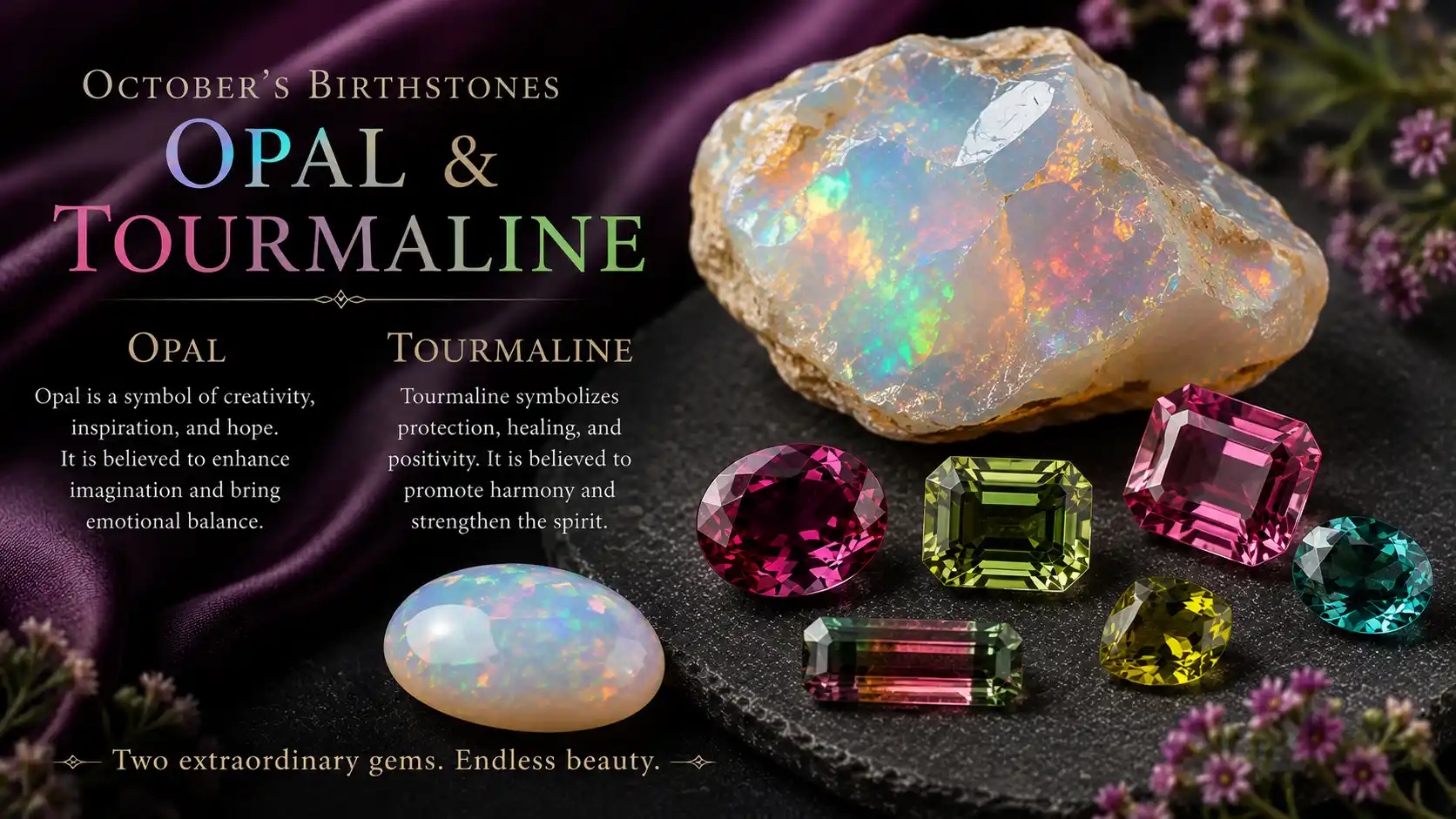
October Birthstone: Opal & Tourmaline
October has two recognized birthstones: Opal and Tourmaline. Opal is known for play-of-color, an optical display that can flash several spectral hues across one stone, while Tourmaline offers one of the broadest natural color ranges in the gem world.
The two materials are unrelated. Opal is hydrated silica with an amorphous or poorly crystalline structure. Tourmaline is a complex crystalline borosilicate group whose chemistry can produce pink, red, green, blue, yellow, brown, black, colorless and multicolored gems.
Their practical differences are equally important. Opal is relatively soft, brittle and sometimes porous, while Tourmaline is harder and better suited to frequent wear. However, some Tourmalines contain fractures, strong pleochroism or treatments that also affect jewelry decisions.
The companion October Birthstone Jewelry Gift Guide owns finished-jewelry choices. This article focuses on the stones themselves, including their history, properties, varieties, symbolism, value and care.
October Birthstones at a Glance
| Feature | Opal | Tourmaline |
|---|---|---|
| Material identity | Hydrated silica | Complex borosilicate mineral group |
| Structure | Amorphous to poorly crystalline | Crystalline |
| Main visual feature | Play-of-color in precious Opal | Extremely broad color range and zoning |
| Typical colors | White, black, gray, blue, orange, pink and many play-of-color combinations | Pink, red, green, blue, yellow, brown, black and colorless |
| Mohs hardness | Approximately 5–6.5 | Approximately 7–7.5 |
| Toughness | Very poor to fair | Generally fair |
| Cleavage | None | Indistinct or absent in common gem use |
| Common treatments | Dye, smoke, sugar-acid treatment, oil, resin and assembly | Heat, irradiation, filling and occasional coating |
| Main jewelry concern | Scratching, crazing, porosity and doublet or triplet construction | Fractures, thermal shock, abrasion and strong color zoning |
| Main source regions | Australia, Ethiopia, Mexico, Brazil and others | Brazil, Africa, Afghanistan, Pakistan, the United States and others |
| Traditional symbolism | Hope, imagination and creativity | Individuality, friendship and emotional expression |
| Safest cleaning | Warm, soapy water only | Warm, soapy water |
Why October Has Two Birthstones
Birthstone lists developed through several religious, cultural and commercial traditions rather than one unchanged ancient system.
The modern jewelry trade standardized birthstone lists during the twentieth century and later expanded some months to offer additional color, price and availability options.
The Birthstones by Month guide owns the complete historical and calendar framework.
Opal has the older and more widely recognized association with October. Tourmaline became the accepted modern alternative and gives October-born wearers a more durable gemstone with an exceptionally broad color range.
Neither choice is secondary in personal meaning. The better birthstone is the one whose appearance, care requirements and budget suit the wearer.
What Is Opal?
Opal is hydrated silica.
Its internal structure contains silica and water rather than the repeating atomic lattice of a conventional mineral crystal.
Precious Opal displays play-of-color. Light interacts with ordered microscopic structures and separates into spectral colors that change as the stone moves.
Common Opal lacks play-of-color but can still show attractive blue, pink, green, orange, white or yellow bodycolor.
Opal may form in sedimentary rocks, volcanic environments, fractures, cavities, fossils and ironstone matrix depending on the deposit.
What Is Tourmaline?
Tourmaline is a group of related borosilicate minerals rather than one simple chemical compound.
Several tourmaline species share the same general crystal architecture while differing in sodium, calcium, lithium, magnesium, iron, aluminum and other components.
This chemical flexibility creates an exceptional range of colors.
Tourmaline commonly forms as striated prismatic crystals in granite pegmatites and metamorphic rocks.
Gem varieties include pink Tourmaline, Rubellite, green Tourmaline, Indicolite, Chrome Tourmaline, Paraíba-type material, Watermelon Tourmaline and black Schorl.
Precious Opal and Play-of-Color
Precious Opal’s defining feature is play-of-color.
The effect may appear as tiny pinfire points, broad flashes, rolling bands, angular patches, harlequin-like blocks or other patterns.
Brightness matters more than the number of colors alone. A vivid green-and-blue Opal may be more desirable than a weak stone containing faint red.
Red and orange play-of-color can command strong demand because the structural conditions required to produce longer-wavelength colors are less common.
The Types of Opal guide owns the full body-type, pattern and variety framework.
Common Opal
Common Opal does not show play-of-color.
It may appear white, pink, blue, green, yellow, orange, brown or nearly colorless.
Some common varieties have a soft translucent glow that is sometimes described loosely as opalescence.
Pink Opal, blue Opal and dendritic Opal belong to distinct visual categories, but they should not be valued as precious Opal unless spectral play-of-color is actually present.
A seller should distinguish bodycolor from play-of-color clearly.
White, Black and Crystal Opal
White Opal has a pale body tone and is one of the most familiar commercial forms.
Black Opal has a dark body tone that can make spectral colors appear especially vivid. Natural dark bodycolor must be separated from smoked, dyed or backed material.
Crystal Opal is transparent to semitransparent, allowing light and color to appear within a clearer host.
The body classification affects appearance but does not replace evaluation of brightness, pattern, color range and stability.
A black body does not guarantee high value when the play-of-color is weak.
Fire Opal
Fire Opal is known for yellow, orange or red bodycolor.
It may show play-of-color, but many Fire Opals do not.
Transparent material is sometimes faceted rather than cut as a cabochon. Mexico is an important source, although Fire Opal occurs elsewhere.
The name refers to bodycolor rather than proof of spectral fire.
Fine transparent orange or red material can be valuable even without play-of-color.
Opal Water Content and Porosity
Opal contains structural water.
The amount varies by type and deposit. Some material, particularly hydrophane Opal, can absorb additional liquids through connected pore spaces.
Absorption may temporarily change transparency, weight and play-of-color. Oil, perfume and dye can enter porous material and cause persistent changes.
Hydrophane behavior should not be tested casually by soaking finished jewelry.
Doublets, triplets, glue and fillers impose additional restrictions even when the Opal layer itself appears stable.
What Creates Tourmaline Color?
Tourmaline color can result from several trace elements and color centers.
Iron and titanium commonly contribute to green and blue, manganese to pink and red, and copper with manganese to vivid Paraíba-type blue, green and violet colors.
Natural or laboratory-induced radiation can create or modify certain pink and yellow colors.
The Tourmaline Color Meaning guide owns symbolism across the palette, while gemological color causes remain separate.
A trade color name does not identify the exact species or treatment by itself.
Pink and Red Tourmaline
Pink Tourmaline ranges from pale blush to saturated pink.
Rubellite is a red, purplish-red or strongly pink-red commercial category. Fine Rubellite should retain attractive color under different lighting rather than turning brownish or dull.
Pink and red Tourmalines commonly contain more visible inclusions than many green and blue stones.
Some heavily fractured material is clarity enhanced with filler.
Pink Tourmaline’s popularity and October association make it one of the most familiar modern birthstone choices.
Green, Blue and Paraíba-Type Tourmaline
Green Tourmaline ranges from yellowish green to bluish green and deep forest tones.
Indicolite describes blue to greenish-blue Tourmaline. Very dark stones may need careful cutting to avoid black areas.
Copper-bearing Paraíba Tourmaline can show vivid blue, green, turquoise and violet colors associated with copper and manganese.
Fine Paraíba-type material occupies a much higher market than ordinary Tourmaline and requires laboratory evidence when origin or copper-bearing identity affects price.
The general October birthstone category should not be used to imply that every blue-green Tourmaline is Paraíba.
Watermelon and Parti-Colored Tourmaline
Watermelon Tourmaline displays pink or red centers with green outer zones, resembling the color pattern of the fruit.
It may be cut as cross-sectional slices, polished crystals or faceted stones.
Other Tourmalines contain two or more colors along the crystal length. Parti-colored gems can show pink, green, yellow, blue or colorless zones.
Color zoning is a natural consequence of changing chemistry during crystal growth.
The Types of Tourmaline guide owns the complete species and variety overview.
Black Tourmaline
Black Tourmaline is commonly Schorl, an iron-rich Tourmaline species.
It is generally opaque and used in mineral specimens, beads, carvings and spiritual objects rather than transparent faceted jewelry.
Its protection symbolism overlaps with Obsidian and Onyx, but the materials are physically unrelated.
Black Tourmaline may be selected as an October birthstone in a broad mineral sense, although colorful gem Tourmalines are more common in traditional birthstone jewelry.
Opal Hardness and Durability
Opal ranges approximately 5–6.5 on the Mohs scale.
Its toughness ranges from very poor to fair, and it can scratch, chip or craze.
High heat and sudden temperature changes can create fractures. Some hydrophane Opals also respond visibly to moisture and absorbed liquids.
Earrings and pendants provide safer positions than exposed rings and bracelets.
The Opal Buying Guide owns stability, pattern, body type and treatment evaluation.
Tourmaline Hardness and Durability
Tourmaline ranks approximately 7–7.5 on the Mohs scale.
It is suitable for rings, earrings, necklaces and bracelets with normal care, although included stones and long crystals can chip after hard impact.
Strong heat can alter color in some material or damage fractures and fillers.
Tourmaline’s pleochroism and long crystal form affect cutting. A gemstone may appear darker along one direction and lighter along another.
The Tourmaline Buying Guide owns detailed color, clarity, cut and variety selection.
Opal Treatments and Assembled Stones
Opal can be dyed, smoked, sugar-acid treated, impregnated with oil or resin, coated or assembled.
A doublet combines a thin Opal layer with a backing. A triplet adds a transparent protective cap.
These products can provide attractive play-of-color at a lower price but require disclosure.
Prolonged water exposure may weaken adhesive, while side examination often reveals the layers.
The Treated Opal guide owns the enhancement boundary, and Real vs Fake Opal covers doublets, triplets, synthetic material and imitations.
Tourmaline Treatments
Tourmaline may be heated to improve selected colors.
Irradiation can create or strengthen pink and other hues, sometimes in combination with heat. Color stability depends on the material and process.
Fracture filling may improve apparent clarity in heavily included stones, especially selected Rubellite and Paraíba-type material.
Some fashion-color stones may receive coatings.
Treatment should be stated when known and reflected in care instructions and price.
Synthetic and Imitation Opal
Synthetic Opal reproduces an ordered silica structure capable of producing play-of-color but forms through manufacturing.
Imitation Opal may consist of glass, resin or assembled material that resembles the optical effect without matching natural Opal’s structure.
Synthetic products can be attractive and durable when represented accurately.
Regular repeated patterns, columnar structure and unusual backing may provide clues, but professional testing is more reliable than one visual sign.
Natural, synthetic and imitation categories should never be merged under the phrase created Opal without explanation.
Synthetic and Imitation Tourmaline
True laboratory-grown Tourmaline is not common in ordinary jewelry.
Glass, synthetic Spinel, synthetic Sapphire, Cubic Zirconia and other natural gems can imitate Tourmaline colors.
Color names such as Paraíba blue, Rubellite red or Watermelon should not be applied to unrelated materials without identifying the base substance.
Laboratory testing may use refractive index, pleochroism, spectroscopy, inclusions and chemical analysis.
A seller card is not proof of material identity.
Important Opal Sources
Australia is historically famous for white, black, Crystal and Boulder Opal.
Ethiopia supplies important hydrophane Opal with vivid play-of-color and a wide range of body types.
Mexico is associated strongly with Fire Opal. Brazil, the United States, Honduras, Slovakia and other countries also produce material.
Origin affects market expectations but does not guarantee stability or beauty.
A laboratory may provide an origin opinion for some material, although treatment, assembly and individual quality remain more important than country name alone.
Important Tourmaline Sources
Brazil produces a wide range of Tourmaline colors and is historically important for Paraíba material.
Mozambique and Nigeria also produce copper-bearing Tourmaline, while Afghanistan and Pakistan are known for pink, green, blue and multicolored crystals.
Madagascar, Namibia, Sri Lanka, the United States and several other countries contribute to the market.
Maine and California have important Tourmaline histories in the United States.
Country alone does not determine quality. Fine and commercial stones can come from the same mining region.
October Birthstone History and Symbolism
Opal has long been associated with hope, imagination, creativity and changing color.
Historical European superstition later gave it an unfair reputation for bad luck, strengthened by literary storytelling rather than the stone’s physical properties.
Tourmaline’s broad palette supports symbolism involving individuality, friendship, emotional expression and diversity.
These meanings are cultural rather than scientifically measurable.
A birthstone can gain personal significance through a birthday, family gift or individual color preference without being expected to change health or fate.
October Zodiac Connections
October birthdays commonly fall under Libra or Scorpio in the Western tropical zodiac.
The Libra Birthstone guide owns the earlier-October zodiac framework, while the Scorpio Birthstone guide covers later October.
Zodiac stones and monthly birthstones belong to different systems.
An October-born person can choose Opal or Tourmaline regardless of astrological sign.
Anniversary Associations
Opal is commonly associated with the fourteenth wedding anniversary.
Tourmaline is widely linked with the eighth anniversary.
These traditions provide an additional gifting context but are not universal historical laws.
A person celebrating an anniversary should still choose according to durability and color preference.
Opal may suit a carefully worn pendant, while Tourmaline provides a broader range of practical ring options.
Opal and Tourmaline Prices
Opal prices vary enormously according to body type, brightness, pattern, color range, transparency, stability, treatment and origin.
The Opal Price Guide owns those market differences.
Tourmaline pricing depends heavily on color variety. Ordinary green and pink material can be accessible, while fine Rubellite, Chrome Tourmaline and Paraíba-type stones may command major premiums.
The Tourmaline Price Guide owns current valuation.
Birthstone status does not make every example rare or expensive.
Choosing Between Opal and Tourmaline
Choose Opal when the wearer values one-of-a-kind play-of-color and accepts more cautious care.
Choose Tourmaline when color choice, greater hardness and more frequent wear are priorities.
A person who loves spectral flashes may prefer precious Opal, while someone seeking a specific pink, green or blue can often find it in Tourmaline.
Opal is generally better suited to protected earrings and pendants. Tourmaline offers more flexibility for rings and bracelets.
Neither choice is universally superior because they serve different visual and practical needs.
Cleaning and Care
Follow How to Clean Opal Jewelry Safely and use warm, soapy water only.
Do not use steam or ultrasonic equipment on Opal. Avoid high heat, sudden temperature changes and prolonged soaking, especially with hydrophane or assembled material.
Follow How to Clean Tourmaline Jewelry Safely for the second October birthstone.
Warm, soapy water is the safest Tourmaline method. Steam and ultrasonic cleaning are not recommended because fractures, inclusions and treatments can create vulnerability.
Store Opal separately from Tourmaline because the harder Tourmaline can scratch it.
Frequently Asked Questions
1. What are the October birthstones?
Opal and Tourmaline are the two recognized October birthstones.
2. Which is the traditional October birthstone?
Opal has the older traditional association, while Tourmaline is the widely recognized modern alternative.
3. Are Opal and Tourmaline related?
No. Opal is hydrated silica, while Tourmaline is a crystalline borosilicate mineral group.
4. What causes Opal’s rainbow colors?
Ordered microscopic silica structures diffract light into spectral colors, creating play-of-color.
5. Does every Opal show play-of-color?
No. Precious Opal displays play-of-color, while common Opal does not.
6. Why does Tourmaline come in so many colors?
Its complex crystal structure accepts many elements and color-producing defects during growth.
7. Which October birthstone is harder?
Tourmaline ranks about 7–7.5, while Opal ranges approximately 5–6.5.
8. Which is better for an everyday ring?
Tourmaline is generally more practical. Opal requires a protected setting and more cautious wear.
9. Are Ethiopian Opals harmed by water?
Many are hydrophane and can absorb liquids, temporarily changing appearance. Finished jewelry should not be soaked.
10. Is Watermelon Tourmaline natural?
Natural pink-and-green zoning occurs, although imitations and assembled products also exist.
11. Which October birthstone is more expensive?
Either can be costly at the highest quality. Fine Black Opal and Paraíba Tourmaline occupy especially high market levels.
12. How should October birthstones be cleaned?
Use warm, soapy water for both. Avoid steam and ultrasonic equipment, and never soak assembled or hydrophane Opal.
October’s birthstones approach color from opposite directions. Opal can contain several spectral colors within one shifting pattern, while Tourmaline divides the palette among crystals, zones and varieties. One offers optical individuality with demanding care; the other offers nearly unlimited color with greater everyday durability.
Opal and Tourmaline meanings involving hope, creativity, friendship, protection or emotional healing are cultural and personal traditions rather than scientifically established medical or destiny-changing effects.