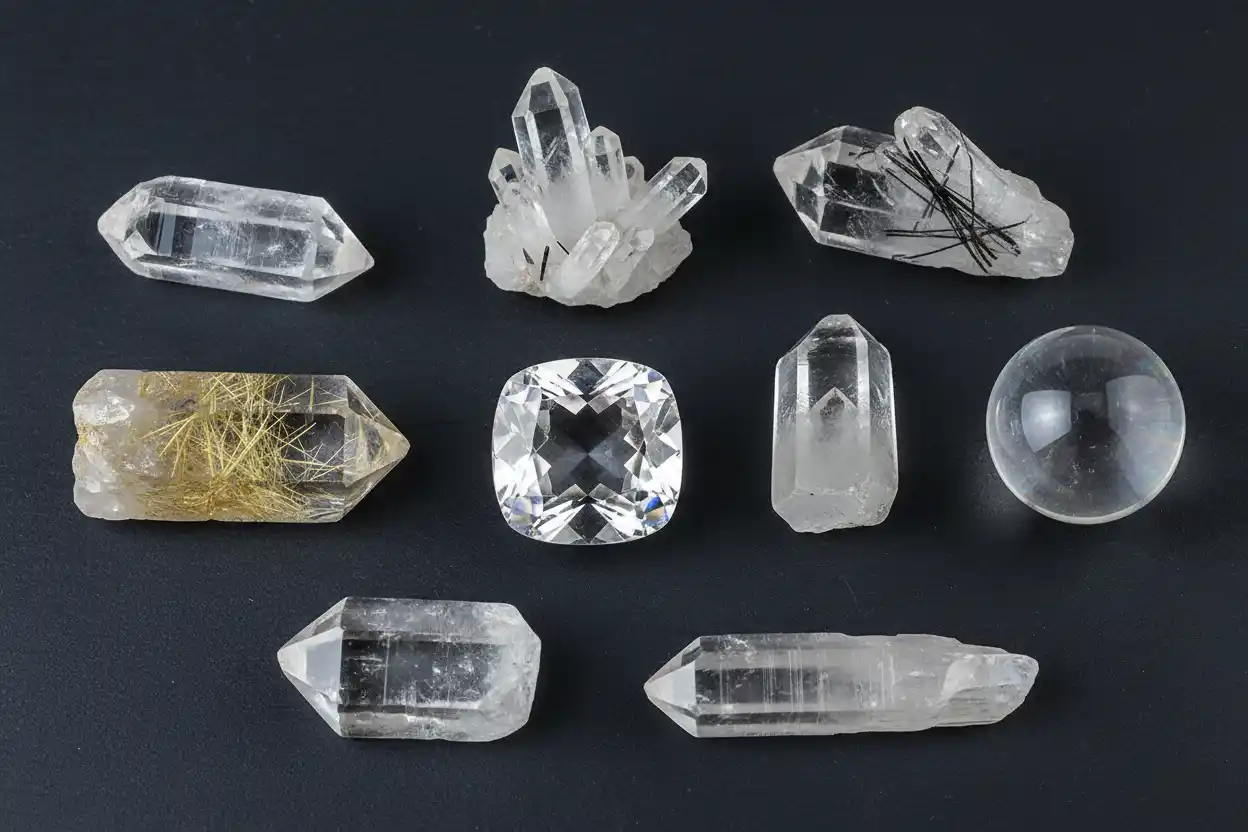
Types of Clear Quartz: Colors and Varieties Explained
Clear quartz is transparent to nearly transparent crystalline silica without enough color-producing defects or inclusions to place it in a colored quartz variety. Although “rock crystal” is its traditional mineralogical name, the market divides clear quartz into many types based on crystal habit, locality, inclusions, internal growth features, surface texture, and treatment.
Those labels do not usually represent separate mineral species. They describe different expressions of the quartz covered in the main clear quartz meaning and properties guide.
Clear Quartz at a Glance
| Property | Clear Quartz |
|---|---|
| Composition | Silicon dioxide, SiO₂ |
| Mineral group | Quartz |
| Colors | Colorless, near-colorless, faintly smoky, milky, or tinted by inclusions |
| Crystal system | Trigonal |
| Typical habit | Six-sided prisms with pyramidal terminations; doubly terminated crystals; clusters; druses; massive material |
| Luster | Vitreous |
| Transparency | Transparent to translucent |
| Mohs hardness | 7 |
| Cleavage | None |
| Tenacity | Brittle |
| Common uses | Faceted gems, cabochons, carvings, beads, crystal points, mineral specimens, lenses, and industrial components |
| Main care concern | Chipping, internal fractures, undisclosed coating or crackling, thermal shock, and silica dust during lapidary work |
What Counts as a Type of Clear Quartz?
Unlike amethyst, citrine, and smoky quartz, clear quartz has no strong body color defining its variety. Its practical types therefore come from structure and context.
Some names describe crystal form, such as doubly terminated or skeletal quartz. Others identify a locality, as with true Herkimer diamonds. Inclusion names such as rutilated, tourmalinated, and garden quartz describe what the crystal contains. Trade labels such as Lemurian quartz attach spiritual or commercial interpretations to common growth features.
The parent quartz family guide owns the broader discussion of colored and microcrystalline quartz. This article remains focused on colorless or predominantly transparent quartz and the forms sold within that market.
Rock Crystal
Rock crystal is the traditional name for transparent colorless quartz. It can occur as individual prismatic crystals, intergrown clusters, massive transparent rough, or water-worn pebbles.
Fine material shows high transparency, bright vitreous luster, sharp natural faces, and minimal internal fracturing. However, inclusions and growth features can increase value when they form attractive patterns or document geological history.
Rock crystal has been used for beads, seals, carved vessels, lenses, spheres, and faceted ornaments for centuries. Today, it remains abundant enough for large carvings while exceptional water-clear crystals and aesthetically balanced clusters retain collector value.
Single-Terminated Clear Quartz
A typical quartz point grows from matrix at one end and develops a natural pyramidal termination at the exposed end. The base may be rough, broken, healed, or attached to host rock.
Collectors assess termination quality, face luster, symmetry, clarity, damage, internal features, and matrix presentation. A perfectly terminated crystal usually commands more than a comparable point with a repaired or polished tip.
Some commercial points have been cut and polished to resemble natural crystals. Polishing is not inherently deceptive, but sellers should disclose it because natural crystal faces and manufactured facets have different collector significance.
Doubly Terminated Quartz
Doubly terminated quartz develops complete terminations at both ends because it grows with limited attachment to matrix or inside an open cavity.
These crystals can form in many localities. Double termination alone does not make a stone a Herkimer diamond.
Small doubly terminated crystals may be exceptionally clear, while larger examples can contain fractures, carbonaceous material, clay, hydrocarbons, fluid inclusions, or other minerals.
A complete undamaged crystal with balanced terminations generally carries more specimen value than a broken or re-polished example.
Herkimer Diamond
A true Herkimer diamond is doubly terminated quartz associated with the Herkimer County region of New York and nearby geological formations.
The name “diamond” describes the material’s natural brilliance and shape. It is quartz, not carbon diamond.
Herkimer crystals commonly contain fluid inclusions, black carbonaceous matter, healed fractures, negative crystals, or movable bubbles. High-grade specimens may be remarkably transparent with eighteen natural faces formed by six prism faces and two sets of six terminal faces.
Quartz from Pakistan, China, Mexico, and other countries is often sold as “Herkimer-style” or incorrectly labeled Herkimer diamond. Accurate locality wording preserves the geographic meaning of the name.
Arkansas Rock Crystal
Arkansas is one of North America’s best-known sources of clear quartz crystals. The Ouachita Mountains have produced individual points, clusters, plates, and substantial transparent crystals.
Arkansas quartz is a locality designation rather than a different chemical variety. Quality ranges from commercial points to museum-grade clusters with sharp terminations and bright luster.
Mining commonly involves removing clay and weathered host material from quartz veins and pockets. Mechanical extraction can damage terminations, while careful hand recovery preserves specimen quality.
Clean Arkansas crystals are widely used for display and lapidary work, although provenance alone does not guarantee exceptional clarity or value.
Alpine Quartz
Alpine-type quartz forms in fissures within metamorphic mountain belts, including the European Alps and comparable geological settings.
Crystals may show exceptional luster, tapered forms, chlorite inclusions, smoky zones, unusual habits, or association with feldspar, adularia, calcite, rutile, and other minerals.
“Alpine quartz” should ideally refer to documented geographic or geological provenance. Applying it to any slender clear crystal weakens the term’s meaning.
Phantom Quartz
Phantom quartz contains one or more ghost-like outlines of earlier crystal stages.
A phantom forms when quartz growth pauses and another mineral, dusting layer, chlorite, hematite, clay, or fine particles coat the existing termination. Growth later resumes, enclosing the old surface within new clear quartz.
The result may resemble a smaller crystal suspended inside the larger one. Multiple pauses can create stacked or nested phantoms.
Sharp, centered, well-contrasted phantoms generally carry more value than diffuse layers. Grinding a crystal into a poorly oriented shape can obscure the feature, so cutters plan cabochons and polished points around the internal outline.
Garden Quartz and Lodolite
Garden quartz is transparent or translucent quartz containing scenic inclusions that resemble moss, gardens, clouds, underwater landscapes, or miniature terrain.
The trade also uses the name lodolite. Common inclusions include chlorite, iron oxides, clay minerals, feldspar, amphiboles, and other fine mineral aggregates.
Garden quartz differs from phantom quartz because its inclusions usually create irregular scenes rather than a clear replica of an earlier crystal termination.
Each piece is visually unique. Value depends on the composition, depth, contrast, transparency of the host, polish, and whether the inclusions create an appealing scene from the face-up direction.
Rutilated Quartz
Rutilated quartz contains needle-like or hair-like rutile crystals. The inclusions may be golden, copper-colored, reddish, brown, silver-gray, or nearly black.
Rutile can occur as isolated needles, dense sprays, crossing bundles, stars, or radiating clusters. Fine transparent host quartz provides the strongest contrast.
The needles may intersect fractures or extend beyond polished surfaces. Consequently, cutters must avoid weakening the stone along heavily included zones.
Not every gold-colored inclusion in quartz is rutile. Goethite, tourmaline, hematite, and other minerals can produce similar appearances.
Tourmalinated Quartz
Tourmalinated quartz contains tourmaline crystals, most commonly black schorl, enclosed within clear or milky quartz.
The inclusions may form straight rods, crossing needles, radiating groups, or irregular prisms. Some crystals show broken tourmaline fragments that were enclosed and partly healed during later quartz growth.
Strong black-and-clear contrast makes the material popular for cabochons, beads, carvings, and polished freeforms. Excessively dense inclusions can weaken transparency and create stress around internal contacts.
Druzy Quartz
Druzy quartz consists of a surface covered with numerous tiny quartz crystals.
Clear druzy may line geodes, coat chalcedony, cover matrix, or form over earlier minerals. Each microscopic termination reflects light, producing a sparkling texture.
Natural druzy is commonly colorless, white, gray, or faintly tinted. Bright metallic and rainbow surfaces usually result from vapor-deposited coatings.
Druzy is better suited to protected pendants, earrings, and specimen display than exposed rings because the tiny points can abrade, catch fabric, or break.
Enhydro Quartz
Enhydro quartz contains fluid trapped in a sealed internal cavity. Some cavities include a movable gas bubble that shifts when the crystal turns.
The liquid was enclosed during or after crystal growth and can preserve information about ancient hydrothermal fluids. Nevertheless, not every internal cavity contains visible movement, and some sellers incorrectly apply “enhydro” to ordinary negative crystals.
Drilling, heating, ultrasonic vibration, and aggressive cutting can rupture the cavity. An intact movable bubble generally contributes more value than a static or poorly visible inclusion.
Owners should not attempt to open an enhydro crystal. Doing so destroys the specimen feature and may release contaminated or mineral-rich fluid.
Petroleum Quartz
Petroleum-included quartz contains hydrocarbons within internal cavities. Under ultraviolet light, some petroleum inclusions fluoresce blue, yellow, green, or white.
Fine examples may contain liquid petroleum, a mobile gas bubble, solid bitumen, and other phases in the same negative crystal.
Pakistan, Afghanistan, and several petroleum-bearing geological regions have produced notable material. Fluorescence alone does not prove petroleum because other inclusions and treatments can also respond to ultraviolet light.
Petroleum quartz is primarily a collector material. Careful low-heat handling preserves its internal fluids.
Girasol Quartz
Girasol quartz is translucent quartz with a soft, misty, bluish-white, or opalescent glow.
Microscopic inclusions and internal scattering create the diffused appearance. It should not be confused with precious opal, moonstone, or girasol opal.
The best material shows an even internal glow rather than chalky opacity. It is commonly cut into spheres, cabochons, beads, and polished freeforms.
Because the name is used inconsistently, buyers should verify whether a seller means girasol quartz, girasol opal, or another cloudy material.
Lemurian Quartz
Lemurian quartz is a modern trade and spiritual name usually applied to clear or pale quartz crystals with pronounced horizontal striations on alternating prism faces.
Those striations are normal growth features produced as crystal faces develop. They do not establish a separate mineral variety or scientifically recognized ancient origin.
Some dealers reserve the name for crystals from specific Brazilian deposits, while others apply it to similar material from Colombia, Russia, Zambia, or elsewhere.
Quality should be evaluated through crystal condition, luster, transparency, form, and documented locality rather than metaphysical marketing alone.
Candle Quartz
Candle quartz has a central crystal covered by smaller secondary crystals, creating a textured surface that can resemble dripping candle wax.
It is also called pineapple quartz in parts of the trade. The overgrowth reflects a later stage of quartz crystallization around the original core.
Well-formed examples display a recognizable central termination and balanced secondary growth. Damage to the smaller crystals can reduce specimen value.
Skeletal and Elestial Quartz
Skeletal quartz grows faster along edges and corners than across full crystal faces, leaving stepped, hollowed, or recessed structures.
“Elestial quartz” is a trade name commonly applied to heavily stepped, layered, or complex skeletal crystals. It is not a formal mineral species.
Open growth cavities may trap clay, fluids, iron oxides, or other minerals. Complex surfaces can be fragile and difficult to clean without damaging thin edges.
A natural skeletal specimen should show consistent crystal growth rather than random grinding marks or acid-etched surfaces created after mining.
Window and Key Quartz
Window quartz is a trade description for crystals with a relatively smooth rhombohedral face or clear area that appears to provide a view into the interior.
Key quartz refers to angular impressions or recessed shapes formed when another crystal contacted the quartz during growth and later detached or dissolved.
Both are morphological descriptions rather than mineral varieties. Their value depends on natural form, clarity, condition, and collector interest.
Snow, Spirit, and Other Pale Quartz Forms
Snow quartz is milky to opaque white quartz whose abundant microscopic inclusions scatter light. It falls outside strict water-clear rock crystal but remains part of the broader colorless quartz spectrum.
Spirit quartz has a central crystal coated by many smaller quartz points, usually from South African deposits. Amethyst, citrine, and smoky colors also occur.
These materials illustrate how crystal texture can define a commercial quartz type even when composition remains unchanged.
Included Trade Varieties
Several clear-quartz names reflect specific inclusions rather than body color.
Hollandite quartz contains dark star-like or radiating inclusions traditionally identified with hollandite-group minerals. Lithium quartz is a trade name for quartz with pink, violet, gray, or red inclusions claimed to contain lithium-bearing minerals.
Harlequin quartz generally contains red hematite or lepidocrocite-like inclusions along with other contrasting internal features. Fire quartz commonly refers to quartz with reddish hematite inclusions, also called hematoid quartz.
Golden healer quartz has yellow or golden iron-oxide staining, coatings, or inclusions. These names overlap in the market, and mineral identification of the inclusions may require Raman spectroscopy or other analysis.
Crackle Quartz
Crackle quartz, sometimes marketed as fire-and-ice quartz, contains a network of internal fractures that strongly reflect light.
Some quartz fractures naturally through geological stress or temperature change. However, much commercial crackle quartz is produced by heating and rapidly cooling clear quartz.
The fractured material may later be dyed, allowing color to penetrate the crack network. Heat-crackling weakens the stone and increases the chance of breakage during drilling, setting, or impact.
Natural-looking fractures do not establish natural origin, so treatment disclosure remains essential.
Aura and Coated Quartz
Aura quartz is natural or synthetic quartz coated with a thin metallic film. Vapor deposition can create blue, gold, pink, green, rainbow, or iridescent surfaces.
Common coating materials include titanium-related compounds, gold, platinum, and other metals or oxides. Trade names such as angel aura, aqua aura, rainbow aura, and flame aura refer to coating color rather than different quartz varieties.
Coatings can scratch, abrade, or react to harsh chemicals. They should not be represented as naturally occurring surface colors.
Synthetic Clear Quartz
Clear quartz can be grown hydrothermally under controlled laboratory conditions. Industrial synthetic quartz is essential for oscillators, electronics, optics, and frequency-control components.
Gem-quality synthetic rock crystal can be transparent and nearly inclusion-free. Some pieces are cut as gemstones or used as carving material.
Natural and synthetic quartz share the same basic composition, hardness, and refractive properties. Advanced separation may rely on growth structures, infrared spectroscopy, trace chemistry, seed-plate features, or diagnostic inclusions.
The dedicated guide to treated and synthetic clear quartz should retain the full detection discussion.
Glass and Other Imitations
Glass is the most common clear-quartz imitation. It may contain round gas bubbles, flow lines, swirls, mold seams, or surface wear inconsistent with quartz hardness.
Optical glass can be exceptionally clean, so the absence of inclusions does not prove quartz. Refractive index, birefringence, thermal behavior, and polarized-light testing provide better evidence.
Clear calcite, selenite, topaz, synthetic spinel, and other transparent materials can also be confused with quartz. The dedicated clear quartz versus selenite guide covers one especially common comparison.
For consumer-level checks, the real versus fake clear quartz guide owns the focused identification intent.
Formation and Geological Environments
Quartz forms in igneous, metamorphic, sedimentary, and hydrothermal environments. Silica-rich fluids fill fractures, open cavities, pegmatites, and veins, allowing crystals to grow when temperature, pressure, and fluid chemistry change.
Large transparent crystals commonly develop in hydrothermal veins and pegmatitic cavities where space remains open for well-formed prisms.
Repeated interruptions create phantoms and inclusion layers. Other minerals may crystallize before, during, or after quartz, producing rutilated, tourmalinated, chlorite-bearing, or scenic material.
Crystal shape records its growth environment. Rapid growth, restricted space, fluid composition, and contact with neighboring crystals can produce skeletal faces, keys, double terminations, or complex intergrowths.
Important Localities
Brazil supplies large quantities of clear quartz, included quartz, phantoms, carvable rough, and crystal clusters. Madagascar is known for transparent crystals, polished material, and unusual inclusions.
Arkansas remains an important source of North American rock crystal. Herkimer County in New York produces its distinctive doubly terminated crystals.
Pakistan and Afghanistan yield alpine-type quartz, petroleum inclusions, chlorite-bearing specimens, and crystals associated with pegmatite minerals. China, Nepal, India, Russia, Colombia, Namibia, South Africa, Switzerland, and many other regions also produce important material.
Locality should be supported by provenance rather than inferred from shape. A crystal’s habit may resemble a famous deposit without coming from that region.
Inclusions and Internal Features
Clear quartz can contain fluid-filled negative crystals, gas bubbles, healed fractures, growth tubes, rutile, tourmaline, chlorite, hematite, goethite, feldspar, calcite, mica, hydrocarbons, and numerous other minerals.
Inclusions may reduce transparency but increase collector value when they are attractive, rare, scientifically informative, or well positioned.
Natural fingerprints and multiphase fluid inclusions can support natural origin. Nevertheless, some synthetic quartz also contains inclusions or seed-related features, so identification should consider the complete evidence.
Cutting Behavior
Rock crystal can be faceted into large stones because transparent rough is abundant. Rounds, ovals, cushions, emerald cuts, fantasy cuts, carvings, intaglios, and spheres are all common.
Quartz has no cleavage, which simplifies orientation compared with topaz or calcite. However, internal fractures and brittle tenacity can still cause breakage.
Included varieties demand careful planning. A rutilated stone should present its needles attractively, while garden and phantom quartz require an orientation that keeps the scene visible through the polished face.
Faceted colorless quartz has modest brilliance and dispersion compared with diamond, zircon, or cubic zirconia. Its appeal therefore comes from clarity, size, natural form, inclusions, or artistic cutting rather than exceptional fire.
Durability and Jewelry Suitability
Quartz has Mohs hardness 7 and no cleavage. The gemstone hardness chart shows that it resists ordinary wear better than calcite, fluorite, apatite, and feldspar.
Even so, quartz can chip at sharp edges or break across existing fractures. The gemstone cleavage guide clarifies why a mineral without cleavage can remain brittle.
Solid rock crystal works in rings, earrings, pendants, bracelets, beads, and carvings. Druzy, enhydro, heavily included, skeletal, and crackled types require more protection.
A setting should not place prongs directly over surface-reaching fractures or vulnerable inclusions.
Clear Quartz Prices in 2026
Ordinary clear quartz remains inexpensive because it is widely available. Small tumbled stones and commercial points frequently retail for $2–$20.
Hand-sized clear points and ordinary clusters commonly fall between $15 and $100. Better transparency, intact terminations, attractive matrix, locality documentation, and aesthetic balance can move specimens into the $100–$1,000-plus range.
Commercial faceted rock crystal may cost approximately $1–$10 per carat. Precision cuts, large flawless carvings, custom intaglios, or specialist optical material can reach $10–$50-plus per carat, although artistry often contributes more value than the rough.
Small commercial Herkimer crystals may cost $5–$30, while water-clear, large, undamaged, documented New York specimens can sell for $50–$500 or more. Exceptional clusters and historic mining-locality specimens may exceed those ranges.
Included quartz varies even more widely. Common rutilated or garden-quartz cabochons may sell for $10–$75, while unusually scenic, transparent, or rare-inclusion pieces can reach hundreds or thousands of dollars.
Buying Guidance
Decide whether you want natural crystal form, lapidary polish, a particular inclusion, locality provenance, or a spiritual trade label. These categories should not be valued by the same criteria.
For natural points, inspect every termination, edge, base, and contact point. Ask whether the tip has been polished, repaired, glued, or reconstructed.
For included quartz, request views from several angles. A photograph taken from one ideal direction may conceal cloudiness, fractures, or an inclusion that disappears when the stone moves.
Treatment questions should cover crackling, dye, coating, irradiation, filling, polishing, laboratory growth, and assembled construction.
The dedicated clear quartz buying guide retains detailed retailer checks and authenticity guidance.
Cleaning and Storage
Solid untreated clear quartz can be cleaned with lukewarm water, mild soap, and a soft brush. Rinse it briefly and dry it with a lint-free cloth.
Avoid rapid temperature changes, especially in enhydro, heavily included, repaired, or crackled specimens. Heat can expand trapped fluids and stress existing fractures.
An ultrasonic cleaner may be acceptable for flawless untreated rock crystal, but it is unsuitable for coated, filled, glued, crackled, enhydro, petroleum-included, druzy, or heavily fractured material. Review the guide to gemstones in ultrasonic cleaners before using equipment.
Strong sunlight does not normally damage colorless quartz itself, but it can overheat fluid-bearing specimens and affect dyes or coatings. Broader light guidance appears in the article on crystals that fade in sunlight.
Store polished quartz away from topaz, sapphire, diamond, and other harder materials. Delicate clusters need a stable padded box rather than a crowded display shelf.
Meaning and Symbolism
Clear quartz has been associated in modern spiritual traditions with clarity, focus, intention, balance, and the amplification of personal practices.
Different growth forms have developed their own symbolic interpretations. Phantom quartz is often associated with stages of growth, garden quartz with reflection and connection to nature, and doubly terminated crystals with balance or exchange.
Lemurian, record keeper, window, key, and elestial labels carry modern metaphysical narratives rather than mineralogical classifications.
These meanings can support personal ritual, meditation, collecting, or cultural practice. They are not scientifically demonstrated effects of crystal structure, inclusions, locality, or shape.
Frequently Asked Questions
1. Is rock crystal the same as clear quartz?
Yes. Rock crystal is the traditional mineralogical and gemological name for transparent colorless quartz.
2. How many types of clear quartz are there?
There is no fixed number. Clear quartz is classified by crystal habit, locality, inclusions, internal growth features, treatment, and trade terminology.
3. Is every doubly terminated quartz a Herkimer diamond?
No. True Herkimer diamonds come from the Herkimer County region of New York. Doubly terminated quartz from other countries should be described by its actual locality.
4. What creates a phantom inside quartz?
A phantom forms when crystal growth pauses, another mineral or fine material coats the old termination, and later quartz growth encloses that earlier surface.
5. Is garden quartz the same as lodolite?
Usually. Both names describe transparent or translucent quartz with scenic mineral inclusions, although trade usage can vary.
6. Is Lemurian quartz a scientific variety?
No. Lemurian quartz is a modern trade and spiritual name commonly applied to striated quartz crystals. The striations are normal growth features.
7. Does enhydro quartz contain ancient water?
It contains fluid trapped during or after crystal growth. The fluid may be geologically old, but age and composition require scientific analysis rather than visual assumption.
8. Is crackle quartz natural?
Natural fractured quartz exists, but much commercial crackle quartz is deliberately heated and rapidly cooled. It may also be dyed.
9. Is aura quartz naturally iridescent?
No. Aura quartz receives a thin artificial metallic coating that creates its iridescent surface.
10. Can clear quartz be laboratory-grown?
Yes. Hydrothermal synthetic quartz is produced extensively for industrial use and can also enter the gem and carving market.
11. How can glass be distinguished from clear quartz?
Glass may show bubbles, flow lines, mold marks, and single refraction, while quartz is doubly refractive and has different optical properties. Instrumental testing is more reliable than appearance alone.
12. Which clear quartz type is most valuable?
Exceptional natural specimens with documented locality, undamaged terminations, rare inclusions, movable enhydro bubbles, strong aesthetics, or historic provenance can be far more valuable than ordinary colorless rough.
Clear quartz types record growth conditions rather than a spectrum of body colors. A rock-crystal point, Herkimer diamond, nested phantom, scenic garden quartz, fluid-bearing enhydro, and rutile-filled cabochon all share the same silica framework, yet each preserves a different geological event. Related pages appear in the crystals that start with C directory and the gemstones that start with C guide.
Safety disclaimer: Cutting, sanding, drilling, or polishing quartz can release respirable crystalline silica dust, which can cause serious lung disease. Use wet lapidary methods, effective local extraction, eye protection, and correctly rated respiratory protection; never dry-grind quartz in an unventilated area.