How to Clean Moissanite Jewelry Safely
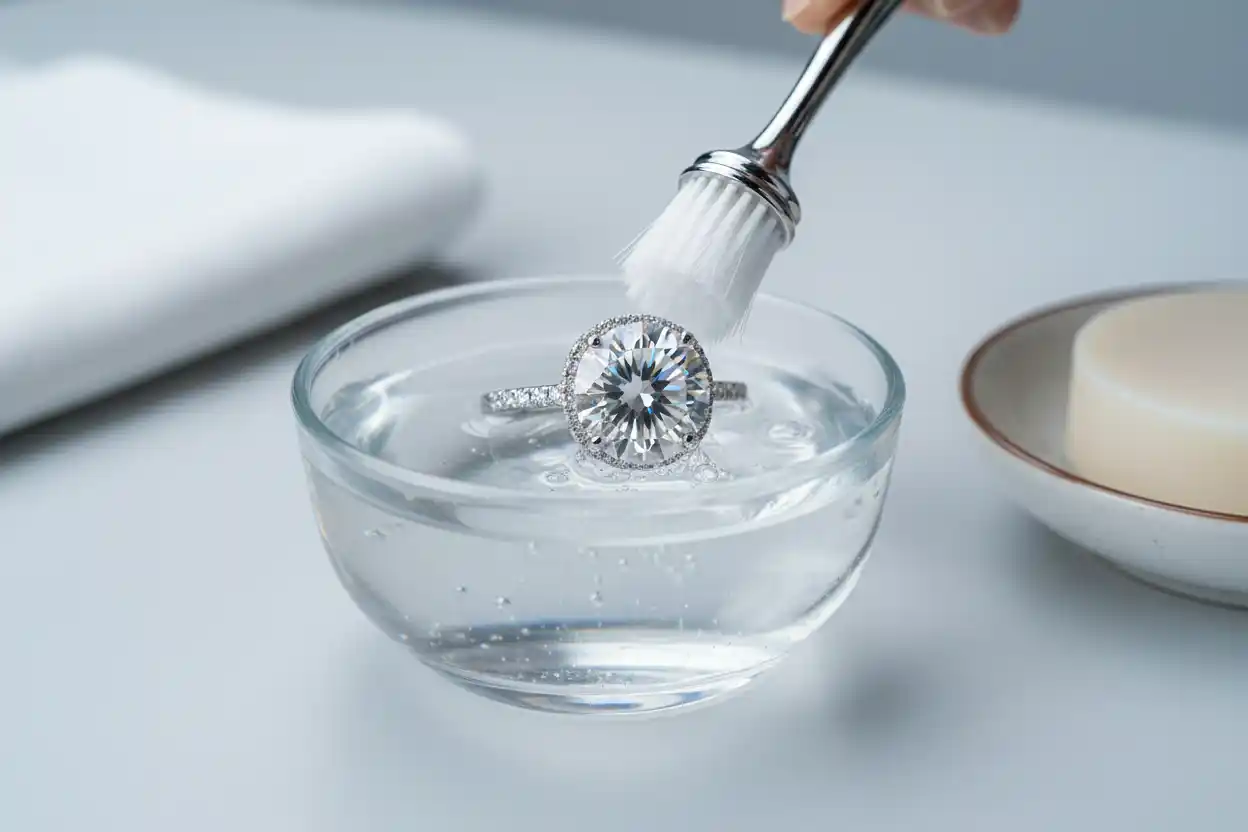
Moissanite jewelry can be cleaned safely with warm water, mild liquid soap, and a soft-bristled toothbrush. Sound moissanite in a secure compatible setting can generally tolerate ultrasonic and steam cleaning, although the metal, plating, glue, coatings, accent stones, and mounting condition may require a gentler method.
Most apparent cloudiness comes from oils, cosmetics, soap film, or residue beneath the stone rather than deterioration of the moissanite itself. Cleaning the pavilion and setting openings usually restores the strongest improvement.
Why Moissanite Is Highly Durable
Moissanite is silicon carbide. Natural crystals are exceptionally rare, so nearly all moissanite used in modern jewelry is laboratory grown.
Its material properties, optical behavior, origin, and symbolism belong to the broader Moissanite guide.
Gem-quality moissanite ranks about 9.25 on the Mohs scale, making it harder than sapphire and softer only than diamond among widely used jewelry stones.
| Property | Cleaning implication |
|---|---|
| Composition | Silicon carbide |
| Commercial origin | Almost entirely laboratory grown |
| Mohs hardness | Approximately 9.25 |
| Cleavage | Poor |
| Fracture | Conchoidal |
| Safest routine method | Warm water, mild soap, and a soft brush |
| Ultrasonic cleaning | Generally safe for the stone |
| Steam cleaning | Generally safe for the stone |
| Main limitations | Settings, glue, coatings, plating, fractures, and companion gems |
The gemstone hardness chart places moissanite among the most scratch-resistant jewelry materials.
Hardness does not protect a weak prong or delicate mounting. The broader distinction appears in Gemstone Toughness vs Hardness, while its poor cleavage is placed in context by Gemstone Cleavage Explained.
Why Moissanite Becomes Dull or Filmy
Moissanite is less grease-attracting than diamond, but skin oils, lotion, sunscreen, soap, makeup, hair products, and cooking residue can still coat its facets.
The pavilion and lower setting openings collect much of this film. A stone may look clean from above while residue underneath reduces brilliance and fire.
Some pieces develop a persistent rainbow-like or oily-looking film. Ordinary washing may improve it, but heavy deposits can require professional cleaning.
Do not attack a stubborn film with abrasive powder, metal polish, toothpaste, or scraping tools. Such methods can damage the mounting and may create uneven surface wear.
Inspect the Setting Before Cleaning
Examine every prong, bezel, channel wall, halo bead, link, hinge, and clasp beneath bright light.
Touch the center stone gently without twisting it. Clicking, movement, or a visible gap indicates that the jewel requires repair before washing or machine cleaning.
Check small accent stones individually. A durable moissanite center does not prevent a loose pavé diamond, sapphire, emerald, or decorative component from being dislodged.
Inspect plating for peeling or thinning. Aggressive brushing and chemical cleaners may wear rhodium, gold vermeil, or other finishes.
Check for Coatings and Unusual Treatments
Colorless and near-colorless moissanite normally receives no care-sensitive clarity enhancement. However, coated or color-modified products have existed, and jewelry may contain adhesive, foil, enamel, or decorative finishes.
The complete treatment boundaries belong to How to Spot Treated or Synthetic Moissanite and Gemstone Treatments Explained.
When the surface shows an iridescent coating, unusual color layer, peeling effect, or uncertain treatment, use manual washing rather than ultrasound or steam.
Treatment history matters less for standard uncoated moissanite than for emerald or opal, but it should not be ignored.
Prepare the Cleaning Solution
Fill a small bowl with warm—not hot—water and add a few drops of mild liquid dish soap.
Prepare a second bowl of clean warm water for rinsing. Use a new soft-bristled toothbrush or a brush reserved exclusively for jewelry.
A lint-free cloth is appropriate for blotting and final fingerprint removal.
Do not clean over an uncovered drain. A loose accent stone or lightweight earring can disappear during rinsing.
Avoid soap containing bleach, abrasive particles, heavy moisturizers, or aggressive degreasers.
Clean Moissanite Step by Step
Place the jewel in the mild solution for several minutes so oils and residue begin to loosen.
Brush the crown, girdle, pavilion, gallery, prongs, and underside of the stone. Cleaning the back is especially important because accumulated film blocks light entering and leaving the jewel.
Use light pressure around pavé, enamel, plating, and delicate settings. The moissanite can resist the brush, but the surrounding metal is much softer.
Do not insert a needle, pin, or knife beneath the stone. Metal tools can bend prongs and scratch the setting.
Rinse and Dry Thoroughly
Rinse the jewel in the second bowl of clean warm water.
Inspect it from several directions to ensure no soap remains beneath the setting. Dried detergent can resemble a cloudy film.
Blot with a lint-free cloth and let hidden moisture evaporate naturally.
Once the piece is dry, inspect the prongs again. Stop wearing the jewel if the stone moves or a metal edge catches on the cloth.
Can Moissanite Go in an Ultrasonic Cleaner?
Moissanite itself is generally safe in an ultrasonic cleaner.
| Jewelry condition | Ultrasonic recommendation |
|---|---|
| Uncoated moissanite in a secure modern setting | Generally safe |
| Secure solitaire in compatible solid metal | Generally safe |
| Loose pavé, halo, or channel setting | Avoid |
| Glued stone | Avoid |
| Surface-coated stone | Prefer manual cleaning |
| Heavily plated fashion jewelry | Prefer manual cleaning |
| Antique or repaired setting | Professional assessment required |
| Mixed-gem jewelry | Follow the most vulnerable material |
Vibration may expose worn prongs, loosen accent stones, damage glue, or affect another gemstone.
The wider equipment comparison belongs to Which Gemstones Can Go in an Ultrasonic Cleaner?.
A machine is optional rather than necessary. Warm soapy water restores most jewelry effectively.
Can Moissanite Be Steam Cleaned?
Uncoated moissanite is generally safe under steam.
However, the setting may include glue, enamel, plating, antique solder, repairs, coatings, or heat-sensitive accent stones.
Professional steam cleaning is most appropriate after the jeweler has inspected the complete piece. Routine home care does not require concentrated heat and pressure.
Cleaning a Moissanite Ring
A Moissanite ring collects lotion, soap, sanitizer, cooking oils, and skin residue quickly.
Brush through the gallery openings and around every prong. Pay particular attention to hidden halos and under-basket details where film can accumulate.
Remove the ring before gardening, exercise, cleaning, swimming, and heavy manual work. Moissanite is durable, but repeated blows can bend the setting.
A Moissanite engagement ring worn every day benefits from periodic professional prong and pavé inspections.
Cleaning Moissanite Earrings
Moissanite earrings collect cosmetics, hairspray, and skin oils behind their baskets.
Clean the posts, backs, hooks, hinges, and lower facets. Screw backs and push backs should be rinsed and dried separately.
Keep alcohol-based disinfectant away from glue, coatings, enamel, and plated finishes.
Cleaning a Moissanite Necklace
A Moissanite necklace or pendant may develop residue from perfume, sunscreen, and contact with the skin.
Apply cosmetics before putting on the necklace and allow them to dry.
Prevent the chain from rubbing across the stone or becoming caught in a halo setting during storage.
For necklaces with many stones, inspect every link and setting rather than concentrating only on the central pendant.
Cleaning a Moissanite Bracelet
A Moissanite bracelet combines multiple settings with flexible links, hinges, and clasps.
Support the bracelet during cleaning and work one section at a time.
Inspect every stone after rinsing. Tennis-style bracelets may contain one weak setting that is difficult to notice until the stone moves.
Removing a Persistent Oil-Slick Film
Begin with repeated warm-soapy-water cleaning using a clean soft brush.
Rinse thoroughly because soap residue can itself create an iridescent film. Dry the jewel and examine it under neutral light.
Do not use toothpaste, baking soda, powdered cleaner, automotive compound, or metal polish.
When the film remains, ask a jeweler familiar with moissanite to clean the piece professionally. Specialized workshop methods should not be reproduced with household chemicals.
Moissanite Versus Diamond
Moissanite and diamond are different materials. Moissanite is silicon carbide, while diamond is crystalline carbon.
The complete optical, durability, value, and origin comparison belongs to Moissanite vs Diamond vs Lab Diamond and Lab Diamond vs Moissanite.
Their safest household cleaning method is similar, but the stones differ in hardness, refractive behavior, dispersion, conductivity, and market positioning.
Cleaning response is not an authenticity test.
Moissanite Versus Cubic Zirconia
Moissanite is harder and more wear resistant than cubic zirconia. The two also differ in composition, density, optical properties, and long-term abrasion resistance.
The direct distinction belongs to Moissanite vs Cubic Zirconia.
The separate physical-care workflow for CZ appears in How to Clean Cubic Zirconia Jewelry Safely.
Do not use scratching, heat, or destructive testing to decide which stone is present.
Buying and Documentation
The Moissanite buying guide covers cut, color, clarity, size, brand, coatings, warranties, and seller disclosure.
Market factors belong to the Moissanite price guide, while color grades, cuts, generations, and commercial varieties appear in Types of Moissanite.
The tracker’s Real vs Fake Moissanite page owns the complete identification workflow.
A report or warranty does not confirm that the current mounting remains secure. Jewelry condition still needs physical inspection.
Storage and Preventive Care
Store moissanite separately from softer gemstones.
It can scratch sapphire, ruby, quartz, topaz, emerald, and many ornamental materials. Diamond can scratch moissanite, while two moissanites may abrade one another.
Use separate padded compartments and prevent chains from rubbing across exposed facets.
Wipe the jewel after wear to remove fresh oil before a persistent film develops.
Frequently Asked Questions
1. What is the safest way to clean moissanite?
Use warm water, mild liquid soap, and a soft toothbrush, then rinse and dry the jewel thoroughly.
2. Can moissanite get wet?
Yes. Water does not normally harm uncoated moissanite, although glue, plating, watches, and companion materials may impose limits.
3. Can moissanite go in an ultrasonic cleaner?
The stone is generally safe, but loose settings, glue, coatings, plating, and vulnerable accent gems may not be.
4. Can moissanite be steam cleaned?
Uncoated moissanite generally tolerates steam. The complete setting should be inspected first.
5. Why does moissanite look cloudy?
Oil, lotion, soap film, cosmetics, residue beneath the setting, or a persistent surface film may reduce brilliance.
6. What causes an oil-slick appearance?
Skin products, soap residue, environmental film, or stubborn surface deposits can produce a rainbow-like sheen.
7. Can toothpaste clean moissanite?
No. Toothpaste is abrasive and can damage the metal, plating, and setting.
8. Is dish soap safe for moissanite?
A few drops of mild liquid dish soap are suitable. Avoid abrasive or heavily moisturizing formulas.
9. Can vinegar clean moissanite?
Vinegar is unnecessary and may affect the metal, solder, plating, glue, or accent stones.
10. Does moissanite lose its sparkle permanently?
The stone normally retains its optical properties. Most loss of sparkle comes from residue or surface wear rather than internal deterioration.
11. How often should moissanite jewelry be cleaned?
Clean frequently worn rings when oils reduce their brilliance, often every few weeks.
12. When should moissanite receive professional cleaning?
Professional care is appropriate for persistent film, loose pavé, worn prongs, antique settings, coatings, or mixed-gem jewelry.
Conclusion
Moissanite is durable enough to tolerate several cleaning methods, but the setting remains the practical limit. Warm soapy water removes most film without placing prongs, plating, or companion stones under unnecessary stress. When an oil-slick appearance survives thorough rinsing, professional cleaning is safer than increasingly abrasive household experiments.