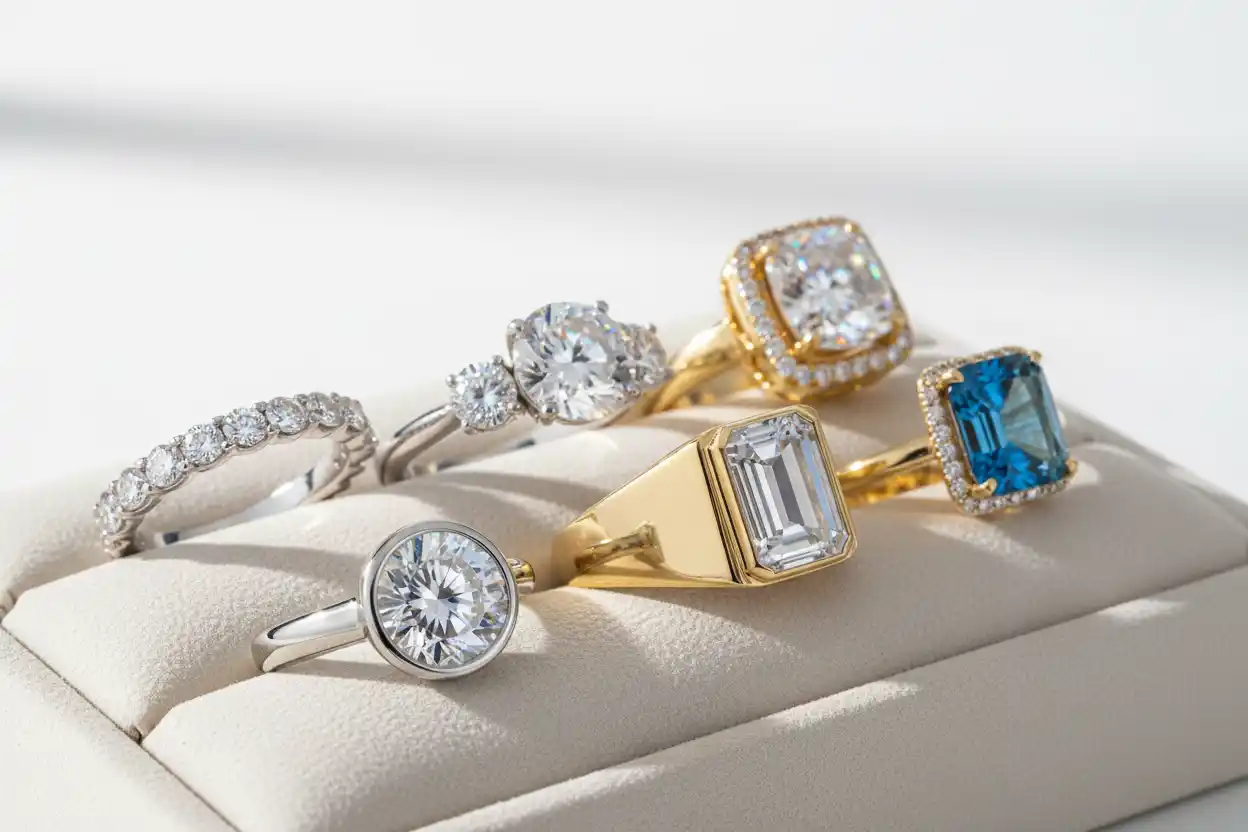
Moissanite Rings: Styles, Settings and Buying Tips
Moissanite rings combine strong brilliance, conspicuous rainbow fire and excellent scratch resistance in designs ranging from understated bands to large cocktail rings. The stone can provide substantial visual size without requiring the budget normally associated with a comparable natural diamond.
Modern jewelry Moissanite is laboratory-created silicon carbide. It is neither diamond nor laboratory-grown diamond, even when it is colorless and mounted in a familiar solitaire setting. A trustworthy listing should use the word Moissanite clearly and disclose colored coatings or other alterations.
This page focuses on non-bridal and general Moissanite rings. Couples choosing a proposal or wedding design should use the dedicated Moissanite engagement-ring guide, which owns wedding-band fit, bridal settings and long-term engagement-ring planning.
The wider Moissanite gemstone guide explains the material’s composition, optical properties and history. Here, the emphasis remains on ring styles, cut, construction, sizing, comfort, buying and care.
Moissanite Rings at a Glance
| Feature | What to evaluate |
|---|---|
| Gem material | Laboratory-created silicon carbide |
| Mohs hardness | Approximately 9.25 |
| Optical appearance | Strong brilliance and high spectral fire |
| Optical character | Doubly refractive |
| Common ring forms | Solitaires, three-stone rings, bands, eternity rings, signets and cocktail designs |
| Most practical setting | Low bezel or substantial prong basket |
| Main size measurement | Millimeter dimensions rather than carat equivalent alone |
| Main durability issue | Setting, prongs and shank rather than the stone |
| Common colors | Colorless, near-colorless, gray, yellow, green, blue and coated fashion colors |
| Main disclosure issue | Must not be represented as diamond or lab diamond |
| Main fit concern | Top-heavy rotation and thin-shank distortion |
| Routine care | Warm water, mild soap and soft brushing |
Is Moissanite Suitable for Everyday Rings?
Moissanite is one of the most durable transparent stones used in everyday jewelry.
Its hardness of approximately 9.25 gives it excellent resistance to ordinary scratching. Only a limited number of gem materials, most notably diamond, rank above it on the Gemstone Hardness Chart.
The stone also has good practical toughness. Nevertheless, hardness does not prevent every type of damage. A severe blow can chip a girdle, while bent prongs or a distorted shank can release an undamaged stone.
The distinction between scratch resistance, toughness and cleavage is explained in Gemstone Toughness vs Hardness.
A well-constructed Moissanite ring can tolerate frequent wear. It should still be removed before mechanical work, heavy lifting, harsh cleaning and activities likely to bend the metal.
The wider Best Gemstones for Everyday Wear comparison places Moissanite among other durable options without treating hardness as the only consideration.
Main Moissanite Ring Styles
| Ring style | Visual character | Main advantage | Main concern |
|---|---|---|---|
| Solitaire | One central stone | Clean and versatile | Setting height and rotation |
| Bezel solitaire | Smooth metal surround | Low snagging and strong edge protection | More visible metal |
| Three-stone ring | Center with two side stones | Balanced and symbolic | Matching and stone separation |
| Five-stone ring | Graduated or equal line | Strong finger coverage | Articulation and side impact |
| Half-eternity band | Stones across upper shank | Easier resizing than full eternity | Pavé and prong maintenance |
| Full-eternity band | Stones around complete ring | Continuous brilliance | Difficult sizing and palm wear |
| Channel-set band | Stones held between metal rails | Smooth and protected | Repair complexity |
| Cocktail ring | Large or elaborate center | Maximum visual impact | Height, leverage and comfort |
| Signet ring | Recessed or framed center | Low profile and strong structure | Stone depth and metal weight |
| Cluster ring | Several smaller stones | Large apparent spread | Numerous prongs |
| Halo ring | Center surrounded by accents | Enlarged outline | More maintenance |
| Colored Moissanite ring | Gray, yellow, green or blue center | Distinctive non-diamond look | Treatment and replacement matching |
Moissanite Solitaire Rings
A solitaire places one center Moissanite above a plain or lightly decorated shank.
Although the style is associated strongly with engagement rings, it also works as a right-hand ring, anniversary ring, milestone gift or everyday fashion design.
The stone should sit low enough to limit snagging while allowing the pavilion to remain cleanable. A high basket may create dramatic visibility but increases leverage when the ring is struck.
Four prongs expose more of the girdle and can create a squarer outline around a round stone. Six prongs provide greater redundancy and usually produce a rounder appearance.
A large center requires a substantial connection between the basket and the shank. A delicate-looking ring can still contain adequate metal, but an extremely narrow neck beneath a large stone may bend over time.
Bezel-Set Moissanite Rings
A bezel surrounds the stone with metal.
This construction protects the girdle, creates a smooth profile and reduces snagging. It is particularly practical for healthcare workers, parents, travelers and anyone who frequently handles fabric or equipment.
A full bezel covers a small portion of the stone’s edge, but Moissanite remains highly brilliant through its face. A partial bezel leaves two or more sides open while preserving much of the protective benefit.
The setting should follow the stone evenly without ripples or gaps. Uneven metal can indicate poor workmanship or make future stone removal difficult.
The back should remain accessible for cleaning. A completely enclosed cavity can trap soap, oil and moisture beneath the gem.
Three-Stone Moissanite Rings
Three-stone rings place one larger center between two accents.
Round, pear, trapezoid, oval and baguette-shaped side stones can create very different outlines. The side stones may be Moissanite, diamond or colored gems.
When Moissanite and diamond are combined, their optical patterns may differ. Moissanite generally produces stronger rainbow fire, while diamond produces a different balance of white brilliance, fire and scintillation.
The invoice should identify each stone separately.
The girdles should not rub against one another. Metal must maintain enough spacing to prevent direct stone contact while keeping the design visually continuous.
Side-stone replacement may be more difficult when the original cut has unusual dimensions.
Five-Stone and Anniversary Rings
Five-stone rings create substantial finger coverage without relying on one large center.
The stones may be identical in size or graduated toward the middle. A gradual size progression usually looks more intentional than abrupt jumps.
Each basket should sit at a similar height so the line follows the finger naturally. A stone that projects above its neighbors receives greater impact.
Five-stone rings commonly mark anniversaries, family milestones or personal achievements. Their symbolism comes from the occasion rather than any inherent energy within Moissanite.
A lower setting is usually more comfortable between adjacent fingers than a broad high gallery.
Moissanite Bands
Moissanite bands range from delicate pavé designs to substantial shared-prong or bezel-set rows.
A half-eternity band places stones across the visible upper portion while leaving solid metal beneath the finger. This structure is generally easier to resize and repair.
A full-eternity band continues stones around the entire circumference. It provides uninterrupted brilliance but exposes settings to palm-level wear and greatly restricts resizing.
Channel settings hold stones between metal rails and reduce snagging. Shared-prong settings show more of the stones but make adjacent gems dependent on the same small sections of metal.
A band should not feel sharp between the fingers. Prongs and girdles must remain contained within the ring’s overall width.
Moissanite Eternity Rings
Eternity rings require particularly accurate sizing.
Because stones and settings continue around the complete ring, substantial enlargement or reduction may be impossible without rebuilding the design.
The inner circumference also affects comfort. Large stones occupy more space between the finger and ring, making a nominal size feel tighter than a plain band of the same measurement.
Inspect the underside because palm-side settings receive the most abrasion. A full-eternity design worn beside another ring may also experience continuous metal-to-metal contact.
A half- or three-quarter-eternity ring often provides a similar face-up appearance with better serviceability.
Cocktail and Statement Rings
Moissanite’s affordability relative to diamond allows large stones and elaborate clusters to be used in statement jewelry.
A cocktail ring may feature an oversized round, oval, cushion, pear or emerald-cut center. Some designs use colored Moissanite or several shapes arranged into a floral or geometric composition.
Large stones display more spectral fire. Under concentrated light, the rainbow flashes may become far more obvious than they would in a small stud or band.
The ring should be judged on the hand rather than only in a display box. A stone that overwhelms the wearer’s finger or spins constantly may not provide comfortable long-term use.
Wide or top-heavy rings often benefit from a broader lower shank, sizing beads or another stabilizing feature.
Moissanite Signet Rings
A signet ring can use a recessed Moissanite, flush setting or framed geometric center.
The broad metal structure protects the stone and suits people who prefer a low-profile design.
Emerald, Asscher, baguette, shield and portrait-style cuts can work well in modern signets. Round stones may be flush-set individually or arranged in a small cluster.
The metal should remain thick enough beneath and around the gem. A very thin signet face can flex, causing the setting to loosen.
A signet can be designed for any wearer. Its success depends on proportions, construction and personal style rather than gendered marketing.
Choosing the Cut
Round brilliant Moissanite produces strong brightness and the most familiar symmetrical appearance.
Ovals, pears and marquises offer greater visual length. Their face-up spread can make the stone appear large for its actual scale weight, but bow-tie effects and outline consistency require inspection.
Cushions and radiants may use organized brilliant facets or a crushed-ice pattern. Two stones sold under the same shape name can therefore look very different.
Emerald and Asscher cuts produce broad flashes rather than dense scintillation. They also reveal double refraction, bodycolor and internal features more readily.
The Types of Moissanite guide owns the broader cut, color and variety comparison.
Understanding Rainbow Fire
Moissanite has high dispersion, meaning it separates white light into spectral colors strongly.
The effect appears as red, blue, green and yellow flashes when the ring moves. Large brilliant-cut stones and concentrated showroom lighting make it especially visible.
Some buyers choose Moissanite specifically for this fire. Others prefer a more restrained appearance.
A stone should be viewed in daylight, diffused office light and ordinary home lighting. Store spotlights show only one extreme of its behavior.
The broad Moissanite vs Diamond vs Lab Diamond guide compares these optical patterns directly.
Colorless and Near-Colorless Moissanite
Modern Moissanite can appear colorless or near-colorless when viewed face-up.
Some stones show a slight gray, yellow or green cast from the side or under particular lighting. The effect becomes more noticeable as stone size increases.
Seller designations resembling diamond letter grades may be internal categories rather than independent diamond color grades. Ask what the grading description actually represents.
White gold and platinum emphasize cool or gray undertones. Yellow and rose gold can reduce the visibility of slight warmth.
A ring with several Moissanites should use stones that match face-up rather than relying on identical labels alone.
Colored and Coated Moissanite
Gray, green, yellow, blue and black Moissanite can create distinctive rings that no longer attempt to resemble colorless diamond.
Some colors occur through the material. Others, especially selected fashion shades, may rely on a surface coating.
The dedicated treated-Moissanite guide explains coatings, color alterations and synthetic-material terminology.
A coating may wear at facet junctions or be damaged by repolishing. The jeweler must know about the treatment before applying heat or abrasive finishing.
Replacement matching can be difficult when a proprietary color is discontinued.
Choosing the Setting
A secure setting supports the stone beneath its girdle and contains enough metal to resist bending.
Prongs should remain evenly spaced, smooth and proportionate to the gem. Extremely fine claw prongs may look elegant but require closer inspection.
A bezel provides stronger protection, while a halo increases apparent size and introduces many additional settings.
Tension-style rings can create a dramatic floating effect, but their security depends on exact metal engineering. They are more difficult to resize and repair than conventional settings.
Settings should be evaluated as structures rather than as decorative labels.
Choosing the Metal
Platinum provides a naturally white, dense setting and develops a surface patina rather than losing a plated finish.
White gold offers a bright appearance but is often rhodium plated. The plating may require periodic renewal.
Yellow gold creates warm contrast and can make slight Moissanite warmth less noticeable. Rose gold creates a softer, more contemporary effect.
Fourteen-karat gold generally provides a practical balance of strength and gold content. Eighteen-karat gold has a richer color but may be softer, depending on alloy.
People with metal sensitivity should consult Best Gemstones and Metals for Sensitive Skin and request the full alloy rather than relying only on the word gold.
Shank Width and Ring Strength
A very thin shank can make the center appear larger, but it may bend during ordinary wear.
The ring should retain enough metal beneath the finger, where abrasion and resizing occur most often.
Large stones, halos and high galleries require additional support. A tapered design can look delicate near the center while retaining a stronger lower shank.
Ask for metal weight and shank dimensions when comparing similar rings online. Photographs alone can make hollow or lightweight designs appear substantial.
Ring Size and Comfort
A properly sized ring should pass over the knuckle with moderate resistance and sit securely without compressing the finger.
Wide bands generally feel tighter than narrow bands of the same nominal size. Full-eternity designs and thick settings also reduce internal space.
A top-heavy ring that rotates may need a smaller size, wider lower shank or sizing beads.
Adjustable rings should not be bent repeatedly. Frequent opening and closing weakens metal and can disturb the setting.
A ring intended for another person should be purchased only after obtaining a reliable size or confirming a workable resizing range.
Moissanite Fashion Rings vs Engagement Rings
A general Moissanite ring does not need to meet every requirement of a bridal ring.
Fashion and cocktail designs may prioritize visual impact, occasional wear or unusual construction. An engagement ring must also account for continuous wear, wedding-band compatibility, replacement and long-term servicing.
The complete bridal workflow belongs to Moissanite Engagement Rings.
A right-hand ring can still carry personal significance. The distinction concerns use and construction rather than emotional importance.
Moissanite vs Cubic Zirconia Rings
Moissanite is harder and generally retains its polish better than cubic zirconia.
CZ provides a lower-cost appearance but is more likely to develop scratches and rounded facet junctions over extended wear.
The direct Moissanite vs Cubic Zirconia comparison owns composition, weight, optical and identification differences.
A temporary or fashion ring may use CZ effectively. A ring intended for frequent long-term wear generally benefits from Moissanite’s greater surface durability.
Moissanite vs Lab Diamond Rings
Laboratory-grown diamond is diamond produced through HPHT or CVD growth. Moissanite remains silicon carbide.
The Lab Diamond vs Moissanite guide owns that direct distinction.
Lab diamond generally produces diamond optical behavior, while Moissanite shows stronger spectral fire.
Both are suitable for durable rings. The purchase decision should reflect desired material identity, optics, budget and documentation.
Price and Value
The Moissanite Price Guide owns current cost and market value.
Ring price reflects stone dimensions, cutting, brand, metal weight, setting labor, accent stones, treatment and warranty.
A large carat-equivalent number does not compensate for a weak setting or poorly cut stone.
Moissanite should not be purchased with a guaranteed appreciation claim. Its practical value lies primarily in wearability, appearance and design rather than geological rarity.
The Moissanite Buying Guide provides a complete loose-stone evaluation process.
Authenticity and Documentation
The Real vs Fake Moissanite guide owns the complete identification workflow.
Basic thermal diamond testers may register Moissanite as diamond. A professional multi-tester, magnification and additional gemological observations provide better separation.
A report can help with a large or expensive center, but ordinary commercial fashion rings may not require individual certification.
The Gemstone Certification guide explains what a report can confirm and why it is not a resale guarantee.
The invoice should identify Moissanite, metal alloy, accent stones and any color coating.
Buying Online
Follow How to Buy Gemstones Online Without Getting Scammed.
Request actual stone dimensions, ring size, metal weight, shank measurements, treatment disclosure and video of the exact ring.
The video should show the ring on a hand and from the side. A top view cannot reveal basket height, shank thickness or whether the center tilts.
Confirm resizing limits, warranty conditions and whether matched replacement stones are available.
A return period matters because spectral fire, scale and comfort may look different in person.
Wearing and Coordinating Moissanite Rings
A Moissanite ring can coordinate with Moissanite earrings, a Moissanite necklace or a Moissanite bracelet through metal and cut rather than identical carat equivalents.
Stacked rings should not rub directly against delicate prongs. A narrow spacer can prevent a hard neighboring band from wearing the setting.
Remove the ring before weight training, gardening, mechanical work and contact with harsh household chemicals.
Cleaning and Maintenance
Follow How to Clean Moissanite Jewelry Safely.
Use warm water, mild dish soap and a soft brush, paying particular attention to the underside of the stone.
Oil and soap film reduce brilliance even when the Moissanite remains unscratched.
Rinse carefully and dry with a lint-free cloth. Avoid using abrasive toothpaste or metal-polishing compounds on the gem.
Have frequently worn rings inspected periodically. A moving stone, catching prong or distorted shank requires repair before further wear.
Frequently Asked Questions
1. Is Moissanite suitable for everyday rings?
Yes. Its hardness of approximately 9.25 and good toughness make it one of the strongest commonly available transparent ring stones.
2. Is every Moissanite ring an engagement ring?
No. Moissanite is also used in fashion rings, anniversary bands, signets, eternity rings and cocktail designs.
3. What is the safest Moissanite setting?
A low bezel provides excellent girdle protection and reduced snagging. A substantial prong basket can also be secure.
4. Which Moissanite cut is most popular?
Round brilliant is the most familiar, while oval, cushion, radiant and emerald cuts offer different spreads and optical patterns.
5. Does Moissanite look too rainbow-like in a ring?
It has stronger dispersion than diamond. The effect becomes especially visible in large brilliant cuts and concentrated lighting.
6. What does carat equivalent mean?
It estimates the size of a similarly dimensioned diamond rather than stating the Moissanite’s actual scale weight.
7. Can Moissanite be used in eternity bands?
Yes. The stones are durable, but full-eternity settings are difficult to resize and receive heavy palm-level wear.
8. Is Moissanite better than cubic zirconia for long-term rings?
Moissanite is harder and usually retains its polish longer, making it more suitable for frequent wear.
9. Is Moissanite the same as lab diamond?
No. Moissanite is silicon carbide; laboratory-grown diamond is carbon with the diamond structure.
10. Can colored Moissanite be coated?
Yes. Some fashion colors rely on surface coatings that require disclosure and abrasion-aware care.
11. Does a Moissanite ring need certification?
Most fashion rings do not. Documentation is more useful for a large, expensive or disputed center.
12. How often should a Moissanite ring be inspected?
A frequently worn ring should be checked periodically and immediately whenever a prong catches, a stone moves or the shank bends.
A successful Moissanite ring pairs optical intensity with structural restraint. The stone can tolerate daily wear remarkably well, but the ring still needs adequate metal, balanced proportions and serviceable settings. Choosing the design around the wearer’s habits produces greater long-term value than maximizing size alone.