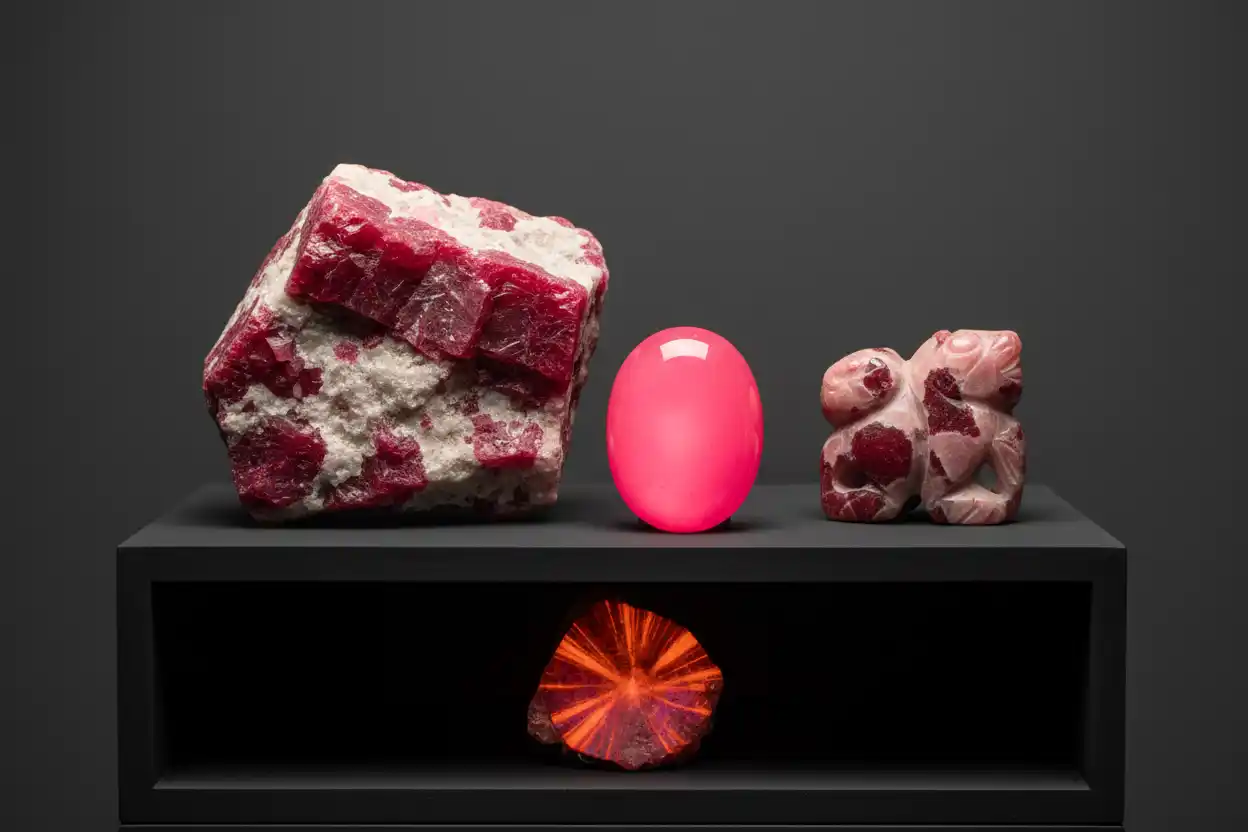
Tugtupite: Meaning, Properties & Symbolism
Tugtupite is a rare sodium-aluminum-beryllium silicate chloride best known for reversible photochromism, intense fluorescence, and raspberry-pink-to-red gem material from southern Greenland. Pale specimens can deepen dramatically after exposure to sunlight or ultraviolet radiation, then fade gradually when stored away from activating light.
Most Tugtupite is massive and cut as cabochons, beads, or carvings. Transparent faceting material exists, but it remains exceptionally scarce and occupies a specialist collector market.
Tugtupite at a Glance
| Property | Tugtupite |
|---|---|
| Composition | Sodium-aluminum-beryllium silicate chloride, Na₄AlBeSi₄O₁₂Cl |
| Group or type | Beryllium-bearing tectosilicate related structurally to Sodalite and Helvine-group minerals |
| Color | Colorless, white, pale pink, rose, crimson, raspberry red, purple-red; rare pale blue or greenish material |
| Crystal system or texture | Tetragonal |
| Habit | Massive, granular, vein-filling, compact; rare small prismatic crystals |
| Luster | Vitreous, greasy, or dull |
| Transparency | Transparent to opaque, commonly translucent |
| Mohs hardness | Variable in references, approximately 4–6.5; gem material is often placed near 5.5–6.5 |
| Cleavage | Distinct |
| Tenacity | Brittle |
| Common uses | Cabochons, beads, pendants, carvings, rare faceted collector gems, fluorescent specimens |
| Primary care concern | Brittleness, scratches, cleavage, reversible color, ultraviolet use, matrix minerals, and beryllium-bearing dust |
What Is Tugtupite?
Tugtupite is a rare tectosilicate containing sodium, aluminum, beryllium, silicon, oxygen, and chlorine.
It is structurally related to Sodalite and shares some optical behavior with Hackmanite, a tenebrescent Sodalite variety.
Tugtupite differs by containing beryllium and by crystallizing in the tetragonal system rather than the cubic system of Sodalite.
The mineral was discovered in 1957 at Tugtup Agtakôrfia in southern Greenland. Its name comes from that locality.
Greenlandic cultural references also connect the stone with tuttu, the word for reindeer, leading to the popular expression “reindeer blood” for its red colour.
Tugtupite belongs among the materials discussed in rarest gemstones in the world, although opaque mixed specimens are more accessible than transparent faceted gems.
It also appears in crystals that start with T and gemstones that start with T.
Tenebrescence: Tugtupite’s Reversible Color Change
Tenebrescence is a reversible color change activated by radiation, usually ultraviolet light or sunlight.
A white or pale pink Tugtupite specimen can deepen to rose, crimson, raspberry red, or purple-red after exposure.
The change may occur within minutes under shortwave ultraviolet light or strong sunlight.
When the specimen is stored in darkness or away from ultraviolet-rich light, the intensified color gradually fades. The process may take hours, days, weeks, or longer depending on the specimen.
The original color can usually be restored by re-exposure, making Tugtupite a naturally repeatable photochromic material.
This phenomenon is not the same as ordinary pleochroism, where different colors appear from different crystal directions.
It is also not conventional gemstone treatment. Brief ultraviolet activation changes the current state of existing color centers rather than permanently adding dye or coating.
What Causes the Color Change?
Tugtupite’s photochromism is associated with sulfur-related defects and electron transfer within its crystal structure.
Ultraviolet energy changes the electronic state of these centres, altering which wavelengths of visible light the mineral absorbs.
The result is stronger red or purple-red body color.
Visible light and thermal energy gradually return the color centers toward their earlier state, causing the stone to fade.
Different specimens respond at different rates because chemistry, sulfur content, structural defects, transparency, and associated minerals vary.
A weakly colored specimen is not necessarily fake, while an extremely vivid one may have been freshly activated before photography.
For fair comparison, sellers should state whether photographs show the stone before or after ultraviolet or sunlight exposure.
Fluorescence and Phosphorescence
Tugtupite is one of the best-known fluorescent gem minerals.
Under shortwave ultraviolet light, many Greenland specimens fluoresce strong orange, orange-red, or fiery red.
Longwave ultraviolet commonly produces a weaker salmon, pink, or orange response.
Some material also phosphoresces, continuing to glow briefly after the ultraviolet lamp has been switched off.
The fluorescent color and intensity depend on specimen chemistry, locality, matrix minerals, and ultraviolet wavelength.
Associated minerals may fluoresce different colors. Analcime, Chkalovite, Sodalite, Albite, Leucophanite, and other minerals can create a multicolored response on one specimen.
A dealer photograph should state whether shortwave, midwave, or longwave ultraviolet light was used.
Ultraviolet lamps require appropriate eye and skin protection, especially shortwave equipment.
Tugtupite and Hackmanite
Tugtupite and Hackmanite can both show tenebrescence, fluorescence, and pale-to-intensified color changes.
Hackmanite is a sulfur-bearing Sodalite variety. It commonly changes between pale grey, cream, pink, violet, and purple.
Tugtupite usually develops stronger pink, red, crimson, or raspberry tones and contains beryllium.
Hackmanite is cubic, while Tugtupite is tetragonal.
Both can occur in the Ilímaussaq alkaline complex and may be present on the same mineral specimen.
A mixed Greenland rock may therefore contain red-fluorescing Tugtupite beside blue, violet, or pale Sodalite-family material.
Visual response alone does not prove which mineral produces each colored area. Raman spectroscopy provides more reliable identification.
How Tugtupite Forms
Tugtupite forms in highly alkaline igneous complexes rich in sodium, beryllium, chlorine, rare elements, and unusual silicate minerals.
The Ilímaussaq complex of southern Greenland is its most important geological environment.
Late-stage hydrothermal fluids moved through alkaline intrusive rocks and deposited Tugtupite in albite-rich veins, fractures, cavities, and altered zones.
The mineral can occur with Analcime, Albite, Sodalite, Chkalovite, Aegirine, Arfvedsonite, Natrolite, Ussingite, Polylithionite, and numerous rare beryllium minerals.
Most Tugtupite forms as irregular massive material rather than well-shaped crystals.
Small transparent prismatic crystals can grow in cavities, but they are rare and generally only a few millimetres in size.
The unusual chemistry required for its formation explains why gem-quality material remains geographically restricted.
Important Localities
The type locality is Tugtup Agtakôrfia near Narsaq in southern Greenland.
The Ilímaussaq alkaline complex contains several important occurrences, including Kvanefjeld or Kuannersuit and the Taseq slope.
Kvanefjeld material is especially associated with bright pink-to-cherry-red gem rough suitable for cabochons and occasional faceting.
Taseq material can show strong reversible color change and complex associations with fluorescent minerals.
The Lovozero alkaline complex on Russia’s Kola Peninsula also contains Tugtupite, commonly as small grains or mineralogical specimens.
Mont Saint-Hilaire in Quebec, Canada, is another documented occurrence.
However, significant gem-quality red material is associated overwhelmingly with Greenland.
A valuable specimen should carry precise locality information because “Greenland mineral” alone covers many rare fluorescent species.
Colors and Appearance
Unactivated Tugtupite may be white, cream, light grey, colourless, or pale pink.
After activation, it can become rose, magenta, crimson, raspberry red, grape red, or purple-red.
Some stones show mottled pink and white areas rather than one uniform body color.
Black or dark inclusions may come from Aegirine, Arfvedsonite, or other associated minerals.
Yellow, grey, white, or blue patches can represent Sodalite, Analcime, Albite, Chkalovite, or matrix material.
Rare pale blue Tugtupite has been documented, though it is not representative of the commercial gem market.
Fine transparent faceted gems can show a bright raspberry color, while opaque cabochons often display marbled pink, white, and black patterns.
Tugtupite naturally fits within pink gemstones and red gemstones, although its reversible behavior matters more than a static color category.
Crystal Habit and Inclusions
Most Tugtupite occurs in massive veins or granular aggregates.
Rare transparent crystals are short prismatic forms growing on cavity walls within massive material.
Gem rough may contain black needles, yellow spots, white matrix, fractures, cleavage traces, and irregular color zones.
Associated minerals can polish differently from Tugtupite, creating pits, grain boundaries, or areas with changing luster.
Transparent gems may contain small crystals, tubes, veils, healed fractures, and cloud-like inclusions.
The internal scene can help establish natural origin, but it also reduces cutting yield and durability.
A homogeneous vivid red cabochon is unusual. Many genuine pieces retain visible matrix or uneven color.
How to Identify Tugtupite
Tugtupite should be identified through a combination of optical properties, photochromism, fluorescence, composition, and spectroscopy.
Refractive indices commonly fall around 1.49–1.51, with low birefringence.
Specific gravity is generally near 2.3–2.6, depending partly on matrix and associated minerals.
The mineral is uniaxial and tetragonal, although massive cabochons may be difficult to test conventionally.
Strong orange-red shortwave fluorescence and reversible deepening of pink or red color are valuable clues.
However, Hackmanite, some Scapolite, glass, synthetic materials, and other photochromic minerals can show superficially similar behavior.
Raman spectroscopy, X-ray diffraction, and chemical analysis offer stronger confirmation.
The how to identify crystals guide explains why a dramatic ultraviolet reaction should support—not replace—standard mineral identification.
Tugtupite Lookalikes
Pink Hackmanite is the closest optical lookalike because it may be tenebrescent and fluorescent.
Pink Sodalite can occur in the same Greenland material but lacks Tugtupite’s beryllium-bearing composition and tetragonal structure.
Rhodochrosite can show strong pink-to-red color but is much softer, denser, acid-reactive, and not normally tenebrescent.
Thulite and Rhodonite can resemble opaque pink Tugtupite in polished pieces, but their chemistry, hardness, fluorescence, and locality differ.
Pink Opal, dyed Calcite, pink glass, and resin can imitate body color.
Fluorescent glass may glow under ultraviolet light, yet it generally lacks the same reversible sunlight-induced color change.
Synthetic photochromic materials can mimic tenebrescence. A seller should not treat the effect alone as conclusive proof of Greenland Tugtupite.
Treatments and Color Activation
Most gem Tugtupite is expected to be natural and untreated.
Exposure to sunlight or ultraviolet light activates its natural color centers and is not usually classified as a permanent gemstone treatment.
Nevertheless, photography immediately after strong ultraviolet exposure can exaggerate the everyday appearance. Sellers should disclose that the piece was activated.
Dye may be applied to pale porous material or matrix, though it will not reproduce the natural reversible color behavior.
Resin can fill fractures, stabilise mixed material, or improve polish.
Wax and oil may deepen the visible color and conceal fine scratches.
Backing can intensify a translucent cabochon, while doublets can combine a thin Tugtupite layer with another support.
Heating is not a routine improvement method and may damage color centers, inclusions, or associated minerals.
The treated Sodalite guide is relevant to related trade practices, though Tugtupite requires its own species-level testing.
Synthetic Tugtupite and Imitations
Tugtupite has been synthesized for scientific study of luminescence and crystal structure.
Laboratory-grown faceted Tugtupite is not an established mainstream jewelry product.
Photochromic glass, fluorescent glass, synthetic Sodalite-like materials, resin, dyed carbonate, and reconstructed stone are more likely substitutes.
A manufactured material may change color under ultraviolet light, so photochromism alone does not establish natural origin.
Natural mixed Greenland rock may also be mislabeled. A specimen containing mostly Sodalite, Analcime, and Albite with only a small Tugtupite zone should be described accurately.
The real vs fake Sodalite guide provides additional tests for related glass, dye, and composite products.
Cutting and Polishing
Most Tugtupite is cut as a cabochon because massive and translucent material displays color and fluorescence better than conventional facets.
Cabochons may be oval, round, freeform, rectangular, or carved into hearts and pendants.
The cutter tries to position the strongest pink or red area across the visible face while minimizing black matrix and fractures.
Mixed minerals grind and polish at different rates. Soft areas may undercut, while harder inclusions create raised zones.
Transparent rough can be faceted, but it is rare, small, included, and brittle.
A faceted gem should retain enough depth to show color without becoming overly dark after ultraviolet activation.
Cutting unknown rough requires particular caution because the material contains beryllium and may be associated with other chemically complex minerals.
Durability and Jewelry Suitability
Tugtupite is less durable than Sapphire, Garnet, Quartz, or Spinel.
Published hardness measurements vary, but the material is generally susceptible to scratching from Quartz dust and harder gemstones.
Distinct cleavage and brittleness create impact risk.
Cabochons work best in pendants, earrings, brooches, and protected occasional-wear rings.
Bracelets and high-set rings expose the stone to frequent impacts.
A bezel supports the edges and protects mixed-material cabochons better than narrow prongs.
The gemstone hardness chart provides scratch-resistance context, while gemstone toughness vs hardness explains why a moderately hard stone can still break.
Tugtupite Value and July 2026 Asking Prices
Tugtupite has a thin market divided among ordinary mixed rough, fluorescent specimens, cabochons, jewellery, transparent faceted stones, and exceptional locality pieces.
As of July 2026, small rough pieces and modest mineral specimens commonly carry asking prices around $15–$75.
Tumbled pieces and commercial cabochons frequently appear around $50–$250 per stone, depending on colour, fluorescence, weight, and matrix.
Current untreated cabochon listings of approximately 2.5–8 carats occupy a range near $140–$165 per stone at specialist retail.
Jewellery using good Greenland cabochons commonly asks $100–$700, with metalwork and provenance influencing the total.
Transparent faceted gems are too scarce for a stable per-carat chart. Small stones may be offered for tens to several hundred dollars, while well-documented clean raspberry-red gems can command substantially more.
Large gem-rich specimens and major fluorescent cabinet pieces can reach $1,000–$5,000 or more. Current specialist examples include museum-scale material listed around $4,500.
The price should reflect actual Tugtupite content, Greenland provenance, natural color response, transparency, condition, cutting, and treatment disclosure.
Buying Tugtupite
Ask whether the photographs show the stone before or after ultraviolet or sunlight activation.
Request a video demonstrating its daylight color, activated color, fading behaviour, and ultraviolet fluorescence.
The seller should state which ultraviolet wavelength was used.
Ask for the exact locality, ideally Kvanefjeld, Taseq, Tugtup Agtakôrfia, or another documented Ilímaussaq occurrence.
Determine whether the object is solid Tugtupite, mixed Greenland rock, resin-stabilized material, a doublet, or a reconstructed product.
Inspect cabochon edges and backs for matrix, glue, filling, open fractures, and colour concentration.
For a faceted stone or expensive cabochon, request an independent report confirming natural Tugtupite.
The general how to buy gemstones online framework covers seller evidence, return rights, photographs, and independent testing.
Cleaning, Light, and Storage
Clean Tugtupite by hand with lukewarm water, mild soap, and a soft cloth. Rinse briefly and dry it immediately.
Avoid prolonged soaking because matrix minerals, fractures, resin, glue, and porous areas can react differently. The crystals you can put in water guide explains that distinction.
Do not use steam, bleach, acids, abrasive powder, or sudden temperature changes.
Ultrasonic cleaning is inappropriate for fractured, mixed, filled, or cleaved material. The general risks appear in gemstones in ultrasonic cleaners.
Long-term darkness will allow activated colour to fade naturally. This fading is expected rather than evidence of damage.
Sunlight or ultraviolet light can reactivate the stone, but repeated exposure should be controlled. Guidance on crystals that fade in sunlight provides useful contrast between reversible photochromism and permanent fading.
Use certified ultraviolet eye protection and avoid exposing skin unnecessarily, especially with shortwave lamps.
Tugtupite Meaning and Symbolism
Tugtupite’s modern symbolism is closely connected with Greenland, its red “reindeer blood” nickname, fluorescence, and reversible colour change.
Its ability to deepen in light and fade in darkness commonly inspires themes of renewal, responsiveness, hidden potential, and qualities that emerge under supportive conditions.
The return to a pale state can also symbolize rest rather than loss. The stone retains the capacity to recover its stronger colour when exposed again.
Pink and red material is often associated in modern crystal practices with affection, courage, warmth, openness, and expressing emotions honestly.
Some traditions connect Tugtupite with romance through Greenlandic stories about love intensifying the stone’s red colour.
These interpretations belong to personal, cultural, and spiritual belief systems. Scientific evidence does not show that Tugtupite measures love, treats disease, changes circulation, or guarantees emotional transformation.
Frequently Asked Questions
1. Is Tugtupite a Sodalite?
No. It is a separate beryllium-bearing mineral structurally related to Sodalite.
2. What is tenebrescence?
Tenebrescence is a reversible light-induced colour change that fades after the activating light is removed.
3. Why does Tugtupite turn red in sunlight?
Ultraviolet energy changes sulfur-related electronic colour centres within the crystal structure.
4. Does the red colour fade permanently?
Usually not. It normally fades in darkness and can be reactivated through sunlight or ultraviolet exposure.
5. Does all Tugtupite fluoresce?
Many Greenland specimens fluoresce strongly, though intensity and colour vary with chemistry, matrix, and ultraviolet wavelength.
6. What colour does Tugtupite fluoresce?
Shortwave ultraviolet commonly produces strong orange-to-red fluorescence, while longwave response is often weaker and salmon-pink.
7. Where is gem-quality Tugtupite found?
Commercial gem-quality material is associated overwhelmingly with the Ilímaussaq complex in southern Greenland.
8. Is Tugtupite the same as Hackmanite?
No. Both can be tenebrescent, but Hackmanite is a Sodalite variety and lacks Tugtupite’s beryllium composition.
9. Can Tugtupite be faceted?
Yes, but transparent faceting rough is exceptionally rare and usually small.
10. Is Tugtupite suitable for daily jewellery?
No. Its variable hardness, brittleness, cleavage, and rarity make protected occasional wear safer.
11. Is ultraviolet activation a treatment?
It is normally considered temporary activation of natural photochromic colour centres rather than permanent gemstone enhancement.
12. What most affects Tugtupite value?
Greenland provenance, colour before and after activation, transparency, fluorescence, tenebrescence, Tugtupite content, size, cutting, condition, and treatment disclosure determine value.
Tugtupite is most remarkable when all of its appearances are shown honestly. Its pale resting colour, intense activated red, ultraviolet fluorescence, gradual fading, and Greenland mineral associations form one natural cycle rather than separate grades of stone.
Tugtupite contains beryllium as a stable part of its mineral structure. Normal handling of an intact polished gem presents a different exposure scenario from cutting, but rough should not be dry-sawed, drilled, ground, sanded, or pulverized. Use professional wet methods, enclosed local exhaust ventilation, sealed eye protection, suitable respiratory protection, and controlled sludge and waste handling. Shortwave ultraviolet lamps also require appropriate eye and skin protection.